Irina Mashinski’s The Naked World, recently published by MadHat Press after many years in the making, is an impressive achievement in the hybrid genre. The collection combines pieces of original and translated poetry and prose that together illuminate not only the author’s past but also her way of seeing. Thematically, this book centers four generations of a Soviet family from the Stalin era to the 1990s and immigration to the United States. Writer, translator, and editor Irina Mashinski has penned ten books of poetry in Russian, and this is her English-language debut that also includes her Russian-language poems in translation by Maria Bloshteyn, Boris Dralyuk, Angela Livingstone, Tony Brinkley, Alexander Sumerkin, and Daniel Weissbort. Mashinski is co-editor, with Robert Chandler and Boris Dralyuk, of The Penguin Book of Russian Poetry and of the Cardinal Points Journal.
Continue reading “Irina Mashinski’s The Naked World, Three Excerpts”Category: Nonfiction
A Motherland of Books: An Essay by Maria Bloshteyn
Taking your beloved books with you into immigration is intimately familiar to those of us who left the Soviet Union. My parents’ двухсоттомник—”200-volume set”—of Russian and world literature, was quite literally my lifeline to the language and culture that I may have otherwise forgotten, and they are still the editions I turn to today. The covers of the volumes are different colors, and some key moments of my life are associated with them, such as the dark green of Gogol’s Мертвые души (Dead Souls) when I started college. Reading Maria Bloshteyn’s essay was genuinely heart-wrenching, because the experience she describes is that of an acute loss of books that mean so much to us, not just for their content, but perhaps even more so because they have made the immigrants’ journey with us and sustained us in our new homes. In the current moment, this poignant essay is framed by the war in Ukraine, where people like us are losing not just their books, but their lives. If you are able to help, please support translators who are struggling due to the war and this initiative to give Ukrainian-language books to refugee children in Poland. Ukraine’s cultural sphere has been badly damaged by Russian forces, and we will continue to look for ways in which those of us in the West can help. Maria recently participated in the Born in the USSR, Raised in Canada event hosted by Punctured Lines, and you can listen to her read from an essay about reacting to the war in Ukraine while in the diaspora.
Continue reading “A Motherland of Books: An Essay by Maria Bloshteyn”Secrets: An Excerpt from Nataliya Meshchaninova’s Stories of a Life, translated by Fiona Bell
Nataliya Meshchaninova is Russian filmmaker. In 2017, she published a book of autobiographical short stories that resonated with her audience, in part, because they supported the Russian #metoo movement. In February 2022, Deep Vellum brought out Fiona Bell’s translation of Meshchaninova’s book under the title Stories of a Life. We are honored to share with you an excerpt from this book, a section from the fourth chapter, “Secrets.”


New World, New Planet, an Open Letter by Ivan Sokolov
Punctured Lines is grateful to Ivan Sokolov for the opportunity to publish his letter and a collection of links. Author’s idiom is preserved.
I am thankful to everyone who has reached out to me—I am safe and away from Russia at the moment. Let this post be an update for my anglophone contacts who have expressed concern about Russia’s ongoing war in Ukraine, possible sources of following the events and the lives, as well as means of giving aid.
I feel compelled to mention, however, just to be fair, that if I find myself displaced and unhinged in every sense of the word, it is far less so than the hundreds of thousands of other Russians evacuating these days to neighbouring countries—and doing so, unlike myself, without visas, academic affiliations, language skills or any experience of living abroad. I did not think I’d live to see (and run into!) my own acquaintances, mostly young, crowded in airports by random gates—the sheer extent of the exodus is mind-blowing. The fate of those who remain in Russia may look bleak—and even if a massive campaign of arrests and repressions does not ensue, the economic deterioration will hit everyone hard. But if we find our plans, ways of life and peace of mind disrupted and displaced, it is unthinkably more literal and cruel for the livelihoods of our friends within Ukraine and those that have managed to escape the war crimes being committed there.
Continue reading “New World, New Planet, an Open Letter by Ivan Sokolov”You Never Know When Speaking Russian Might Come in Handy …: An Essay by Alina Adams
It would be hard to overstate my love of both figure skating and detective fiction, which admittedly isn’t something one normally thinks of together. It is therefore beyond thrilling to feature this personal essay by Alina Adams, who has written a series of five figure skating murder mysteries (yes, really, and I plan to order every one of them). A prolific writer with several fiction and non-fiction titles, Alina’s most recent novel is The Nesting Dolls, which you can read about in the poignant and humor-filled conversation between her and Maria Kuznetsova that Olga recently organized on this blog. I loved reading the story Alina tells below about working as a Russian-speaking figure skating researcher (she must have had a hand in many of the broadcasts that I avidly watched), and I confess to losing, in the best possible way, some of my time to being nostalgically taken back to 1990s figure skating coverage through the two videos in the piece, one of which features Alina translating (for Irina Slutskaya! You all know who she is, right?! Right?!). Let yourself be transported to that marvelous skating era, get ready for all the figure skating at the Olympics next month . . . and watch out, there’s a murderer, or five, on the loose.
Continue reading “You Never Know When Speaking Russian Might Come in Handy …: An Essay by Alina Adams”Cultivating the Habit of Looking: A Q&A with Julia Zarankin
Julia Zarankin is the author of a memoir Field Notes from an Unintentional Birder (Douglas & McIntyre, 2020) that was warmly welcomed by both the birding and the literary communities. She was born in the Soviet Union and as a child immigrated to Canada with her family as part of the Jewish refugee movement. She received her Ph.D. in Comparative Literature and taught in the US before returning to Canada. She lives in Toronto and publishes essays and short fiction in English-language magazines both in Canada and in the United States.

Olga Mark’s “The Lighter”: An Excerpt from Amanat, a Collection-in-Progress of Recent Women’s Writing from Kazakhstan
Shelley Fairweather-Vega on Amanat: Women’s Writing from Kazakhstan
The idea to translate and publish a collection of recent women’s writing from Kazakhstan grew out of my collaboration with Zaure Batayeva, a Kazakh writer and translator living in Belgium. Zaure contacted me in October 2016 when she wanted to hire someone to edit her English translation of a novella by Aigul Kemelbayeva. We eventually submitted the final version to Words Without Borders, whose editor, Susan Harris, was looking for “post-Soviet” literature from different places. Excerpts from the Kemelbayeva novella and two other pieces appeared in a WWB feature in January 2018. By that time, Zaure and I were thinking seriously about collecting writing by more authors and publishing an anthology. Ever since, she and I have been trading stories, checking each other’s translations (she translated the Kazakh-language stories, and I translated the Russian-language pieces), and querying publishers. We won some much-needed funding and publicity from the generous RusTrans program, and our collection is now nearly complete.
Continue reading “Olga Mark’s “The Lighter”: An Excerpt from Amanat, a Collection-in-Progress of Recent Women’s Writing from Kazakhstan”Telling the Story of People Who Didn’t Want to Be Noticed: An Interview with Maria Stepanova
By Svetlana Satchkova
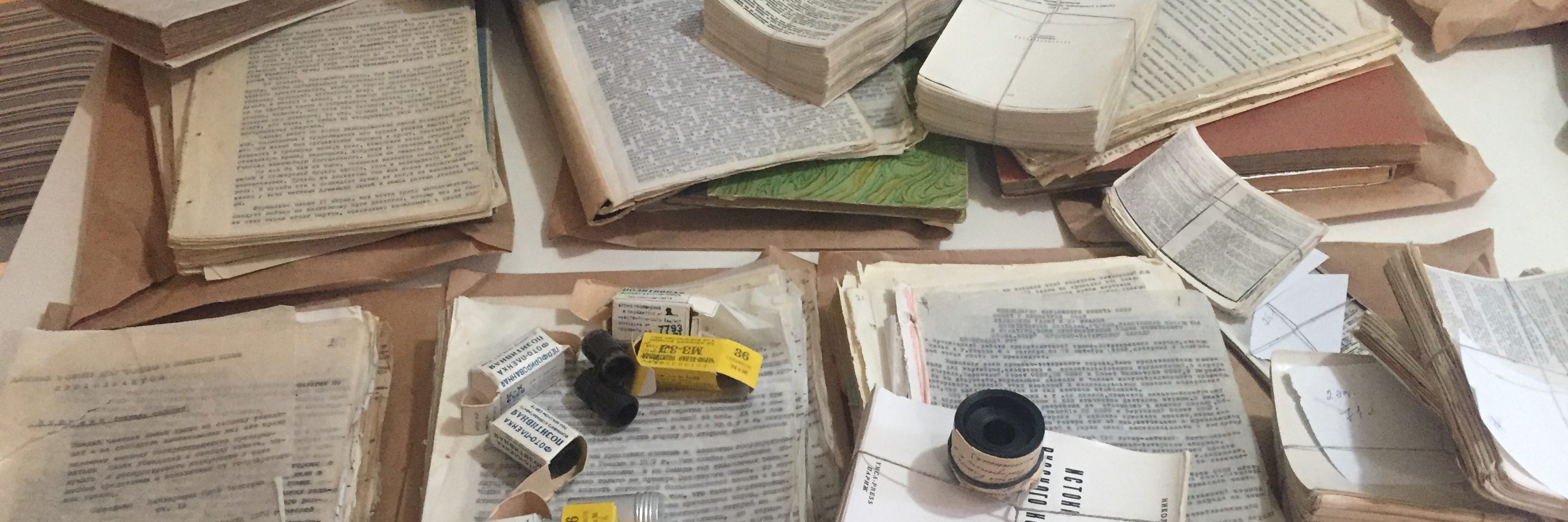
Maria Stepanova is a Moscow-based poet, essayist, and journalist. She’s also the editor-in-chief of Colta, a crowdfunded online publication that she created eight years ago and that has become a major outlet for long-form think pieces on contemporary Russian culture. Stepanova published ten books of poetry and three essay collections and has received numerous literary awards. In 2017, she wrote her first book of prose, In Memory of Memory. It’s a documentary novel that tells the story of the narrator who, after the death of her aunt, goes through the archive the aunt left behind, discovering her family’s history. In parts of this book, there’s no narration – just excerpts from diaries and letters written by Stepanova’s relatives; its other parts engage directly with other authors who wrote about memory – Osip Mandelstam, W. G. Sebald, and Susan Sontag. Despite or, maybe, because of the book’s non-traditional form, it gained a wide readership and won two major Russian literary prizes. On February 9, In Memory of Memory comes out in English from New Directions, translated by Sasha Dugdale, a British poet and playwright. This interview was conducted in Russian and subsequently translated to English by the interviewer.

In your novel, you quote someone saying that quite a lot of books have been written in English by people investigating their family histories. In Russian, though, your book is the only one of its kind.
Actually, it’s not the only one, which makes me very happy. To me, this is a discovery of sorts – that things we usually consider private and insignificant are turning out to be the most interesting not only for me, but also for a large number of people. And the stories they tend to tell sometimes are quite unexpected in their scope and variety. In some of them the twentieth century shows up in all its terrible glory, with all of its tragedies and disasters, but in a number of cases these are just regular domestic stories of how somebody’s grandmother arrived, or how someone left to work in the north, or how three sisters lived in a distant Hungarian village, but then decided to leave for the big city. And yet one can’t get enough of these stories. I think that this is a very important shift, this interest in familial memory. There’s an increasingly palpable hunger for contact with the past which grows stronger as the present becomes less acceptable to us. A couple of years ago, I worked in Berlin for a year, teaching memory writing in Humboldt University. I had large groups made up of different kinds of people, all of them hooked on this search for the past despite it sometimes being painful – because traveling to the past isn’t always pleasant. Moreover, this interest in memory is a global, international phenomenon, which is now shaping the outlines of a new community and works as a link between generations because it attracts people regardless of their age.
Do you have any idea why you became the first person to write about these things in Russian?
I wasn’t really the first one – writing one’s family history is something fairly normal in Russia, as elsewhere, and there is a good number books devoted to the legacy of the twentieth century and the traces it left in private lives…. Maybe the genre is something that makes a difference in my case: I was most interested in trying to shape a new territory between fiction and nonfiction: in my book, a novel, an essay, and a research project meet one another. I guess no one else wrote books like that at the time.
Do you think there isn’t a lot of experimentation happening in the Russian literary space?
This is how it works: since the beginning of the nineties, when literary awards appeared in Russia, the way contemporary fiction works has been largely determined by their existence. Winning one of them is the only opportunity for a prose writer in Russia to receive a substantial amount of money that can greatly improve their life. These awards, in one way or another, are geared towards finding the great Russian novel that is very similar to the great American novel. It’s a long, philosophical narrative without any stylistic nonsense – because it should be easy to read and digest – shaped within the mold of a nineteenth century novel. That is, the writer is forced to reinvent the wheel for the umpteenth time.
In other words, you didn’t expect that your book would become successful and would win two of these very same awards – NOS and Big Book?
I didn’t think about those things at all. I’ve been writing poetry all my life, and it always seemed to me that prose was the medium that wasn’t required of me, that if I wanted to write prose, I could easily write it in verse. And I did: I’ve written long narrative poems and all manner of ballads. At the same time, I always knew that someday I would write a book about my family, even though I didn’t know how I would go about it. I’d been meaning to write it from the age of ten, but I was taking a long time, endlessly getting distracted, looking for a chance to procrastinate a little while more. There came a point, however, when I realized that I had to do it. I set out to write a text that would be convincing to me, and there was one more goal that was even more important. You know, Brodsky has this essay called “To Please a Shadow.” This was what I wanted – to please my dead. I constructed my book in such a way that they would feel good in it. Maybe I could’ve written it in a completely different way, without all those historical and cultural references that work as a large structure into which my own stories then fit. I could’ve written a story about my family and nothing else, but I had in mind something that would belong to the realm of contemporary art. I wanted to create a space in which I could arrange the few remaining photographs, letters, and testimonies, and to make it so that they would feel good in this space, so that they would be seen and understood in the right way. This is how you work when curating an exhibition – you start with the space. I really didn’t think about anything else, and the fact that my book wound up being widely read was a shock both for me and for my publisher, who didn’t hope to sell more than three thousand copies, I think.

How did you arrive at this particular form for your book?
The book is about inconspicuous people, people whose lives resembled those of everyone else: they loved, they fell out of love, someone died, someone was born. As a family, they managed to survive many times, perhaps because they deliberately stayed on the sidelines. At the beginning of the twentieth century, they tried to be actors of history, but later they moved to its margins and spent almost a hundred years there. So, what worried me was the question of how to tell the story of people who didn’t really want to be noticed – and how to talk about people whose fates had nothing extraordinary about them.
I found the story of Lyodik who went to the front and died at the age of nineteen absolutely heartbreaking.
Lyodik’s letters have been in our family for as long as I can remember. When I was little, my mother told me about him sometimes and read his letters out loud. But it’s impossible to surmise from his letters what was actually happening to him and around him – he kept silent about that. In order to look beyond and understand what he kept silent about, I had to read a lot of historical literature on the blockade of Leningrad and the Leningrad front. A documentary novel is a genre in which there are a lot of gradations, that is, there’s a toggle switch that can be moved to the left, towards the documentary, or to the right, towards fiction. I’m probably keeping to the left of this spectrum. I have serious problems with the type of novel writing that uses people who are no longer alive as glove puppets to convey the writer’s own thoughts and emotions. I think and write a lot about the ethics and the etiquette of writing about the dead, about what is allowed and what isn’t, and at what point it turns into the exploitation of people who can no longer object to this treatment.
Have you come across books that dealt with the dead in a way that you liked?
There are a number of books that are great examples of how one can write about the dead without trying to make the story “interesting,” without trying to deceive, and at the same time doing this miraculous work of resurrection. First of all, I should mention W. G. Sebald because he balances on the border of fiction and essay writing in such a way that there’s a constant flicker. We want to, but we cannot ask: was this all real or not? Is this narrator Sebald or someone else with his mustache and his last name? It seems to me that a new type of literature is emerging which still doesn’t have a name, but it no longer fully belongs to either fiction or essay writing. The books I love most belong exactly to this type of writing that is gradually becoming more and more important.
You’ve mentioned in various interviews that fiction is becoming less and less interesting than documentary writing. Why, do you think?
Remember Mandelstam’s article “The End of the Novel”? It was written in 1923, almost a hundred years ago. He says in it that everything has changed, that the man of the nineteenth century had an individual fate and was therefore interested in the individual fate and its trajectories – hence the success and the significance of the novel as a genre in the nineteenth century and beyond, due to some kind of inertia. But we all know how the twentieth century dealt with these trajectories: it took these individual fates, collected them in a bundle, and broke them over its knee. Later, when the smoke cleared, it turned out that the individual survived, though not in the place where we kept looking. It’s no longer where the typical hero appears in the proposed circumstances and carries on their shoulders the novel construction. In the century in which people die in millions, one person isn’t quite the measure. An error, a detail, a very small thing – oddly enough, that’s the measure.
What kind of thing?
For example, a button that I saw at the Museum of the International Memorial in Moscow where they keep the belongings of the prisoners of Soviet camps. They have many remarkable things there, including an archive of drawings made by the prisoners. It amazed me – and I want to write about it sometime – because there are no scenes we remember so well from the Russian camp prose: no barbed wire, or German shepherds, or security officers on the watchtowers. But there’s a huge number of still lives with flowers as well as landscapes and portraits. For some reason, it was important to those people to create beauty rather than to give a realistic depiction of their circumstances. In this museum, I saw a button in which one of the prisoners had sent a note to his wife. This is a striking detail: they were horribly tortured, but they could give their overcoats to their wives for cleaning. This officer handed his overcoat to his wife, and from one of its buttons a corner of this note was sticking out slightly. On tissue paper, he wrote in microscopic letters about how he was arrested and beaten, and he added that he probably wouldn’t come back. The twentieth century is the time when life turns out to be so inhuman that people become speechless and can speak only for all of humanity, while objects do the speaking for them.
You’re fluent in English, and I assume that you’ve read Sasha Dugdale’s translation of your book. How did you like it?
I think it’s brilliant. Sasha is a wonderful poet and a close friend; she translated and still translates my poems – but my book is maybe the largest piece of prose she had ever translated. And what she did with this huge volume is, in my opinion, absolutely incredible. The Russian type of writing involves endless subordinate clauses that circle around the principal meaning until they finally find their way to it. The Russian syntax imitates the confusing, complex work of human thought, while English, it seems to me, entails a completely different logic and a completely different language etiquette. If you translate a Russian text aiming to convey mainly its syntactic features, it won’t deliver the intended message. What Sasha did was amazing: she found a balance between these two things. She delivered the message that is still the main objective of my work, and at the same time she created this English Russian that isn’t a literal reflection of the original, but somehow gives the reader an idea of how it works.
Your book has a subtitle – romance. In addition to its other meanings, this word designates a certain kind of song in Russian.
In the book, there are several definitions of the subtitle, and the reader can choose the explanation that they like best. To me, the English meaning of this word is the most important. I feel that this book is a love story, only it’s facing backward rather than forward, as is usually the case with love stories because love is always looking for some kind of completion in the future. Here, love is addressed to people who are no longer alive, so, on the one hand, my love is happy because I love them and I feel that they love me, but on the other hand, I can’t talk to them anymore, and this love is doomed in a sense.
Your book makes clear that your ancestors had to stifle their literary ambitions. Why was that?
When I began to sort through my archive, it struck me: they were all in one way or another people of the written word, even those of them who never intended to study literature. Therefore, there are parts in my book in which I don’t speak at all: I publish excerpts from letters or diaries to give my ancestors the opportunity to speak in their own voices. It seemed wrong and inappropriate to me to invent a voice for my great-grandmother where she had her own. On the contrary, I wanted them to say once again what they already said once, to get a final chance to be heard. My grandfather wrote poetry all his life, mostly comical, but when his daughter – my mother – began to write poetry too, he strictly forbade it, saying, “You’re Jewish, so you must have a profession.” My mother worked as an engineer all her life and never wrote poetry after that.
Was it the same way with you? Were you told not to write poetry?
In a sense, I’m the result of this half-century of their non-writing, because the first thing my mother taught me was to read and write. She was too shy to sing, so at night, instead of singing lullabies, she recited poetry to me. I turned out to be the completion of my family’s hope that someone could write and speak for everyone. It’s a lot of responsibility, because it’s like dragging around a suitcase full of family stories that haven’t been told, and I’m the knot in which they converge. I have to decide whether to talk about them or not, and what exactly to tell. On the other hand, I was infinitely happy, writing this book and doing almost nothing else for several years. I traveled to all the places where my ancestors once lived, and it was very strange and exciting. For example, I went to this microscopic village in the middle of nowhere, somewhere between Arzamas and Nizhny Novgorod, and there was no train there, only a bus that went there once a week, there was no hotel, no cafes, no nothing. And I looked at all of that and realized that there was some thread that connected me to that place.
Since nonfiction is more interesting to you than fiction, does this mean that you don’t read mainstream novels?
I have a very special reading routine: I read a book a day. This means that I constantly have to throw new texts into the furnace. I really love genre literature: for example, detective stories that have clear rules upon which the author agreed with me. It’s a game the author and I are playing. I also read complicated, experimental texts, and academic stuff. I do sometimes read mainstream psychological novels, but they don’t make up the bulk of my diet. If someone I love comes running and says, “Grab this new novel immediately and read it,” then, of course, I’ll grab it and read it. But when I’m in a bookstore, the shelf with freshly published novels isn’t the first one I’ll be looking at.
You don’t hide your political views: you oppose Putin’s regime. You must’ve had opportunities to leave Russia. Why have you stayed?
This is one of those questions that I have to ask myself every five years or so. When my parents left for Germany in the early nineties, I didn’t go with them. I stayed because I was fascinated by what was happening in Russia. It seemed odd to me to leave when the most interesting things began to happen. And now, I feel that someone has to love this place – with its monstrous situation into which we have driven ourselves, with Putin, with these comic-opera poisoners, with this “insane printer” [in colloquial Russian, this is what the Duma, or the state legislative body, is called – Punctured Lines] that passes these insane laws. Someone has to live here and to treat this space as their home, to make it meaningful. Which isn’t to say that I’ll grip this earth with my teeth and stay here under any circumstance. But as long as it’s possible to live here somehow, I would try to stay here. Because the worse it gets here, the more this place needs our love.
###
Please support writers by buying their books.
Svetlana Satchkova is a writer and journalist from Moscow, Russia, who currently lives in New York City and is working on her MFA at Brooklyn College. Her most recent novel People and Birds came out from Moscow-based Eksmo Press to popular and critical acclaim.
Izmailovich, the General’s Daughter: an Excerpt from the Memoir by Maximalist Klara Klebanova, translated by Caraid O’Brien
After more than one hundred years, the history of the Russian revolution remains contentious. Heated, politicized debate has focused on the issue of violence, namely the origin and impact of violent terror tactics used by some revolutionary groups against the tsarist government. Another area of ongoing debate has to do with the role of Jewish revolutionaries within the larger movement. In his volume Two Hundred Years Together Alexander Solzhenitsyn construes a narrative in which assimilated Jewish revolutionaries took over the “Russian soul” and turned it toward terror. Solzhenitsyn — and in his footsteps some contemporary Russian commentators — lays the blame for the origins of the Leninist and Stalinist mass terror on the Jewish revolutionary contingent.
In the United States such arguments, thankfully, have not had much currency. Given the historical remove of the revolution, the views of the likes of Solzhenitsyn have been received with complacency; there’s been no urge to examine Solzhenitsyn’s biases. It is thus particularly exciting when a new account of the era emerges, shedding fresh light on the past.
###
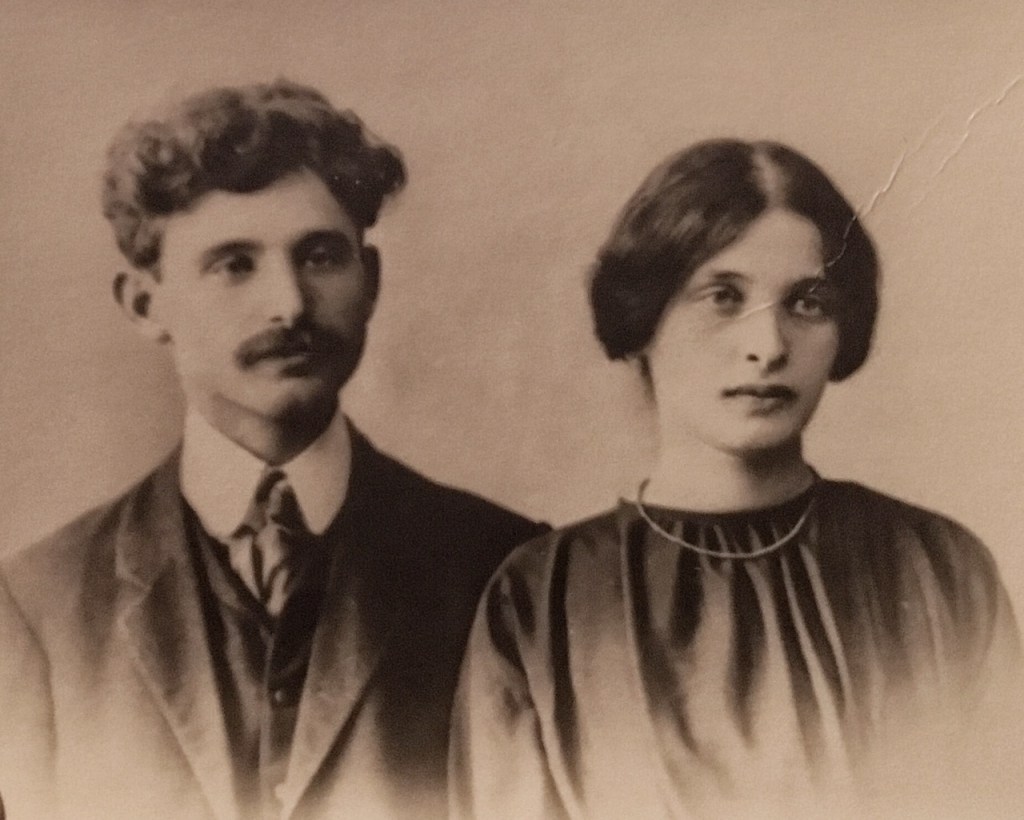
Klara Klebanova was a member of the Maximalist wing of the Socialist Revolutionary party, active in the revolution of 1905. In 1914 she immigrated to the US and in 1922 published her memoirs in the Yiddish-language daily Forverts. Klebanova grew up in Novozybkov, a town in the Chernigov province, which was then Ukraine but is now part of Russia’s Bryansk oblast. Klebanova came from a relatively assimilated and well-off Jewish family; she mentions graduating from a secondary school that was known to have strict quotas for Jewish students. The work of popular Russian writers — Turgenev, Tolstoy, Uspensky, and Nekrasov — moved Klebanova to participate in the revolution. The plight of the Russian peasants and the desire to ease their poverty and suffering brought her into the fold of the Socialist Revolutionary party.
The historical value of an authentic voice may be reason enough to read this memoir. What makes this tale outstanding, however, is Klebanova’s gift as a writer. She deftly weaves together the personal and the political, breathing life into her sketches of fellow activists. Her memoir is both a history of ideas and a love story. It contains an account of a revolutionary movement, a glimpse into the St. Petersburg prison system in the 1900s, and affectionate portraits of some notable revolutionaries.
For the excerpt below, I have chosen from the sections of Klebanova’s story that focus on Katya Izmailovich, a young woman who had a special place in Klara’s heart and who was one of her earliest guides in revolutionary work.
WILD STRAWBERRY, as Klara Klebanova’s memoir is tentatively titled, is as yet unpublished in full. It came to my attention through Peter Kleban, Klara’s relative and a champion of her writing. Kleban worked with translator Caraid O’Brien to render Klebanova’s memoir into English. O’Brien has also made a radiocast of the memoir, available in twelve 30-minute episodes from the Yiddish Book Center. An excerpt “Petticoats and Bombs” also appeared in the Yiddish Book Center’s magazine Pakn Treger and is available online.
This excerpt has been made possible by Peter Kleban, who owns the copyright to the work.
Izmailovich, the General’s Daughter
A Memoir by Klara Klebanova, translated from Yiddish by Caraid O’Brien
Speakers from the Social Democrats and the Socialist Revolutionaries often came to our city to address the students. On one occasion an active and well-known Socialist Revolutionary who went by the name “Grandfather” (Zeyde) came to visit. He was the husband of the famous Socialist Revolutionary Anastasia Bitsenko, who was given a life sentence of hard labor for an attempt on the life of a prominent government official. Grandfather organized a clandestine student group to prepare for propaganda work. I was among its members.

By the time I finished high school in 1904, I was already a committed Socialist Revolutionary. My small home town could not satisfy me. I was drawn to where I believed revolutionary activity was in full swing. I wanted to leave home and be independent of my parents.
Given that my older sister had already served time in prison for protest activity, my father under no circumstances wanted to let me go. After long and difficult arguments, he agreed to send me to Borisov, his hometown, where many friends and relatives could keep an eye on me. He even arranged a part-time job for me as a teacher in a Jewish school. I had absolutely no interest in teaching. In my mind Borisov was just the first phase of my plan to liberate myself completely.
It was not difficult to leave home for the first time and be apart from my parents. Because I was leaving against her wishes, my mother was too angry with me to say goodbye. This did not move me. It was as nothing compared to the happiness I imagined I would feel when I was entirely devoted to revolutionary action. I had no idea what the effort entailed, but I was thrilled to be on the brink of freedom and able to live alone, independently, as I wished.
I stayed only a few months in Borisov. Bitsenko’s husband, the tireless Grandfather, sent Rosa Shabat, a young member of the Socialist Revolutionary party, to collect me. I left with her for Minsk, a city which I knew had a very active Socialist Revolutionary organization. It was where I needed to be to take my first revolutionary steps.
Rosa took me to the house of the famous revolutionary Katya Izmailovich. Katya’s father, a lieutenant general, was in the Far East at the time; her mother was dead and her sister, Sonya, was in prison in St. Petersburg awaiting a life sentence of hard labor for an attempt on the life of Kurlov, the governor of Minsk, who was one of the hated so-called “bloodhounds.” Katya occupied the entire family home along with a soldier assigned as her orderly. I stayed with her for about three weeks.

From the outset Katya’s orderly was very unfriendly toward me and suspicious. Apparently it was inconceivable to him that his noble lady would bring a Jew into the general’s house. He had a dull soldier’s face that appeared to notice nothing, but in fact he was very sly and kept track of everything Katya did. He noted, for example, that she was hosting workers’ meetings. Katya suspected he was spying and informing on her. She was terrified of him, but nonetheless teased him and made fun of him. She named the dog that was always at his side “Compatriot,” meaning countryman, the word soldiers used to greet one another. This offended him tremendously. I often noticed his face was red when Katya stood laughing at him. To taunt him further she invited some of us revolutionaries to dance on the general’s furniture. We jumped all over the white armchairs and divans. Katya even jumped onto the piano and banged the keys with her shoes. The orderly boiled as he watched this group of hooligans desecrating the holy shrine of his general’s furniture. Katya winked at him from across the room with a roguish smile as if scoffing at the luxurious surroundings.
What a wonderful person Katya was, so dignified and distinguished that a young provincial like me could not but idolize her! Still, it annoyed me that she behaved with such contempt toward the orderly. It seemed to me that a revolutionary should not behave in such a way toward a young, poor, unimportant soldier. Once I spoke up about it.
“He spies on me, you know,” Katya said. “He’s here to inform on me, the dog, and he acts as if he doesn’t notice anything.”
Katya was twenty-five or twenty-six years old, tall, bony, and not pretty. From her looks one would have taken her for a small-town seamstress rather than a general’s daughter. She always wore the same blue calico dress, with her hair combed straight and almost nothing feminine about her movements. She gave the impression of being a wily person, aware of everything she did. She was close to everyone and all the comrades, even the old revolutionaries, treated her with great respect. She was very determined and a wellspring of energy; her eyes sparkled with humor. She found things to deride and mock that we would never have noticed. Often she made fun of the sound of Russian spoken with a Yiddish accent. She imitated it perfectly. She told of running with her sister from their secondary school over to the Jewish schools to tease the children and shout “zhidovki, zhidovki!” Anyone could see that she did not intend this in anger or out of anti-semitism, but as pure mischief making.

Katya got fifty rubles a month from her father the general. At the time, this was a huge sum for one person. (It was not meant as maintenance for the orderly, who ate at the barracks.) Katya gave most of the money to the Minsk revolutionary organization and lived on what few groschen remained. Her needs were minimal and she denied herself many things. While I was living with her she sometimes ordered lunch for two from the club, ate a little and saved the rest for later. Sometimes we just bought sour milk and black bread from the corner store and nothing more. I can’t speak for my friend, but I myself was hungry after those meals and my stomach growled a lot.
###
At this time, Katya’s revolutionary activity consisted of propagandizing the workers, in particular the railway workers [and Klara joined her in this activity].
[…Soon], Katya told me that there had been a split among the Socialist Revolutionaries. An opposition group had emerged under the banner “Young Ones.” It differentiated itself from the Socialist Revolutionaries and Democratic Socialists by not recognizing the Minimum Program, part of the program of the latter two groups. The Minimum Program was a set of immediate demands for political rights, a parliament or the creation of a representative body, a free press, a right of free speech and assembly, the right to strike, and an eight hour work day. The Socialist Revolutionaries also included the socialization of the land. The Maximum Program was a more ambitious, longer-term goal, demanding the establishment of a Socialist society.

The Young Ones, by contrast, demanded that the Maximum Program be the immediate goal. They did not recognize the struggle for a parliament as a necessary first step, judging that a parliament would not bring them any closer to their goal of socialism and that indeed it would hinder their aims while dulling the consciousness of the workers. In this sense the Young Ones were like the Syndicalists in France.
The Young Ones declared that the upcoming Russian revolution should be a social revolution rather than a revolution for political freedom. Accordingly the peasants should seize the land and the workers take over the factories and industries. In other words the Young Ones—or Maximalists as they were later called—preached and fought for what Lenin was to bring to life ten to twelve years later. They had to endure a difficult internal struggle, with the Democratic Socialists on one side and the Socialist Revolutionaries on the other! In addition, they—or rather we, because I soon joined them—were called Utopian fantasists, irresponsible people with petit bourgeois aspirations. (At the time it was fashionable to insult people with the label petit bourgeois.)
[…] I could not stay in Katya’s house any longer—spies appeared with increasing frequency—so I rented my own little room. I had no servants and the only way I could earn anything was by giving lessons. I had very few acquaintances in Minsk and in addition I lived under a false passport. I did not think it was fair to take money from the organization at a time when I had brought so little to it, and I didn’t want to take money from Katya. I lived truly half starving. I could have asked my parents for money, but I didn’t want to write to them: it might have exposed where I lived. At times the organization in Minsk sent me to surrounding cities and towns to speak at gatherings. Addressing a crowd no longer made me confused or anxious; everything came out smoothly and clearly. I came back happy, knowing that I had accomplished something.
[Klara then decided to move from Minsk to Bialystok, which had a strong Young Ones group.]
[…] Katya was also about to go away. The night before she left, she had a small good-bye party. A few comrades gathered at her house for wine and drinks. Handing me a glass she said, “Tonight, you and I will sing our swan song.”
I had no inkling that she was about to attempt the assassination of Admiral Chukhnin of the Sevastopol Black Sea Fleet, or that this would be the last time I would see her.
She went to Chukhnin dressed in mourning and naturally under a different name. She posed as a sailor’s widow whose husband had been killed in battle. She had a request, she said, and was allowed to see the admiral. She shot him, but only succeeded in wounding him in the foot.
In a rage, Chukhnin ordered his servant to cut Katya to pieces with his sword. This was in 1906.
Thus this noble revolutionary died. She had rejected all the pleasures that her station in life could have given her and chose instead the greater happiness of fighting for the freedom of all people. Because she believed in the necessity of violence, she thought it wonderful good luck to be chosen to participate.
By then I had decided to become one of the chosen, but I did not yet feel worthy of a deed as important as Katya’s. A feeling smoldered deep in my soul: wait, your time will come.
At Katya’s death, though, I was quite overcome.
Katya had of course guessed that I wanted to take part in violent action. That was what she had meant when she said that I too would soon sing my swan song.
It turned out that my destiny was to survive, forever on the threshold between life and death. My song remained unsung until the end. I traveled to Bialystok.
“Only happy children are loved” — A Review of Daughter of the Shtetl: The Memoirs of Doba-Mera Medvedeva
Most of us who grew up in the Soviet Union will remember Samuil Marshak’s rhyming dramatic tale Koshkin dom — The Cat’s House. A wealthy angora cat builds herself a new residence. Two destitute kittens show up at her doorstep, begging her to share her house with them: We’re your nephews, they say. We’re poor orphans. Won’t you let us in and feed us? The wealthy angora cat has her servant shoo them away, setting off the action of the drama in which the angora cat eventually gets her punishment for refusing help to the kittens in need, and the orphan kittens prove to be in the position to give her shelter.

Marshak’s rhymes were at the tip of my tongue while I was reading Daughter of the Shtetl: The Memoirs of Doba-Mera Medvedeva (Academic Studies Press, 2019), as though Doba-Mera and her brothers were the original orphans, the prototypes behind Marshak’s dramatic tale — except their life’s story didn’t make room for happy endings.
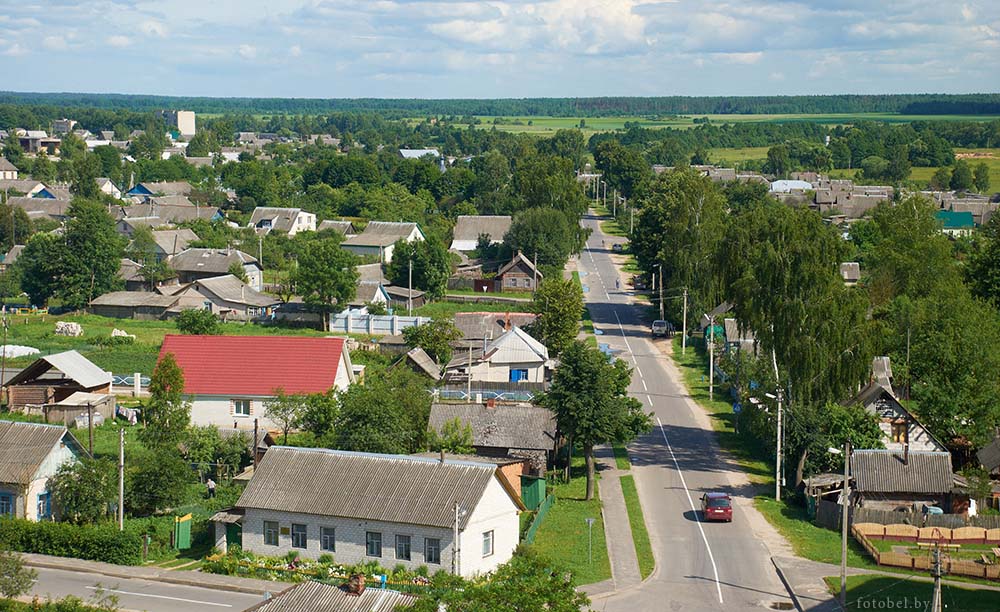
Doba-Mera Gurevich was born in 1892 in the shtetl of Khotimsk on the eastern edge of Belarus and the Pale of Settlement — that part of the Russian empire where Jews were allowed to live. Her mother died in 1903, when Doba-Mera was eleven, and as she was dying, she left Doba-Mera this parting message: “From the moment I close my eyes, the whole world will reject you. Because only happy children are loved.”
This is, indeed, what happened: Doba-Mera had to leave school to take care of her brothers; Doba-Mera’s father, a teacher, remarried, and because his new wife didn’t have the resources to raise the children from his previous marriage, Doba-Mera and her two younger brothers went from relative’s house to relative’s house, working and suffering their way through their childhood. Several years later, her baby brother, of poor health from birth, succumbed to an illness and died.
Doba-Mera describes one occasion on which, after spending time with their grandfather for High Holidays, she and her brothers were sent by a hired wagon to their uncle’s house:
Uncle himself came out and asked in a saccharine way, “Who are these children you have brought me?” “They are the orphans of your younger sister Rokhl”… “So why did you bring them to me? asked Uncle. “You, Veniaminovich,” said the driver, “take them off the wagon, warm them up and feed them — they are hungry and wet — then ask your questions. Look, the poor little ones are frozen stiff.”…. And Uncle stood by the door and stroked his beard and said, addressing the driver by name: “I have nowhere to put them, but they have an aunt here, their father’s sister. They don’t live very far; take them there.”
Eventually, Doba-Mera’s family put together the money to apprentice her to a tailor, and after learning how to fend for herself in a male-dominated environment, she acquired a trade. She witnessed a pogrom and was lucky to come out unscathed physically. She married a distant relative whose parents hated her and made her married life very difficult. She describes years of fear, poverty, and anguish during WWI. After October 1917, she and her husband were eventually able to leave their shtetl and settle in Leningrad, improving their fortunes somewhat, but then came WWII and its attendant horrors.
I won’t overstate the matter if I say that this was a relentlessly sad book down to the very last page. In fact, the most horrific incident comes in a footnote on that page: in this footnote, Michael Beizer, Doba-Mera’s grandson and the force behind the publication of this book, recounts a story told by a resident of the town of Klintsy (not far from Khotimsk), who had been forced to bury the dead after the Nazi shooting of the Jewish residents. I won’t tell this story here — it’s painful. I have to admit, at first, I was deeply angry at Beizer for leaving me with this story on the last page of Doba-Mera’s book, and it’s only with time that I came to realize how appropriate it was to end the book with this Holocaust story. Though Doba-Mera and her children had been able to escape it, it is the Holocaust and the loss of so many lives and so much knowledge that necessitated if not the writing than the publishing of her book. It still hurts to recall that story though.
Doba-Mera began writing her memoirs in the 1930s, living in Leningrad and wanting to tell her children something about her past. Having left school at the age of eleven, she clearly took a lot of pride at her abilities as a learner and deeply regretted that life hadn’t allowed her to use those skills more. She wrote in Russian and addressed herself to her Russian-speaking children and grandchildren, explaining Jewish customs and a way of life. The memoir comes to us in English in a deeply nuanced translation by Alice Nakhimovsky, who in her accompanying note marvels at Doba-Mera, ascribing to her membership in “a vanishingly small group of memoirists who are neither elite nor highly literate but whose observations from the ground cast a vivid light on a lost world.” Nakhimovsky helps to illuminate that world by bringing into English Doba-Mera’s particular idiom, a Russian infused with concepts and a particular cadence taken from Yiddish — the memoirist’s first language.
To me, this memoir feels valuable also because of the way Doba-Mera not only captures her personal experience but constantly connects it to the larger social structures that governed her life. For instance, this is how she recounts life at the edge of the Pale of Settlement (her town was apparently right on the border of what is now Belarus and Russia):
One summer day after work I went with my girlfriends to walk along Barabanovka Street. The street was on the other side of the river, where everybody used to go walking. Jews were allowed to walk but not to live there. A landowner lived there by the name of Robert. He couldn’t stand Jews, but as our stetl was in Mogilev Province, and Jews were permitted to live there, he got the government to make his street part of Orel Province, where Jews were forbidden to live. And he got all the Jews sent away from there. The empty houses where the Jews had lived were boarded up, and nobody would buy them because the Russians were confident that they would get everything anyway.
So on the Sabbath and holidays everybody would stroll there. The street was beautiful, with a lot of greenery, and so everybody liked to stroll along it.
This moment from the year 1907 is probably one of the happiest in Doba-Mera’s life. She goes on to describe her encounters with various socialist revolutionary groups during this period of her life. She wasn’t a revolutionary herself — she had her brothers to provide for — but she recalls going to underground gatherings and gives us the outline of the underground activity in her area.
The other distinct pleasure of reading this memoir is the candid way Doba-Mera writes about her own emotions, including the times when they turned ugly. She doesn’t shy away from describing her feelings of regret, sadness, jealousy. In one particularly devastating moment, she drops her work for several months to travel with her ailing father to Kiev, in the vague hope that he might be saved by the doctors there. She gets recommendation letters to distant family members and with trepidation approaches them upon arrival, encountering in their way of life such luxury and wealth that she hadn’t seen in the Pale.
I was seized with anger and at the same time envy, because [a relative’s son] was a student and could get nothing but Cs and was given everything he could possibly need, while I studied so well but had to become a tailor and live a life of piteous need and, to make matters worse, turn up in a big, unknown city where Jews weren’t allowed to live with a sick father, without money, wondering every minute whether I would get him home alive. At every step I cursed the day of my birth and came to the conclusion that only rich people should have children, because poor people get only suffering from them and the children also suffer.
The bitterness of Doba-Mera’s voice felt deeply familiar to me and eventually I realized that it was bringing back the intonations of my grandmother’s speech. My grandmother Raissa (Reesya) was born in Tikhinichi, another Belarusian stetl, about 130 miles from Khotimsk in 1912 or 13, about the same time as Doba-Mera’s first child. Like Doba-Mera, Raissa received her first education in a male cheder (elementary school where boys learned to read Hebrew and studied the Torah), though being a generation younger and having her mother to help her, she was able to continue her education in Leningrad. Nevertheless, life, to Raissa was a series of trials and punishments for sins she didn’t commit, and though she believed that she improved her lot by hard work and sacrifice, she refused to talk about things like “love” and “happiness.” When I tried to ask her about these things, the most she would tell me was pozhivesh–uvidish, which loosely translates as “just wait and see what life is really like.”
As a child in the 1980s, I resented this attitude and was only too happy to have a chance to escape “my lot” by moving to the United States. I have escaped, and so completely that I needed Doba-Mera’s book as a reminder of this way of thinking. Today, I find myself deeply grateful to Michael Beizer and Alice Nakhimovsky and to Academic Studies Press for this brave book. Its nonconformity to the expectations we place on the genre of the memoir (tell us what your struggles have taught you; or in any case, please land on an uplifting note) is liberating and feels deeply true to my ancestors’ ways of conceptualizing their own lives.

