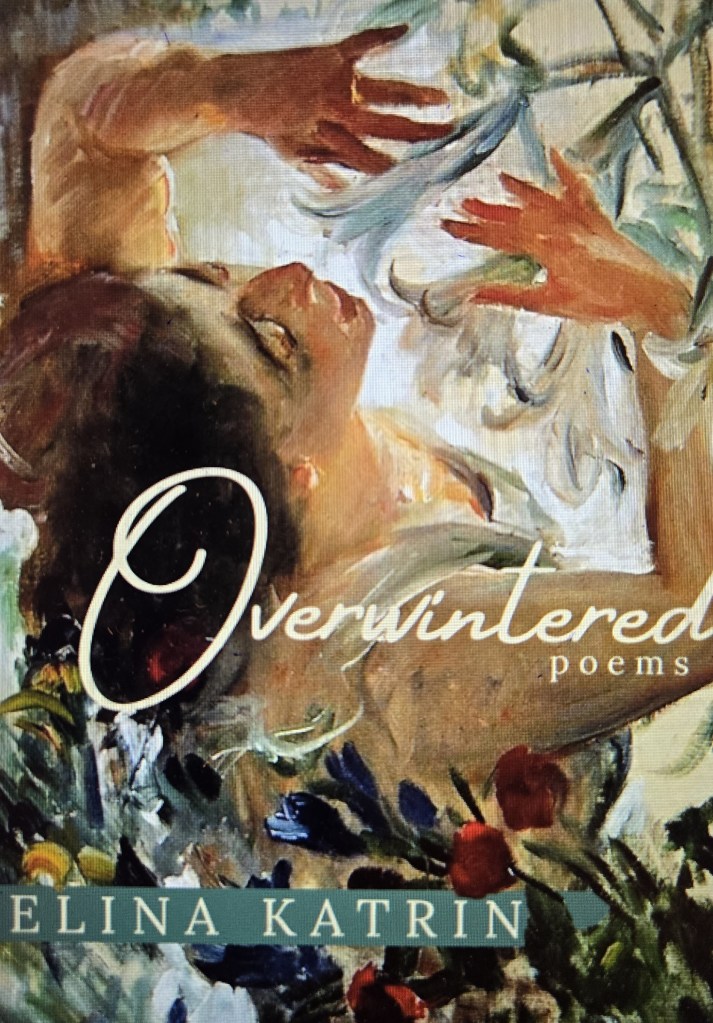
Today we are featuring poems from Elina Katrin’s collection Overwintered (Trio House Press, 2027). Katrin is a Syrian-Russian immigrant poet who lives in Los Angeles. Her poems are characterized by themes of immigration, dislocation, and cultural hybridity. This hybridity is likewise evident in the mixture of languages, as she incorporates Russian and Arabic into her English-language poetry to reflect her multiple identities. The three poems featured below showcase these themes. Overwintered is scheduled to be released in February, 2027, and you can preorder it here, which helps both writers and their publishers.
Spell It Out
after Ae Hee Lee’s (Dis)ambiguation
Before immigrant, confirmation
in card form thrown
to the bottom of my mailbox,
teal outlining the blur of my
face instead of the promised
green, before eliana, elaine,
elena, alina sharpied
on to-go cups, called out
at the doctor’s offices
and work meetings, typed
as email greetings, before
non- then resident alien,
nouns questioned,
answers cut short,
before сестра, sister,
a bloodline calling
warmed by the gentle
touch of two noses,
before картина, малина,
корзина, and other kindergarten
rhymes that end with “ina,”
my mama split the dark
orange skin of persimmons
with a forceful bite in
celebration of finding
a name, a culture connector
in its three-syllable sound:
Элина: a torch, a ray of light.
Could you outshine this dimness?
Vozvrashcheniye
I returned to my city, familiar to tears, Mandelstam wrote about St. Petersburg,
then Leningrad, in 1930.
I, a daughter of many names, return to my city
in the middle of the night, 93 years later.
Full of baggage and interrogation.
I wear my mother’s regret on my waist, criss-
crossed. My memory is full of holes. I never learn
how to sew. To stitch-up this rupture.
I was a Russian daughter once, uniformed in black and white, enough
rhythm in my feet to march, to count syllables.
All Russian girls were the lilies of the valley once, emerging from the cold,
hair adorned with huge white bows and ribbons.
Beauty demands sacrifice, my mother said every time I cried
from the tightness of my pigtails. The offering of tears
in exchange for youth. Tame them I could not, so
language mothered me.
Now I forget the word for bridge when I show my mother
the photographs I took of Brooklyn.
Now I light candles for fun, for ambiance, even when the electricity
is on. I don’t do my hair. I don’t do anything at all
for so long I run out of words and languages to describe
my nothingness.
I open my mouth, and landyshi wither.
Unit 5: Saying “I want” in Arabic
In Levantine, want is a noun-possessive construction.
My desire is.
I am a sliver of lemon topping a mound of dolmas.
ب ِدّي, ب ِدّ ِك, ب ِدّن
Tonight, my tongue is full of want.
The Arabic’s curvature like teta’s closed eyelids.
At home, I practice my desire.
A mélange of sugared berries, a watermelon arch.
I lift a fist to my lips just to feel close to something.
Look: tonight, even the moon is speechless.
Look, moon, my desire.
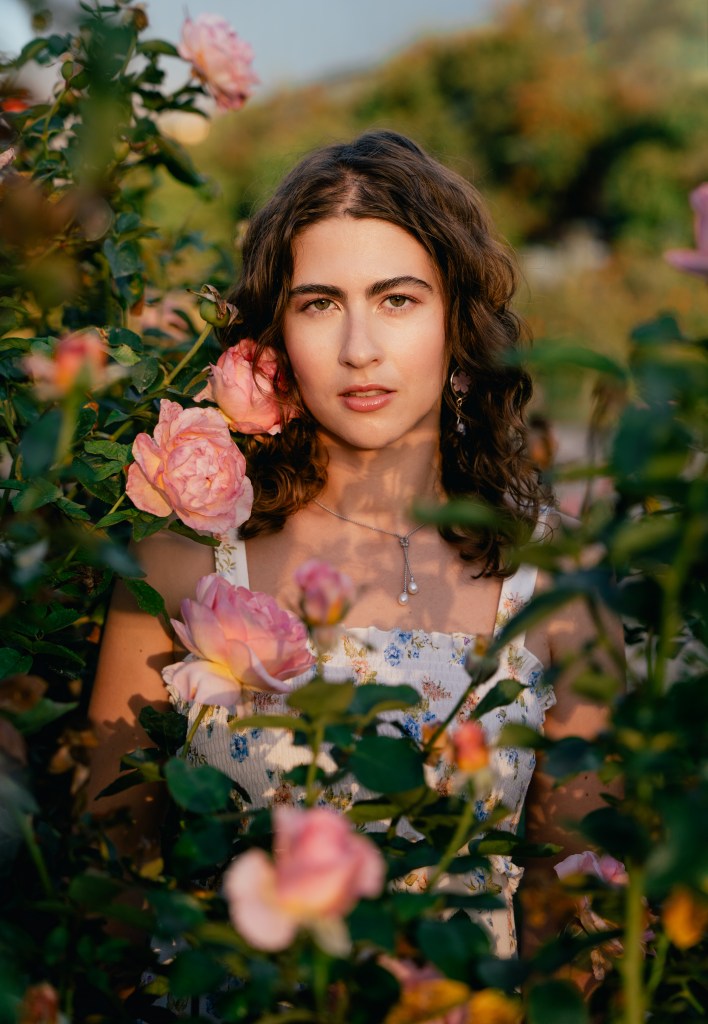
Elina Katrin is a Syrian-Russian immigrant writer and editor. Her chapbook If My House Has a Voice was selected for Newfound’s 2023 Emerging Poets Chapbook Series. Her work has appeared in many literary magazines and journals, including Electric Literature, Poet Lore, and Prairie Schooner, and has been nominated for Best New Poets, Best of Net, and Pushcart Prizes. A runner-up for the 2026 Perkoff Prize in Poetry and the Shō Poetry Prize, she was a finalist for the Black Lawrence Fellowship for New Immigrant Authors. A recipient of scholarships and fellowships from Lambda Literary, Vermont Studio Center, and Periplus, she works and organizes with Mizna as an assistant editor. She holds an MFA in Creative Writing from Hollins University and currently lives in Los Angeles with a dream and her cardigan. Overwintered is her debut book of poetry. You can find more of her work online at elinatkatrin.com and @elinatkatrin.


