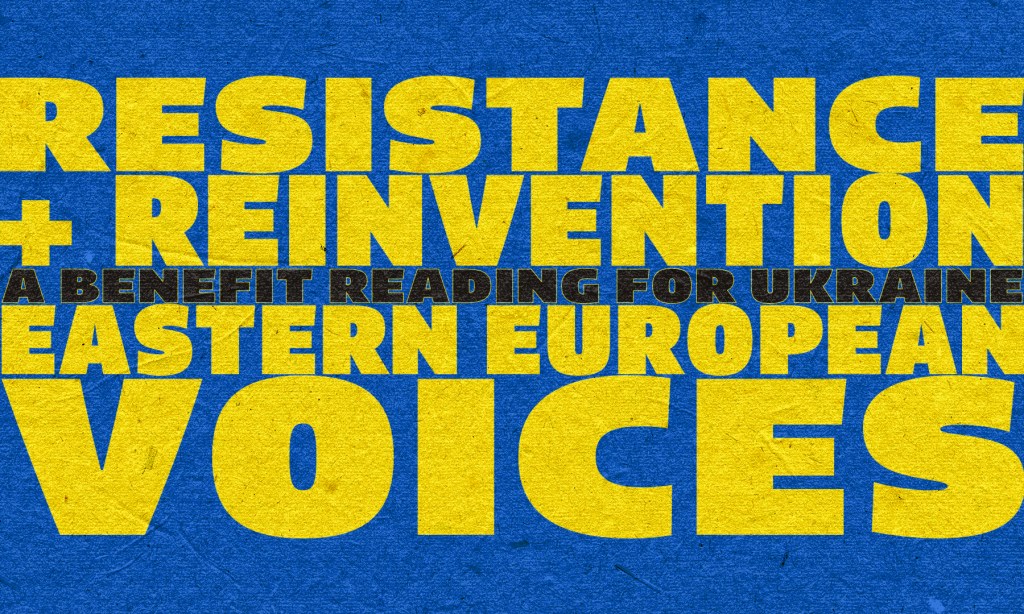
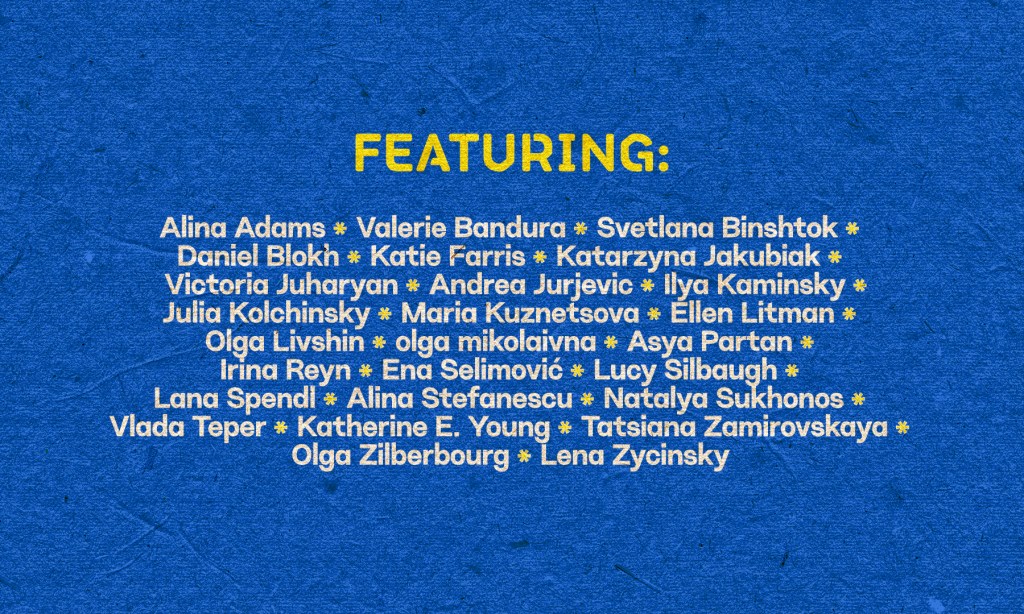
Thanks to those of you who could attend our event, Eastern European Voices for Resistance and Reinvention, hosted by Library Nineteen in Baltimore on March 7. We loved having you as our audience and hope to continue the conversations in various ways.
Ukraine needs all of our support. While there are many ways to help, we’re asking for donataions to Ukraine TrustChain, an organization that helps evacuate civilians out of war zones: https://www.ukrainetrustchain.org/
This one-of-a-kind reading brings together writers from Eastern Europe and the post-Soviet countries who now make their homes across the United States. Taking place during the 2026 AWP Conference, the event celebrates a growing circle of poets, prose writers, and translators from complex, cross-cultural identities whose work is shaped by displacement and immigration, survival and resilience.
On February 9, 2013, Akram Aylisli’s books were burned in his native village. For more than six decades, Azerbaijan’s most prominent writer has written fiction about the mountain village of Aylis, from which he took his pen name; Aylisli called the day of the burning “the most terrible day of my life.” Why were his books burned? Aylisli had published a novella, Stone Dreams, that challenged official propaganda erasing the role played by Armenians in the history of Azerbaijan, a country currently dominated by ethnic Azeris (Azerbaijan and neighboring Armenia have engaged in military hostilities since before the collapse of the Soviet Union). Stone Dreams is among the first fictional works in the greater Turkic-speaking world to depict both historical and contemporary violence against ethnic Armenians, and it includes sympathetic portrayals of Armenian villagers residing in Azerbaijan. The novella also portrays the corruption and authoritarianism of modern-day Azerbaijan. In the uproar that greeted the novella’s publication, Aylisli was stripped of his presidential honors and pension. An empty coffin was paraded around the courtyard of his residence, and a bounty—later rescinded under international pressure—was offered to anyone who would cut off the writer’s ear. In 2014, international supporters nominated Aylisli for the Nobel Peace Prize for “his efforts to reconcile Azerbaijani and Armenian people.” In 2016, trumped-up legal charges were filed against Aylisli by the Azerbaijani government, a case that is still pending. Ten years after his books were burned, Akram Aylisli continues to live under de facto house arrest in Azerbaijan, unable to leave the city of Baku. He is 85.
Here’s a video from yesterday’s poetry reading featuring poets from Ukraine and their English-language translators. Thanks to poets Olga Livshin and Julia Kolchinsky Dasbach who organized this event 800 people from across the globe came together for Ukraine. This event, put together as a part of an ongoing poetry series Words Together Worlds Apart was a fundraiser, and it’s not too late to DONATE to UNICEF.
*Words Together Worlds Apart spearheaded by poet Julia Kolchinsky Dasbach is a virtual reading series. Its mission is: “To maintain & build literary community across distance through our shared love of words. Featured readers will share their work around a weekly theme, followed by interactive discussion.”
Many of us have been wondering how to help Ukrainians who are under a renewed attack from Russia. Poets Olga Livshin and Julia Kolchinsky Dasbach have put together a reading by poets from Ukraine writing in Ukrainian and Russian, and translated to English. Read the event description below and register for the event happening March 1 at 12:30pm ET. This message includes links to organizations where you can make donations to support Ukraine in this time of war.
*Words Together Worlds Apart spearheaded by poet Julia Kolchinsky Dasbach is a virtual reading series. Its mission is: “To maintain & build literary community across distance through our shared love of words. Featured readers will share their work around a weekly theme, followed by interactive discussion.”
From Olga and Julia:
Amid the current catastrophe in Ukraine, a brutal invasion of a sovereign nation, it is more urgent than ever to listen to the voices of its people. While media provides overwhelming coverage, literature, poetry, and art are just as important for processing, coping, and surviving trauma.
Hosts Julia Kolchinsky Dasbach and Olga Livshin unite Ukrainian poets and their translators alongside US poet-allies in Voices for Ukraine–a transatlantic reading spanning from Kyiv, Odesa, and Lviv, to LA, Atlanta, Philly, and Little Rock, as well as recordings Ukrainian poets have sent in the event they are unable to join us live due to internet outages and air raids.
Punctured Lines is looking for reviews of the following recent titles. Reviewers should have some expertise in terms of their chosen work, engaging substantively with its themes and techniques and bringing in direct citation to back up claims. If you are interested in reviewing a work not on the list but that fits our overall themes of feminism, LGBT, diaspora, etc., please let us know. Thank you, and we look forward to working with you.
Fiction:
Alina Adams, The Nesting Dolls (Harper, 2020)***
Nina Berberova, The Last and the First, translated by Marian Schwarz (Pushkin Press, 2021)
To mark National Poetry Month in the United States, Punctured Lines asked two poets with recently published collections to interview one another. Both poets have strong personal and professional connections to the larger Russophone world. Natalya Sukhonos’sA Stranger Home (Moon Pie Press) explores themes of the mother-daughter connection, grief and loss, and finding someone and something to love in locales ranging from Odessa to San Francisco. Katherine E. Young’sWoman Drinking Absinthe (Alan Squire Publishing) concerns itself with transgressions, examined through a series of masks, including Greek drama, folk tales, Japonisme, post-Impressionism, opera, geometry, and planetary geology. In addition to their written comments, Sukhonos and Young have also produced a short video conversation highlighting several poems from each collection.
Please support the poets by buying their books.
***
[Katherine E. Young interviews Natalya Sukhonos about A Stranger Home.]
Katherine E. Young: Your book is set in so many places: San Francisco, Odessa, Rome, New York City. And yet the theme of leaving old places and finding new ones, finding “home,” seemingly plays only a minor role in the book. This book doesn’t dwell on typical themes of emigration / immigration; instead, there are the constants of familial love, amorous love, and putting down roots wherever the earth will accept them. Even the ghosts in your book travel with the speaker and seem at home in multiple cultures. In that context, please talk a little about the line “Home. A dreamscape we flee until it consumes all others” from “The Red Farmhouse.”
Natalya Sukhonos: Thanks for this interesting question, Kate. I think that home is a very fraught concept for me. I’ve moved around a lot—from Odessa to New York, then to Boston and San Francisco, with Turkey and Rio de Janeiro as short sweet sojourns in between, and then back to New York. Each of these places romanced me, intrigued me, made me want to stay there forever—until it didn’t. San Francisco, for instance, was enchanting but forbidding in terms of living expenses, though I still find it very beautiful and have good friends there. And Naomi was born there, which makes it forever special. Why is home a “dreamscape we flee”? I guess I’ve always had that desire to flee, to carve my own path. I’m grateful to my family, but like many families, it imposed its own vision of me which I often longed to tweak or even contradict. But I ended up returning to New York—returning home with my own family, creating my own home, a kind of mise-en-abyme, if you will. Though “The Red Farmhouse” was written before the pandemic, you can see how home and family have become all-consuming entities especially now, for better or for worse.
Katherine E. Young:Mothers and daughters inhabit almost all of these poems, and sometimes the connection is fraught, as in “My Personal Vampire.” Other poems such as “Nadia” celebrate “the wild grasses of love.” The second section of the book contains poems that grieve the loss of a mother. Talk a little about the importance of the mother-daughter connection in these poems.
Natalya Sukhonos: We moved to New York City from San Francisco after my mother was diagnosed with stage 4 ovarian cancer. This collection came out of the process of grieving for her and remembering her. My mother read Gogol’s Dead Souls to me and recited Russian poetry, which she knew inside out—Pasternak, Akhmatova, Tsvetaeva, you name it. She was dramatic, a smart dresser, and had an easy laugh. My mother and I were really close, and four years later, I’m still grieving. The poems in this collection try to ask “why,” but they also try to remember. Simone Weil once said that attention is the purest form of prayer, and this resonates with me even though I’m agnostic. I wanted to pay attention to the little details about her life—her love of gardening, for instance—and also record the process of losing her. When she was gone, I felt really unmoored, as if I didn’t know who I was. But as I was writing the collection, I also had to mother my two-and-a-half year-old daughter Naomi, who is now six. In “Theater of Bones” and “The Lioness and the Wolf, or Words as Prehistoric Shells” I tried to record how she was processing death and grief through questions and magical thinking. And I wanted to be honest about how damn difficult it is to be a mother. Motherhood is often romanticized, but not enough attention is paid (especially by men) to the loneliness, the self-doubt, the very physical burdens that motherhood places on you (hence the comparison of a baby to a vampire). Almost two years ago, I had another baby, Nadia, who bears my mother’s name (Tamara) as a middle name. It’s been delightful to watch the beginning of another life, to do it all over again. And I felt like having this new baby and also reflecting on mothering Naomi has made me reclaim motherhood in a way that wasn’t painful or grieving. At the same time, motherhood made my connection to my mother stronger.
Katherine E. Young: Several of your poems speak of the body as a map, and the poems often feel as if bones, stones, shells, forests, and especially stars are of much more importance and permanence than human constructs of geography and cartography. Talk about the stars and other natural phenomena that inhabit so many of your poems.
Natalya Sukhonos: When I lived in the Bay Area, I was really awakened to the beauty and power of nature because it was everywhere: step seconds away from your house and be surrounded by a giant mountain and giant eucalyptus trees! And the cold sublime of the Pacific! I think that as someone who has lived in cities all her life, I’m puzzled by the natural world, and that gives me comfort—the fact that the ocean just IS, that it doesn’t have to fit into a human story. It has its own story, which we may or may not understand. Maybe this sounds too mystical or vague, but for me what can’t be put into language can provide a source of relief. There’s something important about the fact that my mother loved to garden, and I don’t practice this at all. Or that we witnessed the Pacific Ocean roaring on a remote beach together. Why is this significant? Well, only poems can tell.
Also, the poem where I am a lioness and my husband is a wolf speaks to the way children construct mini-narratives around everything they see, and those stories are often filled with magical, dangerous forests and nature that’s comprised of signs only they could decipher, a sort of Baudelairean forêt des symboles. I think Naomi has taught me a lot about seeing nature this way.
Katherine E. Young:Your poems often reference classical myths, as well as modern literature. In one of my favorite poems, the ekphrastic “Night Sky #16 by Vija Celmins,” the speaker remembers her mother reading from The Little Prince, interleaving references to Saint-Exupéry’s book with lines from Rainer Maria Rilke’s “Elegy 1.” You have a PhD in comparative literature. What is the importance of literature, both classical and modern, to your poems?
Natalya Sukhonos: Believe it or not, literature has always had a sensory or sensual appeal for me. When I was eight years old, I had a sudden epiphany that every book, every author has their own flavor. Since then, literature has always been a huge part of my life: the first time I met my husband, I recited Rilke’s first elegy on the street, for instance. Given that the book revolves around my mother’s life and her legacy, literature plays a vital role in this, too. My mother loved The Little Princewith a passion, and staged it at Camp “Idea” where she was the director and where I worked. The love of literature is something that she and I shared in a way that was rhapsodic and visceral. When I started to write seriously, I couldn’t help but interweave little strands of whichever author I was reading—Borges, Elena Ferrante, Baudelaire—into my poetry. I do this in ordinary conversation, and poetry is another such conversation. For me, literature poses essential questions about identity, existence, good and evil in a way that is liberating because it inspires you to look further. The Master and Margarita, which I’m teaching in the Fall for Stanford Continuing Studies, is one such book, so key to me that I reread it every five years or so. One of my favorite lines by Emily Dickinson is “Tell all the truth but tell it slant.” In The Master and Margarita, Woland does this by asking what the Earth would look like if it were stripped of its shadows. In a “slant,” indirect way, Bulgakov is talking to us about the interconnectedness of good and evil, and for me, this idea is interesting precisely because of the way in which it is conveyed—through slant, poetic meaning.
Katherine E. Young: While free verse is a part of contemporary Russian poetry, it’s a relatively recent formal development, and plenty of Russian poets still write in rhyme and meter—many more than do so in contemporary American poetry. Can you tell me about the formal choices you made in writing these poems and how you came to make them?
Natalya Sukhonos: Even though I grew up reading Pushkin, Pasternak, Akhmatova, Brodsky, and Khlebnikov, when I came of age as a poet writing in English, I was more captivated by the free verse of Mark Strand and Wallace Stevens. That said, T. S. Eliot’s Four Quartets and their mosaic of mythologies and truth-seeking has always fascinated me, and Eliot plays around with rhyme and meter quite a bit.
In my own writing I try to be cognizant of the length of my lines and stanzas, the end words on each line, and the “volume” of words on a page. This all contributes to the way I see sound as vital to any poem’s meaning. So in “Parachute” I play around with the length of the lines to imitate the falling parachute of the poem’s title. I let the form carry the tension of my grandfather jumping off a parachute exactly 94 times during World War II. But “Aphrodite,” for instance, is composed of tercets because it’s a love poem, and I’m harkening back to tercets in Romantic poetry.
I do have some poems in here that experiment with form. “Pantoum of Grief and Birth” is a pantoum because I wanted to get at the repetitive, obsessive nature of grieving my mother while giving birth to my youngest daughter. “Protect Me, Lord” came out of an assignment in a poetry class where I had to put a Shakespearean sonnet into Google Translate twice, choose the best lines from what resulted, and also incorporate several colors, animals, and trees of our own choosing into the poem. And “Lost Souls—After Rilke” is actually a golden shovel, spelling out the first stanza of Rilke’s First Duino Elegy in the ending words of its stanzas. I like to be playful with form, so “In Failing Light” has alternating couplets that are formatted differently and interweave the event of remembering my mother while cooking potatoes and ramps with the actual memory of visiting the Pacific Ocean with her in San Francisco.
Natalya Sukhonos: Especially in “Birdsong,” “The Bear,” and “Nakhla,” I noticed your interest in animals and animal imagery. Can you comment on the way that animals are linked to the theme of freedom vs. unfreedom in your poetry? On the one hand, they’re images of otherness, an alternate perspective, but on the other hand, they’re confined to particular places and spaces by their human subjects…
Katherine E. Young: Hm. I hadn’t thought about this at all before your question, but there are two main groups of animals in these poems. The first group includes birds, cats, the prehistoric sea creatures of “Nakhla,” snakes, a dissected frog, lizards, cicadas, monkeys, bats, the fig wasp, and an actual, historical dog who had an unfortunate encounter with an achondrite (a kind of meteorite). But with the possible exception of the fig wasp, these animals are mostly part of the background flora and fauna of the poems. The other group of animals is quite different: they’re talking animals, and they may not be animals at all. There’s the wish-granting fish of “The Golden Fish,” a tale I first read in Andrew Lang’s The Green Fairy Book (where the fish is an enchanted prince); I read Alexander Pushkin’s version of the tale much later. The enigmatic talking bear of “The Bear” is, of course, the performing bear of countless European folk tales, alternately menacing and pathetic, also possibly enchanted. For me, these creatures aren’t all that different from Bluebeard, the ogre who murders his wives, or the succuba who haunts a man’s waking hours, both of whom also appear in these poems. It’s these talking animals and monsters (or are they humans who have lost their essential human-ness?) who are truly unfree, trapped in enchantments, forced to perform for their supper, or condemned to fulfill various gruesome fates over and over again—they and the humans who become trapped in their tragic, endlessly repeating dramatic arcs.
Natalya Sukhonos: In “Nakhla” and “Euclidean Geometry” I was fascinated with your link between the macroscopic and the microscopic: cataclysmic events like the fall of a gigantic rock and human, intimate events such as a singular act of love. Please comment on this link in your poetry.
Katherine E. Young: Well, that’s the whole point, isn’t it? We go running around the world, eating, reproducing, defecating, dying, and from the biological perspective we’re doing just the same thing as ants. I don’t know what distinguishes one ant from another (although I’m told they sing to one another), and from a bird’s-eye perspective you can’t distinguish one human being from another, either. But when we write, when we make any kind of art, we’re saying “Stop! Look at me! I’m here!” Same for when we fall in love, which is also a kind of art. “Nakhla” started during a visit to the Smithsonian Air & Space Museum, where they have a fragment of this amazing achondrite from Mars that fell rather spectacularly in Egypt in 1911 (and apparently did kill a farmer’s dog). A run-of-the-mill igneous rock on Mars, 1.3 billion years old—the only thing unusual about it is that it got blasted off the Martian surface and ended up here on Earth. You can touch it! I was just charmed by the notion of this anonymous and yet singular rock—as anonymous and as singular as other such interplanetary travelers that brought things, including perhaps some of the elements of life, to Earth. Same for “Euclidean Geometry”: an act of love is both anonymous and singular, seemingly governed by laws and rules as ancient as the universe. Sometimes we mistakenly interpret those laws and rules, though—hence, logical fallacies such as circular logic.
Natalya Sukhonos: In “Today I’m Writing Love Songs” as well as “Place of Peace,” where you describe love as “bursting riotously into bloom,” you write beautifully about love as fruit. There is so much sensuality in your fruit metaphors! The poem “Fig” is a whole extended metaphor of love as a bloom as well, and it is stunning! And in “Succuba,” as well as “Today I’m Writing Love Songs” and “A Receipt to Cure Mad Dogs,” you connect love to herbs and their various flavors. Please say something about the ways in which the “tastes of love” resonate in your poetry through imagery of herbs and fruit.
Katherine E. Young: As I was writing these poems, just about everyone in my close circle, including me, was undergoing really big and often traumatic life changes. So, I was very much coming to the poems asking the hard questions: Who am I? Where am I in life? Am I the person I wanted to be, and if not, what can and should I do about that? The basic idea that one can more or less cultivate oneself as one cultivates a garden speaks to a certain kind of urgency one gets in midlife to take stock and make adjustments, sometimes radical ones. During that period, I was lucky enough to have some choices—not always easy ones, not always good ones, but real ones. To some degree, then, the notion of flowering in these poems is aspirational—what I hoped would happen if I took better, more conscious care of my garden, both for myself and for those I love. Also, I just really, really love figs!
Natalya Sukhonos: What’s the link between the mathematical and the erotic in your poetry? I’ve noticed many poems touching on math, and this was fascinating, maybe not least because I just finished Lara Vapnyar’s Divide Me by Zero.
Katherine E. Young: Excellent question! I don’t really have an answer, except to say that as a young person I wanted to be an astronaut—that’s also the reason I started studying Russian, by the way—and I felt very comfortable with math and science, at least until I ran afoul of a college calculus class. Much later, when I was getting my MFA, I took a wonderful course on the rhetoric of science, and I spent more time than I care to admit reading the Transactions of the Royal Society of London. I was fascinated by the mental steps that natural philosophers in the early nineteenth century had to take to be able to conceptualize dinosaurs out of a bunch of bone fragments stuck in rock. And you already know that I find odd bits of space debris decidedly erotic… Maybe I was seeking a system of beliefs and practices in math and science that might inspire me with more confidence than the beliefs and practices in human relationships that I had found simultaneously confining and unreliable—although true mathematicians and scientists would probably say that their laws and beliefs can be just as confining and unreliable…
Natalya Sukhonos: You are a professional literary translator who has received a National Endowment for the Arts Fellowship for translation. How does the work of translation inform your poetry (and I’m using “translation” here both in the literal sense of the word as well as the metaphorical process of translation)? Comment on the process of cultural translation, as your poetry includes intertextual references to Mrs. Pinkerton, the Golden Fish, Manet, Euclid, and so many other rich and unexpected sources.
Katherine E. Young: Honestly, I don’t really see much difference between writing “original” poetry and translating it. In both cases, making a poem starts with “translating” the impulse for that poem into words. Translating someone else’s impulse—as opposed to your own—is essentially the same process, although there are a few more steps involved. But I’m always trying to make music with words, whether the poem started in my own head or in someone else’s. There are particular benefits to being a translator, though: recently I was asked to translate a selection of poems by Boris Pasternak, and I found that every single one of Pasternak’s lines taught me something important about writing my own poetry in English.
As far as cultural translation, all the cultural flotsam and jetsam in this book comes from things I’ve squirreled away, from the mating habits of ancient sea creatures to Manet’s Bar at the Folies-Bergère, which I first saw in London as a teenager. A lot of my references come from the former Soviet Union, where I first traveled as a student. I didn’t really get serious about writing poetry until I lived in Russia in the 1990s, though—while there, I was lucky enough to read the entire canon of Russian poetry with a scholar who spoke no English. It was that immersion in Russian that helped me to hear my own language, English, with fresh ears—and it certainly helped make me a better poet. I like to joke that I’m the only American-born poet I know who owes more to Pushkin than to Walt Whitman—if that’s not cultural translation, what is?
Natalya Sukhonos is bilingual in Russian and English and also speaks Spanish, French, and Portuguese. She has taught at the Stanford Continuing Studies program for four years. She has a PhD in Comparative Literature from Harvard University. Her poems are published by The American Journal of Poetry, The Saint Ann’s Review, Driftwood Press, Literary Mama, Middle Gray Magazine, Really System, and other journals. Sukhonos was nominated for the Pushcart Prize in 2020 and 2015, and for the Best New Poets Anthology of 2015. Her first book Parachute was published in 2016 by Kelsay Books of Aldrich Press, and her second book A Stranger Home was published by Moon Pie Press. natalyasukhonos.com.
Katherine E. Young is the author of Woman Drinking Absinthe, Day of the Border Guards (2014 Miller Williams Arkansas Poetry Prize finalist), two chapbooks, and the editor of Written in Arlington. Her poems have appeared in Prairie Schooner, The Iowa Review, Subtropics, and many others. She has translated prose by Anna Starobinets and Akram Aylisli and two poetry collections by Inna Kabysh. Her translations of contemporary Russophone poetry and prose have won international awards. Young was named a 2020 Arlington, VA, individual artist grantee; a 2017 NEA translation fellow; and the inaugural poet laureate for Arlington, VA (2016-2018). https://katherine-young-poet.com
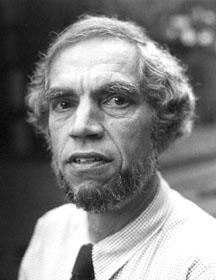
Today, we’re thrilled to present a Q&A with Boris Dralyuk — renowned translator, writer, LARB‘s Executive Editor (thank you for fine-tuning my reviews), former colleague, and old and dear friend. Based in Los Angeles, Boris has been instrumental in promoting Russian and Russophone literature in translation both in the United States and abroad. His recent poetry cycle can be found here. Boris answered our questions by email.
Punctured Lines: Your family emigrated from Odessa to Los Angeles when you were eight. In an interview with Melissa Beck on The Book Binder’s Daughter, you’ve told the story about turning to translation at the age of 14 in the hope of sharing a Pasternak poem with an English-speaking friend. You felt that translation was something of a calling for you. And yet there’s often a long path between that first desire to translate and professional translation. What were some of the challenges you’ve encountered at the beginning? What resources (mental, emotional, literary, etc.) did you draw on to keep going?
Boris Dralyuk: First, let me thank you both for inviting to review the path I’ve traveled. It seems, from here, to be longer and more winding than I usually imagine it to be. I tend to focus not on the path itself but on the small number of items I’ve picked up along the way. It’s these items – discrete memories, some pleasant and inspiring, others disappointing and embarrassing – that offer comfort and refine my perspective when I run into new challenges. A large part of professionalization is learning about yourself, about what you need – mentally, emotionally, physically – in order to do your best work. Is your mind clearest in the morning, the afternoon, or the evening? How quickly can you translate? How many words of prose can you render each day before losing steam? How much coffee do you need, and how much is too much?
One discovers these things over time, often the hard way. And they change – so it’s important to keep watching yourself, adjusting. When I was starting out, I translated omnivorously, at breakneck speed. The practice was useful, but the results were, as you can imagine, mixed… I learned soon enough that I can seldom translate, at a high level, more than 500 words of prose a day. It’s still the case that I move quickly when I translate poems, but two things have changed: I now translate only those poems that speak to me, that won’t let me go; and after I complete a draft, I share it with my most trusted readers, read it after the first blush of inspiration fades, let it sit as I wait for the second and third blushes to arrive, revisit it again – I put the poem through its paces. To sum up, I now have more faith in my personal taste in literature and less faith in my initial satisfaction with my own work.
I can’t imagine coming to any of these realizations earlier than I did – it all takes as long as it takes. What has helped me through every stumble, setback, and paralyzing fit of regret was the sympathy and encouragement of my mentors, who had cleared these hurdles before. The smartest thing I did in my early years as a translator was to seek out such mentors, and they all became dear friends – Mike Heim, Robert Chandler, Irina Mashinski, Maria Bloshteyn, and others.
PL: Some of us were lucky enough to study with Michael Heim at UCLA, but you also worked with him in terms of translation. You touched on this experience in your very poignant tribute when he passed away. Can you talk a bit more about what it was like to work with him?
BD: As I wrote in my little piece, it was the time Mike devoted to my infantile efforts – the interest he showed, when he could well have shown me the door – that proved decisive. I wish I could say that I didn’t need encouragement, or that I don’t need it now, but I very much did and do. Yet I want to stress that Mike didn’t give me encouragement because he felt I needed it, he did it because he believed in translation itself, believed that it was an important art, that it was possible to improve one’s skills, and that I was dedicated to the work. His purity of intention was unmistakable. It was precisely what I was looking for in a teacher and reader, what I look for still, and what I try to manifest whenever I’m asked for feedback or advice. When Mike sat down with a student to go over a text, it isn’t that the world outside the text would disappear, it’s that the text would become the world’s center. And you’d leave his office with the sense that your work had, in its own small way, restored order to the world – had shaken it out as if it were a bedspread, revealing its true design. I feel that way every time I discuss a translation with Robert, Irina, Maria, and my wife, Jenny. Their tastes and sensibilities are even closer to my own than Mike’s were, but they all share the same world-shaking, order-restoring purity of intention.
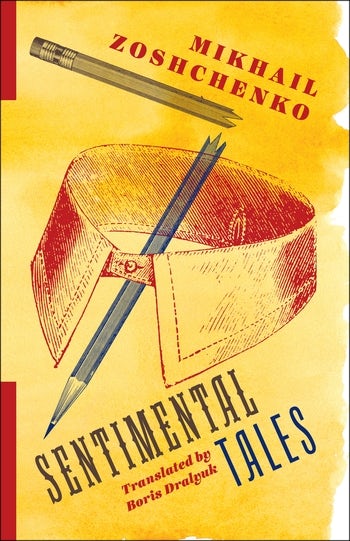
PL: You’ve translated a range of writers from Russian, from Tolstoy to Babel and Zoshchenko to contemporary prose and poetry by Maxim Osipov and Julia Nemirovskaya (here, your translations of poetry are to be commended for often keeping the original meter and rhyme scheme, which is extraordinarily difficult in English but is precisely what lets these poems come through, as opposed to being rendered unrecognizable, in translation). What draws you to a particular author or project? What are the differences, and/or similarities, in the way you approach translating the various genres and sensibilities of the writers?
BD: The greatest training ground and door-opener of my career was the invitation, extended by Robert Chandler and Irina Mashinski, to coedit The Penguin Book of Russian Poetry. The correspondence we conducted over the nearly four years of work on that project led me to discover the range of voices inside me, voices capable of resonating with those of Vasily Zhukovsky, Afanasy Fet, Nikolai Gumilyov, Marina Petrovykh, Georgy Ivanov, Anna Prismanova, and other poets. I learned what I could and couldn’t do, my strengths and my weaknesses. Most importantly, I learned to listen closely in a hundred different ways, from every angle. Of course, when translating Isaac Babel, I don’t need to strain my ears – his Odessan language is the language of my family, of my childhood; and Zoshchenko’s tragic gags are also like mother’s milk. What I need to do, in both cases, is to find Anglophone equivalents for their voices, and, luckily, American literature is full of them. In the case of Babel, I was aided by Daniel Fuchs, Samuel Ornitz, Saul Bellow, Bernard Malamud, Cynthia Ozick, and, for good measure, Dashiell Hammett and Raymond Chandler. When Zoshchenko came knocking, Ring Lardner and Robert Benchley opened the door, with Damon Runyon peeking over their shoulders. In the case of Maxim Osipov and Julia Nemirovskaya, something rather different happened. The voices I use in my translations of their work are often versions of my everyday voice. Better versions, because they always have more important things to say than I myself do. I loved what Anna Aslanyan said in her TLS review of Maxim’s Rock, Paper, Scissors and Other Stories, which I co-translated with the brilliant Alex Fleming and Anne Marie Jackson: “Dralyuk’s idiom packs a punch, Anne Marie Jackson lends Osipov’s prose a gentle English timbre, and Alex Fleming meticulously recreates its cadences and wordplay.” We all make use of what we have inside us, of what we acquire from our reading and from our colleagues – the key is to make the very best use of it.
PL: In addition to translating, you also work with books in another way: as a frequent reviewer, including for the Times Literary Supplement, and of course as the Executive Editor of the Los Angeles Review of Books. It is thanks to you that this publication has come to amplify coverage of translations from the former Soviet countries, as well as diaspora literatures and scholarly works about the region. What do you look for in terms of the books/writers you feature in LARB?
BD: My editorial goal is, first and foremost, to empower and encourage the editors of our sections – which represent over a dozen genres – to cast as wide a net as possible, and to ensure that we’re covering a diverse array of books and uplifting the voices of critics and reviewers who may not have access to other major venues. We love giving authors their first break. I’m not interested in boilerplate reviews of the latest bestsellers or political exposés. I want our pieces to dig deeper, to be deeply informed but also deeply felt, and to come at books from unexpected angles. A good number of our reviewers are associated with colleges and universities, and their first drafts often bear the telltale signs of academic discourse: lots of jargon, sentences that are far more convoluted than they need to be, etc. The jargon may have its place, but one must remember that many readers are encountering these specialized terms for the first time. We always remind our contributors that they’re writing for a general audience of curious non-specialists; the goal is to welcome people into the discussion, not to stupefy them with a display of one’s erudition. The good news is that academics usually learn quickly – that’s why they’re academics.
PL: We talk a lot on Punctured Lines, and elsewhere, both about how to promote translations from Russian in general and of women writers in particular. In your essay “The Silver Age of Russian-to-English Translation” for Translation Review you name the stellar translators and publishers that have made translation from Russian an incredibly vibrant field. What are your thoughts on how we as a community – of translators, scholars, publishers, editors, reviewers, book bloggers, etc. – can work toward greater visibility of female authors within Russian-to-English translation overall?
BD: From Constance Garnett and Louise Maude on down, women have long been at the forefront of Russian-to-English literary translation. It seems to me that many, if not the majority, of our most prolific and accomplished contemporary translators are women. Among them are Marian Schwartz, Antonina W. Bouis, Lisa Hayden, Katherine E. Young, the late Jamey Gambrell, and Joanne Turnbull, whose shimmering translations of Sigizmund Krzhizhanovsky have restored that half-forgotten master of dark fables to his proper place, beside Borges and Calvino. But the work of male Russian authors has, until recently, dominated the market. When Anglophone readers think of a typical “Russian author,” I would bet many of them still imagine a bearded face… This is changing, slowly and steadily, because translators – both women and men – are more enthusiastically advocating Russian women’s writing. The resurgence of interest in Teffi, fueled by the efforts of Robert and Elizabeth Chandler and the team they’ve assembled, is just one indication of this shift – and may be one of the driving forces behind it. Pushkin Press, which releases the Chandlers’ Teffi volumes in the UK, has now also put out phenomenal books by two other émigré women authors, Irina Odoyevtseva’s Isolde, translated by Bryan Karetnyk and Irina Steinberg, and Banine’s (Umm El-Banu Assadullayeva) Days in the Caucuses, translated from the French by Anne Thompson-Ahmadova. The openness and dedication of small- and medium-sized publishers like Adam Freudenheim of Pushkin Press, Edwin Frank of NYRB Classics, and Will Evans of Deep Vellum, which has released two novels by Alisa Ganieva in Carol Apollonio’s translations, as well as of Christine Dunbar of Columbia University Press’s Russian Library, should be applauded without cease. And Lisa Hayden, who not only translates Guzel Yakhina and Margarita Khemlin but also highlights the work of countless other women authors on her indispensable Bookshelf, is a hero and an inspiration to us all. As members of the community, we must actively seek out the widest variety of Russian voices and, if any of these voices resonate with us individually, we should try to bring them across into English ourselves or to suggest them to other translators.
PL: Soviet and post-Soviet lives don’t always fit neatly into the contemporary American classification of identities. For instance, in conversation with Katya Michaels at Odessa Review, you described Babel as a Jewish-Ukrainian-Russian-Soviet writer. This sounds about right and yet in American parlance this often gets shortened to “Russian writer” or “Soviet writer.” How do you approach this work of identity constructions that critics and translators are often asked to do?
BD: Yes, this is always a challenge. I suppose the first and most important step is to determine how these authors see – or saw – themselves in their own time and within a given tradition or set of traditions. But once you establish that, what do you do with it? If your press allows you to supply the text with an introduction, or even a brief translator’s note, that’s an opportunity to enrich a reader’s understanding of an author’s identity. And there are, of course, decisions to be made within the text itself. Is it appropriate for Yiddishisms, both syntactic and lexical, to color a Russian text in English translation? If you ask me, Babel wouldn’t be Babel without them. And would Lev Ozerov, a Soviet Jewish poet who, although he wrote in Russian, was raised in Ukraine, counted Ukrainian intellectuals among his closest friends, and translated scores of Ukrainian poems object to our using the spelling “Kyiv” in our rendering of his work? I think he’d heartily approve. Needless to say, there’s no one-size-fits-all approach – and that’s the beauty of it.
PL: What are you working on now? What project(s) is/are on your wish list?
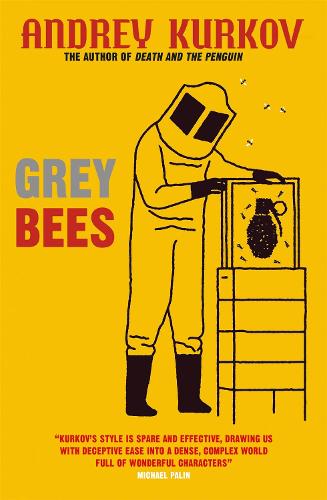
BD: Right now I’m awaiting the publication of my translation of Andrey Kurkov’s latest novel, Grey Bees – a moving, gently surreal picaresque set in Donbas and Crimea two years into the current war. (Talk about Ukrainian place names!) Alex Fleming, Nicolas Pasternak Slater, and I are also making great progress on a second volume of Maxim Osipov’s beguilingly nuanced stories and essays, and are relishing every minute of it. Julia Nemirovskaya’s humbly revelatory and incomparably humane verse continues to work its way through me, and I’m always on the lookout for little treasures to share on my blog – like this delightful poem by Sofiya Pregel.
On September 27, 2020, Punctured Lines hosted our first ever Zoom event dedicated to the publication of LOOK AT HIM by Anna Starobinets, translated from Russian by Katherine E. Young. The author and the translator were joined on Zoom by scholar Dr. Muireann Maguire from the University of Exeter, UK to discuss this important book and the what it has to give to its English-language audiences.
To keep up with the conversation about Look at Him, including interviews, reviews, and other links, please visit translator Katherine E. Young’s website.
Anyone interested in the cover artist can find Ghislaine Howard’s work on her website.
We atPunctured Lines are delighted to host our first public event via Zoom. We recently ran Svetlana Satchkova’s interview with Anna Starobinets about her memoir, and welcome an opportunity to continue this conversation. On September 26, we’ll be moderating a book release celebration for LOOK AT HIM by Anna Starobinets in Katherine E. Young’s translation. This event will begin at 3 pm EST.
About the Event:
In 2012, Russia-based writer and journalist Anna Starobinets was told in her sixteenth week of pregnancy that the baby she was carrying had developed a kidney defect incompatible with life. Following a dehumanizing experience in Moscow clinics, Starobinets traveled to Berlin, Germany, to undergo an abortion. In Berlin, Starobinets also discovered a level of medical support, including emotional support and counseling, that was practically unheard of in Russia at the time.
Starobinets wrote LOOK AT HIM on the heels of those events. Its 2017 publication in Russia was met with critical praise, including a nomination for the National Bestseller Prize, but the book also ignited a firestorm of condemnation. The author was blamed for breaking social taboos by discussing women’s agency over their own bodies and examining the lingering aftereffects of abortion and miscarriage on women and families—taboos that we, as feminists, believe needed to be broken. Beautiful, darkly humorous, and deeply moving, LOOK AT HIM explores moral, ethical—and quintessentially human—issues that resonate for families in the world beyond Russia.
Now Three String Books / Slavica Publishers has brought out Katherine E. Young’s English translation of LOOK AT HIM. Today we’re celebrating the publication of this book that expands the English-language literary canon with a powerful story, masterfully told. Young has captured not only the factual specificity of Starobinets’s experiences but has also emphatically conveyed their emotional intensity.
Join us for a reading from the book and a Q&A with author Anna Starobinets and translator Katherine E. Young. Dr. Muireann Maguire from the University of Exeter, UK, will comment. Hosting are Yelena Furman and Olga Zilberbourg from Punctured Lines, a feminist blog about post-Soviet literature.
*** A special publisher discount for purchase and free shipping (US) of the book will be available during the event. ***





 Punctured Lines