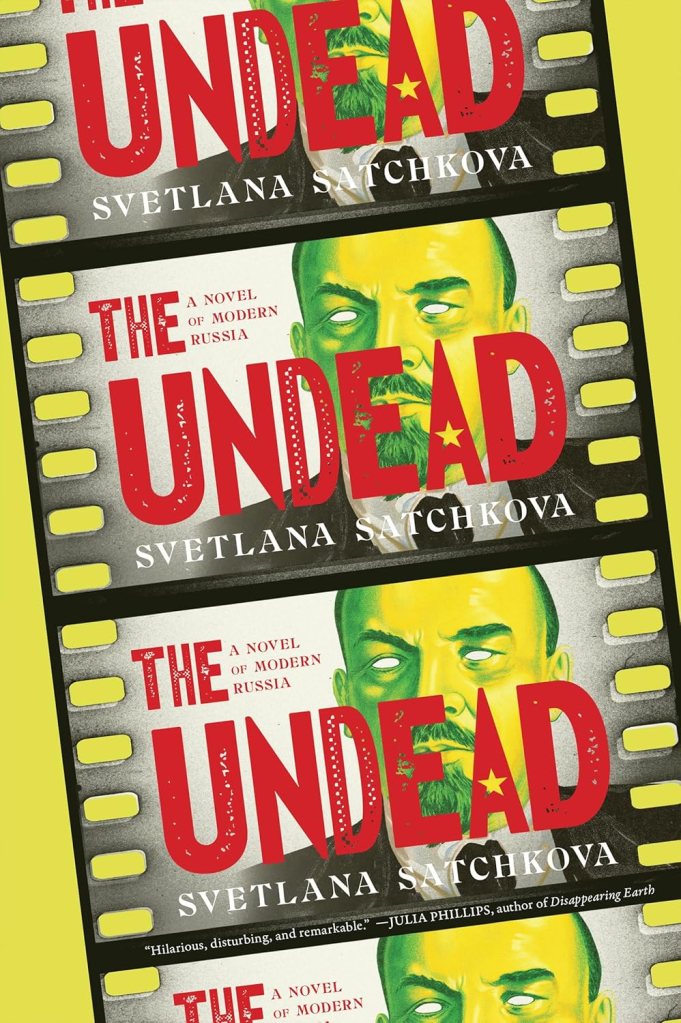
Svetlana Satchkova’s English-language debut, The Undead: A Novel of Modern Russia, was published earlier this year by Melville House Publishing to rave reviews. It’s a story of an aspiring Moscow filmmaker, Maya Kotova, who makes an arthouse horror movie as a commentary on the fragility of human nature, and then finds herself arrested and prosecuted because her movie is deemed a threat to the Russian government. In Moscow circa 2017, during the era of the Kirill Serebrennikov trial, there is no longer room for apolitical art. Satchkova, who had just ended her career in film journalism at the time when her novel is set, beautifully captures the sense of an extravagant party mixed with paranoia gripping Moscow’s film industry at the time.
Satchkova has previously published three novels in Russian and is a longtime contributor to Punctured Lines. She has brought us interviews with some of the preeminent writers working in Russian today: her interview with Tatsiana Zamirovskaya back in 2020 (first published in Storytel and translated to English by Fiona Bell), her conversations with Anna Starobinets and Maria Stepanova, and a translation of an interview Satchkova gave to Egor Mikhailov of Afisha Daily about a Russian-language novel of hers published in 2021, Люди и птицы [People and Birds].
We’re grateful to Melville House Publishing for allowing us to run an excerpt from this highly entertaining and illuminating novel. This excerpt comes from Chapter Three of the novel, when Maya and her sister Polina visit their parents, and Maya shares the good news of signing a film contract for the movie she wrote.
Please buy the book, and don’t forget to read and review. Reviews on Goodreads and Amazon tell publishers that we want more work by this author.
A Psychological Thriller with a Touch of Mythology: An Excerpt from Svetlana Satchkova’s The Undead: A Novel of Modern Russia
“I have news,” Maya volunteered. “I’ve signed a contract with a producer and will be shooting my first movie this fall.”
For a second, everyone appeared stricken. Then Polina said, “Wow, cool! We have to drink to that!”
Normally, their parents didn’t drink. Their mother said, apologetic, “I don’t think we have anything.”
“We can toast with lemonade, it’s fine,” Polina said, grabbing the bottle from the table and starting to pour.
After Maya divulged some details of the upcoming production, her mother said quietly, “So this means you won’t be starting a family anytime soon.”
It was their parents’ ultimate dream to have grandchildren. They didn’t much care if their daughters were productive members of society, if they accomplished great professional success or even just simple human happiness. What they wanted for them was to procreate, as if the absence of kids on Maya’s and Polina’s end somehow devalued their own efforts spent raising them. If their family line didn’t continue, their parents’ thinking probably went, there had been no point in their sacrifices and the hardships they’d overcome. Since they’d already given up on Polina in this respect, they kept pushing Maya into thinking about having children—the sooner, the better.
“To start a family, first you have to meet someone to start a family with,” Maya mused darkly.
“Good luck with that,” Polina said. “Your last train left a while ago.”
The woman Polina’s ex had left her for was twenty-five and had big boobs.
Maya couldn’t blame her sister for being so jaded, not really. Her own love life to date had been just as pathetic as Polina’s, if not more so. She’d spent a whole decade with a man twenty years her senior, being loyal to him, cooking him daily meals, being friends with his friends, and partaking in his stupid hobbies, like fishing and collecting unusual rocks. He was a supremely dull man who hadn’t been all that nice to her, and she wasn’t even sure she’d ever been in love with him. Could she have been so scared of life that she’d preferred staying with him just for the sake of being in a stable relationship that she knew wouldn’t bring her any surprises, unpleasant or otherwise? And here she was now, fancying herself capable of saying something new and provocative to the world.
“What will your movie be about?” her dad asked, genuinely curious, as far as Maya could tell. She hesitated, unsure if she should keep going. Maybe it was better to switch the topic to something lighter, less charged with everyone’s old grudges and unmet expectations.
To her family, Maya’s decision to quit work and study directing— at midlife, no less—seemed utterly incomprehensible. They were practical, down-to-earth folks who saw artistic endeavors as frivolous and only suited to those with independent wealth and no obligations. Her parents had done their best to teach their daughters the merits of a secure, respectable job that let one steadily increase one’s income and social standing. No number of symphonies, paintings, novels, or films—each offering solace and meaning—could convince them that the people who created such works deserved respect, perhaps even more than engineers, lawyers, or doctors. After many attempts to justify her choice, Maya had come to believe that there was no way to explain the necessity of art to people who didn’t experience it as a necessity.
It was because of her parents’ contempt for creative pursuits that they hadn’t enrolled her in any extracurriculars as a kid, even though she’d begged them to let her try dancing, painting, or playing an instrument. They hadn’t seen any value in that, hence Maya’s childhood, which she remembered as filled with sticky nothingness—until that one lucky day when, around the age of ten, she discovered a way to escape. Her parents had several shelves full of books—in their milieu, these signaled a certain measure of success, much like a furniture set from Czechoslovakia did. She’d opened many of these volumes before, out of sheer desperation, but the sentences had been too dense for her to extract any meaning. This time, however, Maya found herself engrossed in the adventures of a man on a desert island, comprehending maybe sixty percent of what was written. But even that seemed like a miracle, and the more she read, the more she understood. After she’d finished every last tome on the shelves, she joined a local library, then moved on to a larger, more central branch, where they also screened rare films.
In all those years, she’d never seen her parents pick up a book.
How would she even begin to explain that she was making a horror movie? Their understanding of the genre likely didn’t go beyond cheap jump scares and gore. On her way over, Maya had debated how to present her project and decided to describe it as a psychological thriller with a touch of mythology—true, in a way.
This was what she tried to convey now. As she spoke, she became aware of blank facial expressions all around, signaling that her words weren’t being appreciated. Perhaps if she’d written something historical—like a script about WWII that focused on great human suffering and extraordinary, larger-than-life personalities—they would have been more impressed. The terrible thing was that she could totally see how, from their perspective, her story seemed to hold little value. Her parents were from another generation. Culturally, it was like they’d come from a place both isolated and stuck in time. Speaking with decreasing conviction, Maya eventually fell silent, her last sentence trailing off.
There was something resembling pity in her father’s eyes when he said, “You think people will be interested in seeing this film?”
From Undead. Used with permission of the publisher, Melville House Publishing. Copyright © 2026 by Svetlana Satchkova.
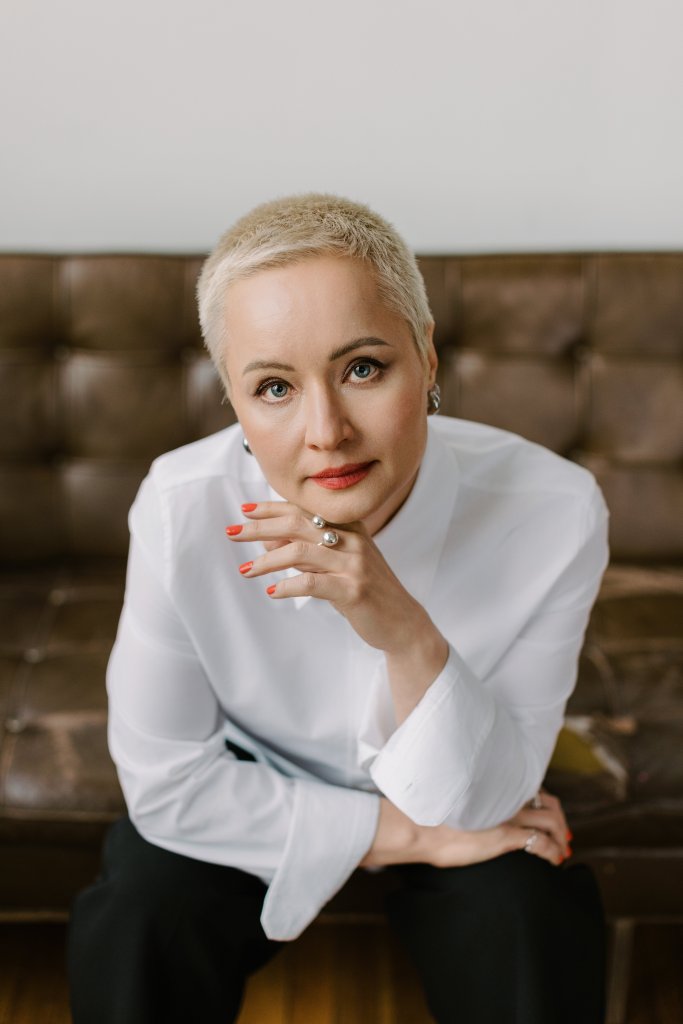
Svetlana Satchkova is a New York-based journalist and novelist. She covers culture and politics, with bylines in Literary Hub, The Rumpus, Newsweek, LARB, the Independent, and others. Currently a research fellow at the Jordan Center for the Advanced Study of Russia at NYU, she holds an MFA from Brooklyn College. Svetlana has published three novels in Russian; The Undead: A Novel of Modern Russia, is her English-language debut.

 Punctured Lines