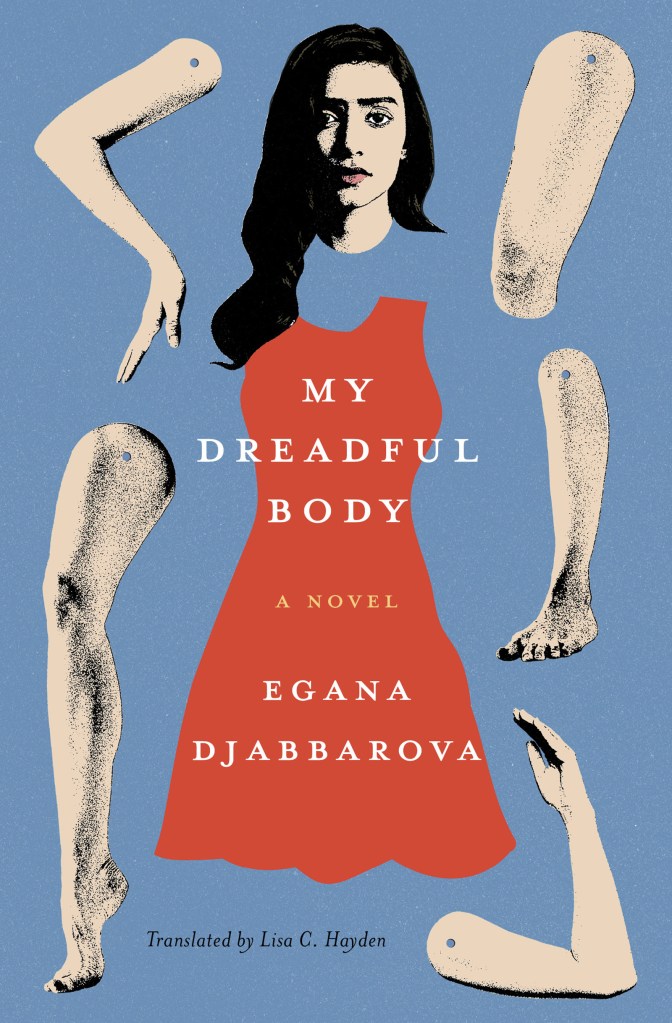
We’re celebrating today the arrival of an eagerly anticipated novel that portrays the life of a young woman from a traditional Azerbaijani community in Russia. A feminist poet, essayist, scholar, and educator, Egana Djabbarova is the author of five books in Russian. In English, her work has previously appeared in the anthology F Letter: New Russian Feminist Poetry, edited by Galina Rymbu, Eugene Ostashevsky, and Ainsley Morse (read our conversation with Ostashevsky and Morse). My Dreadful Body is Djabbarova’s first book in translation to English. The team behind this book includes Lisa C. Hayden, a beloved and celebrated translator from Russian, and New Vessel Press, an indie publisher specializing in literature in translation with a very strong list of titles from the countries of the former Soviet Union.
The protagonist of My Dreadful Body suffers a debilitating neurological illness that compromises her ability to move and communicate. In search for treatment and in her reflection on her illness, the protagonist finds an unexpected source of strength. Her journey is also that of liberation from the expectations of traditional roles allotted to women in her community. It’s a powerful and in many ways unexpected story; truly an event for feminist literature. The novel is told in eleven chapters, each of which is titled after a part of a woman’s body. It is our great pleasure to share an excerpt from the seventh chapter, “Tongue.”
This novel is now available in both paperback and eBook formats. Please buy it directly from the publisher, from Bookshop.org, or from your favorite local bookstore.
Tongue
An Excerpt from Egana Djabbarova’s My Dreadful Body, translated by Lisa C. Hayden
Everybody at school spoke Russian, but at home I heard Azeri and Turkish in the television series that Mama watched. It was obvious to me as a child that if I spoke several languages there would be several different versions of me. I was Russian in the big world of school or in the yard, but I was Azerbaijani in the small world of family.
There were also specific words that were never translated, that seemed to simply exist like plants and flowers: those words were what they were, existing organically and inexplicably like parts of the body, like secret knowledge without which it would be impossible to fathom the family history. My ancestors’ words burned like hot coals inside my mouth and my voice box, leaving scorch marks. And so when my mother poured boiling water from a pot, she inevitably uttered, “Bismillah ir-Rahman ir-Rahim.”1 And if someone was going away for a long time, she had to spill some water after they left and say, “yol açık olsun,”2 and if we were far away and my mother was worrying a lot, she finished the conversation with the phrase “Allah’a emanet ol.”3 Each appeal referred to an age-old ancestral agreement, qurban olum, meaning “may I sacrifice myself for you.” At one time the tribe decided that love entailed the capacity for self-sacrifice, so its members determined that forgoing one’s own body guaranteed the prosperity of the community. It also decided that only a knife plunged into flesh attests to love. These phrases were unrelated to human love and were instead needed to demonstrate one’s love for Allah, the Merciful and Compassionate.
Going to visit my father’s relatives in Baku meant I would need to speak only one language, something that became harder with every passing year. The relatives often mocked our accents, and Russian words had forced out Azerbaijani equivalents over time. I noticed that most people knew Russian and that some had graduated from Azerbaijani high schools, where they were taught in Russian and were referred to as being in the “Russian sector,” and I sometimes felt as if we hadn’t left Russia at all. My tongue had difficulty switching to Turkish articulation because speaking Russian was significantly easier. The language confidently emerged from my mouth, which produced choppy, resonant, loud, and sharp sounds resembling those of a butcher’s cleaver, though that same knife had, of course, cut off my second tongue. The language of my mother and father, the language of my maternal and paternal grandmothers, is soft and flowing, a language where one sound smoothly transitions into another, a language that is as fast-moving and agile as Azerbaijani mountain streams, a language that eluded me in the thick white fog of Gabala.4 I lost my language gradually, as if it were an organ that slowly failed me and initially felt restorable, as if I would always be able to return to it, switching it back on again whenever I needed it. But as time went on I had fewer and fewer Azerbaijani words: the organ had stopped fulfilling its function and lay powerless in my mouth. My parents were afraid that if they didn’t speak with us in Russian we wouldn’t be able to learn the language and study, so we most often heard Russian at home; books in Russian later began appearing there, too.
Russian books first came into my life at the children’s library not far from home, where I went as regularly as if to a job, meaning the librarians recognized me and affectionately set aside new arrivals. I loved wandering around the various sections and gathering up all kinds of books: I recall being engrossed in reading the Japanese writer Masahiko Shimada, scrutinizing a Dale Carnegie book, and reading Spanish detective novels. All those books were in Russian, which became an intermediary between me and the world of literature. I felt as if books were acceptable djinns: they took over the consciousness and twisted time into a slender straw, telling stories about people who resembled me a lot or not at all, telling of love and devotion, of death and dying. They were portable sanctuaries that conversed with me. I always took a few hefty books along when we set off to visit my father’s relatives in Baku or see my mother’s relatives in a small Georgian village. Books helped me hide from my feelings of shame over my horrible pronunciation and ridiculous accent, forgotten phrases and everyday expressions, and my wayward and strange desires. My face was solidly hidden behind books in all the family photographs, which may be why Bibi called me “the Russian professor.” I felt something break inside me every time the relatives made fun of me and my sister at family meals and affectionately called us rus bala.5 I didn’t understand why they considered us Russian children. We were, after all, reminded of the opposite every day in Russia, told that we weren’t Russian children, which was specifically what rankled our classmates and those around us. We were outsiders. Where, then, was our home if we didn’t belong here, either? Were we not seen as part of the world? It turned out that we didn’t fit into either of the worlds, like defective puzzle pieces. What happens to puzzle pieces that don’t fit no matter which way you turn them? Is there a place for pieces like that? And where, in that case, is the “motherland”? Or maybe we really had become rus bala, given that we read and wrote in Russian? How had it happened that the only language I could express myself in found no affectionate ways to address me, instead flinging insults at me like lifeless kernels of corn, reminding me that I’m black, blackie, black-ass, alien, monster, foreigner, foreign-born, and extraneous? I’d become part of that language, but it was poisoning me like contaminated water, and the words burned like the bodies of plague victims, piercing my alien body, my Eastern woman’s body, my Eastern woman’s sickly, thickening body. How was I to speak of that body?
- “In the name of God, the compassionate, the merciful” (Arabic). This phrase opens
every sura of the Koran except the ninth. ↩︎ - “Have a good trip, may the road be open” (Azerbaijani). ↩︎
- “Trust in Allah” (Azerbaijani). ↩︎
- Gabala, which is also known as Qabala in English (Qəbələ in Azerbaijani, and Габала
in Russian) is a town in northern Azerbaijan. ↩︎ - “Russian child” (Azerbaijani). ↩︎
Buy the book and support feminist and independent literature.
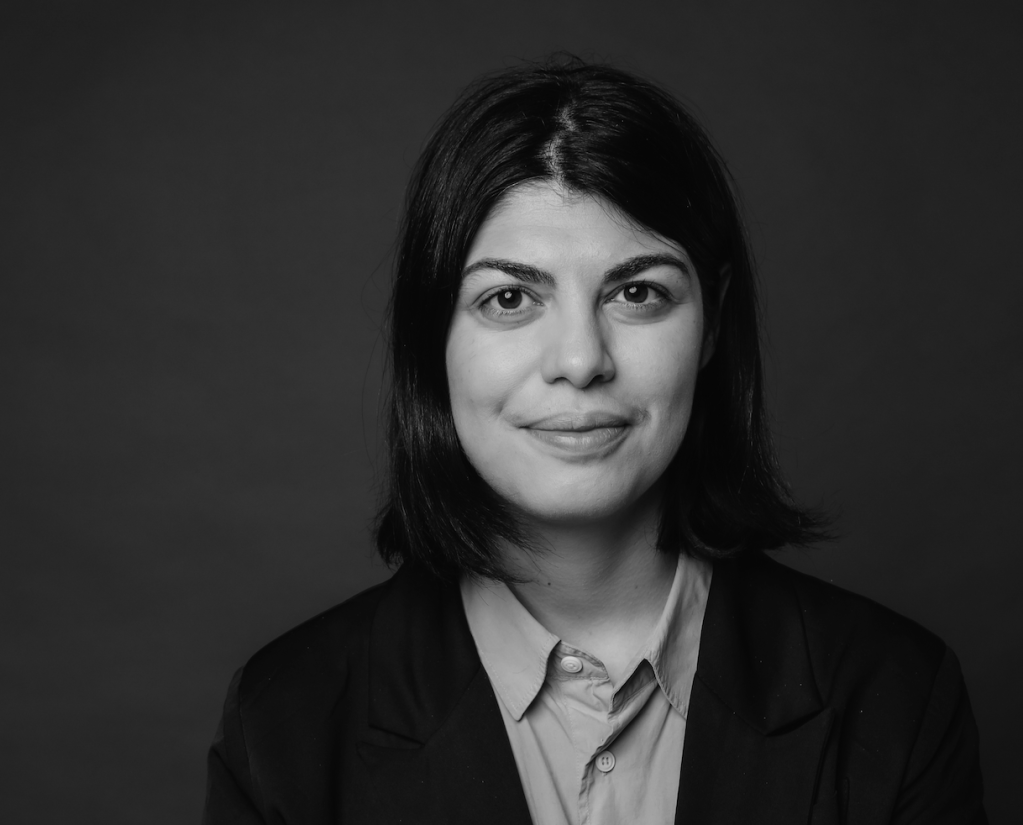
Egana Djabbarova, born in 1992 into an Azerbaijani family in Yekaterinburg, Russia, is a poet, essayist, and scholar. She is the author of several collections of poetry. Having been forced to flee Russia in 2024 because of her LGBTQ activism and opposition to the war in Ukraine, she lives in Hamburg, Germany.

 Punctured Lines