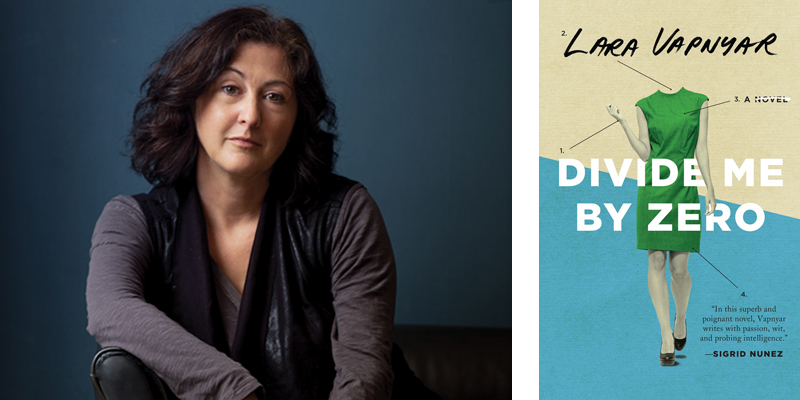
Lara Vapnyar’s Essay: On Being a Cool Parent

*Post updated to include a second excerpt from Vapnyar’s Divide Me by Zero.

In a Facebook post, Lara Vapnyar mentioned that she adapted this touching, lyrical essay into a chapter in her new book, Divide Me by Zero. Read the piece and use Powells.com to order the novel.

Shortly after my mother died, the kids and I established the routine of taking long beach walks about an hour before sundown. We lived on Staten Island then, the long beautiful stretch of Great Kills beach was only seven minutes away by car. My husband and I had separated just a few months before my mother’s death, and all three of us were still reeling from these two blows. David was almost 18 then, Stephanie had just turned 15; I would look at our shadows and see that they were about the same lengths. We looked like three orphaned siblings rather than a mother and her kids.

https://www.powells.com/post/original-essays/on-being-a-cool-parent

An excerpt from a different chapter of Vapnyar’s Divide Me by Zero appears in Lit Hub:

One week before my mother died, I went to a Russian food store on Staten Island to buy caviar. I was brought up in the Soviet Union, where caviar was considered a special food reserved for children and dying parents. I never thought of it as extravagant or a romantic delicacy. My mother would offer me some before important tests in school, because it was chock-full of phosphorus that supposedly stimulated brain cells. I remember eating caviar before school, at seven am, still in my pajamas, shivering from the morning cold, seated in the untidy kitchen of our Moscow apartment, yawning and dangling my legs, bumping my knees against the boards of our folding table, holding that piece of bread spread with a thin layer of butter and thinner layer of caviar.

https://lithub.com/divide-me-by-zero/

On a personal note, this observation about caviar did hold up in my family, in part. When my grandmother was dying, my mother fed her caviar sandwiches. (Before the tests, though, I got a chocolate bar.) I’ve never seen this detail about caviar captured in prose before–it resonates so deeply.
A Soviet YA Classic: Aleksandra Brushtein’s Дорога уходит в даль (The Road Goes off into the Distance)

It is hard to overstate just how much Aleksandra Brushtein’s autobiographical novel about Aleksandra (Sasha) Yanovskaya, a young Jewish girl growing up in Vilna at the turn of the century, was beloved by generations of Soviet children. At a time when I have completely forgotten plots of books I read much later, I can still recall various episodes from this one. A copy of the book, which my family took with us when we left the Soviet Union, is one of my prized possessions. My mom loved this book so much she wanted to name me Sasha (an attempt ended by my great-grandmother Aleksandra’s announcement post my birth that Ashkenazi Jews cannot name children after living relatives). A remarkable thing about this novel is that it has a Jewish protagonist and depicts Jewish life but still became so popular in a country as anti-Semitic as the Soviet Union. Its popularity has endured in contemporary Russia, where “since 2005, a new printing of the book by different publishers has appeared almost every two years,” including an annotated edition.

Yet as Liza Rozovsky’s article notes, Brushtein “is barely known outside the Russian-speaking world.” To date, there is no English translation. If there is a translator out there who could take on this project, many in the diaspora would be eternally grateful on behalf of their children and their English-speaking friends’ children. In any case, it’s great to see this book being written about at length and we — and our inner younger selves — are thrilled to highlight it on Punctured Lines.

“The book that is imprinted in my memory as a moral and political compass, and the book I would like my children to know, is a Soviet-era work for children and juveniles titled “The Road Slips Away into the Distance.” It’s an autobiographical trilogy by the Jewish children’s playwright and memoirist Aleksandra Brushtein, who is barely known outside the Russian-speaking world. The first volume of the work was translated into Hebrew in the 1980s, but Brushtein (1884-1968) remains unknown in Israel, too. In the Soviet Union, where it ran through many editions of tens of thousands of copies each, the trilogy achieved cult status.”

The Novel That Introduced Soviet Jews to Their Forgotten History

National Book Award Finalist: Julia Phillips

A debut novel by Julia Phillips, Disappearing Earth, set on the Kamchatka peninsula, was recently selected as a finalist for a major US book award. It’s one of the five books from which a panel of judges will pick a winner, to be announced at a ceremony on November 20.

Fun fact: the largest active volcano in the Northern Hemisphere, Klyuchevskaya Sopka, is located on Kamchatka. (Apparently, there are 29 active volcanoes there altogether.)

USSR’s Impact on the lives of Muslim Women in Central Asia

Here’s a fascinating study about the role that the Soviet Union played in the lives of Muslim women from Central Asia. This was filed by Özge Öz Döm, a scholar at Yildirim Beyazit University in Anakara, Turkey. Her thesis is that “even though the Soviet officials had a genuine intention for the emancipation of Central Asian women from the patriarchal structure both in the public and private spheres of life, the policies and their implementation were shaped in accordance with the basic motive of regime survival. In the first years of the Soviet regime, mostly ideological intentions shaped the women’s emancipation project. However, in time, the Soviet officials needed to make more reforms in the political, economic and socio-cultural areas not just for the ideological aims such as emancipation of the women, but also for the survival of the Soviet Union.”

Muslim Women in Central Asia

In fiction, I have seen this conflict reflected most directly in Guzel Yakhina’s novel, Zuleikha, recently translated to English by Lisa Hayden. This history also provides useful context for Akram Aylisli‘s work, in particular his trilogy from the 1960s, People and Trees (I read this book in Russian under the title Люди и деревья).

The researcher makes a point in this paper that seems relevant for Punctured Lines: “The studies about women in the Soviet and post-Soviet eras are mostly concerned with the European parts of the Soviet Union, and neglect the Muslim women under Soviet rule. Therefore, the first problem related to the literature regarding Central Asian women is that there are insufficient numbers of studies regarding this area; and the second problem is that the Western scholars studying this subject sometimes fail to understand the meaning of Islamic based customs and traditions to Central Asian women as well as men. So, this study also attempts to make a contribution to gender studies literature regarding Central Asian women “

Yelena Furman on Olga Zilberbourg’s Like Water and Other Stories

“In ‘Rubicon,’ which opens Olga Zilberbourg’s Like Water and Other Stories, the narrator, on her way to pick up her son from preschool, says, ‘spring came on hard and much too early this year, which must be why the dimensions of reality shifted.’ If the story’s realistic beginning gives the impression that this shift is figurative, it soon becomes apparent that reality really does alter: on a street in San Francisco, a young man she knew back in 1990s Russia, who is ‘still seventeen on this day in 2018,’ drives up to hand her a ‘TDK compact cassette, the exact kind he and I used to exchange in high school.'”

http://jordanrussiacenter.org/news/review-olga-zilberbourgs-english-language-debut-like-water-and-other-stories/#.XaItf0ZKiyI  

Yelena Furman on Ksenia Buksha’s “The Freedom Factory”

“A NOVEL ABOUT a Soviet military factory whose workers must eventually adjust to a post-Soviet way of life does not sound like a thrilling read. Yet there’s a very good reason why Ksenia Buksha’s The Freedom Factory (Zavod “Svoboda”) won Russia’s National Bestseller Prize in 2014 (Buksha is only the second of three women to do so since the prize’s founding in 2001) and was also a finalist for the Big Book Award. In the author’s hands, this unpromising raw material is skillfully transformed into a genuinely and unexpectedly compelling narrative.” 

https://lareviewofbooks.org/article/shintity-fug-these-vulstes-on-ksenia-bukshas-the-freedom-factory

Olga Tokarczuk Wins the Nobel Prize

The Nobel winners have been announced and Olga Tokarczuk of Poland has won for 2018 (there was no prize given out last year because the Swedish Academy was mired in a sexual assault scandal; with the announcement of the winner for 2019, it quickly became mired in a genocide denial scandal). Tokarczuk is the author of Flights (trans. Jennifer Croft), which won the Man Booker International Prize in 2018, and Drive Your Plow Over the Bones of the Dead (trans. Antonia Lloyd-Jones; both out from Riverhead Books).

You can read Tokarczuk’s statement about receiving the prize here: https://lithub.com/read-olga-tokarczuks-response-to-winning-the-nobel-prize/

And here is an excerpt from Flights: https://www.asymptotejournal.com/fiction/olga-tokarczuk-flights/

2019 Warwick Prize in Translation, Long List

We congratulate Lisa Hayden, whose translation of Guzel Yakhina’s novel Zuleikha has been included among thirteen books longlisted for the third annual award of the Warwick Prize for Women in Translation. We love this book and we are delighted with this news.

Read the full announcement here.

The list of longlisted titles, in alphabetical order, is as follows:

· Brother In Ice by Alicia Kopf, translated from Catalan by Mara Faye Lethem (And Other Stories, 2018)

· Convenience Store Woman by Sayaka Murata, translated from Japanese by Ginny Tapley Takemori (Granta, 2018)

· Disoriental by Négar Djavadi, translated from French by Tina Kover (Europa Editions, 2018)

· Drive Your Plow Over the Bones of the Dead by Olga Tocarczuk, translated from Polish by Antonia Lloyd-Jones (Fitzcarraldo Editions, 2018)

· Katalin Street by Magda Szabó, translated from Hungarian by Len Rix (Maclehose Press, 2019)

· Negative of a Dual Photograph by Azita Ghahremann, translated from Farsi by Maura Dooley with Elhum Shakerifar (Bloodaxe, 2018)

· People in the Room by Norah Lange, translated from Spanish by Charlotte Whittle (And Other Stories, 2018)

· Picnic in the Storm by Yukiko Motoya, translated from Japanese by Asa Yoneda (Little, Brown Book Group (Corsair), 2018)

· Season of the Shadow by Léonora Miano, translated from French by Gila Walker (Seagull Books, 2018)

· Shadows on the Tundra by Dalia Grinkevičiūtė, translated from Lithuanian by Delija Valiukenas (Peirene, 2018)

· The Years by Annie Ernaux, translated from French by Alison L. Strayer (Fitzcarraldo Editions, 2018)

· Thick of It by Ulrike Almut Sandig, translated from German by Karen Leeder (Seagull Books, 2018)

· Zuleikha by Guzel Yakhina, translated from Russian by Lisa C. Hayden (Oneworld, 2019)

Zhivago’s great passion inspires plagiarism row | News | The Sunday Times

Here’s a bit of upsetting news. The Sunday Times (paywall) reports that Anna Pasternak, the author of Lara, a biography of Olga Ivinskaya, has accused Lara Prescott of plagiarism. Lara Prescott is the author of the recently published novel The Secrets We Kept that in fictional form follows the story of Olga Ivinskaya. Lara Prescott’s publisher is standing by her, and we will follow the story of the legal complaint as it develops, but I feel that the situation is unfortunate on many levels.

The story of Olga Ivinskaya, who was Boris Pasternak’s partner at the end of his life and through the writing of Doctor Zhivago, continues to fascinate writers and readers of Pasternak’s novel, in particular, for its parallels to that of Lara, the character of Pasternak’s novel. Olga Ivinskaya has told her story herself, in her memoir A Captive of Time that was translated to English by Max Hayward and published by HarperCollins in 1979, and there have been a number of retellings since then (not all of them translated to English).

Penguin Random House pointed out that the story of Olga Ivinskaya has been the subject of multiple books before Anna Pasternak’s, including Ivinskaya’s 1978 autobiography, a book by her daughter Irina Emelyanova, and Peter Finn and Petra Couvee’s 2014 book The Zhivago Affair.

https://www.theguardian.com/books/2019/oct/01/lara-prescott-doctor-zhivago-boris-pasternak-plagiarism-penguin-random-house

One of the reasons I find the legal complaint unfortunate is because it carries on the notes of scandal and sensationalism, associated with Doctor Zhivago from the beginning. I fear that the book and the nuance of the stories of the women behind it get lost in the fray.

On the other hand, given this interest to her story, I do hope that Olga Ivinskaya’s book might see a new English-language edition. And, perhaps, an enterprising English-language writer will take up Zinaida Pasternak’s story. If we’re writing the story of the affair, Zinaida’s side of it is no less captivating than Olga’s.

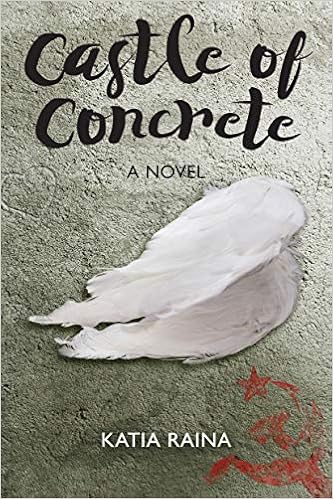
New Book: Katia Raina’s Castle of Concrete

Thanks to Lea Zeltserman and her Soviet Samovar newsletter for the mention of this novel. This is labeled as “Young Adult,” which means might fly under the radar when I look at reviews of contemporary fiction. This also means, it might be a gripping and fast-paced read. The description and preview of the first few pages are certainly promising.

Sonya is a daughter of a “dissident poetess moneyless famous jobless” mother, who had nearly aborted her. Jewish, too–being Jewish in the Soviet Union seems to be a major theme of this book. The novel takes place just before the collapse of the Soviet Union, and emigration looms large. Sounds both familiar and intriguing.

Publisher: Young Europe Books

Agent: Jessica Regel