When I’m Out of Here: Staying Human in a Dictator’s Jail, by Hanna Komar

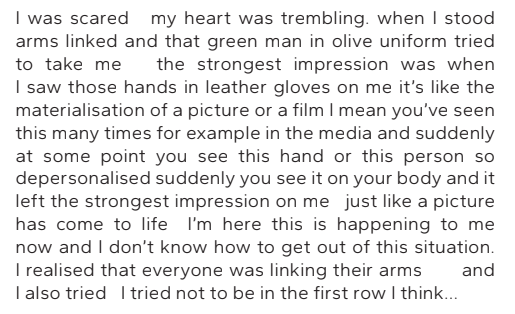
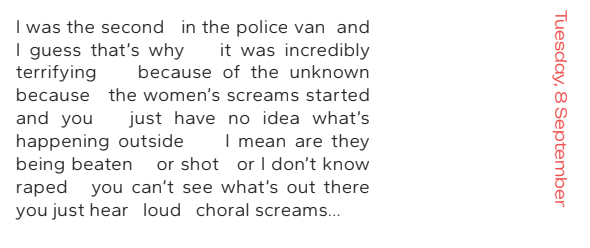
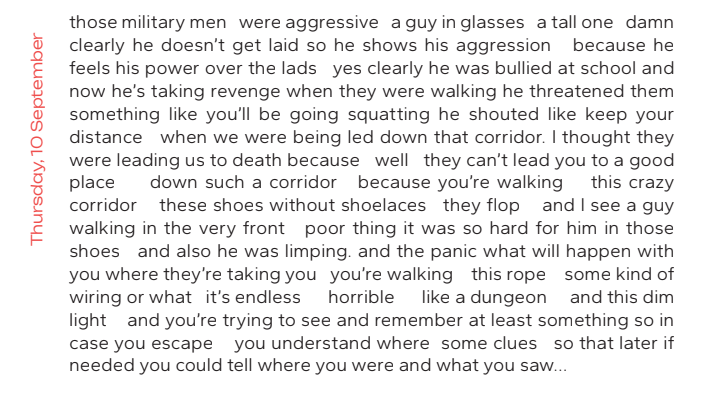
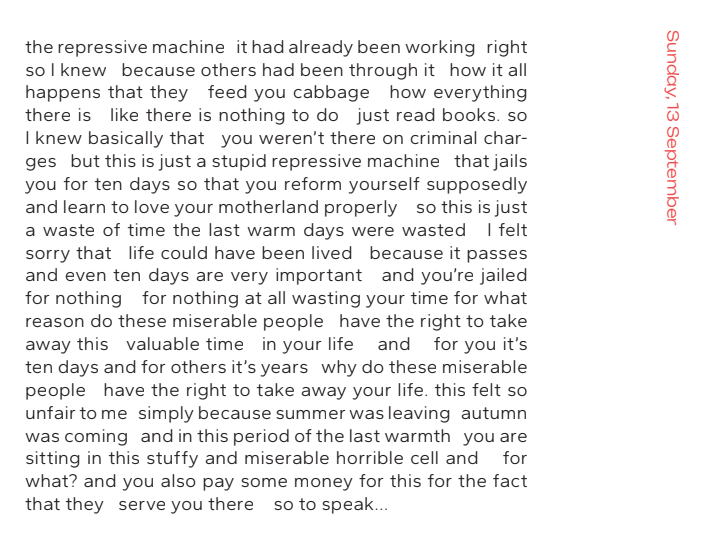
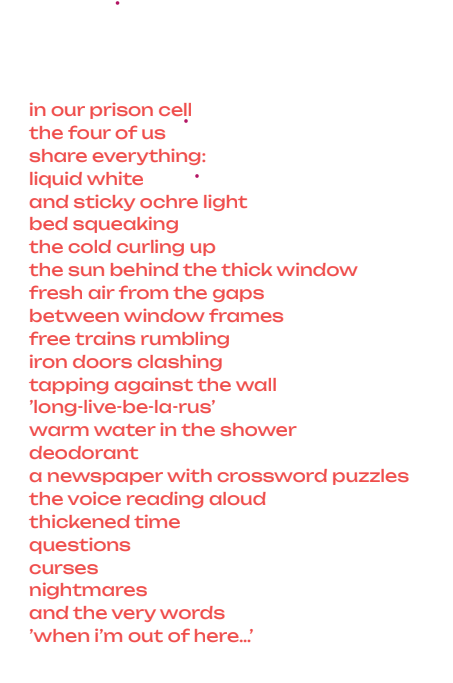
Today on the blog we are featuring excerpts from Hanna Komar‘s When I’m Out of Here: Staying Human in a Dictator’s Jail, translated by Hanna Komar and John Farndon (Skaryna Press, 2026). The book is an account of her arrest and imprisonment during the mass protests in Belarus in 2020 against fraudulent election results and in support of the recently arrested pro-democracy activist Maryia Kalesnikava. As Komar says in the Foreword, “I had to tell this story. But telling only my own story felt wrong […] At that time, I read The Unwomanly Face of War by Svetlana Alexievich. And so I began to collect voices, as she did.” Thus, Komar writes this book as a series of different “voices” representing both herself and others who were imprisoned along with her, as can be seen below; my heartfelt gratitude to Olga Zilberbourg for reproducing and editing screenshots that preserved the book’s layout. You can buy the book from Skaryna Press in English here, and if you are a Belarusian speaker, here, along with many other Belarusian-language titles. For those of us outside Belarus, buying books like Komar’s When I’m Out of Here is a way to show support for these writers and the larger movement they are a part of for a free Belarus.

Hanna Komar, When I’m Out of Here: Staying Human in a Dictator’s Jail

Foreword

And so I wrote…

To understand — my own experience, and myself as part of the collective one.

In Belarus, the same dictator, Aliaksandr Lukashenka, has been in power for over 30 years, since 1994. The fraudulent presidential election on 9 August 2020 was followed by the largest mass peaceful protests in Belarusian history, met with unprecedented police brutality and systemic repression. At the time of this publication, over 1,200 political prisoners remain behind bars. Over 8,000 individuals have faced politically motivated criminal prosecution, and over 50,000 have experienced arbitrary detentions. All of them have been subjected to ill-treatment; psychological, physical and sexual violence; torture and other inhumane conditions. I was one of the 50,000. This is my story.

I was detained on 8 September 2020. It was when we were marching in support of Maryia Kalesnikava and other activists detained around that time. The extraordinary Maryia Kalesnikava was a professional flautist who became the head of Viktar Babaryka’s presidential campaign, and was one of the key figures of the fight against Lukashenka. Our march happened right the day after Maryia was suddenly kidnapped in the centre of Minsk by unidentified law enforcement officers. During the night, they took her to the Belarusian-Ukrainian border to deport her forcibly. But at the border crossing, Maryia tore up her passport, got out through the car window and walked towards the Belarusian border. They took her to prison and after a “trial” a year later condemned her to 11 years. Maryja was released on 13 December 2025.

Later in the day of the border incident, protesters gathered at various locations in Minsk in support of her. The march I attended was the largest. We were surrounded by the security forces which came out in large numbers, armed and masked, to break up the protest. By the evening, more than a hundred marchers had been grabbed forcibly and thrust into police vans to be taken off to prison — many of them women, including me. The targeting of women like that was new and seemed a turning point for us. After that, mass detentions of women were common at every women’s protest.

After a cold anxious night at a Pieršamajski police department, I was brought before a court the following day, still hoping for some justice. With little evidence but the police statement, the so-called court sentenced me to nine days of administrative arrest. I spent two days in Akrescina prison and then was transferred to the prison in Žodzina, where I received a care package from my friends outside. In that package, my flatmate and ally Alena included a little notebook, so, I kept a diary of my time in prison. It was difficult, but I forced myself to write down something — anything — even just dry observations and facts. Activities. Details. Thoughts. This was my way of finding meaning in what was happening. “You are a poet, a writer,” I thought to myself, “you are here anyway, and this is a unique experience: you can see this place, the one you’ve heard so much about, from the inside. You must write about it.”

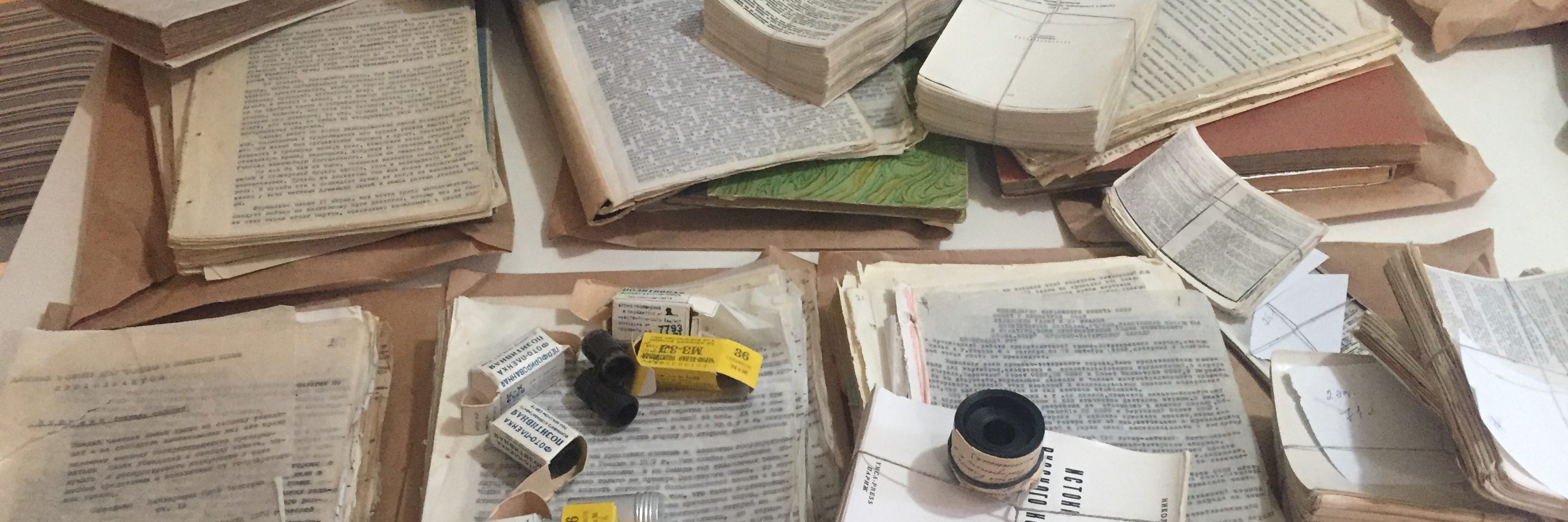
At first, I imagined this would be a slim book about my own experience, but for six months after my release, I couldn’t even open that notebook. Then, on the day the court sentenced the journalists Katsiaryna Andrejeva and Darya Chultsova to two years in prison, I realised that as long as I was free, I had no right to remain silent. I had to tell this story. But telling only my own story felt wrong. I was also at a loss for words — my psyche refused to let me go deeper. At that time, I read The Unwomanly Face of War by Svetlana Alexievich. And so I began to collect voices, as she did.

[…]
[…]
[…]
[…]
[…]
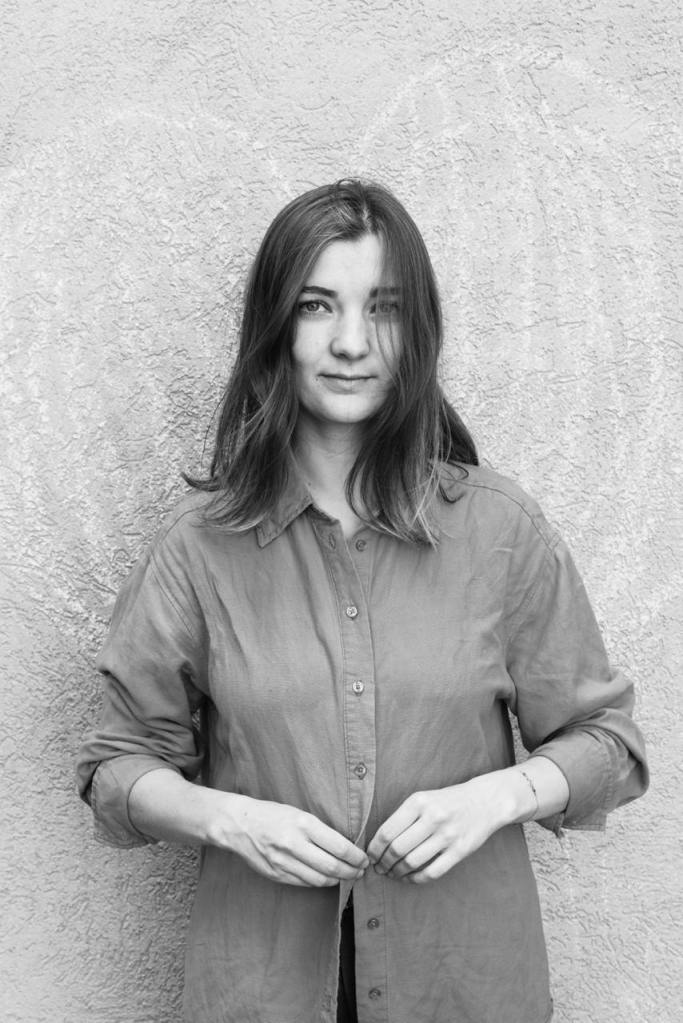
Hanna Komar is a Belarusian poet, translator, writer, and performer, whose work explores what it means to grow up as a girl — and later a young woman — in a strongly patriarchal, authoritarian country. Much of her writing comes from her own experience, trying to give voice to what is often left unsaid or unspeakable. She has published five poetry collections: Страх вышыні (Fear of Heights), the docupoetry book Мы вернемся (We’ll Return), and Вызвалі або бяжы (Set Me Free or Run) in Belarusian, and the bilingual collections Recycled and Ribwort. She is also the author of the non-fiction book When I’m Out of Here: Staying Human in a Dictator’s Jail, which reflects on the collective experience of incarceration for peaceful protest in Belarus, and the play Body in Progress, about the cruelty of the Belarusian regime, exile, and her journey of healing. Her work has been translated into Polish, Ukrainian, Swedish, Norwegian, German, Czech, Lithuanian, Slovenian, Danish, Italian, Russian, and Slovak, and she translates her own poetry into English. She is a member of PEN Belarus and an honorary member of English PEN. In 2021, she was a joint recipient of the Freedom of Speech Prize from the Norwegian Authors’ Union. She has an MA in Creative Writing: Writing the City from the University of Westminster and is completing a PhD exploring how poetry can support Belarusian women in sharing experiences of gender-based violence and patriarchy.

Q&A with Masha Rumer: Parenting with an Accent (forthcoming from Beacon Press)

Today on Punctured Lines, we have a Q&A with Masha Rumer, author of Parenting with an Accent: An Immigrant’s Guide to Multicultural Parenting, whose arrival we previously announced here and are very excited about. Masha answered our questions by email.

Punctured Lines: Describe, briefly, your process in writing this book.

Masha Rumer: My decision to write the book was pretty simple: I wished there was something like that when I became a parent, and since there wasn’t, I figured I’d write it. I was born in Russia and my partner was born in the U.S., so in addition to navigating differences common to a multicultural relationship, having a baby brought up questions, nostalgia and my awareness of straddling multiple cultural identities. How do I teach my kids Russian, without forcing it?  How do I connect with other parents, even if I lack certain shared childhood experiences? Is a peanut butter sandwich an acceptable meal? How much borscht is too much? The more I spoke to others, parents or not, the more I realized that these concerns are very much shared, but people don’t always feel comfortable discussing it.

Surprisingly, I found no nonfiction book about the contemporary immigrant parenting experience, even though there is a record high of 43 million immigrants in America today and over 18 million kids with at least one foreign-born parent.

I realized there needs to be a research-driven, accessible look at what it’s like for immigrants to raise kids in the U.S., not a “how-to” parenting manual, but a realistic portrait of sorts. The book will have a bit of everything: candid conversations with families across the U.S., personal narrative and interviews with experts in psychology, language development and sociology. And beets. Lots of beets.

PL: What is your relationship with contemporary Russian literature? Who are some of the writers that inspire you?

MR: I really wish I’d read more contemporary Russian literature, but a significant chunk of my reading is in English (unless we’re talking news or kid lit – I try to read Russian books with my children daily). That said, I’ve recently been enjoying the work of Dina Rubina and of the investigative journalist Svetlana Alexievich, and have been getting into translation more (just finished a delightful Russian translation of A Man Called Ove [PL: This Swedish title by Fredrik Backman has also been translated into English]).

PL: Do you find yourself working against some Russian cultural stereotypes?

MR: Sometimes I find myself dodging jokes about being a spy, especially in the wake of the 2016 presidential election (I’m not a spy). I’ve also been questioned whether I came to the U.S. “on my own” and “with papers” or if my husband ordered me via a catalog. The people who ask are demure and almost apologetic, but they want to know. Recently, though, a job recruiter was pretty explicit about questioning my immigration status and any political connections. And something many female-identifying Russian speakers have probably experienced – there’s often an assumption that our closets have this secret compartment where we stash sable fur coats and leather outfits from a James Bond movie.

PL: As a writer who addresses stories of immigrant families, do you find yourself connecting with other diaspora writers?

MR: I definitely find myself connecting with other diaspora writers. It’s probably due to the shared immigrant experiences of reinventing and translating yourself and the trauma of having been uprooted. I love the work of Lara Vapnyar and Dinaw Mengestu; they both write so incisively and honestly about diaspora realities. Eva Hoffman and Jhumpa Lahiri were among the first contemporary immigrant authors I read, and it felt so validating. Then there’s the work of Edwidge Danticat, Anya Ulinich and Natalia Sylvester, particularly her recent essay on being bilingual, and the Foreignish blog, run by Yaldaz Sadakova. I’m also excited to read the new collection Like Water by Olga Zilberbourg. It’s thrilling to see that the contemporary immigrant narratives are no longer othered as “niche,” but are becoming a part of the “mainstream” literary canon. 

Notable Books: Russian Titles in English Translation, 2009-2019

The impetus for creating this post came from a recent Twitter discussion. We at Punctured Lines decided to accept a dare and came up with a list of notable Russian titles available in English translation from the last decade. This has been an opportunity to take stock of the years 2009-2019, both to remember the books we’ve read and to look back at those that we might have missed.

In this task, we relied heavily on Lisa Hayden’s blog, Lizok’s Bookshelf, where Lisa keeps chronological track of the English translations – our deep gratitude for creating and maintaining this resource. Our methodology for choosing among all those works was based on several factors. Rather obviously, for our purposes we only considered works by women. We also wanted to highlight writers whose names may not be very familiar to English-speaking readers but whose work we feel deserves wider exposure and shows the range of contemporary Russian women’s literature.

For this reason, we chose not to include writers who are well-known in the Anglophone world, but of course we love them too. We note proudly the women whose work has been translated into English numerous times: Anna Akhmatova, Svetlana Alexievich, Eugenia Ginzburg, Ludmilla Petrushevskaya, Dina Rubina, Olga Slavnikova, Marina Tsvetaeva, Ludmila Ulitskaya, and Tatyana Tolstaya (whose problematic views on women and feminism may be less known).

One or both of us have read many of titles below, and we’re happy to report that the field is larger than our reading capacity. We included a few books we haven’t read because they sparked our curiosity and to encourage ourselves and our followers to return to these publications. An important factor for consideration was translators whose work we’re interested in. Here we would like to say a huge thank you to translators for their often unacknowledged efforts that allow English speakers to know Russian literature.

Our list has four categories: Contemporary Prose, Contemporary Poetry, Recent Translations of Earlier Prose Works, and a rather catch-all Drama, a Graphic Novel, and an Anthology. The titles in each category are given chronologically by year of the translation. This list reflects our personal opinions and is in no way meant to be comprehensive or conclusive. We welcome your comments and suggestions about these and other titles by Russian women who you think should be on this list. This is, hopefully, the beginning of that conversation.

Contemporary Prose

Elena Chizhova, The Time of Women, translated by Simon Patterson and Nina Chordas; Glagoslav, 2012. 

Linor Goralik, Found Life: Poems, Stories, Comics, a Play, and an Interview, edited by Ainsley Morse, Maria Vassileva, and Maya Vinokur; Columbia University Press, 2017.

Ksenia Buksha, The Freedom Factory, translated by Anne Fisher; Phoneme Media, 2018.

Alisa Ganieva, Bride and Groom, translated by Carol Apollonio; Deep Vellum, 2018.

Margarita Khemlin, Klotsvog, translated by Lisa C. Hayden; Columbia University Press, 2019.

Guzel Yakhina, Zuleikha, translated by Lisa C. Hayden; Oneworld Publications, 2019.

Contemporary Poetry

Anzhelina Polonskaya, Paul Klee’s Boat, translated by Andrew Wachtel; Zephyr Press, 2012. 

Polina Barskova, Anna Glazova, and Maria Stepanova, Relocations: Three Contemporary Russian Women Poets, translated by Catherine Ciepiela, Anna Khasin, and Sibelan Forrester; Zephyr Press, 2013.

Maria Rybakova, Gnedich, translated by Elena Dimova; Glagoslav, 2015.

Inna Kabysh, Blue Birds and Red Horses, translated by Katherine E. Young; Toad Press, 2018.

Aigerim Tazhi, Paper-Thin Skin, translated by James Kates; Zephyr Press, 2019.

Olga Livshin, A Life Replaced: Poems with Translations from Anna Akhmatova and Vladimir Gandelsman, Poets & Traitors Press, 2019.

Recent Translations of Earlier Prose Works

Teffi, Memories: From Moscow to the Black Sea, translated by Robert Chandler and Elizabeth Chandler, Anne Marie Jackson, and Irina Steinberg; NYRB Classics and Pushkin Press, 2016.

Sofia Khvoshchinskaya, City Folk and Country Folk, translated by Nora Seligman Favorov; Columbia University Press, 2017.

Olga Berggolts, Daytime Stars: A Poet’s Memoir of the Revolution, the Siege of Leningrad, and the Thaw, translated by Lisa A. Kirschenbaum; University of Wisconsin Press, 2018.

Doba-Mera Medvedeva, Daughter of the Shtetl: The Memoirs of Doba-Mera Medvedeva, translated by Alice Nakhimovsky; Academic Studies Press, 2019.

Karolina Pavlova, A Double Life, translated by Barbara Heldt; Columbia University Press, 2019.

Irina Odoevtseva, Isolde, translated by Bryan Karetnyk and Irina Steinberg; Pushkin Press, 2019.

Drama, a Graphic Novel, and an Anthology

Yaroslava Pulinovich, Olga Rimsha, Ksenia Stepanycheva, Ekaterina Vasilyeva, Russian Drama: Four Young Female Voices, translated by Lisa Hayden; Glas, 2014.

Victoria, Lomasko, Other Russias, translated by Thomas Campbell; Penguin and n+1, 2017.

Teffi, Marina Tsvetaeva, Anna Akhmatova, Lydia Ginzburg, Galina Scherbakova, Ludmila Ulitskaya, Svetlana Alexievich, Olga Slavnikova, Irina Muravyova, Ludmila Petrushevskaya, Margarita Khemlin, Slav Sisters: The Dedalus Book of Russian Women’s Literature, edited by Natasha Perova; Dedalus, 2018.

An encounter with Svetlana Alexievich through the eyes of her Spanish translator: an essay in World Literature Today

Jorge Ferrer and his English translator Jacqueline Loss, writing for World Literature Today, offer us an interesting glimpse of Svetlana Alexievich’s reception in Spain. Ferrer was born in Havana and now lives in Barcelona and translates Russian-language writers, including Svetlana Alexievich, into Spanish. I love knowing that a character from Secondhand Time has a life of her own on the stage of a Barcelona theatre.

I’m just going to simplify the problem for us to understand: (1) A Belarusian writer who operates by means of a method usually called “novel of voices” includes in a book a woman’s testimony; (2) An actress reads that testimony in Spanish translation, falls in love with the witness, takes that text to the theater, and constructs, in a parallel manner, a life in the real and digital worlds; (3) The actress asks the translator of the original text into the language in which she represents the character to write a new monologue for the witness, that is, to take her out of the realm of reality and transport her into fiction—from being a person, to turn her into a character and, instead of translating the life transcribed for her, write a future life for her.

https://www.worldliteraturetoday.org/2019/autumn/date-svetlana-alexievich-berlin-or-smuggling-bugs-soviet-moscow-jorge-ferrer

Beyond the encounter with Alexievich herself, Ferrer takes us on several delightful tangents in this essay. This piece feels particularly appropriate this week, when we’re celebrating the 30th anniversary of the fall of the Berlin wall.