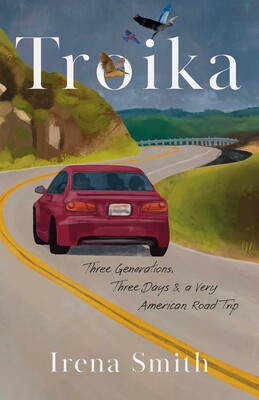
It is our pleasure to present a conversation between Alina Adams, whose writing has been featured several times on Punctured Lines (here and here) and Irena Smith, whom we welcome for the first time. They happened to have crossed paths as newly arrived immigrant children in the U.S., and now they both have come out with new books. Alina Adams is the author of Go On Pretending (History Through Fiction, 2025; her essay about it is on the blog). Irena Smith is the author of Troika: Three Generations, Three Days, and a Very American Road Trip (She Writes Press, 2026). I met her earlier this year at her reading of Troika at LA’s beloved independent bookstore Book Soup; the reading was hosted by Prof. Lilya Kaganovsky, the chair of our department at UCLA, and as it turns out, Irena’s close friend from childhood. Alina and Irena conducted the conversation over Zoom and transcribed it, and it was edited for clarity and expanded in parts.
“This Bone-Deep Memory of Movement”: A Conversation between Alina Adams and Irena Smith
Alina Adams: In a complete coincidence, you and I both ended up writing books about a grandmother, a mother, and a daughter on a road trip. In your memoir, Troika: Three Generations, Three Days, and a Very American Road Trip, a three-day journey to California’s central coast with your mother and grown daughter becomes a mini-Odyssey complete with dangers, obstacles, and beguiling distractions—not to mention a hefty dose of family history in Soviet Russia, as well as the United States.
In my most recent novel, Go On Pretending, there is also a road trip involving Rose, an American-born grandmother who immigrated to the Soviet Union as a young idealist with her African-American husband, her Soviet-born daughter, and her American-born granddaughter, except their road trip is in a war zone in Rojava, an autonomous region in Syria. And in fact, my previous novel, My Mother’s Secret, A Novel of the Jewish Autonomous Region, was also about a mother and daughter, two generations rather than three, going to the Soviet Union to see if they can find out what happened to the daughter’s father, who disappeared at the end of The Great Patriotic War.
My background is in writing for and about soap operas, so I naturally gravitate to multi-generational family sagas and all the family drama that emanates from that. I write about Soviet immigrants because of that whole “write what you know” advice that they give you the first day of creative writing class, and I write about families moving from place to place because I have never felt settled anywhere. There was one year, 1994, when I lived in three different major cities. And, even though I’ve lived in New York City for a little over 30 years now—longer than I have ever lived anywhere else—I still feel like a visitor, like it will never be “my” city. My characters feel the same way, especially in Go On Pretending, where everyone is looking for that perfect utopia. Rose does it by leaving America for the USSR. Her daughter, Emma, does it by leaving the USSR for America, where she and her husband go through a variety of political parties without ever settling down, and their daughter, Libby, does it by going to the women’s communes of Rojava, Syria. Everyone is hitting the road to find a utopia that doesn’t exist. Which isn’t quite the same as your California road trip, but close enough! I’m curious why you think both of us keep returning to these themes?

Irena Smith: I suspect there’s something about being uprooted from the place where you were born and grew up and moving to a different continent. My parents and I left the former Soviet Union in 1977, when I was nine years old; at the time, the only way Jewish families could emigrate was to receive a vyzov—a summons, basically—from relatives in Israel so they could claim that they wanted to repatriate. If the USSR granted them an exit visa (which was in no way a sure bet), they would travel to Vienna, at which point they could decide to actually proceed to Israel or to choose another destination. At the time, the options were: the United States, Australia, or Canada, and families who chose the U.S. then had their paperwork processed by the Hebrew Immigrant Aid Society (HIAS) and travelled to Italy, where they waited for their petition for political asylum to be granted by the U.S. government.

This experience, common to many Russian-Jewish émigrés of our era, probably forms some of our core memories. And obviously it does something to a person’s psyche when not only are they picked up and moved over large distances and multiple cultures but also across multiple languages. So I think that sticks with you. And then as you grow up, you come to realize that your core story is that you’re an immigrant, you’re a child of immigrants, and then on top of that you grow up with familial stories—presumably, your family has them too—of evacuations, upheavals, disappearances. While writing Troika, I quickly realized that apart from chronicling the story of our short American road trip, I was also trying to answer a bigger question: specifically, “Why are we like this?” Why does my father insist on giving me a CB radio as we set out in a rainstorm even though we all have cell phones? Why did my grandmother call and leave plaintive voicemail messages about where we could be in such weather, even if the weather was 72 degrees and sunny? Why am I always imagining the most catastrophic possible outcome—and at the same time, why did I insist on embarking on the trip in the middle of a severe winter storm?
I think the main theme I wanted to explore was how—and why—people move through space and time, both voluntarily and involuntarily. And because I spent many years studying literature, I also brought in literary references to travel and transit—most prominently, The Odyssey, but also Ilya Il’f and Yevgenii Petrov’s delightful 1937 travelogue Roadside America, as well as my dissertation about Henry James and Vladimir Nabokov, writers whose relation to America was not entirely American (the former was an expatriate by choice, the latter an immigrant by necessity). I think you strike a similarly peripatetic note in Nesting Dolls, which moves from Odessa to Siberia, back to Odessa, and finally Brighton Beach, and in My Mother’s Secret, whose characters move from Stalinist Moscow to Birobidzhan and eventually escape to San Francisco. And of course there’s such a strong theme of movement in Slavic and Soviet-Jewish culture and literature—migration, invasion, evacuation, flight, going all the way back to Genghis Khan.
This sort of restlessness, this bone-deep memory of movement, whether by choice or by necessity—I think that that gets passed on generationally. And since we were both young when we left, we didn’t get a lot of say in where, or whether, we were going.
Alina Adams: My nephew had to do an immigration project. He’s in fourth grade, and he interviewed me. The question he’d been given by the school was, why did you leave? And my answer was, I was seven years old. I had no say in the matter. I don’t know about you, but I had no idea A) where we were going, or B) that we were leaving for good.
So the answer to my nephew’s question, “Why did you leave?” is basically, “Because I was picked up and moved.” My sister-in-law, who was listening to the interview, said to my nephew, who’s nine, “Oh, we would have definitely told you.” And I was like, “No, you wouldn’t.” My parents were terrified I would tell somebody. So not only did I not have any say in whether we were leaving, but I didn’t even know we were leaving. I didn’t understand why my grandparents were hysterically sobbing.
For context, we left in 1976, going through Vienna and Rome, and arrived in the U.S. in 1977. At the time, nobody had any idea that the Soviet Union was on its last legs, that there was a little over a decade to go. And the fact is, the way the Soviet government worked, the border could have shut at any minute and my grandparents might have never seen either of their children or grandchildren again. I think that’s why, in my books, I have this ongoing theme of characters having to make very binary decisions: If I do this, then my life will be this. If I do that, then my life will be that.
If I may get pretentious here for a moment: I am always lecturing my children that “F. Scott Fitzgerald said, ‘There are no second acts in American lives.’ He couldn’t have been more wrong. America is ALL second acts. People COME to America for the second acts. And the third, fourth, and fifth acts, too. In America, if you make a bad decision, you have so much more opportunity to go back and fix it, or to start again from the beginning.” It’s in a place like the USSR where one decision closes so many doors.
I suspect my early childhood experience of only moving forward, without looking back, colors so much of my writing and my characters’ experiences. My younger son helped my parents pack up and move from the house they’d lived in for almost forty years. “As the car drove away,” he reported to me, “they didn’t look back even once.” My characters never expect to look back, so they completely block the past out of their minds. Unlike most people, where leaving is the trauma, for my characters, it’s being forced to look back on what they left that becomes the defining moment of their stories.
Irena Smith: I had exactly the same experience as you in terms of not knowing we were immigrating. I was nine when we left and my greatest ambition was to become a young Pioneer and get the red scarf, and my parents, who were not stupid people, also kept from me, a burgeoning Soviet patriot, that we were leaving.
Alina Adams: I will see your red scarf, and I will raise you September 1. We left the Soviet Union on September 20th. What happens on September 1st? First day of school. I was seven, so this would have been первый раз в первый класс [going to school for the first time – PL]. It was very exciting. I had the standard Soviet school uniform with the lace collar and the cuffs, but my parents decided it wasn’t worth it to send me to school for three weeks. So everybody’s out in their uniforms with the bows bigger than their head, and I am sitting at home like the village idiot, with no idea why.
Irena Smith: There’s some hardcore trauma right there for your parents to account for. In my case, my parents and I had a very memorable conversation on the subject, which I recounted in Troika. My parents were selling off the furniture, packing suitcases, various grandparents were crying, and I had my suspicions that something was afoot because I was a very perspicacious nine-year-old. So I announced to my parents, “I know where you’re going. You’re going to Israel.” I had no idea where Israel was, or what it was, but it was literally the most dangerous word I knew, and I figured now’s the time to bust it out.
And my parents looked completely shocked, so I followed that up with, “Well, wherever you’re going, I’m coming with you!” And they were like, “Oh, yes, totally.”
Alina Adams: So did you actually really think your parents would leave without you? Because I’m always living in terror that people are going to leave me. To the point where if I’m in a supermarket with you and you walk away into another aisle, it’s like, oh, well, I’ll never see her again. That’s sort of my default. My oldest son loves to say, let’s unpack that trauma. And my response is always, “Let’s not, and I’m sure being moved over two continents in one year had nothing to do with it.”
Irena Smith: I don’t have that level of anxiety, but I think there’s something about emigration that spikes anxiety and hypervigilance in pretty much everyone. Plus, I grew up with grandmothers for whom worrying was basically a professional occupation.
Alina Adams: Lifestyle choice. I like to call it a lifestyle choice.
Irena Smith: Here’s what’s interesting: my mom has an extraordinary amount of guilt for not telling me that they were emigrating. And I feel exactly like you do in that conversation with your nephew. You would have to be some kind of stupid to tell your patriotic Soviet child that you’re leaving.
And my father has an extraordinary amount of guilt because I had a wind-up stuffed rabbit with a little drum that we had to leave because we were only allowed to take four suitcases and it was more important to bring things that were necessary for survival rather than toys. But to this day, my father is tormented about this rabbit. And actually, a couple of days ago he called me and said, “I was thinking that we didn’t bring the stuffed rabbit with the drum, and as a result of that loss, you became a writer. If we had brought the stuffed rabbit, you might have become a drummer.”

Alina Adams: It’s so interesting that you brought up the stuffed animal. When we left the Soviet Union, I had this stuffed bear. I had that bear with me through Vienna, Italy, New York. In New York, we spent the night in a hotel because everyone had to stop over in NYC, regardless of where we were ultimately going. And then the next day we were supposed to fly to San Francisco. We’re at the airport, and the teddy bear is gone.
I actually have no memory of this, but my mother says I went to the corner and just stood there with my face to the wall. I wasn’t screaming, I wasn’t complaining, I had clearly hit my limit. So my father, who otherwise is a rational, reasonable man, sneaks away from the group, goes out of the airport back to the hotel, and eventually digs it out of a massive pile of linen in the laundry room. I don’t remember anything until my father shows up again with the bear in his hands. That’s how blacked out I was. So, it’s very interesting that your father has been thinking about the rabbit.
Later, my mother said to me, “Do you think we’re stupid? You think we thought that the bear was just a bear? Or is it that the bear pretty much stood for everything in that moment?”
Irena Smith: Right. It’s like, you have lost your language, your culture, your homeland, literally everything. So, of course, the bear or the rabbit or whatever becomes this synecdoche for all the loss and our attempts to replace what has been lost.
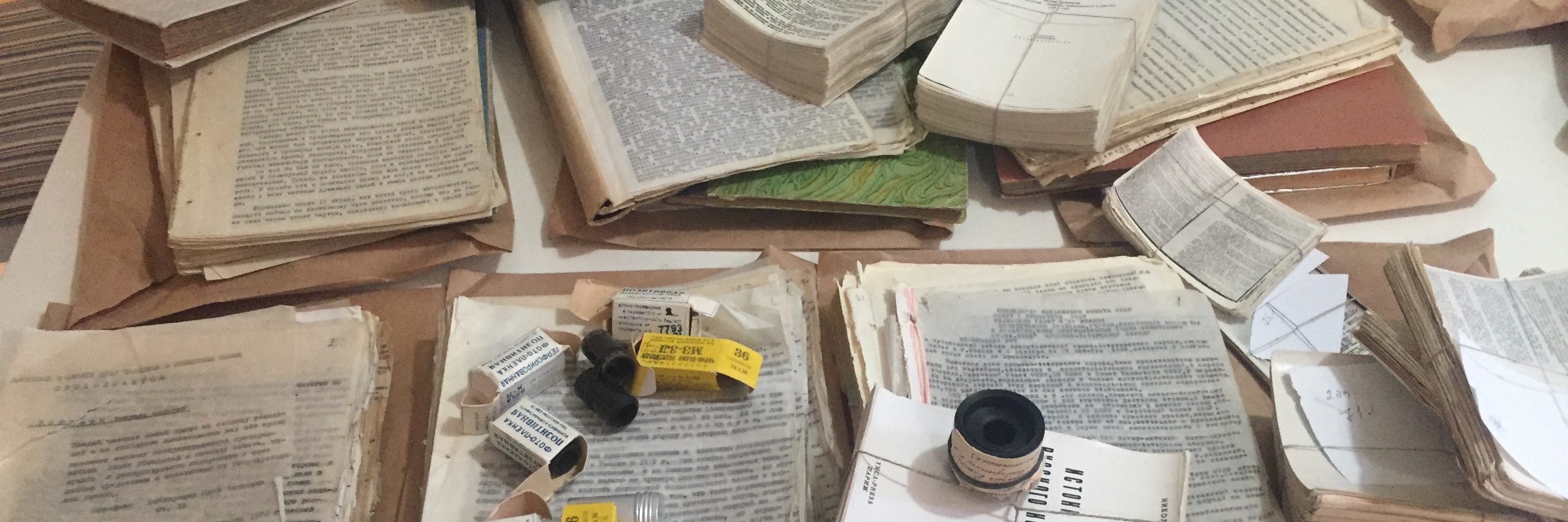
To this day, the four suitcases with which my parents and I left the Soviet Union remain a central part of our family story; in Troika, I wrote about the fact that three of the suitcases were filled with essentials and one was filled with kitschy Russian souvenirs and boxes of Cuban cigars that my parents sold at the flea market in Rome to supplement the stipend we received from HIAS. Each wave of Soviet-Jewish émigrés advised the wave that followed to bring these items to sell, so the flea market—called “The Americana” for reasons I still don’t know—was practically overrun by Soviet Jews selling lacquered wooden boxes and spoons and matryoshka dolls and cigars and little tins of caviar.
One of the things I’ve realized in writing about my family history is how much our relationship with objects is shaped by dislocation, exile, or emigration. My paternal grandmother was evacuated from Odessa with my infant father in summer of 1941, and the only story about the war that she repeated again and again was how she washed my father’s diapers and, whenever the train stopped, strung a clothesline between train cars. One night, one of the train cars was uncoupled and went elsewhere, snapping the rope and taking all the diapers with it—after which, my grandmother claims, she taught my four-month-old father to pee in a tin can.
When you have to pick up and go, what you bring with you and what you leave behind assumes so much weight. Interestingly enough, that particular grandmother was an epic minimalist, whereas my maternal grandmother never missed senior discount Tuesday at Ross Dress for Less and was an enthusiastic collector of tchotchkes, including miniature shoes. As much as I wish I could be more like my paternal grandmother, I think I’ve inherited my maternal grandmother’s compulsion to keep things. To this day, I have an incredibly hard time letting go of sentimental objects or mementos.
Alina Adams: As Freud would say, sometimes a bear is not just a bear.
So let me ask you, when you were taking this trip with your mother and your daughter, and then when you were writing about this trip with your mother and your daughter, did everything take on heavier meaning? Was the trip more than just the trip?
Irena Smith: First of all, there’s this great Russian word зациклиться, which, as you know, is when you become completely obsessed with something. In my case, I was obsessed with going on the trip because I had never been on a road trip with my mother or my daughter. We had always traveled as a family—my mother, my father, and me (the original troika), or my husband and me, or my husband, me, and our children. But this particular configuration—three women in a car for three days—was brand new, and it felt like an incredible opportunity to learn more about each other. I had this idyllic vision of how it would go—good weather, beautiful scenery, a stop in Carmel, camaraderie in the car—and I was dead set on going even though our departure date coincided with one of the most severe winter storms in decades. The day before we left, the storm brought down a pier in Santa Cruz, there was a water tornado off the Sonoma Coast, plus widespread flooding and road closures (including Highway 1, so no stops in Carmel for us) and still, I was like, “Nope, we’re going.”
For reasons I can’t fully explain to this day, it felt like more than an ordinary trip from the very beginning. Our original destination was Bruce Munro’s outdoor light installation in Paso Robles—which features tens of thousands of solar-powered lights scattered like flowers over rolling hills—but as we were planning our itinerary, we tacked on Solvang (thereby adding a 200-mile loop to the trip), solely because both my grandmothers had been there decades earlier and came back raving about what a quaint and delightful town it was. So the grandmothers featured in the stories my mother and I shared with my daughter as soon as we began driving, and honestly, the whole trip was a distillation of generational dynamics. Like, the way my mother was raised (as a Soviet child) and the way I was raised (as a partly Soviet and partly American child, though probably leaning Soviet) was very different from the way my daughter was raised, and navigating expectations and conflicts and misunderstandings—not to mention very different cultural registers—was not always easy. At one point, my mother was horrified at my daughter’s messiness and proceeded to whisper-yell at me in Russian about it, which is a very Soviet thing to do; at various other instances, we realized we were operating with different vocabularies (my mother still doesn’t understand what a meme is; my daughter still doesn’t fully understand the concept of toska). And yet we also bonded deeply, developing our own shared vernacular, embarking on side quests for the perfect latte and good pastries, and binge-watching the second season of The White Lotus.
In retrospect, what stands out to me the most about our trip is the tension between discovery and loss. We originally decided to visit the light installation in Paso Robles because my husband and I planned a trip to see it for April 2020, and we all know what happened in 2020. In that same year, my daughter’s life went badly off track, and it took her a while to find her footing. But even beyond those struggles, I think our family is haunted by loss—relatives who died or disappeared during the Second World War, loss of a homeland, loss of a sense of safety. On top of that, I think all three of us—my mother, my daughter, and I—have a somewhat understandable tendency to anticipate the worst possible outcome. But then, over the course of the trip, events started unfolding in such a way that they felt almost foreordained, and more significant than ordinary events. As we were driving, we talked about my grandmothers—how in 1941, my maternal grandparents left on the last transport truck out of their small Belarusian town while their families chose to remain, about the infamous clothesline that broke as my paternal grandmother and infant father were being evacuated from Odesa, about the losses they had suffered (each of them had lost a first child in infancy), and the ways they adjusted (and didn’t adjust) to life in America—so it was like they were in the car with us. There’s a passage in the book that reflects this feeling: “The story itself is so simple: car, rain, road, hotel, television show, coffee, ostriches. But then the past rolls in and the car fills with clamorous ghosts. The ghosts want to be part of the story. If I don’t let them in, the story becomes a travelogue. I want this story to mean something more, something beyond We went here, we saw that.”
But on top of all these stories of loss and escape, the trip itself felt mythic. As we were approaching Solvang, the rain had stopped, but there was a thick mist in the air, and we passed this ostrich farm in the twilight and the ostriches looked like monsters straight out of a folk tale. And then in our hotel, we started watching The White Lotus and my mother and daughter were mesmerized from the moment the opening credits started rolling because the theme song is so enchanting—it sounds, honestly, like what I imagine the Sirens’ song in The Odyssey might sound like. And when we finally got to the light installation (which was called “Field of Light,” which made me think of the Elysian Fields from Greek myth), it was indescribably beautiful, like a place from a fairy tale.
So there were all these fortuitous discoveries, and conversations about big and little things—the time my mother accidentally threw her wedding band into the gorilla enclosure in the Rome zoo, my mother’s and daughter’s speculation about who dies in The White Lotus, how having and not having money affects people’s behavior, migration and immigration, assimilation and adaptation. Meanwhile, as all these conversations were happening, my daughter was managing the music and had this great playlist going, heavy on Edith Piaf, so we had a fantastic soundtrack. And of course she had her own stories of growing up in Silicon Valley, which had become a very different place from the Silicon Valley I grew up in forty years earlier. I call her “the fun one” in the book because she’s responsible for some memorable one-liners, as well as for these casually oracular observations (my favorite one is “Why is this happening to me, a mostly good person?”).
What I tried to convey in Troika was both a specific story of a specific family—each of us with our own baggage, as it were—as well as ways in which that story connects with larger, more mythic elements. Obviously, our story is rooted in a specific place and time, but if you shift your gaze from your own circumstances to the people who came before, you realize there are universal motifs in play. We all want to be safe; we all want to belong; we all want to be with people who understand us. This is why I found The Odyssey so resonant—it’s ancient, but it’s also timeless, and like our road trip, it’s also a story of discovery and loss. And while visiting an ostrich farm is not exactly steering a ship through Scylla and Charybdis, I loved playing with the mythic elements. There was also the fortuitous coincidence that my paternal grandmother was an accomplished seamstress, and although I sadly did not inherit her gift for sewing, I wanted the book to have a woven quality—a patchwork of stories that cohered into a larger whole—and also to evoke Penelope’s weaving and unweaving of her father-in-law’s funeral shroud as she waited for her husband to return.
To go back to what we were talking about earlier—the rabbit and the bear, which sounds like a Russian fairy tale—it’s not just the rabbit and the bear, a road trip, or a cup of coffee. I think that when you shift worlds, and languages, and cultures, everything acquires this overlay, this almost double meaning, not in the sense that you say one thing but mean another, but in the sense that there’s almost like the shadow meaning behind everything that happens to you—and in our case, everything we write about.
I also have a question for you that goes back to the beginning of our conversation: I write memoir and you write historical fiction, but we both deal with strikingly similar themes—specifically, the reverberations of displacement, exile, and immigration as seen in relationships between mothers and daughters. Why do you think you’re drawn to this dynamic, and what do you hope readers will gain from reading your books?
Alina Adams: I hope the main thing that readers get from Go On Pretending is that Mothers Are People, Too. As children, we have a tendency to see our parents as these monoliths who sprang fully formed, personalities intact, from Zeus’ head. But mothers (and fathers, but they can write their own books) were formed by their experiences.

One thing I’ve noticed among my peer group is that the kids who immigrated with their parents, rather than those who were born in America to immigrant parents, have a very different view of the world. Those of us who watched our parents struggle during what was possibly the most stressful time of their lives, who saw their worry, their helplessness, and their panic—no matter how hard they worked to keep it from us, and they worked hard, which likely only added to their stress–tend to understand and sympathize with their fearful natures (though we still roll our eyes and groan) better than those who think their parents are just acting like that to be difficult.
A friend of my parents’ actually said that she gave a copy of one of my books to her American daughter-in-law and after reading it, the younger woman said, “I understand better where you’re coming from now.” I write my books so that my children, and all children of immigrants, might understand better where we’re coming from.

Alina Adams is the NYT best-selling author of soap opera tie-ins, figure skating mysteries (where half the suspects speak Russian), and romance novels. Her Soviet-Jewish historical fiction includes The Nesting Dolls, My Mother’s Secret: A Novel of the Jewish Autonomous Region, and Go On Pretending. Her upcoming title, Admit None: An NYC Schools Mystery, is scheduled for a March 2027 release and, yes, it too has some post-Soviet representation. Read more at: http://www.AlinaAdams.com

Irena Smith is the author of the award-winning memoir The Golden Ticket: A Life in College Admissions Essays and Troika: Three Generations, Three Days, and a Very American Road Trip. Her obsession with how words work began early (as a child growing up in Soviet Russia, she was known to occasionally stand on furniture and recite Pushkin poems), and her writing focuses on migration, memory, motherhood, generational expectations, the petty indignities of middle age, and the importance of embracing a broader, more generous vision of success. Irena’s writing has been published in Huffington Post, Writer’s Digest, and Electric Literature. She also writes two Substacks, Personal Statements and The Curmudgeon’s Guide to College Admissions, and lives in the San Francisco Bay Area with her husband, a rotating cast of children, and two ungovernable cats.


