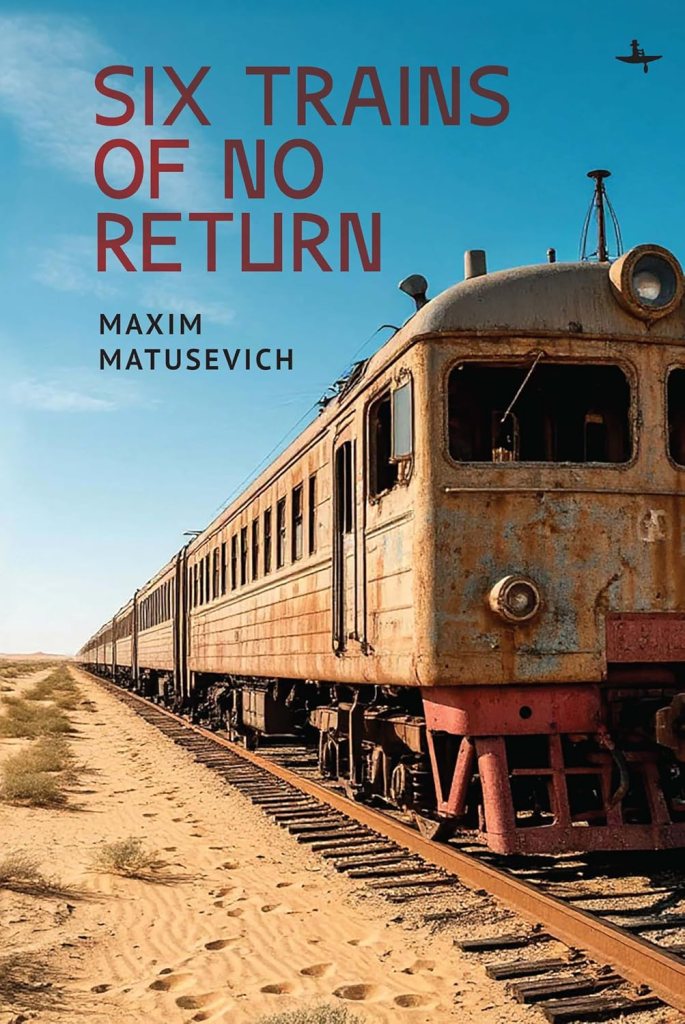
Maxim Matusevich’s fiction is filled with people crossing borders — between countries, languages, identities, and versions of the past. That seems fitting for a writer whose own life has taken him from a communal apartment in Soviet Leningrad to army barracks, from pizza delivery in Oklahoma to academic archives in Nigeria, and eventually to a career as a historian and writer in the United States. Now Professor and Chair of the Department of History at Seton Hall University, Matusevich has recently published his first book of fiction, the short story collection Six Trains of No Return (Academic Studies Press, 2026). We spoke on Zoom about the unlikely path that led him to fiction, the relationship between history and memory, and why he keeps returning to lives shaped by displacement and reinvention.
— Svetlana Satchkova
Svetlana Satchkova: Maxim, let’s start with your story. It seems to have a direct connection to much of your fiction. Could you tell me a little about yourself?
Maxim Matusevich: I was born in Leningrad, in what used to be the Soviet Union, and grew up in the very center of the city. We lived in a large communal apartment, which I think is significant when it comes to some of the stories I write because it was my introduction to life in the USSR. My parents and I shared space with people with whom we otherwise wouldn’t have had much in common. My family was urban Jewish intelligentsia, and our neighbors came from all walks of life and different ethnic backgrounds.
Growing up, I wanted to be an archaeologist and joined the archaeological section at the Leningrad Palace of Pioneers. It sounded very official, but it was really part of an informal counterculture, and through it I made lifelong friends who were interested in history and literature. I didn’t go to college because being Jewish made it difficult to be admitted to Leningrad State University, so I went to a teacher training institute. But since the institute didn’t grant military deferment, I had to go into the army, which I did in the late 1980s.
Svetlana Satchkova: Was that also a formative experience?
Maxim Matusevich: Yes, and it found its way into some of my stories. When I think about it, there is a connection between those two stages of my life: growing up in a large communal apartment and later sharing space in the barracks. At first, I went into the army with great trepidation because I was Jewish. But it also took me far beyond the world I knew. I had spent most of my life in Leningrad. If we traveled, we went to Crimea or the Baltic coast. I didn’t really know the country. So finding myself on a military base in a small provincial town in central Russia was eye-opening. Once again, I was surrounded by people from very different backgrounds, people I wouldn’t have crossed paths with otherwise. Some barely spoke Russian because they came from Turkmenistan or Tajikistan. It was also a period of great change, but we knew nothing about it because we were so isolated on that base. When I got out, I found a country that looked and felt very different from the one I remembered.
Svetlana Satchkova: What changed so dramatically?
Maxim Matusevich: One sign of the changes was that people began to leave. Mostly Jews, but not only Jews. It seemed like one farewell party after another. I had come back expecting to pick up my old life where I had left off: reconnect with my girlfriend, see my friends, carry on as before. Instead, it felt as though my whole future was thrown into question.
My girlfriend and I married within weeks of my leaving the army; people got married very young then. It turned out that her father, who hadn’t really been part of her life, had emigrated in the 1970s and was living in the United States. Soon after our wedding, he came to visit with his American wife and suggested that we move to the United States. Eventually, we left with our little son and ended up in Oklahoma. It felt like the middle of nowhere: strange landscapes, a completely unfamiliar environment. We lived there for a while, and I had no idea what I was doing.
Svetlana Satchkova: How did you end up becoming a historian?
Maxim Matusevich: I enrolled at the University of Oklahoma. I didn’t know what to major in, but I had always been interested in history, so I more or less continued what I had been doing in Russia. My wife was already ahead of me academically and started graduate school there. To make money, I delivered pizzas, so during my first years in America, much of my life revolved around pizza delivery. It also introduced me to people I would never have met otherwise. My coworkers were fascinating: American and foreign students, but also local guys who felt they had few opportunities in life. It was a very diverse crowd, and we all came together in this late-night pizza joint that was cinematic in many ways. I even published a few pieces about it in Russian back in the 1990s.
Later, my wife and I both went on to graduate school at the University of Illinois. I pursued African studies and history because African history was something that had long fascinated me, while she studied for a PhD in French literature.
Svetlana Satchkova: And then you went back to Russia for a while?
Maxim Matusevich: In the early 1990s, people began returning to Russia because of all the new opportunities. It seemed as though the country was finally becoming normal. By then my marriage fell apart, and I went back to St. Petersburg, where I worked as a translator and journalist. It was a mind-boggling time to be in Russia. I was writing for some of the trendiest newspapers and felt part of the intellectual and cultural scene. For a while, I thought that would be my life. I had no intention of returning to the United States and my pizza delivery routine there.
But that didn’t last. There were things about Russia that made me uncomfortable. Society remained harsh, and people seemed increasingly obsessed with status, which never appealed to me. I also realized that I still wanted to be a historian, and if I stayed in Russia, that path would likely remain out of reach. So I returned to the United States, went back to graduate school to earn my PhD, and eventually spent some time in Africa.
Svetlana Satchkova: Africa appears to fit the pattern you’ve been describing: a new place, a new world to discover.
Maxim Matusevich: Nigeria was certainly one of those places. I went there to do research for my PhD dissertation, spent time in the archives, and even taught a little at the University of Lagos and the University of Ibadan. Afterward, I returned to the United States, finished my PhD, and started looking for an academic job. My first position was at a small liberal arts college in Missouri, and it was a wonderful job. But I always wanted to live in a city, which I missed desperately. It took me a few years to find my way to the East Coast, and eventually I landed at Seton Hall University.
Svetlana Satchkova: Let’s talk about how you first started writing fiction.
Maxim Matusevich: Where I come from in Leningrad, everyone wrote poetry. A lot of people who should never have touched a typewriter or a pencil still did it. I wasn’t immune, so I did too. My family is a very literary family: writers, playwrights, journalists, people deeply immersed in the literary scene. But I never dared to write fiction in English.
Then I became a professor of history, which means I had to write a lot. I wrote academic prose in English, and the more secure I felt in the language, the more I wanted to do something beyond academic writing. At the same time, I had accumulated certain ideas about the past, my own past and the past of my generation. I realized I was in a somewhat privileged position: I had the language skills, but I also had professional training as a historian. Millions of people went through that experience, but very few write it down, and even fewer write it down in a language other than Russian. About eight or nine years ago, I finally felt ready to try. I started writing short stories, and the very first one was picked up by The Kenyon Review. The next one was accepted by the New England Review. That encouragement convinced me to keep going, and over the next few years I continued writing and publishing stories.
Svetlana Satchkova: And how did those stories become a book?
Maxim Matusevich: One of the editors at Academic Studies Press, the acclaimed literary scholar and writer Maxim Shrayer, reached out to me after reading some of my work. I was surprised because I knew them as an academic publisher. But they had recently launched a fiction imprint, particularly for work by academics. Around the same time, they published a novel by a good and very talented friend of mine, Pavel Lembersky, and I began to think the idea might actually work. My collection became one of their early fiction titles. I don’t expect to sell hundreds of thousands of copies, but so far, so good.
Svetlana Satchkova: How does your academic work on Africa inform your creative writing?
Maxim Matusevich: When I came to the United States, I became interested in the African American experience because growing up Jewish in the Soviet Union I could see certain parallels. Africa itself also fascinated me. As a young man, it seemed like the ultimate Other – so distinct from the drabness of the Soviet everyday, a world completely different from my own. That’s not a fashionable thing to admit today, but I was in my early twenties and had not yet read Edward Said.
When I finally went to Nigeria, I was surprised by how familiar it felt. It was different, frustrating, and often difficult, but in some ways, it reminded me of Russia. That realization fascinated me and shaped much of my academic work. I became interested in the connections between Africa, the Soviet Union, and the Cold War, especially in how people from different historical backgrounds perceived the same place differently. When I wrote about African Americans visiting the Soviet Union, I was also writing about my own country through someone else’s eyes. In a way, that search for new perspectives on a familiar past is what eventually led me to fiction.
But I have to say that, apart from one story set in Nigeria, my academic work on Africa is not very overtly present in my fiction.
Svetlana Satchkova: I’m interested in how you build a plot. Some of these stories seem closely rooted in real life. Take the first story about your father, for example. How much of it comes directly from family history, and how much did you invent?
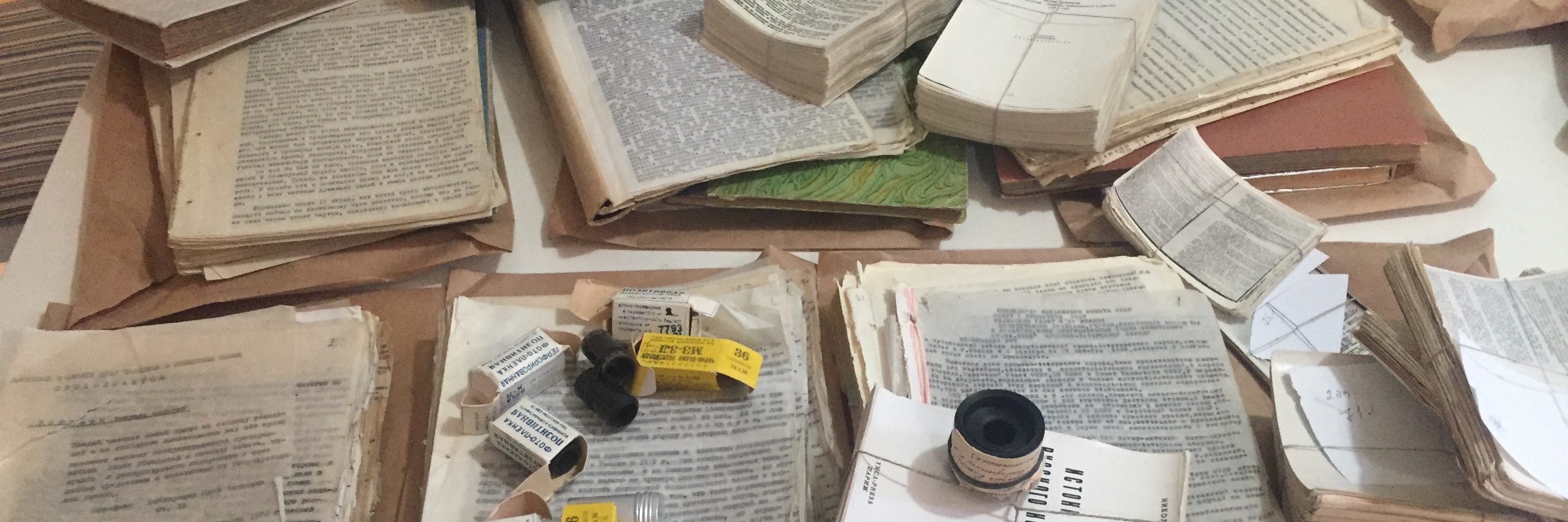
Maxim Matusevich: The first story in the collection is actually quite different from the others. It’s the closest I come to documentary writing. It’s based on family archives and on stories my father told me about his childhood and the war. My father and I were very close, and I was always fascinated by his life. At the center of the story is my parents’ quest to obtain a private apartment, which in the Soviet Union was a life-changing event. After years in communal apartments, they were desperate to have a place of their own, and when a once-in-a-lifetime opportunity finally appeared, it became a quest that lasted for years. What attracted me to this memory as a writer was that this seemingly simple goal gradually took on the scale of an epic quest.
There is one story that’s almost completely imagined: the Cambodia story. It was based on something I saw in a museum while my wife Alina and I were traveling in Cambodia. I came across the story of a Cambodian actress who had once been very famous. Then the Khmer Rouge came to power, her family was destroyed, but she somehow survived the genocide and eventually made it to France. Those were the historical pieces. The rest I imagined. While I was in Cambodia, I met a number of people, including a tuk-tuk driver, and some of them found their way into the story as well. In the end, I took these different people and fragments of history and brought them together into a single narrative.
Svetlana Satchkova: Where do your stories typically begin?
Maxim Matusevich: I think there are a couple of things that usually motivate me to write a story. One is a strong feeling or emotion that I would like to give shape to. It could be an obsession, a fear, or a very intense sense of nostalgia. Often, I build a plot around that emotion. It’s important to me not just to tell a story, but to find a way to make other people feel what I felt.
The other is a set of ideas about the past that I keep coming back to. There’s this film by Kurosawa, Rashomon, where the same dramatic event is interpreted in completely different ways by the people involved. I’ve always found that fascinating because we see it all the time in real life. People share the same experiences, the same marriage, the same country, and yet when they look back, they tell very different stories about what happened. A lot of my fiction is built around those questions: what is real in our past, what is imagined, and why do the things we imagine sometimes become so real to us?
Svetlana Satchkova: We’ve talked about a story rooted in your life. Are there others that began with something you experienced firsthand?
Maxim Matusevich: I can think of one story that grew directly out of something that happened to me. Imagine getting a call from someone you haven’t seen or thought about in twenty years. This person wants to talk about your shared past and tells you that you played a central role in their life. You feel guilty because you barely remember any of it. Then, as the conversation continues, you realize they have confused you with someone else.
I found that situation intriguing. On the one hand, it’s humbling. On the other, it raises all sorts of questions about memory and the stories people tell themselves. Maybe this person really has built an important part of their identity around the past. Or maybe they need that story for reasons that have more to do with the present than with what actually happened. Those ambiguities interested me, and I built a plot around them.
Svetlana Satchkova: There’s a story in your collection that’s almost the opposite of that: “Red Dress.”
Maxim Matusevich: So “Red Dress” is partly about obsession, but it’s also about memory. The protagonist spends decades remembering a woman and a relationship that once felt overwhelming. When they meet again, he realizes that he can still remember the intensity of those feelings, but he no longer feels them. I think many of us have experiences like that. At the time they seem all-consuming. Years later, they survive mostly as stories we tell ourselves about who we once were.
I’ve always been interested in stories about people losing control over their emotions. Perhaps that’s because I have a deep-seated fear of losing control myself. I remember one episode from my youth when I sat down at a slot machine and suddenly found myself completely absorbed. Forty-five minutes later, I had lost all my money and barely understood what had happened. It frightened me because I realized how quickly a person can slip into that state. I’ve never really struggled with addiction, but that experience left an impression on me.
Svetlana Satchkova: What are you working on now? Do you plan to write more fiction?
Maxim Matusevich: Since the book came out earlier this year, I’ve been trying to juggle my academic responsibilities with fiction writing. Being department chair entails a lot of administrative busy work and sometimes I find it challenging to shift gears and switch back to writing non-academic stuff. But I have started four different stories; all four for now remain uncomplete. The four are quite distinct from each other, and only one of them is autobiographical. It’s about a Texas road trip, which I took in the company of my two then girlfriends — one American, one Russian. The situation was both absurd and fascinating because it featured a combination of romantic tension and relentless culture clashes. It also definitely belonged to a very specific time, to a very particular historical context. The same three characters placed in different surroundings would’ve acted and expressed themselves completely differently. I’m often drawn to such situations that undermine our conceptions of normalcy, wreak havoc with our expectations and moral certitudes.
Besides continuing to write short stories, I have a still rather vague idea for a novel, which will feature characters who defy constraints of time, geography, age, and gravity. I know, I know … this sounds like The Master and Margarita. It’s quite difficult to step out of the looming shadow of one’s favorite writer. But one can try. One should always try.
Punctured Lines: Buy Six Trains of No Return from Academic Studies Press or at your favorite bookstore.
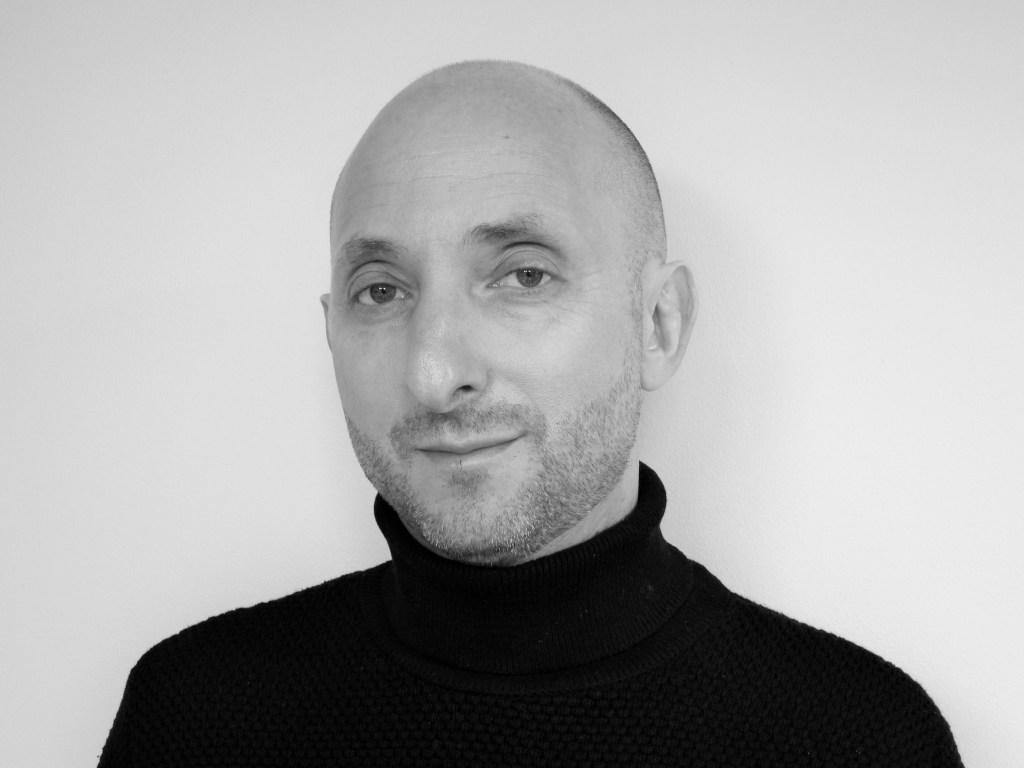
Maxim Matusevich was born and raised in Leningrad (now St. Petersburg) and immigrated to the United States in 1991, as the Soviet Union teetered on the brink of collapse. He is Professor of History and Department Chair at Seton Hall University in New Jersey. Maxim has published extensively on African–Soviet encounters and the history of race during the Cold War. His fellowships and residencies include the Fulbright Program (Russia), the Woodrow Wilson International Center for Scholars, the Jordan Center for the Advanced Study of Russia at NYU (Writer-in-Residence), and the W. E. B. Du Bois Research Institute at Harvard University, where he served as a Sheila Biddle Ford Research Fellow.
In addition to his academic work, Matusevich writes fiction. His short stories, novellas, and essays have appeared in literary magazines in the United States, Canada, Israel, the United Kingdom, Germany, and elsewhere, including The Kenyon Review, New England Review, BigCityLit, San Antonio Review, Fatal Flaw Literary Magazine, among many others. Six Trains of No Return (Academic Studies Press, 2026) is his debut book of fiction. The collection brings together twelve short stories and novellas that explore immigrant lives and dislocations that are at once deeply personal and broadly universal. These are stories of past lives and loves, of fragile and unreliable memories, and of individual destinies entwined with larger historical forces.
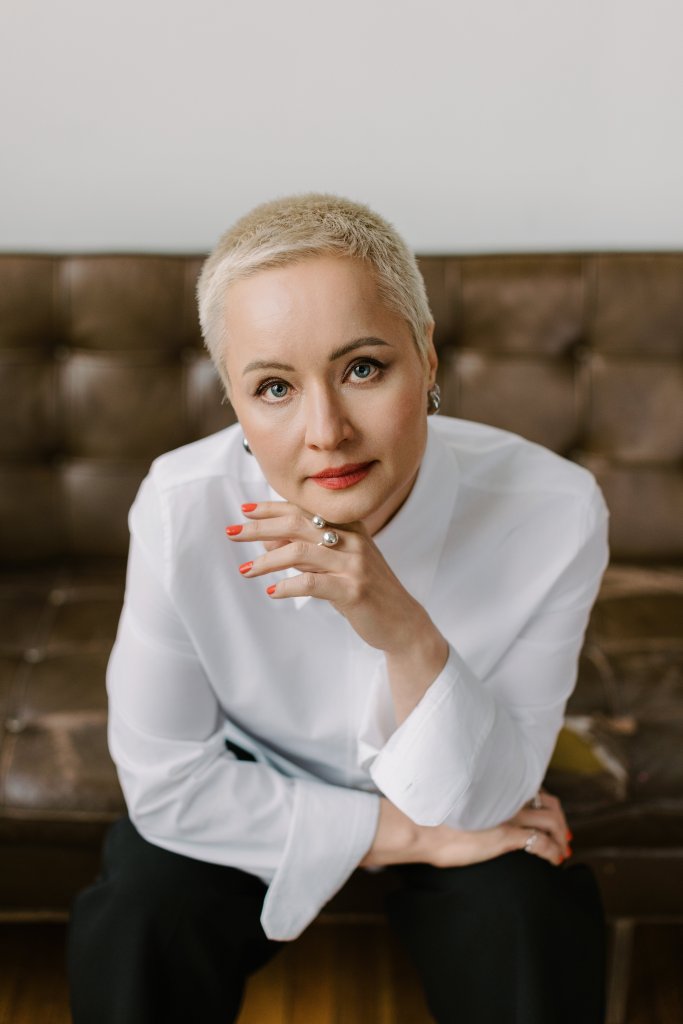
Svetlana Satchkova is a New York-based journalist and novelist. She covers culture and politics, with bylines in Literary Hub, The Rumpus, Newsweek, LARB, the Independent, and others. Currently a research fellow at the Jordan Center for the Advanced Study of Russia at NYU, she holds an MFA from Brooklyn College. Svetlana has published three novels in Russian; The Undead: A Novel of Modern Russia, is her English-language debut.



 Punctured Lines