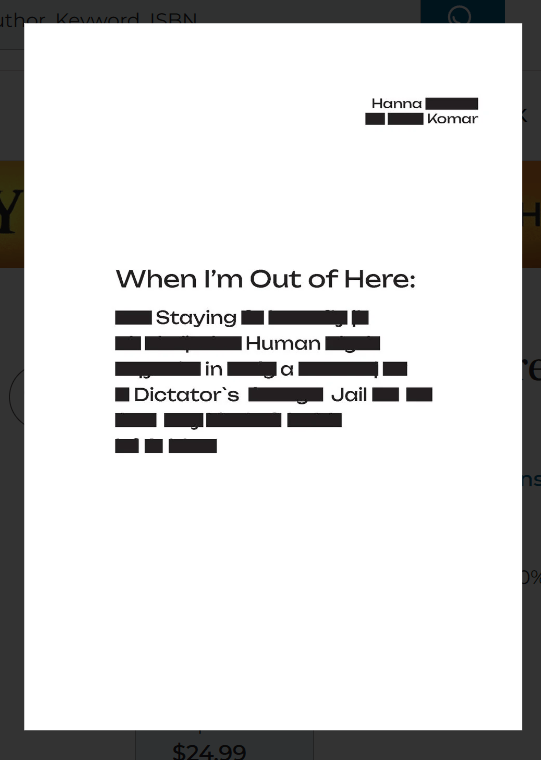
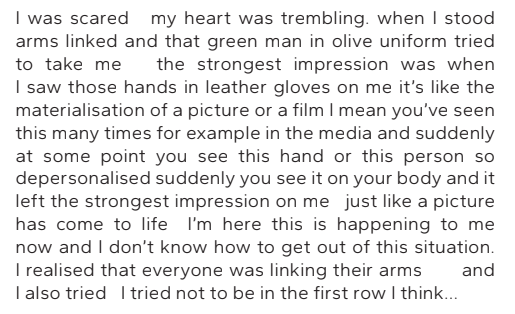
Today on the blog we are featuring excerpts from Hanna Komar‘s When I’m Out of Here: Staying Human in a Dictator’s Jail, translated by Hanna Komar and John Farndon (Skaryna Press, 2026). The book is an account of her arrest and imprisonment during the mass protests in Belarus in 2020 against fraudulent election results and in support of the recently arrested pro-democracy activist Maryia Kalesnikava. As Komar says in the Foreword, “I had to tell this story. But telling only my own story felt wrong […] At that time, I read The Unwomanly Face of War by Svetlana Alexievich. And so I began to collect voices, as she did.” Thus, Komar writes this book as a series of different “voices” representing both herself and others who were imprisoned along with her, as can be seen below; my heartfelt gratitude to Olga Zilberbourg for reproducing and editing screenshots that preserved the book’s layout. You can buy the book from Skaryna Press in English here, and if you are a Belarusian speaker, here, along with many other Belarusian-language titles. For those of us outside Belarus, buying books like Komar’s When I’m Out of Here is a way to show support for these writers and the larger movement they are a part of for a free Belarus.
Hanna Komar, When I’m Out of Here: Staying Human in a Dictator’s Jail
Foreword
I knew you would want to write this…
And so I wrote…
To understand — my own experience, and myself as part of the collective one.
In Belarus, the same dictator, Aliaksandr Lukashenka, has been in power for over 30 years, since 1994. The fraudulent presidential election on 9 August 2020 was followed by the largest mass peaceful protests in Belarusian history, met with unprecedented police brutality and systemic repression. At the time of this publication, over 1,200 political prisoners remain behind bars. Over 8,000 individuals have faced politically motivated criminal prosecution, and over 50,000 have experienced arbitrary detentions. All of them have been subjected to ill-treatment; psychological, physical and sexual violence; torture and other inhumane conditions. I was one of the 50,000. This is my story.
I was detained on 8 September 2020. It was when we were marching in support of Maryia Kalesnikava and other activists detained around that time. The extraordinary Maryia Kalesnikava was a professional flautist who became the head of Viktar Babaryka’s presidential campaign, and was one of the key figures of the fight against Lukashenka. Our march happened right the day after Maryia was suddenly kidnapped in the centre of Minsk by unidentified law enforcement officers. During the night, they took her to the Belarusian-Ukrainian border to deport her forcibly. But at the border crossing, Maryia tore up her passport, got out through the car window and walked towards the Belarusian border. They took her to prison and after a “trial” a year later condemned her to 11 years. Maryja was released on 13 December 2025.
Later in the day of the border incident, protesters gathered at various locations in Minsk in support of her. The march I attended was the largest. We were surrounded by the security forces which came out in large numbers, armed and masked, to break up the protest. By the evening, more than a hundred marchers had been grabbed forcibly and thrust into police vans to be taken off to prison — many of them women, including me. The targeting of women like that was new and seemed a turning point for us. After that, mass detentions of women were common at every women’s protest.
After a cold anxious night at a Pieršamajski police department, I was brought before a court the following day, still hoping for some justice. With little evidence but the police statement, the so-called court sentenced me to nine days of administrative arrest. I spent two days in Akrescina prison and then was transferred to the prison in Žodzina, where I received a care package from my friends outside. In that package, my flatmate and ally Alena included a little notebook, so, I kept a diary of my time in prison. It was difficult, but I forced myself to write down something — anything — even just dry observations and facts. Activities. Details. Thoughts. This was my way of finding meaning in what was happening. “You are a poet, a writer,” I thought to myself, “you are here anyway, and this is a unique experience: you can see this place, the one you’ve heard so much about, from the inside. You must write about it.”
At first, I imagined this would be a slim book about my own experience, but for six months after my release, I couldn’t even open that notebook. Then, on the day the court sentenced the journalists Katsiaryna Andrejeva and Darya Chultsova to two years in prison, I realised that as long as I was free, I had no right to remain silent. I had to tell this story. But telling only my own story felt wrong. I was also at a loss for words — my psyche refused to let me go deeper. At that time, I read The Unwomanly Face of War by Svetlana Alexievich. And so I began to collect voices, as she did.
[…]
[…]
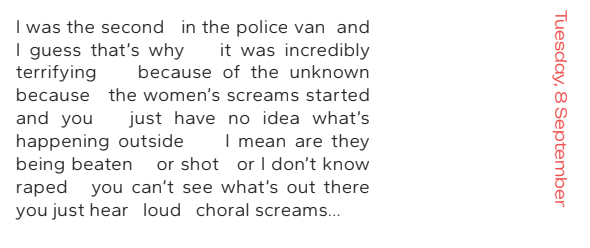
[…]
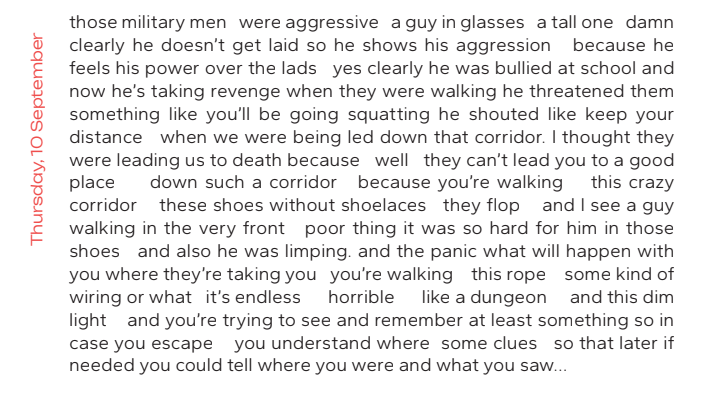
[…]
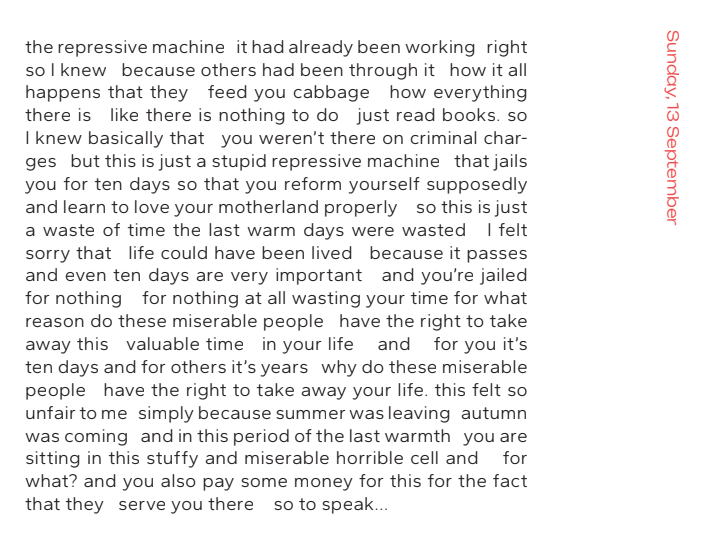
[…]
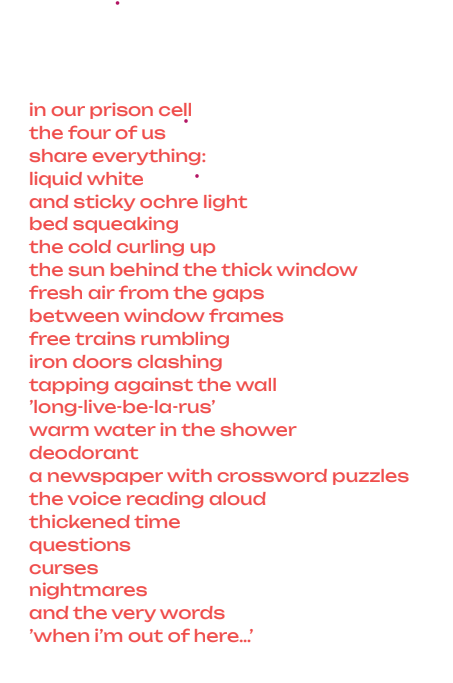
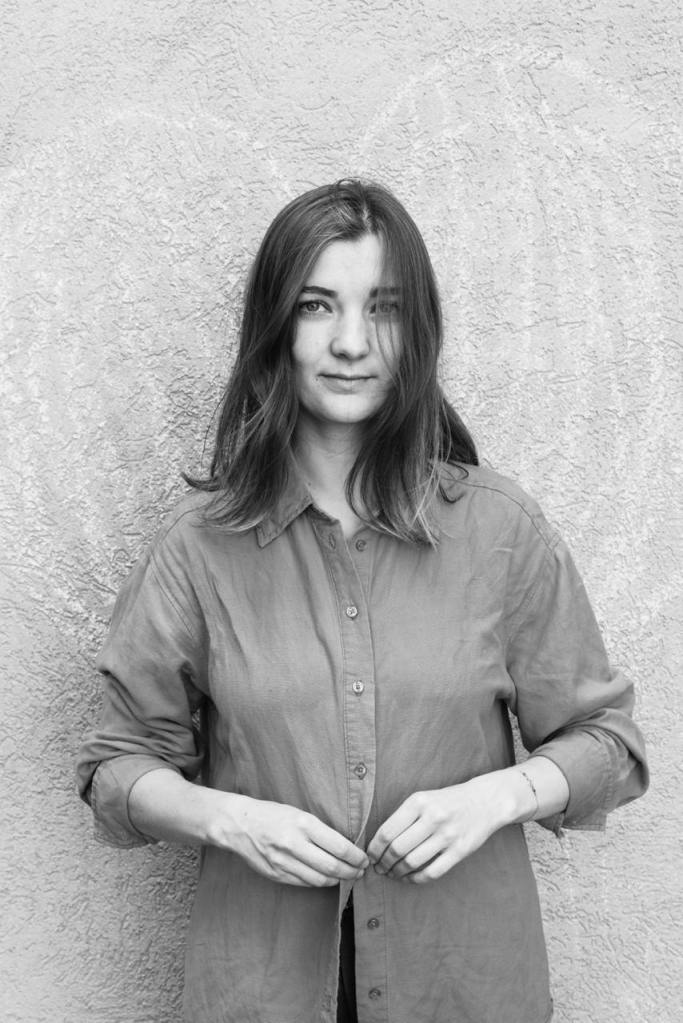
Hanna Komar is a Belarusian poet, translator, writer, and performer, whose work explores what it means to grow up as a girl — and later a young woman — in a strongly patriarchal, authoritarian country. Much of her writing comes from her own experience, trying to give voice to what is often left unsaid or unspeakable. She has published five poetry collections: Страх вышыні (Fear of Heights), the docupoetry book Мы вернемся (We’ll Return), and Вызвалі або бяжы (Set Me Free or Run) in Belarusian, and the bilingual collections Recycled and Ribwort. She is also the author of the non-fiction book When I’m Out of Here: Staying Human in a Dictator’s Jail, which reflects on the collective experience of incarceration for peaceful protest in Belarus, and the play Body in Progress, about the cruelty of the Belarusian regime, exile, and her journey of healing. Her work has been translated into Polish, Ukrainian, Swedish, Norwegian, German, Czech, Lithuanian, Slovenian, Danish, Italian, Russian, and Slovak, and she translates her own poetry into English. She is a member of PEN Belarus and an honorary member of English PEN. In 2021, she was a joint recipient of the Freedom of Speech Prize from the Norwegian Authors’ Union. She has an MA in Creative Writing: Writing the City from the University of Westminster and is completing a PhD exploring how poetry can support Belarusian women in sharing experiences of gender-based violence and patriarchy.