Notable Books: Russian Titles in English Translation, 2009-2019

The impetus for creating this post came from a recent Twitter discussion. We at Punctured Lines decided to accept a dare and came up with a list of notable Russian titles available in English translation from the last decade. This has been an opportunity to take stock of the years 2009-2019, both to remember the books we’ve read and to look back at those that we might have missed.

In this task, we relied heavily on Lisa Hayden’s blog, Lizok’s Bookshelf, where Lisa keeps chronological track of the English translations – our deep gratitude for creating and maintaining this resource. Our methodology for choosing among all those works was based on several factors. Rather obviously, for our purposes we only considered works by women. We also wanted to highlight writers whose names may not be very familiar to English-speaking readers but whose work we feel deserves wider exposure and shows the range of contemporary Russian women’s literature.

For this reason, we chose not to include writers who are well-known in the Anglophone world, but of course we love them too. We note proudly the women whose work has been translated into English numerous times: Anna Akhmatova, Svetlana Alexievich, Eugenia Ginzburg, Ludmilla Petrushevskaya, Dina Rubina, Olga Slavnikova, Marina Tsvetaeva, Ludmila Ulitskaya, and Tatyana Tolstaya (whose problematic views on women and feminism may be less known).

One or both of us have read many of titles below, and we’re happy to report that the field is larger than our reading capacity. We included a few books we haven’t read because they sparked our curiosity and to encourage ourselves and our followers to return to these publications. An important factor for consideration was translators whose work we’re interested in. Here we would like to say a huge thank you to translators for their often unacknowledged efforts that allow English speakers to know Russian literature.

Our list has four categories: Contemporary Prose, Contemporary Poetry, Recent Translations of Earlier Prose Works, and a rather catch-all Drama, a Graphic Novel, and an Anthology. The titles in each category are given chronologically by year of the translation. This list reflects our personal opinions and is in no way meant to be comprehensive or conclusive. We welcome your comments and suggestions about these and other titles by Russian women who you think should be on this list. This is, hopefully, the beginning of that conversation.

Contemporary Prose

Elena Chizhova, The Time of Women, translated by Simon Patterson and Nina Chordas; Glagoslav, 2012. 

Linor Goralik, Found Life: Poems, Stories, Comics, a Play, and an Interview, edited by Ainsley Morse, Maria Vassileva, and Maya Vinokur; Columbia University Press, 2017.

Ksenia Buksha, The Freedom Factory, translated by Anne Fisher; Phoneme Media, 2018.

Alisa Ganieva, Bride and Groom, translated by Carol Apollonio; Deep Vellum, 2018.

Margarita Khemlin, Klotsvog, translated by Lisa C. Hayden; Columbia University Press, 2019.

Guzel Yakhina, Zuleikha, translated by Lisa C. Hayden; Oneworld Publications, 2019.

Contemporary Poetry

Anzhelina Polonskaya, Paul Klee’s Boat, translated by Andrew Wachtel; Zephyr Press, 2012. 

Polina Barskova, Anna Glazova, and Maria Stepanova, Relocations: Three Contemporary Russian Women Poets, translated by Catherine Ciepiela, Anna Khasin, and Sibelan Forrester; Zephyr Press, 2013.

Maria Rybakova, Gnedich, translated by Elena Dimova; Glagoslav, 2015.

Inna Kabysh, Blue Birds and Red Horses, translated by Katherine E. Young; Toad Press, 2018.

Aigerim Tazhi, Paper-Thin Skin, translated by James Kates; Zephyr Press, 2019.

Olga Livshin, A Life Replaced: Poems with Translations from Anna Akhmatova and Vladimir Gandelsman, Poets & Traitors Press, 2019.

Recent Translations of Earlier Prose Works

Teffi, Memories: From Moscow to the Black Sea, translated by Robert Chandler and Elizabeth Chandler, Anne Marie Jackson, and Irina Steinberg; NYRB Classics and Pushkin Press, 2016.

Sofia Khvoshchinskaya, City Folk and Country Folk, translated by Nora Seligman Favorov; Columbia University Press, 2017.

Olga Berggolts, Daytime Stars: A Poet’s Memoir of the Revolution, the Siege of Leningrad, and the Thaw, translated by Lisa A. Kirschenbaum; University of Wisconsin Press, 2018.

Doba-Mera Medvedeva, Daughter of the Shtetl: The Memoirs of Doba-Mera Medvedeva, translated by Alice Nakhimovsky; Academic Studies Press, 2019.

Karolina Pavlova, A Double Life, translated by Barbara Heldt; Columbia University Press, 2019.

Irina Odoevtseva, Isolde, translated by Bryan Karetnyk and Irina Steinberg; Pushkin Press, 2019.

Drama, a Graphic Novel, and an Anthology

Yaroslava Pulinovich, Olga Rimsha, Ksenia Stepanycheva, Ekaterina Vasilyeva, Russian Drama: Four Young Female Voices, translated by Lisa Hayden; Glas, 2014.

Victoria, Lomasko, Other Russias, translated by Thomas Campbell; Penguin and n+1, 2017.

Teffi, Marina Tsvetaeva, Anna Akhmatova, Lydia Ginzburg, Galina Scherbakova, Ludmila Ulitskaya, Svetlana Alexievich, Olga Slavnikova, Irina Muravyova, Ludmila Petrushevskaya, Margarita Khemlin, Slav Sisters: The Dedalus Book of Russian Women’s Literature, edited by Natasha Perova; Dedalus, 2018.

Central Asian feminists are carving out their space in gender studies, by Aizada Arystanbek

Part of Open Democracy’s “new series on activism, academia and equality in Central Asia,” this piece is by Aizada Arystanbek, “a Central Asian graduate student of gender studies in Europe” (links to the other pieces in the series are included). As she writes, “along with the thrill of being able to study what I am passionate about comes a certain violence of erasure, as I am left constantly searching for my identity in feminist academia.

As I think about Russia’s colonisation of Central Asia and the process of Russification my mother had to undergo in her school in Tselinograd (the former name of the current capital of Kazakhstan), I feel deeply for Latina, black and indigenous women who write about their ancestors being colonised, their land being stolen, and them being perceived as backward simply because they lacked culture in the western conception of the word.

But I am always caught in between these various identities and almost never am I seen for my own very distinguishable one, a Central Asian woman. I have to stitch together my identity in academia by myself, learning little-by-little from other feminist scholars of colour, hoping that I understand their experiences correctly and that their words will represent my struggle accurately when I use them in my essays.”

Central Asia, once part of the Soviet Union and now comprising independent nations, is not particularly well known in the West. In the U.S., academic study of the region has traditionally come out of Slavic departments, where it has only recently begun to garner more attention, although not necessarily about issues of gender and feminism. This series looks to be an important and much-needed step in this direction.

https://www.opendemocracy.net/en/odr/central-asian-feminists-are-carving-out-their-space-gender-studies/

Emily Couch on The Ethnic Avant-Garde and Diversity in Russia Studies

By Emily Couch

In 2015, Steven S. Lee published the monograph The Ethnic Avant-Garde: Minority Cultures & World Revolution. It may seem strange to write about a book four years after its publication, but the continued lack of racial and ethnic diversity in Russia studies makes Lee’s work more relevant than ever. Today we should consider The Ethnic Avant-Garde as not only a valuable source of information and analysis on a much neglected topic, but also as a springboard for reconsidering the field’s methodologies, as well as dominant political discourses on the region and its Soviet past. 

WHAT IS THE BOOK ABOUT?

Lee defines the “Ethnic Avant-Garde” as referring to the diverse artists and writers who engaged with the Soviet Union from beyond its borders, but his central contention is that the phrase defines a  “largely unrealized utopian aspiration […] the dream of advancing simultaneously ethnic particularism, political radicalism, and artistic experimentation, debunking the notion that particularism yields provincialism.”  The Ethnic Avant-Garde, he adds, “foregrounds a distinct way of seeing – a ‘transnational optic’ that, for the contemporary reader, makes it possible to discern unexpected connections among radical artists and writers from many different countries.” The book does not idealize the Soviet system or its minority policy, but rather argues that foregrounding the Ethnic Avant-Garde facilitates a “minority and Soviet-centered remapping of global modernism” and “provides for new scholarly and creative communities in the present day.”

Chapter 1 analyzes the cultural exchange between Vladimir Mayakovsky and Langston Hughes by looking at the way in which the latter translated and adapted the poetry of the former. Chapter 2 considers Sergei Tretyakov’s play Roar, China and its reception in the United States. Chapter 3 looks at Hughes’ famous dismissal of the planned Soviet movie about African American struggles, and Chapter 4 addresses the complex attitude of American Jews towards socialist internationalism.  Overall, the book covers the inter-war period from 1918 to 1939.

REVIEW OF THE BOOK 

The strongest suit of The Ethnic Avant-Garde is the multitude of significant, but little known, examples of cultural interaction between Western ethnic minorities and the Soviet Union. Perhaps the most emblematic of these is Lee’s analysis of Vladimir Mayakovsky’s “Black & White” (1925) – a poem in which Willie, a black sweeper at an American cigar company in Havana, slowly gains awareness of racial inequity – and its subsequent translation into English by Langston Hughes in the 1930s. Through analysis of word choice, form, and rhythm, Lee reveals the cultural collaboration that took place between these seemingly disparate authors (even though Mayakovsky was no longer alive by the time of Hughes’ translation), and highlights the way in which Hughes not only translated Russian into English, but also represented Afro-Cuban culture in a way that was comprehensible to an American audience.  Another strength of The Ethnic Avant-Garde is that its content – the book covers multiple ethnicities, including African American, Asian, Afro-Cuban, and Jewish – reflects Lee’s mission to “delineate an avant-garde grouping that cuts across racial, ethnic, and national boundaries.”

This ambitious motivation is, in part, responsible for the book’s shortcomings.  The concept of the Avant-Garde is inherently abstract (think of Kazimir Malevich’s paintings), so it is not surprising that Lee’s writing style is heavily theoretical – his use of Vladimir Tatlin’s Monument to the Third International (1919 – 1920) as a visual metaphor for the Ethnic Avant-Garde is a prime example of this tendency.  The plethora of abstract concepts with which Lee grapples frequently leads to dense and obtuse paragraphs that would make little sense to a reader who was not well-versed in the theoretical underpinnings of modernism. Terms such as “Freudian melancholia” and “Now-Time,” for example, receive little explanation. This trend carries through to the final chapter which, instead of bringing the book’s narrative to a close, offers yet more theorization – this time, focusing on how Karen Tei Yamashita’s I Hotel (2010) negotiates the “eternal idea” of Mao’s Cultural Revolution and its reality.  While the discussion of Yamashita’s work is rigorous, it does feel like something of a non sequitur in a book that primarily discusses the Soviet Union.

WHY IS IT SIGNIFICANT?

Let’s turn to methodologies. Russia studies, like every field of area studies, is an umbrella term that houses multiple disciplines – namely, international relations, political and social science, history, literature, art, and language.  Yet, while Russia studies is a broad church, there is a strange lack of interdisciplinary dialogue, particularly when it comes to the international relations and political science strands.  For scholars of literature and art, it is natural to draw on the research in these fields in order to understand the backdrop of, and worldview encoded in, the work. However, there is little in the way of reciprocal influence due to the unfortunate tendency among IR and political science scholars to see their disciplines as detached from the “softer” realm of cultural studies. The Ethnic Avant-Garde embodies the fruitful results of this kind of interdisciplinarity work.  Lee himself is an Associate Professor of English Literature at Berkeley, but he uses the techniques of literary analysis in order to draw wider conclusions about the social and political nature of the relationship between the Soviet Union and ethnic minorities abroad.  

Interdisciplinary methodologies, in turn, prompt a rethinking of Western political discourse on the Soviet Union. Understanding the cultural ties and, indeed, the cultural attraction that it exerted for Western ethnic minorities invites a critical reassessment of the traditionally antagonistic Cold War rhetoric. The dominant U.S. rhetoric of the Cold War period posited the Soviet Union as the antithesis to American ideals of democracy and capitalism.  Encoded in this rhetoric, however, was the pervasive inequity in racial relations, especially regarding the African American community. Thus, anti-Soviet discourses erased the experiences of those ethnic/racial groups who were not included within these “patriotic” ideals. Granted, The Ethnic Avant-Garde does not technically cover the Cold War (i.e. post-World War II) period.  However, its final chapter does suggest that the People’s Republic of China – founded in 1949 – offered a beacon of hope for Western ethnic minorities. The nuancing called for by Lee’s work, in turn, spotlights the ever growing need for greater diversity among the practitioners and scholars who study the region.

THE PERSONAL IS POLITICAL 

The iconic slogan of the 1960s and 70s women’s movement has been repeated to the point of banality over the last six decades, but this does not mean that it is any less relevant today. Academic book reviews rarely mention the author’s personal biography, but in this discussion of racial and ethnic diversity in Russia studies it is salient to point out that Lee himself – as he writes in the Acknowledgements – is the child of Korean immigrants to the United States.  He is among the few ethnically East Asian scholars in Russia studies (other examples being Notre Dame’s Emily Wang and UPenn’s Brian Kim). Lee’s personal background makes The Ethnic Avant-Garde political: beyond its specific content, the very fact that a seminal contribution to the field has been made by a person of color is, in itself, worthy of celebration. Most significantly, however, is that The Ethnic Avant-Garde points to the way diversity in the profession can facilitate a dramatic reinterpretation of the Soviet Union’s place in the global cultural space by foregrounding the inter-ethnic and inter-racial connections that the present Eurocentric scholarship has overlooked.

Emily Couch is a Staff Intern at the Kennan Institute.  She recently completed a double Master’s degree in Russian & East European Studies at University College London and the Higher School of Economics (Moscow). She has just returned from a year living in Russia where, in addition to her degree, she interned with the independent Russian pollster, The Levada Center.  Earlier this year, she defended her thesis entitled The Inter-regional Diffusion of Russian Protest Repertoires in a Trans-National Context, 2008 – Present.  Her articles have been published by news outlets including The Moscow Times and The Calvert Journal.
Twitter: @EmilyCouchUK

Looking Back on Our First Event: Participatory Reading in Post-Soviet Literatures, in Pictures

On November 25th, Punctured Lines hosted our first literary event in San Francisco. Thanks to a conference that brought to San Francisco scholars, translators, and writers in Slavic, East European, and Eurasian Studies, we were able to gather a star list of participants. A few of the readers have appeared in Punctured Lines, and we certainly hope to feature more of their work. Following the scheduled portion of the event, we hosted an open mic that turned out to be a great crowd-pleaser. Below are the pictures we captured that night and brief descriptions of everyone’s contributions.

Shelley Fairthweather-Vega opened with an excerpt from her recently published translation of Talasbek Asemkulov’s novel A Life at Noonavailable for purchase here. A story about a musician growing up in Soviet Kazakhastan and learning his art form from his father.

Yelena Furman read the opening from her short story “Naming,” recently published in Narrative Magazine, and available in full online (free, with free registration required).

Wayne Goodman read a few brief excerpts from his historical novel Borimir: Serving the Tsars that re-imagines gay romance in Imperial Russia. There’s lots of awkward flirting! This book is available for purchase on Amazon.

Maggie Levantovskaya read from her essay about a trip to Auschwitz concentration camp “To Conjure Up the Dead,” published in Michigan Quarterly Review. The bizarreness of Holocaust tourism with the post-Soviet twist. An excerpt from this essay appears online.

Dmitri Manin wore the T-shirt with Genrikh Sapgir’s poem on the back, and read to us his translations from Sapgir’s “Poems on Shirts” book. We have published three of these translations in an earlier post.

Masha Rumer shared an essay about exposing an unsuspecting date to the delights of pickled herring-and-boiled beet salad, aka “Seledka pod shuboj.” He lived long enough to propose. We’re hoping to read the follow up on this story in her upcoming book, Parenting with an Accent: An Immigrant’s Guide to Multicultural Parenting. More about Masha and her book in the Q&A she gave Punctured Lines.

Sasha Vasilyuk followed with an excerpt from her novel-in-progress about a Soviet prisoner of war. We will be following the development of this project closely.

Mary Jane White delighted us with her translations from Marina Tsvetaeva — her delivery of the “Ode to the Rich” landed particularly well with our audience. Mary Jane’s book of her own poetry and translations from Tsvetaeva Starry Sky to Starry Sky is available online. We will be following up with news of her upcoming book of translations from Tsvetaeva’s Berlin and Prague years, Poems of an Emigrant: After Russia, Poem of the Hill, Poem of the End, and New Year’s.

I read the opening of “Rubicon,” a short story from my collection Like Water and Other Stories.

Josie von Zitzewitz followed up on the thread of discussion about the lack of visibility of contemporary Russian literature in the United States, and introduced a project that she’s developing with Marian Schwartz and Hilah Cohen, soliciting work from young Russophone writers to create a feature publication in an American magazine (possibly more than one).

Joining us for the open mic portion of the show, we had Maxim Matusevich, a writer and a historian of USSR intersections with African countries. He delivered an excerpt from his hilarious short story about cultural encounters between American students going to study abroad in St. Petersburg.

Christopher Fort closed the evening with a poem that he read in both Uzbek and English, bringing our attention to a particular rhyming pattern of Turkic languages. We have previously linked to Christopher’s interview about translating Abdulhamid Sulaymon o’g’li Cho’lpon novel Night and Day. This novel is now available for purchase online.


An encounter with Svetlana Alexievich through the eyes of her Spanish translator: an essay in World Literature Today

Jorge Ferrer and his English translator Jacqueline Loss, writing for World Literature Today, offer us an interesting glimpse of Svetlana Alexievich’s reception in Spain. Ferrer was born in Havana and now lives in Barcelona and translates Russian-language writers, including Svetlana Alexievich, into Spanish. I love knowing that a character from Secondhand Time has a life of her own on the stage of a Barcelona theatre.

I’m just going to simplify the problem for us to understand: (1) A Belarusian writer who operates by means of a method usually called “novel of voices” includes in a book a woman’s testimony; (2) An actress reads that testimony in Spanish translation, falls in love with the witness, takes that text to the theater, and constructs, in a parallel manner, a life in the real and digital worlds; (3) The actress asks the translator of the original text into the language in which she represents the character to write a new monologue for the witness, that is, to take her out of the realm of reality and transport her into fiction—from being a person, to turn her into a character and, instead of translating the life transcribed for her, write a future life for her.

https://www.worldliteraturetoday.org/2019/autumn/date-svetlana-alexievich-berlin-or-smuggling-bugs-soviet-moscow-jorge-ferrer

Beyond the encounter with Alexievich herself, Ferrer takes us on several delightful tangents in this essay. This piece feels particularly appropriate this week, when we’re celebrating the 30th anniversary of the fall of the Berlin wall.

Lara Vapnyar’s Essay: On Being a Cool Parent

*Post updated to include a second excerpt from Vapnyar’s Divide Me by Zero.

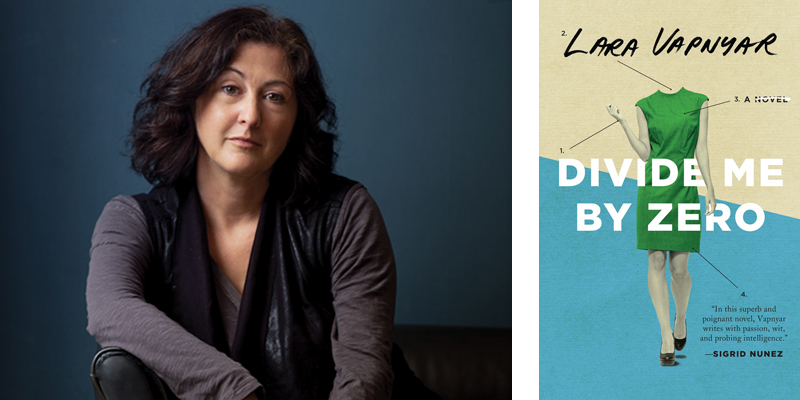
In a Facebook post, Lara Vapnyar mentioned that she adapted this touching, lyrical essay into a chapter in her new book, Divide Me by Zero. Read the piece and use Powells.com to order the novel.

Shortly after my mother died, the kids and I established the routine of taking long beach walks about an hour before sundown. We lived on Staten Island then, the long beautiful stretch of Great Kills beach was only seven minutes away by car. My husband and I had separated just a few months before my mother’s death, and all three of us were still reeling from these two blows. David was almost 18 then, Stephanie had just turned 15; I would look at our shadows and see that they were about the same lengths. We looked like three orphaned siblings rather than a mother and her kids.

https://www.powells.com/post/original-essays/on-being-a-cool-parent

An excerpt from a different chapter of Vapnyar’s Divide Me by Zero appears in Lit Hub:

One week before my mother died, I went to a Russian food store on Staten Island to buy caviar. I was brought up in the Soviet Union, where caviar was considered a special food reserved for children and dying parents. I never thought of it as extravagant or a romantic delicacy. My mother would offer me some before important tests in school, because it was chock-full of phosphorus that supposedly stimulated brain cells. I remember eating caviar before school, at seven am, still in my pajamas, shivering from the morning cold, seated in the untidy kitchen of our Moscow apartment, yawning and dangling my legs, bumping my knees against the boards of our folding table, holding that piece of bread spread with a thin layer of butter and thinner layer of caviar.

https://lithub.com/divide-me-by-zero/

On a personal note, this observation about caviar did hold up in my family, in part. When my grandmother was dying, my mother fed her caviar sandwiches. (Before the tests, though, I got a chocolate bar.) I’ve never seen this detail about caviar captured in prose before–it resonates so deeply.

A Soviet YA Classic: Aleksandra Brushtein’s Дорога уходит в даль (The Road Goes off into the Distance)

It is hard to overstate just how much Aleksandra Brushtein’s autobiographical novel about Aleksandra (Sasha) Yanovskaya, a young Jewish girl growing up in Vilna at the turn of the century, was beloved by generations of Soviet children. At a time when I have completely forgotten plots of books I read much later, I can still recall various episodes from this one. A copy of the book, which my family took with us when we left the Soviet Union, is one of my prized possessions. My mom loved this book so much she wanted to name me Sasha (an attempt ended by my great-grandmother Aleksandra’s announcement post my birth that Ashkenazi Jews cannot name children after living relatives). A remarkable thing about this novel is that it has a Jewish protagonist and depicts Jewish life but still became so popular in a country as anti-Semitic as the Soviet Union. Its popularity has endured in contemporary Russia, where “since 2005, a new printing of the book by different publishers has appeared almost every two years,” including an annotated edition.

Yet as Liza Rozovsky’s article notes, Brushtein “is barely known outside the Russian-speaking world.” To date, there is no English translation. If there is a translator out there who could take on this project, many in the diaspora would be eternally grateful on behalf of their children and their English-speaking friends’ children. In any case, it’s great to see this book being written about at length and we — and our inner younger selves — are thrilled to highlight it on Punctured Lines.

“The book that is imprinted in my memory as a moral and political compass, and the book I would like my children to know, is a Soviet-era work for children and juveniles titled “The Road Slips Away into the Distance.” It’s an autobiographical trilogy by the Jewish children’s playwright and memoirist Aleksandra Brushtein, who is barely known outside the Russian-speaking world. The first volume of the work was translated into Hebrew in the 1980s, but Brushtein (1884-1968) remains unknown in Israel, too. In the Soviet Union, where it ran through many editions of tens of thousands of copies each, the trilogy achieved cult status.”

The Novel That Introduced Soviet Jews to Their Forgotten History

A profile of Ilya Kaminsky

The Guardian has published a lovely profile of Ilya Kaminsky, related to Deaf Republic, his second collection of poetry.

Odessa was a cosmopolitan place, a “city of laughter” in which poetry was revered, and from an early age Kaminsky wrote and learned it by heart. When he was 12 his prose writing was published in the local newspaper, after he answered a call-out to schoolchildren to contribute, because the paper had no money to pay journalists. At 15, though he thought of poetry as “a private thing”, he produced his first chapbook. He had graduated from school by the time the family was forced into exile.

Upcoming Book: Cold War Casual

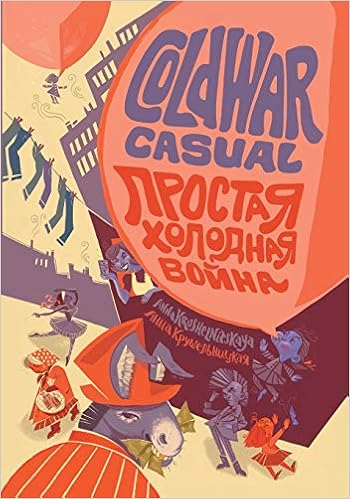
Anna Krushelnitskaya’s book, Cold War Casual/Простая холодная война is a bilingual work that collects oral testimony and interviews about the ways the events of the Cold War and the government propaganda affected people in the US and in the USSR. This seems of tremendous interest to all of us who have lived through that epoch and/or write about it.

Krushelnitskaya has translated the testimony and interviews so that each piece is available in both Russian and English. The announcement reads: “The interviews were conducted in the native languages of the respondents in a casual, friendly format to record the subjective evaluations of the Cold War period in an attempt to establish whether, and how, the lived experiences and memories of the respondents influenced their sense of national pride, instilled a fear of war or the enemy, invited cultural openness or isolation and participated in forming personal long-term ideological stances.”

This books is available for pre-order.

Pub date: October 22, 2019

Publisher: Front Edge Publishing, LLC

Olga Zilberbourg: To Understand Russia’s Complexities, Turn to Its Contemporary Literature

“A FRIEND’S TEN-YEAR-OLD SON son recently came up to me at a party to ask, ‘You’re from Russia, right?’ Sensing caution in my assent, the boy hesitated before asking the next question, clearly trying to phrase it in a way that wouldn’t cause offense but would express his curiosity. He finally came up with, ‘It’s a very violent place, isn’t it?'”

http://epiphanyzine.com/features/understand-russias-complexities?fbclid=IwAR35rzgR1U6dFXsYJM6ueL6nid8S9R6BR0Qr44elOeHnU2HwPtyzVpxJ0RY