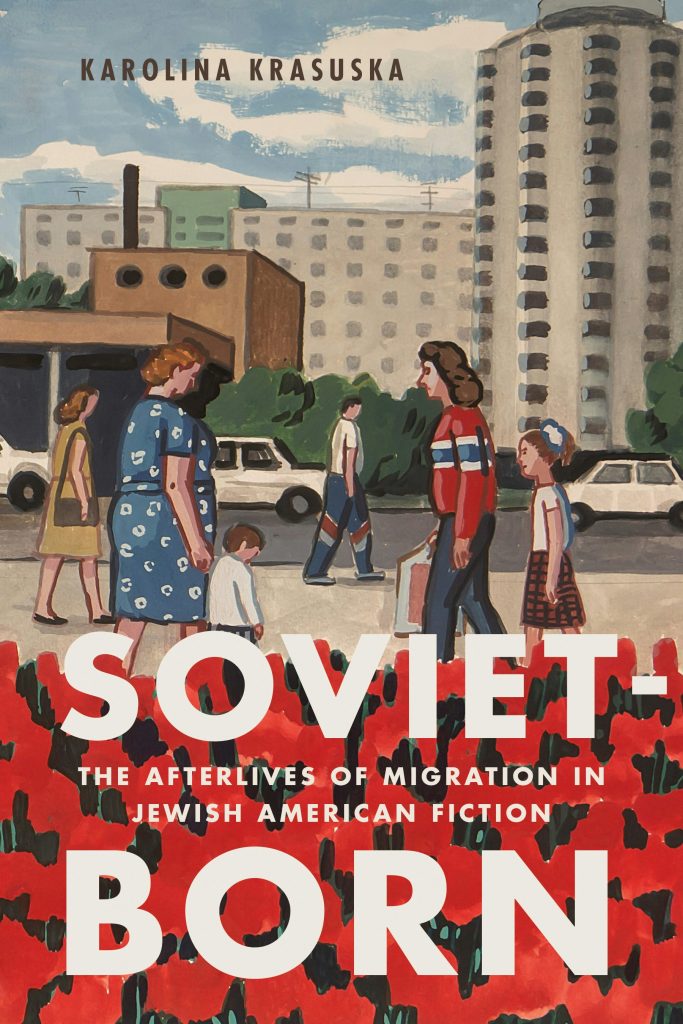
Today we are featuring an excerpt from Soviet-Born: The Afterlives of Migration in Jewish American Fiction (Rutgers UP, 2024) by Karolina Krasuska, associate professor at the American Studies Center and co-founder of the Gender and Sexuality MA Program at the University of Warsaw, Poland. Starting in the early 2000s, Jewish immigrant writers from the former Soviet Union have appeared on the US literary scene in increasing numbers. While Gary Shteyngart, who can give lessons in self-promotion, is the most well known, the list comprises more women, including Lara Vapnyar (a Q&A with whom we have featured on this blog), Anya Ulinich, Irina Reyn, and Ellen Litman, to name only a few. As their books continued to be published, academics began to take note, organizing conference panels and writing on the subject (I am happy to have contributed to this field of study from its inception). The first and foundational monograph was Adrian Wanner’s Out of Russia: Fictions of a New Translingual Diaspora (Northwestern UP, 2011), which discussed the global phenomenon of ex-Soviet immigrant writers in the various countries to which they immigrated. Krasuska’s is the first academic volume specifically devoted to ex-Soviet Jews living and writing in the US, where the largest number of such immigrants resides.
While there are many differences among these writers, a strong commonality is the theme of hybrid cultural and linguistic identities brought about through immigration. In my academic work, I have argued that, despite living in the US and writing in English, these writers cannot be straightforwardly considered part of the American literary tradition due to their sustained emphasis on hybrid immigrant identities; nor can they be squarely fitted into a Jewish-American framework, given the fundamental differences of experience between ex-Soviet and American Jews. As the subtitle of Soviet-Born indicates, Krasuska does place them within the Jewish-American framework, maintaining that they expand and redefine it. As I noted in my review of Soviet-Born, the “question of whether hyphenated writers can be said to expand an existing literary category or constitute a distinct one of their own is a never-ending debate. One may disagree with the book’s premise, yet the argument Krasuska builds from it allows for new and original ways of understanding these writers’ works.” The fact that this debate exists, along with the one about what term to use to refer to these Russian-speaking Jewish writers from various former Soviet republics who now live in the US and write in English, testifies to the richness and diversity of this body of work that, like immigrants themselves, resists easy categorizations.
The excerpt below, from a chapter titled “Soviet Intimacy,” analyzes Lara Vapnyar’s short story, “Lydia’s Grove,” from her first short story collection, There Are Jews in My House (Anchor Books, 2004). This story is one of the few that depicts lesbian relationships in this type of fiction, and Krasuska’s discussion represents how her approach to this literature is “based in feminist and queer theory.”
Queering Peripheries: Lara Vapnyar’s “Lydia’s Grove” by Karolina Krasuska
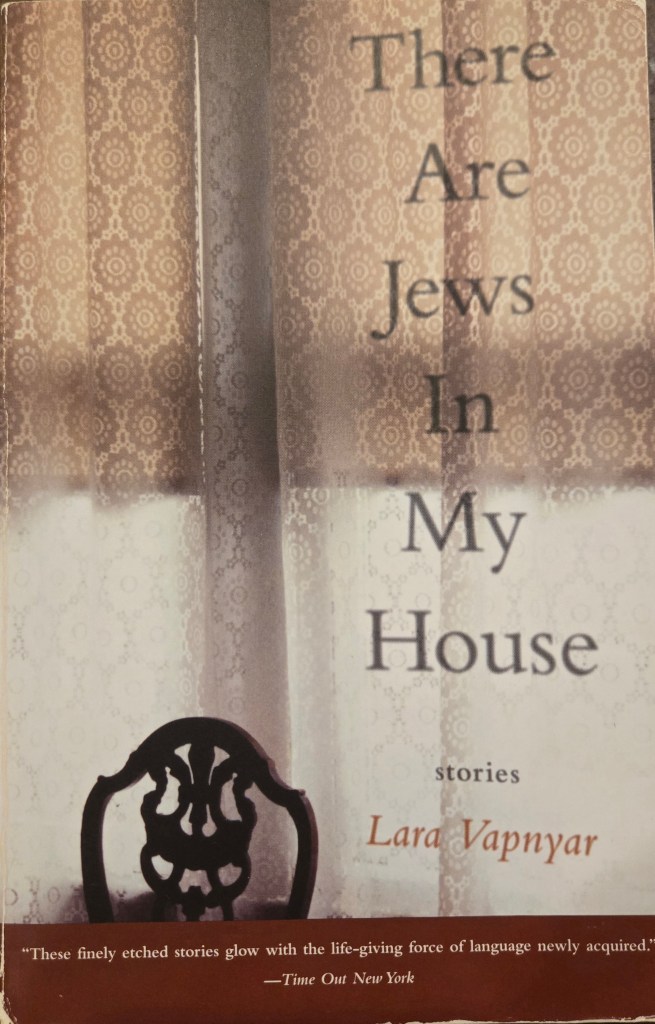
“We did not know anything and they know too much,” is Lara Vapnyar’s quick comparison of sex ed in the late Soviet Union and in the contemporary United States. Vapnyar’s short story “Lydia’s Grove,” from the volume There Are Jews in My House, stages this un-knowledge—specifically with regard to same-sex relationships—from the point of view of a young child. Until more recently, Soviet-born Jewish writing in English has not featured many queer presences. At the same time, queerness has recently become a defining programmatic characteristic of inclusive writerly and activist groups within the post-Soviet diaspora. A combining of non-heteronormativity and womanhood, including trans women as well as non-binary gender identification, is seen, for example, in two recently established collectives. The Cheburashka Collective brings together “women and non-binary writers from the Russian diaspora,” as they write about themselves on Twitter, now known as X. The Kolektiv Goluboy Vagon, meanwhile, defines itself as “Queer & Trans, Gender- Marginalized, Post-Soviet Jewish Immigrant-Settlers.” Creative enterprise, including writing, is one aspect of their progressive activities. In this case, gender/sexuality becomes a key coordinate intersecting with (post-)Sovietness and Jewishness—a configuration that is crucial to Soviet-born writers’ narratives of state-regulated intimacy.
[…]
“Lydia’s Grove” is set in 1980s Moscow and narrated by eight-year-old Lara, who tells the story of the literary partnership between her mother and Lydia Petrovna Rousseau. Across several winter months, every weekend Lara and her mother take long trips by bus and metro to Lydia’s apartment on the peripheries of Moscow—that is, to the titular Lydia’s grove. Lydia and Lara’s mother are coauthors of books for children, published under the shared pen name Veller-Rousseau, combining the names and identities of both authors. Lara’s mother is close to Lydia, bound by a relationship that remains unnamed—is impossible to be named—by Lara. The bond between the two women slowly unravels as a new friend of Lydia’s, Emma, appears on the scene and then moves in with her. The narrator, using Lara’s perspective, notices the multilayered aspect of this relationship, wondering to herself, “Friends sometimes stayed at our house, too, but never for such a long time.”
[…]
This story serves as a model example of the classic narrative involving the homosexual/homosocial continuum among women as described by Eve Kosofsky Sedgwick, in which female friendships with erotic elements are narrated from the naive and unreliable perspective of a child. This sort of epistemological uncertainty regarding relationships between women correlates with the transformative way time and place are presented in “Lydia’s Grove.” Lydia’s home is out of date and ill-fitting with the topography of Moscow as imagined in the story, which aligns with the way queer spaces are theorized. The apartment is carefully presented in ways that make it seem odd: situated far from the city center, clearly set apart from “where we lived,” as if in some “fairy tale.” The old-fashioned yet elegant furnishings, dark carved wood upholstered in satin, contrast sharply with the typical “Moscow apartments.” At the same time, the story utilizes familiar tropes of unproductive bodies floating about aesthetic delights, tropes that are characteristic of queer fantasies, especially those from the turn of the twentieth century. Lydia herself embodies a wholly elegant aesthete, at nights “wearing dark pants and soft white blouses, often with a big opal brooch.” Emma, Lydia’s younger friend, is a stereotypical representation of womanly apathy from the early twentieth century. Dressed in kimonos or flowery pajamas, she wanders around the apartment with never-ending migraines, hugging a pet dog: she is beautiful, yet useless. Meals consumed in “Lydia’s Grove” do not serve the needs of nutrition but are a source of exotic, sensual delight: for Lara, these are dishes with “unknown subtle flavors,” bought in delicatessens rather than cooked at home because Lydia considers cooking too ordinary and a waste of time.
Vapnyar moves beyond the dominant Russian or more broadly Soviet era socialist gender templates based on productivity, according to which working mothers are dutifully bound to serve their men. Working mothers embody a gender stereotype that is “etacratic”: they are figures with the ability to be both demographically and economically productive for the benefit of the state. The Soviet regime actively promoted motherhood in ways that allowed women to work professionally: daycare centers were developed, encouraging women to have children. The female characters in “Lydia’s Grove” create a network of dependencies supporting and at the same time surpassing state-sanctioned templates. Lara’s mother makes superficial efforts to be the ideal working mother; Lydia, by cooperating with her, helps create a doubly productive motherhood. The romantic relationships between women demonstrate an aspect of intimacy that creates a network of supportive interdependence, going beyond state-prescribed models that ignore individual, corporeal, and sexual pleasures (and the right to choose them). While the unspoken partnership between Lara’s mother and Lydia adheres to the state-sanctioned ideal, the relations between Lydia and Emma directly represent “bourgeois” flaws that have no place in the workaday, party-approved collective.
By setting the story in a stylized private home—a heterotopia in the standard Russian gender framework—on the outskirts of Moscow, Vapnyar does not create a model narration that treats queer presence as something untimely and inappropriate, on the borders of nonexistence, as it might at first appear, but rather refers to the idealized gender patterns of late-Soviet socialism. Oral histories reveal that late-Soviet lesbian circles often met in private homes. In that context, Vapnyar’s short story is an attempt to extract an anachronistically queer time and queer space that opposes state-sanctioned norms based on modernization and productivity, but that also supports some of the state’s partially emancipatory ideals.

Karolina Krasuska is an associate professor at the American Studies Center at the University of Warsaw, Poland and a co-founder of the Gender and Sexuality MA Program at the University of Warsaw. She is the author of Soviet-Born: The Afterlives of Migration in Jewish American Fiction, a coeditor of Women and the Holocaust: New Perspectives and Challenges, and the Polish translator of Judith Butler’s Gender Trouble.

 Punctured Lines
One thought on “Queering Peripheries: Lara Vapnyar’s “Lydia’s Grove”: Soviet-Born: The Afterlives of Migration in Jewish American Fiction by Karolina Krasuska”