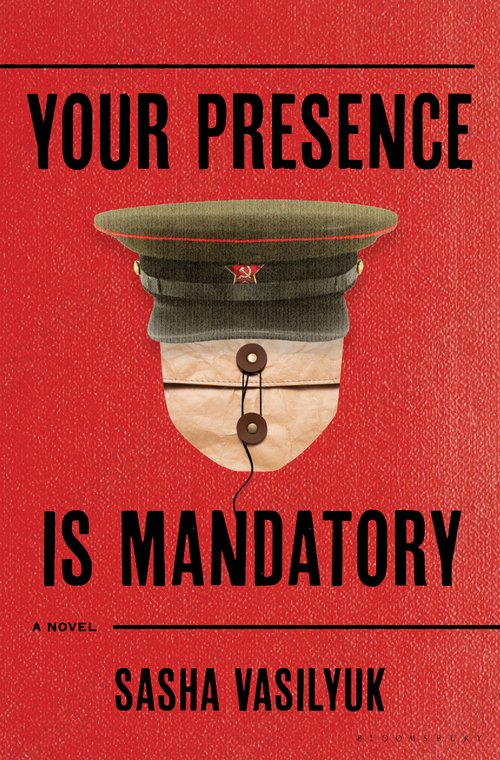
A new novel set in World War II enters a crowded and hotly contested field. It is a particularly remarkable feat for a debut novelist that Sasha Vasilyuk’s Your Presence Is Mandatory (Bloomsbury, 2024) earned universal praise from celebrated writers across the former USSR diaspora community and far beyond. Gary Shteyngart wrote, “Wonderfully written, elegiac and necessary, Sasha Vasilyuk uncovers the history behind the recent headlines with great skill and grace.” Susanne Pari, author of In the Time of Our History and The Fortune Catcher, wrote, “An outstanding novel of sacrifice, love, and forgiveness.”
We celebrate this novel’s arrival with particular pleasure. A contributor to Punctured Lines, Vasilyuk participated in a number of events we’ve hosted over the years, and we’ve heard excerpts from this novel as she was working on one draft after another. In May 2024, Olga Zilberbourg interviewed Vasilyuk during a book release event at Telegraph Hill Books in San Francisco. The following Q&A is a follow-up to that in-person conversation.
Olga Zilberbourg: Your Presence Is Mandatory opens in the city of Donetsk, Ukraine in 2007. After a man’s death, his wife and daughter find a document from decades earlier that turns out to be his confession letter to the KGB. His family knew Yefim as a hero of World War II, a man who fought Nazis and had marched with the Red Army all the way to Berlin. It turns out that the reality of his military service was much different than his family had imagined.
Opening the book with the death of a central character seems to be one of those risky moves that craft books always tell writers to avoid. What inspired you to open the novel with Yefim’s death?
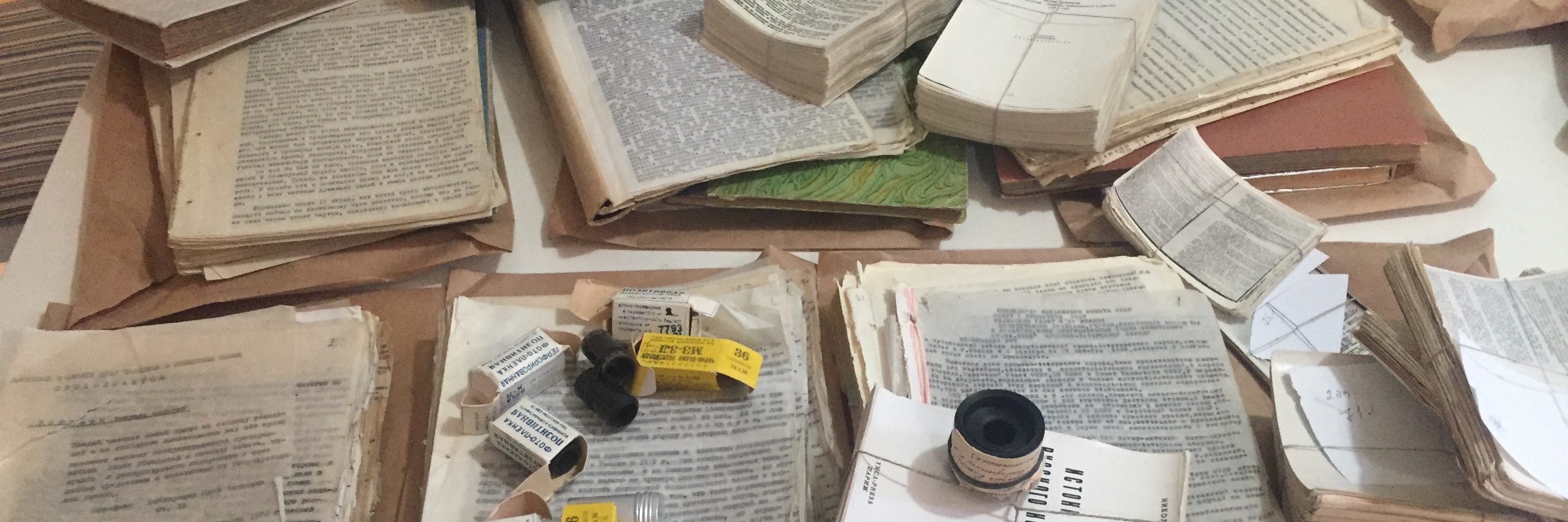
Sasha Vasilyuk: American craft advice can so often be too prescriptive. But everything depends on the individual storyline, doesn’t it? For me, the inspiration for this novel came from the moment after my grandfather’s death when my grandmother found his confession letter to the KGB that unraveled all we knew about him. That experience begat so many questions: What did he sacrifice to survive the war? Why did he hide what happened to him? What effect does a lifetime of secrecy have on a person and on their loved ones? And, more generally, how does a society built on secrecy, fear, and shame function and what does it leave in its wake?
Olga Zilberbourg: I love the way you illustrate that death can also be a beginning. In this way, this book is similar to a detective story, and we get to investigate Yefim’s life. His war experiences are told in alternating chapters throughout this novel. In June 1941, shortly before the German army attacked the Soviet Union, drawing the USSR into WWII, Yefim is a fresh conscript into the Red Army. He’s assigned to an artillery unit and is stationed in Soviet-occupied Lithuania. Within the first days of the war, his unit is surrounded, he suffers an injury and is captured by German troops, becoming a POW.
What circumstances do you think have contributed to Yefim’s survival in the war? What character qualities might have served him best?
Sasha Vasilyuk: So the question of survival is an interesting one because in my research I saw that luck played a huge role in why certain people survived. But luck, obviously, isn’t a character quality and you can’t really build a solid novel around a character who just keeps getting lucky.
In my research, I was horrified to find out that Jewish POWs were often just as afraid of their Soviet comrades as of Nazi guards. Having to hide your identity from your fellow prisoners gave me a very different understanding of Soviet society. To clarify, this wasn’t just a function of antisemitism. There were other examples of Soviets giving each other up for various reasons. For me, who was fed this Soviet slogan about “friendship of the peoples,” it was quite a shock to realize how fractured Soviet society actually was in the 1940s. I suppose the Russia-Ukraine war is the final breakdown of that illusion of friendship.
But I digress. Given this context, one of the things that helped POWs survive the camps was friendship. Having a small network of close friends made a big difference in their ability to outlast hunger, cold, disease, etc. It meant everything to know that someone had your back. Humor is another one. As you know, humor was essential in living a Soviet life.
Another survival technique—and this is more of a hunch—but I think surviving the famine as a child, as Yefim does with Holodomor, made you physically and mentally sturdier, so that when you faced extreme hunger as a POW, your body and mind were less susceptible to it.
Olga Zilberbourg: One thing that I found particularly endearing about Yefim was that he has a lot of empathy for the average German people. He develops something of a relationship with his boss’s son, a young boy whom he offers to train in the use of machine tools. Yefim also develops a relationship with a young German woman. What motivated you to include these scenes in the novel?
Sasha Vasilyuk: I didn’t think the world needed another WWII novel full of evil, screaming Nazis and their good-natured Allied victims. There was a lot more gray in the war that with time is easy to forget. Just as the Soviets who gave each other up, the Germans also came in a full spectrum of good to evil. Because that’s how life is, right? Very few people are full Hitler or full Gandhi.
Since Yefim spends a decent part of his war years as a forced laborer—or Ostarbeiter—I learned from reading firsthand accounts that these laborers often lived in close proximity with the Germans. Many young Soviet women worked as nannies in Germany, for example, so you can imagine they experienced a full spectrum of interactions with their employers.
It was important for me to have all this nuance in my novel, so I threw these characters at Yefim to see what relationship they end up building. While the German woman character is entirely fictional, the boy is actually based on the real boy who is still alive today, though my attempts to reach him have failed.
Olga Zilberbourg: The Soviet Union treated its citizens who were suspected of having had interactions with the Germans as potential traitors. So, people in POW camps and people who were forced laborers in German-occupied territories were later forced through a filtration process in the USSR, as a result of which many ended up in Soviet labor camps. Yefim eventually rejoins the Red Army and goes through this process. However, he manages to avoid the GULAG with the help of a lie: he withholds information about having been a prisoner of war.
This is the key lie on which the rest of the novel is based, and we get to see the way this lie reverberates through all aspects of Yefim’s life, affecting all of his relationships.
I know this episode is also part of your family history and the impetus behind writing this novel. But sometimes the truest of personal stories sound too farfetched when we try to bring them into fiction. Did you find it challenging to convince your early readers in the significance of this story arc?
Sasha Vasilyuk: Not really. I think a character with a secret is a pretty easy sell for readers. The bigger challenge was cultural. Any Soviet-born person knows—even if not in detail—that a POW was something shameful. Even for my generation, having a grandpa who “sat out the war,” as was common to say about captive soldiers, was something you didn’t want to advertise. But to a Western audience, a POW is a hero. People think of John McCain, for example. That’s a pretty huge cultural discrepancy and turned into one of my biggest challenges because I wanted this book to work for both Western and post-Soviet audiences. So I had to make a lot of decisions as to how much to show or explain.
Olga Zilberbourg: To return to the question of structure, the book is told in alternating chapters, one part of which recounts Yefim’s war experiences, but the other part of it is told from the point of view of his wife Nina, his children, and a granddaughter. Do you think of this book as Yefim’s story first and foremost, or do you think of it as a story of a family? How did the book’s structure emerge in the writing process? Were some of these points of view harder to write than others?
Sasha Vasilyuk: At first, this was primarily Yefim’s story, both in the war and in the post-war chapters. But the arc always began and ended with Nina, who brings us into the story and then outlives her husband to witness the start of the Russia-Ukraine war. I wanted to explore the price of secrecy on the generations of the family, but in the first couple of drafts it was still largely happening from Yefim’s point of view (POV). Mostly because I couldn’t figure out how to portray him hiding something from the point of view of someone else who isn’t even aware that something is being hidden.
Then I began to bring in more Nina because as a Ukrainian and a woman she had her own interesting story to tell. My editor at Bloomsbury encouraged me to rewrite a couple of chapters, including the one where Nina and Yefim first meet, from Nina’s POV just to see how it works. And it worked great! I also had one chapter that works like a split screen in a movie, where we alternate between what’s happening with Yefim and with Nina on the same day.
Eventually, I gave each of my characters, including the two children and the granddaughter who get a chapter each, a secret because I’m very interested in the idea of why we keep things from those we love. A chapter written from the POV of Yefim’s teenage daughter Vita in the 1960s was my last challenge. I just felt like I couldn’t get her story to be dramatic or propelling enough. Then, I gave her a problematic, kind of slutty classmate, which somehow helped bring her more to life. Now I think that’s one of my favorite POVs.
Olga Zilberbourg: One particular irony I loved at the beginning of the book is that when Nina and Yefim first meet, Nina remarks on his honesty: “She liked how honest he was. Most vets she had come across didn’t talk about the war with such ease.” Of course, he talks so easily about his experiences in the war because he’s lying, but by the time she fully catches on to how inspired of a liar he is, they are already married and have children.
Later on, we learn that not only is Yefim an inspired liar, Nina is also very good at closing her eyes to truths she doesn’t want to know. I found it fascinating the way the two qualities combined allowed this couple to stay together and to weather the difficulties of a long-term marriage. How do you evaluate their relationship? Do you think of theirs as a happy marriage?
Sasha Vasilyuk: Ha! I wouldn’t call it a happy marriage, no, but a complex one with its twists and turns. I think to survive as a couple for half a century you often need to close your eyes to certain things. And of course, in that generation, where abortion was temporarily illegal and divorce wasn’t popular, that was even more important. Nina is a pretty independent woman in many ways even if she pines for a more romantic, closer bond. And I actually think that’s a very common experience of Eastern European women. They crave Big Love that they see in books and movies, but often settle for having a man at all, especially after the war when there was a huge disbalance of genders. Then they work and cook and clean and raise kids, while the men often do less than half of that, often succumbing to depression and alcoholism. Nina understands that Yefim isn’t a bad husband and to her, family unity trumps romance. Their marriage becomes centered around commitment and endurance, about supporting each other in domestic ways, about parenting and grandparenting together. It isn’t based on intimacy and tenderness. And it is only after Yefim’s passing that Nina reassesses why he was the way he was.
Olga Zilberbourg: I was very impressed with how you prepared us for Yefim’s confession to the KGB. As you say in the novel, nobody ever confesses to the KGB, and yet Yefim did, and you allow us to understand how the years of lying to his wife and family wore him down. It feels particularly brave that you actually represent his meeting with a KGB officer, where Yefim delivers his confession. How did you decide to write this scene and what were your goals with it?
Sasha Vasilyuk: Oh, I loved writing that scene. A good old confrontation of the hero and a representative of the nebulous evil power that had held him captive for years. What is Soviet life without the fear that you might end up in that chair? Even if you’ve never experienced that scene yourself, you somehow absorb that fear of authority with your mother’s milk. That’s why I so love that essay of yours, “Quieter Than Water, Lower Than Grass.” It really helped spell out the fear I’d always felt every time I got off the plane in Moscow.
The particular twist on my KGB scene is that it’s happening in the mid-80s during the USSR’s decline, not during Stalin’s reign of terror. So it was interesting for me to play with the fear and with how Yefim would try to get out of his predicament, given that he’s lived in his country long enough to understand how the authorities think.
By the way, for a modern twist on this scene, I’d recommend Andrey Kurkov’s Grey Bees which takes place in Crimea after its 2014 annexation.
Olga Zilberbourg: To many people in the US, the USSR feels like a known quality, like a place and time that they have read and heard a lot about, and about which hardly anything else is worth finding out. When writing about the USSR for a US-based audience, were you aware of working against particularly pernicious stereotypes?
Sasha Vasilyuk: That’s funny because I think Americans know very little about life in the USSR. Just as we, living during its end, still know so little. This project was a way to educate myself on my country’s history outside of how it was taught to me by our state-sanctioned school program. But you’re right about the stereotypes. Many Americans visualize the USSR as a black and white image of a bread line and a giant Communist poster. The poems, the humor, the movies, the summer dachas—all those things that play such a huge role in our memories aren’t part of what they see. With Your Presence Is Mandatory, I wanted to show them Soviet and post-Soviet life in all its variety, in its domesticity and preoccupations that aren’t stereotypically Soviet, but human.
Olga Zilberbourg: How did the context of Russia’s ongoing war on Ukraine affect your work on this novel?
Sasha Vasilyuk: The war, which began in the Donbas in 2014 and turned my family into refugees, was a catalyst for me writing this novel, but of course I didn’t anticipate it would grow into a full-scale invasion. I was finishing my last draft in February 2022, preparing it for agents. Once the war began, things with the book happened very quickly. Though the book was complete by then, the full-scale invasion changed certain ways I was looking at my work. It made me want to give more space to the Ukrainian experience beyond WWII and beyond the Soviet narrative—especially to Holodomor, to the question of languages, and to the relationship between Russia and Ukraine after they became separate countries. Since Nina now had a bigger part in the book, I could weave in more stories that reflected that history. I also carefully relooked at every place name and minor character to determine whether they should be spelled in a Russian or Ukrainian way.
A couple of times, I got asked why my book jacket refers to “the Russia-Ukraine conflict” rather than “war,” so I’d like to address it here. Because the book ends in the Donbas in 2015, saying “Russia-Ukraine war” might have given readers the wrong idea that it goes all the way to the full-scale invasion of 2022, so we chose “conflict” to indicate the earlier regional version of this war. So far, readers from the post-Soviet community have reacted very positively to my novel. It often brings up a lot of emotions and questions around their own family stories. I really hope this novel reaches more readers from Eastern Europe. It is my dream that it is translated into Ukrainian and Russian, and, obviously, that this barbaric war ends soon.

Sasha Vasilyuk is a journalist and author of a debut novel, Your Presence Is Mandatory (Bloomsbury), which is longlisted for the Center for Fiction First Novel Prize and is forthcoming in Italy, France, Germany, Israel, Finland, and Brazil. Sasha grew up between Ukraine and Russia before immigrating to San Francisco at the age of 13. She graduated from Lowell high school and received a BA from UC Berkeley and an MA in journalism from New York University. Her nonfiction has been published in the New York Times, CNN, Time, Harper’s Bazaar, San Francisco Chronicle, USA Today, Los Angeles Times, KQED, and elsewhere. She lives in San Francisco with her husband and children.

 Punctured Lines
thank you for this wonderful conversation, Olga!
LikeLike