Poetry of Place and Displacement: A Q&A with Natalya Sukhonos by Valerie Bandura

Natalya Sukhonos’ third collection of poems, Sunlight Trapped in Stone (Green Writers Press, 2026), is an act of witness. At the center of the book are questions about history and place in the face of loss and displacement. Sukhonos was born in Odesa, Ukraine, and immigrated to the U.S. at the age of nine. The immigrant experience, its practical struggles, and the sense of belonging to multiple communities, languages, and histories is explored in each poem, most poignantly expressed in “Tunnel Vision”: “We’re all intact, but barely.”
Sukhonos introduces us to an intimate album of characters and visceral images: a grandfather reliving the past through Soviet-era movies, the hands of a mother raising her dead child from the crib, old women shelling sunflower seeds in a chestnut-lined courtyard, and the sweetness of apricot ice cream. These poems describe the past as vividly present, passing forward intergenerational trauma as much as creating a historical record.

With a Ph.D. in Comparative Literature and experience teaching at Harvard and Stanford, Sukhonos is also a translator. Her previous work translating the testimonies of Ukrainians during Russia’s invasion contextualizes her own family history. Memory and the immigrant experience are recorded by language and transformed by it.

Each poem, like her parachutist grandfather’s urgent Morse code messages transmitted to an unknown audience while falling through air, enacts the hope of reaching out to another, and at the same time to the other in the self.

It’s my pleasure to explore this work through the questions below.

— Valerie Bandura

Valerie Bandura: In language both conversational and reverent, Sunlight Trapped in Stone creates space for otherness and assimilation. In “Tunnel Vision,” you imagine your younger self “who promised she’ll always belong to Odesa and never wear jeans” despite becoming “another girl: confident, cat-eyed, spilling with stories.” And yet, despite the loss of your country of origin, you still remain deeply connected to its history. For example, in “Parachute,” I’m struck by your compassionate approach to violence: “Ukraine’s black earth, good for harvest / is so broken it bleeds.” Each immigrant has their own solution for a hybrid identity. How has your immigrant experience informed your identity? Has writing this book changed that identity for you?

At nine months old, I’m ensconced between my grandparents — grandpa Andrei and grandma Galya. Galya could be stoic but she made the best dumplings, adored math, and let me turn her white tablecloth into a bridal veil. Tragically, she died of lung cancer when I was only five years old.

Natalya Sukhonos: Being an immigrant allows you to navigate multiple cultures, languages, and identities. My childhood in the Soviet Union and then independent Ukraine has enriched me not merely with a plethora of sounds, smells, textures, and tastes but also with the stories of others like my grandfather, who was a paratrooper in World War II, or my taciturn grandmother, who was obsessed with math but never got the chance to study it at a higher level. At the same time, after I came to the U.S. at age nine, I also witnessed some of the indignities of immigration, the way that it led some, like my gregarious father, to a loss of self. The “cat-eyed” girl in “Tunnel Vision” is actually my daughter, who a year ago was roughly the same age as I was when I immigrated. It’s often refreshing to see how utterly unlike she is from me at her age, how confident she is in her own skin. Writing this book has made me revisit the stories of immigration, to revel in them, to embrace the ambiguities that drive the characters in my pages, to contemplate the very notion of the journey.

Valerie Bandura: In “Dreaming Odesa,” you refer to your own childhood: “So much of her childhood seems to take flight / in passageways, doors, tunnels to another world. Everything / is foreign, everything is familiar.” The image itself is a doorway to the past and also to how memory works in both “foreign” yet “familiar” spaces. Here is the lived experience and an introduction to the book’s subject. How has memory directed the poems in this book? Does memory for an immigrant behave in particular ways?

Natalya Sukhonos: Most of my poems are narrative poems, so they are naturally driven and created by memory. Even though memory is often a catalogue of losses (as in Bishop’s “One Art” and my homage to her poem, “After Bishop”), paradoxically it acts to revitalize and lovingly recreate on the page the people, places, and things lost in the real world. What’s at stake in my work is a reckoning with the ways in which, through the prisms of memory, art can be a way to confront the often traumatic losses of the past — both an individual’s past and the past of a nation. The collection plays with the metaphor of amber to this effect, as amber helps to preserve what’s been lost in the natural world. The memory of an immigrant is nostalgic, fickle, and playful, just as that of an artist. We remember what we’ve left behind, like the tropical dragonfly that strayed into an Odesa train station, but we also transform our memories into a talisman, an omen, or a symbol. The dragonfly in question, for instance, becomes a symbol of estrangement, the very feeling that would accompany me a few years later in New York City as a recent immigrant, but before I wrote this poem, I wouldn’t have made the connection between my own feelings of alienation and the dragonfly that swooped upon us from a far-away land. Such is the alchemy of artistic practice.  

Valerie Bandura: The book explores tensions between love and loss, tenderness and heartbreak. There are examples of intergenerational estrangement alongside moments of intimacy, such as a grandmother making dumplings with her granddaughter despite a strained relationship with her daughter. How do these family tensions reflect intergenerational trauma, the immigrant experience, or broader Ukrainian history?

This is my great-aunt, Alexandra Tishchenko. I’m barely ten and I’m literally in the shadow of her motherly, protective presence. Aunt Sasha, as we all called her, was by turns a seamstress, agriculturalist, eternal playmate, storyteller, and artist. She made cards with delicate compositions with dry flowers, and had a generous spirit attuned to art, nature, and spirituality.

Natalya Sukhonos: The trauma reflected in “Symmetries of Loss” reflects a mismatch between the aspirations and expectations of different generations, my mother’s and her mother’s. My mom got the chance to fulfill her aspirations of a successful career in teaching and theater, whereas her mother, my grandmother, didn’t get to pursue her passion for mathematics beyond teaching it at the local one-room village school. The cause for this was the tragedy at the core of Ukraine’s history in the 20th century — the experience of Holodomor. Because of the man-made famine in Ukraine in the 1930s and its consequences into the 40s and beyond, grandma Galya never had a chance to study at a higher level. So much of her daily experience revolved around survival.

And in “Aunt Sasha’s Dementia,” my beloved great-aunt cannot stop feeding the phantom children who crowd her bed, even though she has long since left behind the dearth of her own childhood in 1930s Ukraine.  Of course, as the poem above demonstrates, historical traumas don’t subside but rather continue and even become exacerbated with immigration. Thus, the process of writing these poems really made me reflect on the rough hewing of my father’s core self after immigration. It was heartbreaking for me to think of how his love of music only sparkled in certain moments in his life in NYC and was generally buried under the need to make money and a new career in real estate. In a more general way, at the beginning of the full-scale invasion of Ukraine, I became acutely aware of the lacunae in my own knowledge of Ukrainian language, as well as Ukrainian history and literature, and this is its own kind of trauma.

Valerie Bandura: I’m interested in the book’s intentional specificity and variety densely accumulated throughout the poems; these qualities suggest to me a sensibility of place that is both tactile and conceptual, perhaps in addition to an abstract sensibility of place. Yes, Odesa, but also the Black Sea, Cathedral Square, Bath Beach, the Solnechnaya Train Station, the “green-eyed” Volga River, the “graffitied” Lincoln Tunnel, and Lake Ladoga and its nearby Valaam Monastery. How do these places evoke physical, emotional, or political resonances for you, and how do you approach the specificity of place in your work?

Natalya Sukhonos: For me, place is fundamental to the way we conceive of ourselves and our lives. My previous book was called A Stranger Home, so that gives you an idea. I think that being specific about particular places in Odesa, such as Cathedral Square or the Solnechnaya Train Station has allowed me to focus on the visceral details of my childhood memories of those places without giving way to nostalgia in labeling it all “Odesa.” Places in New York City are often laden with pain as they get associated with my mother’s death in 2017, but it’s more complicated than that. New York was also exhilarating to me as a young immigrant, and it’s the place where one daughter was born and another was a toddler, so my recollection of the city is bittersweet. Other places like the Volga, Lake Ladoga, Valaam Monastery, and Poltava, for that matter, are real places that have emotional significance because they hold my family’s stories or the stories of other Ukrainians, so I try to balance places that are dear to me with those important to a wider community that I evoke in my poems.

Valerie Bandura: As a translator, you also invite the reader into the intimate experiences of those living through the war in Ukraine. In “Journey through Ladoga,” we see “corpses lying in the street” and “people delirious after eating sawdust, carpenter’s glue, / library paste, window putty, and plaster.” In “My Love, My Home, My Earth,” a soldier’s wife tends the wounds of her husband returned from the war in Ukraine. How do these experiences of history sharpen or complicate our understanding of the private poems of family?

Natalya Sukhonos: I wrote the war poems after I became engaged in the Writings from the War translation project during the full-scale invasion. I began editing and eventually translating the testimony of ordinary Ukrainians who were living through the war, and my translations made their way into my poetry collection. The truth is, “Journey through Ladoga” and “My Love, My Home, My Earth” both illustrate stories of wartime Ukrainians in ways that are very intimate. In the former, a woman tells the story of how her grandfather helped Russians during the Leningrad Siege, and the horrific details she shares about his heroism in the face of hunger and strife serve as an ironic contrast to Russian barbarism towards Ukrainians in the present war. My Ukrainian grandfather also served in World War II, so I felt a real connection to this story. And “My Love, My Home, My Earth” is about tending to a wounded lover, but it’s also about the tenderness that the narrator feels towards her ravaged home. As an immigrant and someone who has moved several times across the country, I found this especially poignant. These experiences of ordinary Ukrainians broaden my sense of community and complicate my sense of home.

Valerie Bandura: Poetry’s superpower is the immediacy of the subjective experience of the first-person point of view. Like journalism, the private, lived moment engages the reader emotionally with sociopolitical issues. So I’m really interested in your choice of using the first-person point of view for transforming the lived experiences of others, as in the poems mentioned above. Are they persona poems for you, ways of talking about yourself through the lives of others?

Natalya Sukhonos: I love persona poems in that they make you privy to another’s consciousness and experience. When I was in Nova Scotia in the summer of 2024, I was really struck by the artifacts displayed along with the stories of British children transported to safety in Halifax during the Second World War. Their stories of escape, strife, and the necessity of building a new life resonated with me because they were reminiscent of the Kindertransport, the organized rescue effort of Jewish children from Nazi-controlled territory in 1938-1939. It was also interesting to note the differences: the children in the Canadian Museum of Immigration at Pier 21 were not Jewish and thus were not in immediate danger, but their parents were perspicacious enough to perceive that they would be in danger should the Nazis conquer the UK. My older daughter was almost ten at the time, the age of one of the children whose story was told at the museum, and I really enjoyed doing some archival research in order to get the Canadian refugees’ full story.

Valerie Bandura: So many vivid, visceral, consequential stories. In these conversational narrative poems, many use the long line. Lately, more poets are turning to memoir. Have you considered nonfiction, or even short- or long-form fiction?

Natalya Sukhonos: Between my 9-5 work schedule and caring for my two young daughters, I hardly have the time and mind space to devote to something long-form, such as memoir or fiction. Plus, the associative logic particular to my way of thinking lends itself more easily to poetry. But I did have a great time writing this piece almost eight years ago about the influence of Soviet songs on my childhood, and I might write something like this again!

I’m about nine months old in the photo, and my sister — nine years old. Beaming in the picture, my mother was a drama professor at the time. Though he looks a bit stern here, my dad Yakov Korenfeld was one of the leaders of the Klub Veselikh i Nakhodchivikh in Odesa at the time. It was a team comedy club that, much later, contributed to Zelenskyy’s fame and rise to power.

Valerie Bandura: Often poets repeat words and images as a kind of private myth-making, idiosyncratic language that textures the work. Mandelshtam’s sky (nebo) imagery suggests the limitless indifference of an existential void, perhaps as a critique of closed political systems. Paul Celan’s snow has been associated with a state of memorylessness, an erasure of history. I notice that Sunlight Trapped in a Stone contains various foods, the sounds and imagery of weaponry, and so many hands. Could you describe the significance for you of these echoes of words and images?

Natalya Sukhonos: I love to think of poetry as a kind of play with patterns, and I love that some of these patterns are apparent to the reader. Food is very significant for this collection, especially for the Ukrainian poems, as apples, dumplings, and apricot ice cream are all little madeleines that compress significant moments in my life or my family history into one sensory moment. And hands evoke connection, affection, and the importance of bodily presence. I hadn’t noticed the prevalence of weaponry, but it makes sense, given that a lot of my poems are poems of war and confrontation.

Valerie Bandura: Some of the poems reference other writers and political figures, such as Gogol, Chekhov, Elizabeth Bishop, and figures in Greek mythology. Which writers or thinkers would you say have most influenced your poems? Which do you turn to these days for your artistic direction?

Natalya Sukhonos: I’m influenced by the lyricism of Jack Gilbert, the spare poetics of Mark Strand, the musicality of Pasternak and Akhmatova. I’m also fascinated by the fierce feminism and lyricism of Ukrainian thinkers like Oksana Zabuzhko and contemporary Ukrainian poets such as Lyuba Yakimchuk and Yuliya Musakovska. I would like to delve more into Ukrainian literature, especially writers such as Ivan Franko and Lesya Ukrainka.

Valerie Bandura: Are there themes you find yourself returning to in multiple projects? Can you introduce us to your next project?

Natalya Sukhonos: Yes — the inscrutability of the self and the paradoxes of home; children and journeys; the serendipity of encounter; the voices of nature. My next project is an exploration of the ways in which the self is peopled by other selves, animals, specters, and other creatures.

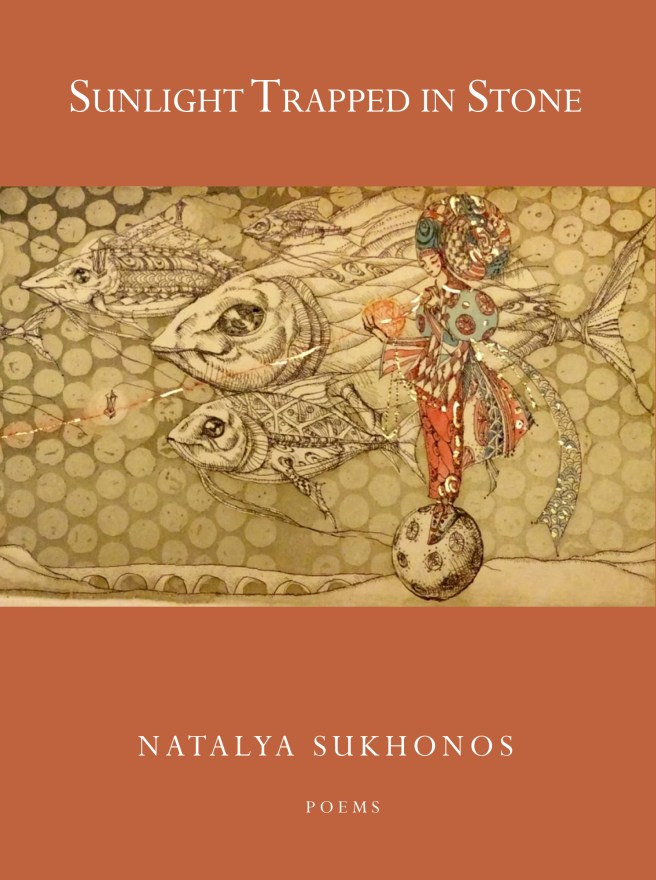
PL: Order your copy of Sunlight Trapped in Stone from Green Writers Press.

A native of Odesa, Ukraine, Natalya Sukhonos is multilingual, speaking Russian, English, as well as Ukrainian, Spanish, French, Portuguese, and Italian. She holds a PhD in Comparative Literature from Harvard. Beyond Odesa, she has lived in New York City, New Haven, Madrid, Boston, Rio de Janeiro, San Francisco, and Istanbul. Natalya is a poet, scholar, and teacher deeply committed to the power of language to uplift, inspire, and defamiliarize us from the ordinary. Natalya is equally comfortable teaching literature and creative writing to children as well as to college students and older adults. Nominated for the Pushcart Prize in 2015 and 2020 and the Best New Poets Anthology of 2015, Natalya was a finalist for the June 2025 Reading Period of the Black Lawrence Immigrant Writing Series. She came out with Parachute in 2016 (Kelsay Books of Aldrich Press) and A Stranger Home (Moon Pie Press) in 2020. Natalya loves to experiment with poetic forms, space on the page, and multilingual writing. Sunlight Trapped in Stone (Green Writers Press, 2026) is her third book. Natalya lives in beautiful Upstate New York with her husband, Ian Ross Singleton, and her two children.

Born in Odesa, Ukraine, Valerie Bandura is the author of Human Interest (Black Lawrence Press) and Freak Show (Black Lawrence Press), Editor’s Selection for the St. Lawrence Book Award, Runner Up for the Brittingham Poetry Award, and a Paterson Poetry Prize finalist. Bandura has received grants, fellowships, and residencies from the Arizona Commission on the Arts, Warren Wilson College, the Vermont Studio Center, and Bread Loaf Writers’ Conference. Her poems have appeared in American Poetry Review, Ploughshares, Gettysburg Review, Beloit Poetry Journal, and others, and received Pushcart Prize nominations. She teaches writing at Arizona State University.