Waiting to Exhale: A Q&A with Natalie Oceanheart, author of Life Beyond Fear: A Ukrainian Woman’s Memoir, by Katya Cengel

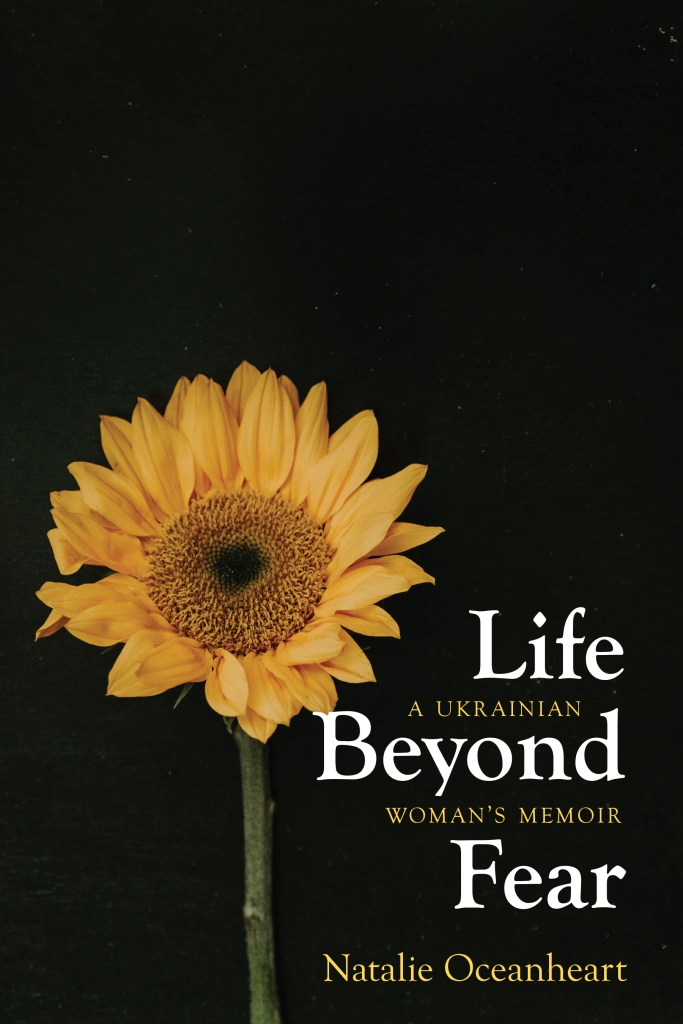
Natalie Oceanheart begins Life Beyond Fear: A Ukrainian Woman’s Memoir (Potomac Books) with the escalation of fighting in Ukraine in 2022. At the time, Oceanheart is just starting out her adult life and yet the choices she makes as a daughter, wife, and mother — as well as a recent college graduate — are made amidst the chaos, despair, and danger of war. Born in eastern Ukraine, Oceanheart experienced the war from Russia’s first hybrid attack in 2014, and she backtracks to explain this, as well as the difficult choices she and her nuclear family make as they become internal refugees and then later leave Ukraine. At its core this is a coming-of-age story, which despite the bleakness of the situation offers hope through Oceanheart’s desire to act as a healer. I hold onto that hope as I once held onto the hope I saw while reporting on the protests that led to the Orange Revolution.

— Katya Cengel

Katya Cengel: In Life Beyond Fear: A Ukrainian Woman’s Memoir, you chronicle your family’s life amidst war. While your focus is on the 2022 escalation, you also include what it was like after the initial Russian aggression in 2014. Why did you feel it was important to describe this time as well?

Natalie Oceanheart: The fighting in 2014 and in 2022 are not two separate wars, but one war that was going on for eight years by the time the escalation came. In 2014, eastern Ukraine was bombed and occupied, while much of the country was not yet directly affected. When 2022 came, it was not a new beginning. It was the same war that had been spreading from the east for years. Only then did the world fully recognize what was happening.

My older daughter has lived in a state of war since she was two years old. She is fourteen now. That is why my memoir begins with 2022 and then moves backward, to show the repeated cycles that started in 2014: war, loss, displacement, and rebuilding life from nothing.

You begin with fear. You go through what seems unimaginable. You start over with one suitcase and try to rebuild your life. And then you go through this cycle once more. I wanted readers to walk through this cycle with me, from the familiar headlines of 2022 back to the often forgotten pain of 2014.

Living through these cycles even now, I can say that life can break you in many ways. But resilience is not about standing straight or looking strong. It is about continuing to stand even when you are exhausted and broken.

Katya Cengel: In 2022 your main identity was not that of a writer. Can you say a bit about why you decided to start writing this account and the role writing played in helping you process the war experience?

Natalie Oceanheart: I was a very creative child and wrote poetry and music. Over time, everyday life pushed creativity into the background. But the idea of writing about my childhood in post-Soviet Ukraine stayed with me.

In 2022, I was focused only on protecting my family. At that time, we were living in central Ukraine, where for many people the war was just beginning. Because we had lived in eastern Ukraine for several years, people often asked us about our experience. Through my volunteer work as a psychologist, I saw how much relief people found in simply talking about what they had lived through. That is when I began to feel a growing need to write about our own experience as well.

After we moved to the United States, this feeling became stronger. Becoming an immigrant made me want to share not only our experience of war, but also the experience of starting a new life in another country. At some point, I realized that I could no longer keep this story inside.

At night, after long workdays, when my children were asleep, I began to write. At first, it did not feel like a book. It became a form of self-therapy for me. Writing helped me endure and move forward.

Katya Cengel: Throughout the book you embark on many journeys, some spiritual, some physical. I want to talk about the physical journeys. As you are forced to relocate, it is clear division exists, especially in how refugees from the east are treated within Ukraine. I imagine this was difficult for you to chronicle. How did you go about handling it?

Natalie Oceanheart: From 2014, when the war reached eastern Ukraine, strong divisions inside the country became more visible. It was difficult to live through and not easy to write about. Ukraine is a large country, and different regions experienced the war in very different ways. This often led to misunderstanding and mistrust between people.

When the first internally displaced families arrived to other parts of Ukraine, many people faced cautious attitudes and closed doors. My family went through this as well. We left one war hoping to find safety, but often found ourselves facing misunderstanding instead.

It was important for me to write about this not to place blame, but to show how war can affect relationships between people inside one country. I wanted to describe how it feels when you escape danger but still do not feel at home among your own people.

Writing about this also helped me better understand the experience myself. I believe that personal stories can bring people closer together. And if my story can help reduce this distance even a little, then it was worth writing.

Katya Cengel: There is a natural human tendency to simplify narratives, especially during times of war, making it difficult to criticize the “good guys.” And yet even those on the right side of history make mistakes. There is a part in the book where you describe how it felt as if the Ukrainian government had abandoned a segment of the population. Can you say more about this?

Natalie Oceanheart: Yes, there are parts of the book where I write about feeling abandoned. In 2014, the Ukrainian government didn’t label what was happening a war. The fighting was officially described as an “anti-terrorist operation.” Because of this, many people felt that their experience was not fully recognized.

A similar feeling returned in 2022, when the full-scale invasion began. There was a lot of uncertainty and very little clear information. Many people did not understand what was happening or what to expect next. In such conditions, it is natural to feel unprotected.

I wrote about this to share what it felt like from the inside. This memoir is about my personal experience and emotions.

Writing these chapters also helped me better understand what we went through and look at it with more compassion, both toward myself and toward others who had to make very difficult decisions at that time.

Katya Cengel: War memoirs often end when the writer leaves the conflict. Your story continues for quite a bit afterwards, showing just how difficult the refugee experience is. Why did you choose to devote almost as much space to life outside Ukraine as inside?

Natalie Oceanheart: Yes, I devoted a lot of attention to immigration because leaving the war was just the beginning of the story.

War is terrible and frightening. But immigration is no less painful. In many ways, it feels like a small loss of an entire world. Your familiar life disappears — your language, daily routines, community, and sense of belonging. You are forced to rebuild yourself in a place where even simple things feel unfamiliar.

I cried more during my first year in the United States than I did during my first year of the war. Even though America is a wonderful country, the emotional weight of starting a new life is very heavy. Losing your home is one kind of grief. Losing your identity, your sense of normal life, and your social connections is another.

It was important for me to show that this part of the story matters too. That survival does not end at the border. That refugees do not step into an easier life.

I wrote about this with one goal: to reach other immigrants wherever they may be and help them feel less alone. There are many things we rarely say out loud — we rarely talk about tiredness and the feeling of being lost — but these are common experiences.

Katya Cengel: I think something that comes across well in your book is how difficult it was for your family to decide whether to leave the country or remain. Within your extended family your parents not only did not leave Ukraine, but they also remained in a particularly dangerous region. For those who have never been faced with this decision, it is hard to understand. As a writer how did you go about conveying this?

Natalie Oceanheart: On the second day of the full-scale invasion, I went to bring my parents from a dangerous area in the east of the country to my home. At first, they lived with us in central Ukraine. Over time, an old family conflict resurfaced. My parents rented an apartment in another part of the city, and we stopped speaking. This added another layer of pain to everything that was happening around us.

The decision to leave the country was one of the hardest in our lives, and it did not come immediately. The turning point came after a terrible tragedy: a nine-story building across from ours was destroyed from the top floor to the basement in seconds. By that time, seven months had passed since our last conversation with my parents.

At first, we moved to the southwest of the country, trying to stay in Ukraine as long as possible. The decision to cross the border came later, during another shelling, when it became clear that staying was no longer safe. When we looked at our children, the decision was no longer abstract. Their safety became the priority.

In my memoir, I tried to show that staying is not always about courage, and leaving is not always about fear. Sometimes, packing your entire life into one suitcase is the hardest step.

People often look for one “right” choice. But war does not give right choices. It only gives the choices you can live with.

Katya Cengel: Without giving anything away, has resettlement become any easier for your family since readers left you at the end of the book?

Natalie Oceanheart: I cannot say that resettlement has become easier. While the war continues, you never fully arrive in a new place. You may live in another country, but a part of you remains at home. It feels like you are living in two places at once. Your body gets used to a new home, but your thoughts and fears stay where your loved ones are living under shelling.

Life has become more stable on the surface — a home, daily routines, school for the children — but emotionally it is still very difficult. Every morning begins with checking the news. Every evening ends with hoping that your loved ones are safe. You learn to live in a divided reality, carrying two worlds inside you at the same time.

One thing that has brought me peace is that my parents and I have reconciled since the events described in the book. We continue to move forward, waiting for the moment when we can finally exhale.

Katya Cengel: Some authors share parts of their memoirs before publication with those included within the text, some do not; what did you do and why?

Natalie Oceanheart: I asked permission from everyone who appears in the memoir. I also asked my children whether they felt comfortable with the moments in which they are included. It was important to me that everyone had a voice in that decision.

Not everyone chose to read the full manuscript, but those closest to the story did: my husband, my brother, and my mother. My husband was the first reader; he has always been my most direct and honest critic.

Some people, such as our sponsors through Uniting for Ukraine, a visa program run by the U.S. government, asked not to be named. I fully respected their decision, and I am deeply grateful that they allowed me to describe the experience itself, without identifying them.

Katya Cengel: What is your next project, literary or otherwise?

Natalie Oceanheart: My next project is already complete. I recently finished a new memoir, Child of the USSR’s Fall, which is currently under consideration. This book is about my childhood in the collapsing Soviet Union and how that experience shaped me and many of the themes that later appeared in Life Beyond Fear.

I have also begun working in fiction. I wrote a thriller about the mysterious disappearances of immigrants in America. It is a story about three friends and how their lives become intertwined. The book explores the fear of being erased and how the lives and work of immigrants often go unnoticed.

Katya Cengel: Is there anything we didn’t discuss that you want to add?

Natalie Oceanheart: I would like to thank you for the opportunity to speak not only about war and immigration, but also about fear, resilience, family, and what ordinary people go through.

Writing a memoir is not easy, and returning to these topics in conversation can also be difficult. But interviews like this remind me that I wrote this book to make sure that the stories and emotions behind the headlines are not forgotten.

Thank you for giving me this space.

Punctured Lines: Buy the book from University of Nebraska Press or wherever books are sold, and please rate and review.

Natalie Oceanheart is a Ukrainian memoirist and novelist, whose work focuses on displacement, identity, and the psychological impact of war. She is the author of Life Beyond Fear: A Ukrainian Woman’s Memoir (Potomac Books / University of Nebraska Press, 2026). Her writing blends literary prose with psychological insight, drawing on personal history and broader social contexts.

Katya Cengel is the author of four non-fiction books covering everything from minor league baseball in Bluegrass Baseball to childhood mental illness in Straitjackets and Lunch Money. Her Eric Hoffer Academic Press award-winning memoir From Chernobyl with Love: Reporting from the Ruins of the Soviet Union chronicles the time she spent reporting from Ukraine earlier this century.