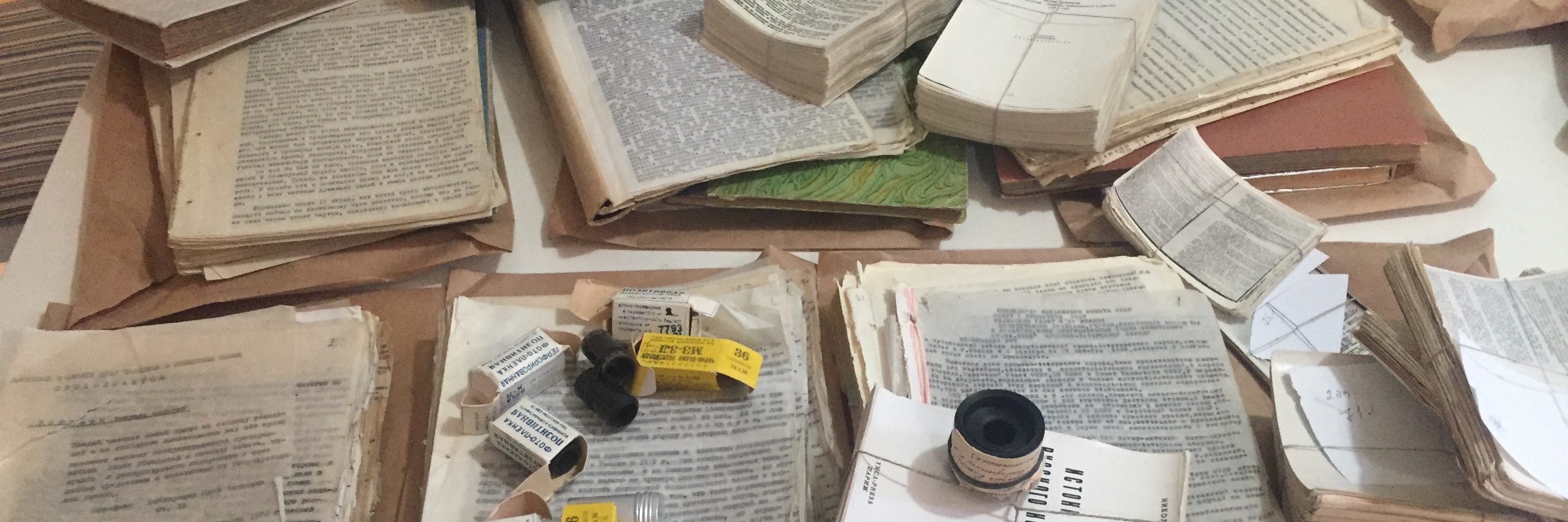
“IN HER INFORMATIVE introduction to Sofia Khvoshchinskaya’s City Folk and Country Folk, Hilde Hoogenboom writes, ‘In the 1860s […] Russia had its own trio of writing sisters. Like the Brontës, the Khvoshchinskaya sisters wrote under male pseudonyms, endured hardships, and lived in the provinces.’ The analogy is fitting, but, as Hoogenboom notes, only to a point: ‘The Brontë sisters became well known not long after their deaths, [but t]he story of the Khvoshchinskaya sisters remains to be told.'” https://lareviewofbooks.org/article/dont-we-know-our-own-minds-a-rediscovered-russian-woman-writer-of-the-19th-century/
Category: Fiction
Yelena Furman on Elena Chizhova’s “The Time of Women”
“THE TIME OF WOMEN is Simon Patterson and Nina Chordas’s translation of Elena Chizhova’s 2009 Russian Booker-winning novel Vremia zhenshchin. (Modeled on the Booker Prize in Britain, the Russian Booker is given to the best Russian-language text; Chizhova had been nominated for the award twice before). Set in Chizhova’s native St. Petersburg, mostly in the 1960s, when the city was known as Leningrad, this most beautiful, yet most maddening city emerges as a central focus of the narrative, as it often has in Russian literature, from Gogol to Dostoevsky to Andrey Bely.” https://lareviewofbooks.org/article/soviet-scars-yelena-furmans-the-time-of-women/
Olga Zilberbourg on Keith Gessen’s “A Terrible Country”
” Novels about Russia written in English for a U.S. audience are numerous enough that they could be grouped into a genre of their own. Keith Gessen’s second novel, “A Terrible Country,” is a solid contribution to this genre, particularly promising because of the author’s deep personal connection to the country and his prior body of work as a journalist, an analyst and a critic of Russia.”
https://www.sfchronicle.com/books/article/A-Terrible-Country-by-Keith-Gessen-13184005.php
How Should We Review Translations? Part I
The beginning of an important, thoughtful, and often maddening conversation by Asymptote journal about the state of translated literature in the U.S. and the role of reviewers writing about it. Shocker: there is relatively little international literature being translated, published, reviewed, and read in this country. There is even less by women/non-Western European writers. A question we have been asking ourselves, each other, and anyone who would listen is what can be done about changing this situation. It is one of the main reasons we started this blog. This is a collective endeavor, which doesn’t have a simple answer. Suggestions welcome.
“For instance, only six of the nearly one hundred books reviewed on my watch were written by African writers. A whole 17% were translated either from Spanish or French. Moreover, only 16% were books of poetry rather than prose […] exactly two thirds of contributors to the Criticism section were men, and […] close to two thirds of the authors reviewed were men.”
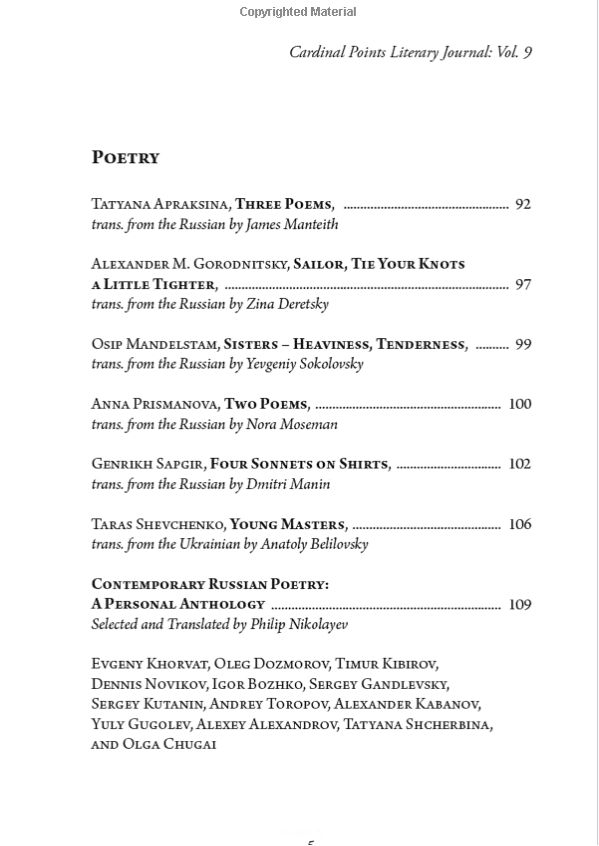
Cardinal Points, Issue 9
Cardinal Points is the Literary Journal of the Slavic Studies Department at Brown University. Issue editor: Boris Dralyuk. Editorial team includes: Boris Dralyuk, Irina Mashinski, Robert Chandler.
Issue 9 is now available for purchase:

Matter | A (somewhat) monthly journal of political poetry and commentary
Guest-edited by Larissa Shmailo and Philip Nikolaev, Issue 26 is dedicated to political poetry and prose in translation from Russian and written originally in English by writers with Russian affiliations.
In the spirit of 2019, at least two poets (Anna Halberstadt and Katia Kapovich) write about Stalin: “O motherland. O motherfuckerland,” sighs-screams Kapovich.
Olga Livshin and Polina Barskova (translated by Philip Nikolaev) are in conversation with Akhmatova.
Katherine E. Young translates Inna Kabysh:
More treasures here:
New Book Announcement — Lara Prescott’s debut novel “The Secrets We Kept”
“Translated into 29 languages, The Secrets We Kept is a thrilling tale of secretaries turned spies, of love, duty, and sacrifice. Inspired by the CIA plot to infiltrate the hearts of Soviet Russia, not with propaganda, but with the greatest love story of the 20th century: Doctor Zhivago. From Moscow and the Gulag to D.C. and Paris, The Secrets We Kept captures a watershed moment in the history of literature. Told with soaring emotional intensity and captivating historical detail, and centered on the belief that a piece of art can change the world.”
Publisher: Knopf
Editor: Jordan Pavlin
Pub Date: September 3, 2019
Agent: Jeff Kleinman and Jamie Chambliss at Folio Literary Management
In Lara Prescott’s ‘The Secrets We Kept,’ the CIA takes a novel approach to Cold War spycraft – The Washington Post
The publication history behind Boris Pasternak’s Doctor Zhivago provides the backbone of this debut novel. Joan Frank, reviewing for The Washington Post, remarks:
Significantly, these are women’s stories. Pasternak’s, while not marginal, is told by his longtime mistress and muse, Olga Ivinskaya — she who inspired “Zhivago’s” famous romantic lead, Lara (for whom Prescott happens to be named). Sent twice to a Gulag labor camp (described in horrific detail) as a result of her affiliation with him, Olga’s own astonishing account nearly eclipses his.
Tidying Up the Shelf: Quick & Basic Takes on Books by Ganieva, Yakovleva, and Stolpovskaya
Another one from Lisa Hayden of Lizok’s Bookshelf on novels by three contemporary Russian women writers: Alisa Ganieva, Yulia Yakovleva, and Olga Stolpovskaya.
http://lizoksbooks.blogspot.com/2019/01/tidying-up-shelf-quick-basic-takes-on.html
My Lucky Day: The 2019 Yasnaya Polyana Longlist
Lisa Hayden of Lizok’s Bookshelf does a round-up of the longlist nominees for Russia’s Yasnaya Polyana award. There are several women on the longlist, including Alisa Ganieva and Guzel Yakhina. Russia’s literary prizes tend to disproportionately go to male writers. We’ll have to keep an eye on the shortlist, and the final result, of course, to see if this holds true here.
http://lizoksbooks.blogspot.com/2019/09/my-lucky-day-2019-yasnaya-polyana.html
 Punctured Lines