Post-Soviet Literature in and outside the Former Soviet Union
Author: Olga Zilberbourg
Olga Zilberbourg’s English-language debut LIKE WATER AND OTHER STORIES (WTAW Press) explores “bicultural identity hilariously, poignantly,” according to The Moscow Times. It also dives into topics of bisexuality and immigrant parenthood. Anthony Marra called it “…a book of succinct abundance, dazzling in its particulars, expansive in its scope,” and Karen Bender said, “Olga Zilberbourg is a writer to read right now.”
Zilberbourg’s writing has appeared in World Literature Today, The Believer, Electric Literature, Lit Hub, Alaska Quarterly Review, and elsewhere. Born in Leningrad, USSR in a Russian-speaking Jewish family, she makes her home in San Francisco, California. She has published four collections of stories in Russia, including most recent Задержи дыхание [Hold Your Breath] from Vremya Press. She serves as a consulting editor at Narrative Magazine and as a co-facilitator of the San Francisco Writers Workshop. Together with Yelena Furman, she has co-founded Punctured Lines, a feminist blog about literature from the former Soviet Union. She is currently at work on her first novel.
Julia Zarankin is the author of a memoir Field Notes from an Unintentional Birder(Douglas & McIntyre, 2020) that was warmly welcomed by both the birding and the literary communities. She was born in the Soviet Union and as a child immigrated to Canada with her family as part of the Jewish refugee movement. She received her Ph.D. in Comparative Literature and taught in the US before returning to Canada. She lives in Toronto and publishes essays and short fiction in English-language magazines both in Canada and in the United States.
We are delighted to present a conversation between Alina Adams and Maria Kuznetsova, whose recent critically acclaimed novels make significant contributions to the body of Russian-American literature. Both Adams and Kuznetsova were born in the USSR and immigrated to the US with their families as children, though some years apart. In their novels, the authors turn to USSR’s history to tell their stories. Adams is a professional writer on topics from figure skating to parenthood and a New York Times bestselling author of soap-opera tie-ins. In The Nesting Dolls(Harper, 2020), she focuses on three generations of Soviet-Jewish women in a story that moves from Odessa to Siberian exile to the Brighton Beach immigrant community. Kuznetsova is a writer, an academic, and a literary editor. In her second novel, Something Unbelievable (Random House, 2021), she alternates between the perspectives of a grandmother and a granddaughter: between the story of a WWII-era escape from the Nazis taking over Kiev and the experiences of a contemporary New Yorker adjusting to new motherhood.
We’re proud to present an excerpt from Margarita Vaysman’s book-length study Self-Conscious Realism: Metafiction and the Nineteenth-Century Russian Novel. Published by Legenda, an imprint of the Modern Humanities Research Association (where it is available to order), this book focuses on the role of metafiction in the Russian novelistic tradition. The excerpt below is but a small taste of the depth and breadth of this project and highlights the work of one important practitioner of this technique, Avdot’ia Panaeva.
Avdot’ia Panaeva (1819-1893) was a successful novelist and short story writer, who made significant contributions to the development of ideas on education equality, marriage, women’s financial and property rights, and the problem of domestic violence. She was also a common-law wife of poet Nikolai Nekrasov, who was valorized in Soviet literary criticism and the popular canon. We are deeply grateful to Vaysman that, as a part of her research, she illuminates the process through which Panaeva’s legacy as a novelist and short story author has been excised from the canon of nineteenth-century Russian literature and begins the work of restoring it to its rightful place.
Punctured Lines is looking for reviews of the following recent titles. Reviewers should have some expertise in terms of their chosen work, engaging substantively with its themes and techniques and bringing in direct citation to back up claims. If you are interested in reviewing a work not on the list but that fits our overall themes of feminism, LGBT, diaspora, etc., please let us know. Thank you, and we look forward to working with you.
Fiction:
Alina Adams, The Nesting Dolls (Harper, 2020)***
Nina Berberova, The Last and the First, translated by Marian Schwarz (Pushkin Press, 2021)
Shelley Fairweather-Vega on Amanat: Women’s Writing from Kazakhstan
The idea to translate and publish a collection of recent women’s writing from Kazakhstan grew out of my collaboration with Zaure Batayeva, a Kazakh writer and translator living in Belgium. Zaure contacted me in October 2016 when she wanted to hire someone to edit her English translation of a novella by Aigul Kemelbayeva. We eventually submitted the final version to Words Without Borders, whose editor, Susan Harris, was looking for “post-Soviet” literature from different places. Excerpts from the Kemelbayeva novella and two other pieces appeared in a WWB feature in January 2018. By that time, Zaure and I were thinking seriously about collecting writing by more authors and publishing an anthology. Ever since, she and I have been trading stories, checking each other’s translations (she translated the Kazakh-language stories, and I translated the Russian-language pieces), and querying publishers. We won some much-needed funding and publicity from the generous RusTrans program, and our collection is now nearly complete.
We’re delighted to publish our conversation with Konstantin Kropotkin, an author and literary and film critic who reviews LGBT books and movies, as well as trends in Russian culture. Kropotkin’s novels and collections of short stories centering queer lives are available on Amazon, in Russian. His commentary on queer culture appears daily on his Telegram blog “Sodom i umora,” and he contributes full-form critical essays to top Russian-language publications. Kropotkin lives in Germany and this conversation was conducted in English and Russian over email, and subsequently translated by the interviewer.
Olga Zilberbourg: Much of your fiction has been focused on portraying the lives of gay men, and as a critic you pay particular attention to LGBT literature and film. Your popular Telegram blog “Sodom i umora” is dedicated to queer books and movies in Russian or in translation to Russian. Despite the retrograde homophobic laws that Russia has passed in recent years, and horrific persecution of gay people in Chechnya, you have shown that Russophone queer literature is a vibrant field. In your blog you seem to strive for balance: you write about various forms of homophobia and also about the many creators that are participating in Russophone queer culture. How would you describe your cultural project as a critic? Does this project change in any way when you turn to fiction?
To mark National Poetry Month in the United States, Punctured Lines asked two poets with recently published collections to interview one another. Both poets have strong personal and professional connections to the larger Russophone world. Natalya Sukhonos’sA Stranger Home (Moon Pie Press) explores themes of the mother-daughter connection, grief and loss, and finding someone and something to love in locales ranging from Odessa to San Francisco. Katherine E. Young’sWoman Drinking Absinthe (Alan Squire Publishing) concerns itself with transgressions, examined through a series of masks, including Greek drama, folk tales, Japonisme, post-Impressionism, opera, geometry, and planetary geology. In addition to their written comments, Sukhonos and Young have also produced a short video conversation highlighting several poems from each collection.
Please support the poets by buying their books.
***
[Katherine E. Young interviews Natalya Sukhonos about A Stranger Home.]
Katherine E. Young: Your book is set in so many places: San Francisco, Odessa, Rome, New York City. And yet the theme of leaving old places and finding new ones, finding “home,” seemingly plays only a minor role in the book. This book doesn’t dwell on typical themes of emigration / immigration; instead, there are the constants of familial love, amorous love, and putting down roots wherever the earth will accept them. Even the ghosts in your book travel with the speaker and seem at home in multiple cultures. In that context, please talk a little about the line “Home. A dreamscape we flee until it consumes all others” from “The Red Farmhouse.”
Natalya Sukhonos: Thanks for this interesting question, Kate. I think that home is a very fraught concept for me. I’ve moved around a lot—from Odessa to New York, then to Boston and San Francisco, with Turkey and Rio de Janeiro as short sweet sojourns in between, and then back to New York. Each of these places romanced me, intrigued me, made me want to stay there forever—until it didn’t. San Francisco, for instance, was enchanting but forbidding in terms of living expenses, though I still find it very beautiful and have good friends there. And Naomi was born there, which makes it forever special. Why is home a “dreamscape we flee”? I guess I’ve always had that desire to flee, to carve my own path. I’m grateful to my family, but like many families, it imposed its own vision of me which I often longed to tweak or even contradict. But I ended up returning to New York—returning home with my own family, creating my own home, a kind of mise-en-abyme, if you will. Though “The Red Farmhouse” was written before the pandemic, you can see how home and family have become all-consuming entities especially now, for better or for worse.
Katherine E. Young:Mothers and daughters inhabit almost all of these poems, and sometimes the connection is fraught, as in “My Personal Vampire.” Other poems such as “Nadia” celebrate “the wild grasses of love.” The second section of the book contains poems that grieve the loss of a mother. Talk a little about the importance of the mother-daughter connection in these poems.
Natalya Sukhonos: We moved to New York City from San Francisco after my mother was diagnosed with stage 4 ovarian cancer. This collection came out of the process of grieving for her and remembering her. My mother read Gogol’s Dead Souls to me and recited Russian poetry, which she knew inside out—Pasternak, Akhmatova, Tsvetaeva, you name it. She was dramatic, a smart dresser, and had an easy laugh. My mother and I were really close, and four years later, I’m still grieving. The poems in this collection try to ask “why,” but they also try to remember. Simone Weil once said that attention is the purest form of prayer, and this resonates with me even though I’m agnostic. I wanted to pay attention to the little details about her life—her love of gardening, for instance—and also record the process of losing her. When she was gone, I felt really unmoored, as if I didn’t know who I was. But as I was writing the collection, I also had to mother my two-and-a-half year-old daughter Naomi, who is now six. In “Theater of Bones” and “The Lioness and the Wolf, or Words as Prehistoric Shells” I tried to record how she was processing death and grief through questions and magical thinking. And I wanted to be honest about how damn difficult it is to be a mother. Motherhood is often romanticized, but not enough attention is paid (especially by men) to the loneliness, the self-doubt, the very physical burdens that motherhood places on you (hence the comparison of a baby to a vampire). Almost two years ago, I had another baby, Nadia, who bears my mother’s name (Tamara) as a middle name. It’s been delightful to watch the beginning of another life, to do it all over again. And I felt like having this new baby and also reflecting on mothering Naomi has made me reclaim motherhood in a way that wasn’t painful or grieving. At the same time, motherhood made my connection to my mother stronger.
Katherine E. Young: Several of your poems speak of the body as a map, and the poems often feel as if bones, stones, shells, forests, and especially stars are of much more importance and permanence than human constructs of geography and cartography. Talk about the stars and other natural phenomena that inhabit so many of your poems.
Natalya Sukhonos: When I lived in the Bay Area, I was really awakened to the beauty and power of nature because it was everywhere: step seconds away from your house and be surrounded by a giant mountain and giant eucalyptus trees! And the cold sublime of the Pacific! I think that as someone who has lived in cities all her life, I’m puzzled by the natural world, and that gives me comfort—the fact that the ocean just IS, that it doesn’t have to fit into a human story. It has its own story, which we may or may not understand. Maybe this sounds too mystical or vague, but for me what can’t be put into language can provide a source of relief. There’s something important about the fact that my mother loved to garden, and I don’t practice this at all. Or that we witnessed the Pacific Ocean roaring on a remote beach together. Why is this significant? Well, only poems can tell.
Also, the poem where I am a lioness and my husband is a wolf speaks to the way children construct mini-narratives around everything they see, and those stories are often filled with magical, dangerous forests and nature that’s comprised of signs only they could decipher, a sort of Baudelairean forêt des symboles. I think Naomi has taught me a lot about seeing nature this way.
Katherine E. Young:Your poems often reference classical myths, as well as modern literature. In one of my favorite poems, the ekphrastic “Night Sky #16 by Vija Celmins,” the speaker remembers her mother reading from The Little Prince, interleaving references to Saint-Exupéry’s book with lines from Rainer Maria Rilke’s “Elegy 1.” You have a PhD in comparative literature. What is the importance of literature, both classical and modern, to your poems?
Natalya Sukhonos: Believe it or not, literature has always had a sensory or sensual appeal for me. When I was eight years old, I had a sudden epiphany that every book, every author has their own flavor. Since then, literature has always been a huge part of my life: the first time I met my husband, I recited Rilke’s first elegy on the street, for instance. Given that the book revolves around my mother’s life and her legacy, literature plays a vital role in this, too. My mother loved The Little Princewith a passion, and staged it at Camp “Idea” where she was the director and where I worked. The love of literature is something that she and I shared in a way that was rhapsodic and visceral. When I started to write seriously, I couldn’t help but interweave little strands of whichever author I was reading—Borges, Elena Ferrante, Baudelaire—into my poetry. I do this in ordinary conversation, and poetry is another such conversation. For me, literature poses essential questions about identity, existence, good and evil in a way that is liberating because it inspires you to look further. The Master and Margarita, which I’m teaching in the Fall for Stanford Continuing Studies, is one such book, so key to me that I reread it every five years or so. One of my favorite lines by Emily Dickinson is “Tell all the truth but tell it slant.” In The Master and Margarita, Woland does this by asking what the Earth would look like if it were stripped of its shadows. In a “slant,” indirect way, Bulgakov is talking to us about the interconnectedness of good and evil, and for me, this idea is interesting precisely because of the way in which it is conveyed—through slant, poetic meaning.
Katherine E. Young: While free verse is a part of contemporary Russian poetry, it’s a relatively recent formal development, and plenty of Russian poets still write in rhyme and meter—many more than do so in contemporary American poetry. Can you tell me about the formal choices you made in writing these poems and how you came to make them?
Natalya Sukhonos: Even though I grew up reading Pushkin, Pasternak, Akhmatova, Brodsky, and Khlebnikov, when I came of age as a poet writing in English, I was more captivated by the free verse of Mark Strand and Wallace Stevens. That said, T. S. Eliot’s Four Quartets and their mosaic of mythologies and truth-seeking has always fascinated me, and Eliot plays around with rhyme and meter quite a bit.
In my own writing I try to be cognizant of the length of my lines and stanzas, the end words on each line, and the “volume” of words on a page. This all contributes to the way I see sound as vital to any poem’s meaning. So in “Parachute” I play around with the length of the lines to imitate the falling parachute of the poem’s title. I let the form carry the tension of my grandfather jumping off a parachute exactly 94 times during World War II. But “Aphrodite,” for instance, is composed of tercets because it’s a love poem, and I’m harkening back to tercets in Romantic poetry.
I do have some poems in here that experiment with form. “Pantoum of Grief and Birth” is a pantoum because I wanted to get at the repetitive, obsessive nature of grieving my mother while giving birth to my youngest daughter. “Protect Me, Lord” came out of an assignment in a poetry class where I had to put a Shakespearean sonnet into Google Translate twice, choose the best lines from what resulted, and also incorporate several colors, animals, and trees of our own choosing into the poem. And “Lost Souls—After Rilke” is actually a golden shovel, spelling out the first stanza of Rilke’s First Duino Elegy in the ending words of its stanzas. I like to be playful with form, so “In Failing Light” has alternating couplets that are formatted differently and interweave the event of remembering my mother while cooking potatoes and ramps with the actual memory of visiting the Pacific Ocean with her in San Francisco.
Natalya Sukhonos: Especially in “Birdsong,” “The Bear,” and “Nakhla,” I noticed your interest in animals and animal imagery. Can you comment on the way that animals are linked to the theme of freedom vs. unfreedom in your poetry? On the one hand, they’re images of otherness, an alternate perspective, but on the other hand, they’re confined to particular places and spaces by their human subjects…
Katherine E. Young: Hm. I hadn’t thought about this at all before your question, but there are two main groups of animals in these poems. The first group includes birds, cats, the prehistoric sea creatures of “Nakhla,” snakes, a dissected frog, lizards, cicadas, monkeys, bats, the fig wasp, and an actual, historical dog who had an unfortunate encounter with an achondrite (a kind of meteorite). But with the possible exception of the fig wasp, these animals are mostly part of the background flora and fauna of the poems. The other group of animals is quite different: they’re talking animals, and they may not be animals at all. There’s the wish-granting fish of “The Golden Fish,” a tale I first read in Andrew Lang’s The Green Fairy Book (where the fish is an enchanted prince); I read Alexander Pushkin’s version of the tale much later. The enigmatic talking bear of “The Bear” is, of course, the performing bear of countless European folk tales, alternately menacing and pathetic, also possibly enchanted. For me, these creatures aren’t all that different from Bluebeard, the ogre who murders his wives, or the succuba who haunts a man’s waking hours, both of whom also appear in these poems. It’s these talking animals and monsters (or are they humans who have lost their essential human-ness?) who are truly unfree, trapped in enchantments, forced to perform for their supper, or condemned to fulfill various gruesome fates over and over again—they and the humans who become trapped in their tragic, endlessly repeating dramatic arcs.
Natalya Sukhonos: In “Nakhla” and “Euclidean Geometry” I was fascinated with your link between the macroscopic and the microscopic: cataclysmic events like the fall of a gigantic rock and human, intimate events such as a singular act of love. Please comment on this link in your poetry.
Katherine E. Young: Well, that’s the whole point, isn’t it? We go running around the world, eating, reproducing, defecating, dying, and from the biological perspective we’re doing just the same thing as ants. I don’t know what distinguishes one ant from another (although I’m told they sing to one another), and from a bird’s-eye perspective you can’t distinguish one human being from another, either. But when we write, when we make any kind of art, we’re saying “Stop! Look at me! I’m here!” Same for when we fall in love, which is also a kind of art. “Nakhla” started during a visit to the Smithsonian Air & Space Museum, where they have a fragment of this amazing achondrite from Mars that fell rather spectacularly in Egypt in 1911 (and apparently did kill a farmer’s dog). A run-of-the-mill igneous rock on Mars, 1.3 billion years old—the only thing unusual about it is that it got blasted off the Martian surface and ended up here on Earth. You can touch it! I was just charmed by the notion of this anonymous and yet singular rock—as anonymous and as singular as other such interplanetary travelers that brought things, including perhaps some of the elements of life, to Earth. Same for “Euclidean Geometry”: an act of love is both anonymous and singular, seemingly governed by laws and rules as ancient as the universe. Sometimes we mistakenly interpret those laws and rules, though—hence, logical fallacies such as circular logic.
Natalya Sukhonos: In “Today I’m Writing Love Songs” as well as “Place of Peace,” where you describe love as “bursting riotously into bloom,” you write beautifully about love as fruit. There is so much sensuality in your fruit metaphors! The poem “Fig” is a whole extended metaphor of love as a bloom as well, and it is stunning! And in “Succuba,” as well as “Today I’m Writing Love Songs” and “A Receipt to Cure Mad Dogs,” you connect love to herbs and their various flavors. Please say something about the ways in which the “tastes of love” resonate in your poetry through imagery of herbs and fruit.
Katherine E. Young: As I was writing these poems, just about everyone in my close circle, including me, was undergoing really big and often traumatic life changes. So, I was very much coming to the poems asking the hard questions: Who am I? Where am I in life? Am I the person I wanted to be, and if not, what can and should I do about that? The basic idea that one can more or less cultivate oneself as one cultivates a garden speaks to a certain kind of urgency one gets in midlife to take stock and make adjustments, sometimes radical ones. During that period, I was lucky enough to have some choices—not always easy ones, not always good ones, but real ones. To some degree, then, the notion of flowering in these poems is aspirational—what I hoped would happen if I took better, more conscious care of my garden, both for myself and for those I love. Also, I just really, really love figs!
Natalya Sukhonos: What’s the link between the mathematical and the erotic in your poetry? I’ve noticed many poems touching on math, and this was fascinating, maybe not least because I just finished Lara Vapnyar’s Divide Me by Zero.
Katherine E. Young: Excellent question! I don’t really have an answer, except to say that as a young person I wanted to be an astronaut—that’s also the reason I started studying Russian, by the way—and I felt very comfortable with math and science, at least until I ran afoul of a college calculus class. Much later, when I was getting my MFA, I took a wonderful course on the rhetoric of science, and I spent more time than I care to admit reading the Transactions of the Royal Society of London. I was fascinated by the mental steps that natural philosophers in the early nineteenth century had to take to be able to conceptualize dinosaurs out of a bunch of bone fragments stuck in rock. And you already know that I find odd bits of space debris decidedly erotic… Maybe I was seeking a system of beliefs and practices in math and science that might inspire me with more confidence than the beliefs and practices in human relationships that I had found simultaneously confining and unreliable—although true mathematicians and scientists would probably say that their laws and beliefs can be just as confining and unreliable…
Natalya Sukhonos: You are a professional literary translator who has received a National Endowment for the Arts Fellowship for translation. How does the work of translation inform your poetry (and I’m using “translation” here both in the literal sense of the word as well as the metaphorical process of translation)? Comment on the process of cultural translation, as your poetry includes intertextual references to Mrs. Pinkerton, the Golden Fish, Manet, Euclid, and so many other rich and unexpected sources.
Katherine E. Young: Honestly, I don’t really see much difference between writing “original” poetry and translating it. In both cases, making a poem starts with “translating” the impulse for that poem into words. Translating someone else’s impulse—as opposed to your own—is essentially the same process, although there are a few more steps involved. But I’m always trying to make music with words, whether the poem started in my own head or in someone else’s. There are particular benefits to being a translator, though: recently I was asked to translate a selection of poems by Boris Pasternak, and I found that every single one of Pasternak’s lines taught me something important about writing my own poetry in English.
As far as cultural translation, all the cultural flotsam and jetsam in this book comes from things I’ve squirreled away, from the mating habits of ancient sea creatures to Manet’s Bar at the Folies-Bergère, which I first saw in London as a teenager. A lot of my references come from the former Soviet Union, where I first traveled as a student. I didn’t really get serious about writing poetry until I lived in Russia in the 1990s, though—while there, I was lucky enough to read the entire canon of Russian poetry with a scholar who spoke no English. It was that immersion in Russian that helped me to hear my own language, English, with fresh ears—and it certainly helped make me a better poet. I like to joke that I’m the only American-born poet I know who owes more to Pushkin than to Walt Whitman—if that’s not cultural translation, what is?
Natalya Sukhonos is bilingual in Russian and English and also speaks Spanish, French, and Portuguese. She has taught at the Stanford Continuing Studies program for four years. She has a PhD in Comparative Literature from Harvard University. Her poems are published by The American Journal of Poetry, The Saint Ann’s Review, Driftwood Press, Literary Mama, Middle Gray Magazine, Really System, and other journals. Sukhonos was nominated for the Pushcart Prize in 2020 and 2015, and for the Best New Poets Anthology of 2015. Her first book Parachute was published in 2016 by Kelsay Books of Aldrich Press, and her second book A Stranger Home was published by Moon Pie Press. natalyasukhonos.com.
Katherine E. Young is the author of Woman Drinking Absinthe, Day of the Border Guards (2014 Miller Williams Arkansas Poetry Prize finalist), two chapbooks, and the editor of Written in Arlington. Her poems have appeared in Prairie Schooner, The Iowa Review, Subtropics, and many others. She has translated prose by Anna Starobinets and Akram Aylisli and two poetry collections by Inna Kabysh. Her translations of contemporary Russophone poetry and prose have won international awards. Young was named a 2020 Arlington, VA, individual artist grantee; a 2017 NEA translation fellow; and the inaugural poet laureate for Arlington, VA (2016-2018). https://katherine-young-poet.com
To find new Russian poetry, it is no longer enough to read literary journals (including online journals) and keep an eye on the catalogs of established publishing houses. Nowadays, many Russian poets first publish their new texts on their social media feeds (VKontakte, Facebook, Telegram, YouTube et al). The initial audience is curated by the poets themselves, and their connectedness – how many people subscribe to their feed, and who these people are – has a direct influence on the number of readers the text will find in the short term.
Popular writers do not only use social media to publish new texts and for other literary activities, such as promoting events and books – one’s own and those of others – and sharing critical articles and discussing aspects of literary form. Some also offer materials, ranging from commentary on current affairs to pictures of their pets or extended contemplations on matters close to their heart, to a broad public beyond their own network of “friends.” The poet Olga Sedakova has amassed over 15,000 Facebook followers who receive her public posts in their newsfeed. Dmitrii Vodennikov, one of the first generation of writers to use social media as a vehicle for literature, is followed by more than 26,000 people.
In the Russophone literary world, self-publication is no impediment to publishing the same text again in online journals or in print. On the contrary, publication on social media can heighten a writer’s visibility and fast-track both print publication and translation. The recent flurry of new international editions by feminist poets who publish prolifically on social media, like Oksana Vasyakina, Lida Yusupova, and Galina Rymbu, corroborates this thesis. While print publication remains an important goal, the tastes and power of a small number of editors no longer determine the opportunities for interaction between a poet and their audience.
Ksenia Zheludova is a poet from St. Petersburg who publishes her new poetry on her feed on the Russian social network VKontakte. She is the author of two collections of poetry. A selection of her poems in English translation appeared in the February issue of Words Without Borders. Here she is talking to her translator Josephine von Zitzewitz about social media and different strategies for interacting with her audience. The interview was conducted in Russian and translated by Josephine von Zitzewitz.
Josephine von Zitzewitz: What does it mean to you to publish your work on social media, as opposed to in books and journals?
Ksenia Zheludova: It’s important to me that, on social media, I can interact with my audience directly. To some degree I assume the role of editor and producer, and I create a space around myself through which I transmit my texts. In contrast, when I publish in a journal or other literary publication, I will be transmitted via an intermediary. There’s no universal gatekeeper for all authors, and it’s easier, in this case, to remain an individualist than to join a collective that you don’t know.
Josephine von Zitzewitz: Are you consciously aiming for print publications, or are those a coincidence? After all, you have published two collections of poetry.
Ksenia Zheludova: Yes indeed. My first collection, Slovno (2013), was a slim volume I published with the help of some friends at a new publishing house (Moscow: Yang Buk, Nulevaia Seriia). They were doing a series of poetry collections in a very small print run, around 100 copies. The whole thing was the kind of friendly collaboration that brings joy to everyone involved. We didn’t aim to sell the book or to use it for promoting my existence or my work. It was simply a fun thing to do, and it worked!
Josephine von Zitzewitz: It did indeed work – several titles of this series were on display at the well-known independent bookshop and event hub Poriadok slov in St Petersburg, and that’s how I first read your poetry! And your second collection, how did that come about?
Ksenia Zheludova: The second collection, Navernost’(2017), I self-published with the help of special software. I did the typesetting myself, using a template. The book is simply a collection of texts that were topical at that moment in time. It was uploaded to several online shops selling e-books, and one of them also offered print-on-demand copies. After that, I stopped doing collections. But now I dream of a real book, a high-quality, beautiful book with illustrations and a cover. A sort of “Best of the Best,” to bring together all those texts I’m definitely not ashamed of. That’s still at the planning stage. I’m slowly collecting the poems I want to include. And recently I had an idea for yet another book because, a while ago, I started publishing poems that naturally come together as a cycle: a cycle of terrifying tales for bedtime. These are more narrative and quite dark, like horror stories. And they fit together really well – they would make a great collection. And perhaps this collection will come into being if I pull myself together and step out into the field of print publishing, which still feels alien and not very inviting.
Josephine von Zitzewitz: What is the role of literary journals in Russia today?
Ksenia Zheludova: I can’t offer an expert opinion, because I don’t feel very at home in the world of print. Literary journals were very important and popular in the Soviet Union. They offered access to the world of publication and were a stepping stone towards publishing a single-author collection. In those circumstances, literary journals were the only way of promoting your texts, and the only way an author could reach their audience. Public readings are a different matter, as they reach only those who are present in the room where you’re reading. Now, with the Internet available, I have the impression that literary journals remain in the hands of a very narrow group of professionals – literary critics and publishers. So we’re talking about a very self-contained environment that doesn’t really touch upon the outside world, the world where the readers are. But the readers are the audience that I, as an author, want to address.
Josephine von Zitzewitz: Who is your target audience? Do you actively curate your audience?
Ksenia Zheludova: At first – about 15 years ago – my audience consisted of my close friends, who’d repost my poems. The texts would then spread through their respective networks to reach their friends. But over the last seven years, ever since VKontakte started doing “publics” (“public pages” where users can share content with followers – Punctured Lines), I collected around 3,700 followers. I must admit I didn’t always like communicating with my readers. I am a fairly serious introvert. I’d come, put up a new poem, and leave again. That was all I was capable of doing. Only lately have I started to get an energetic charge from communicating with my audience. I have understood that, paradoxically, interaction with the audience supports my creative process – I want to tell these people something. My readership is fairly random but, when I checked the statistics tool that shows the age and gender of the group members, I noticed an interesting thing: my audience and I are growing up together. Five years ago, the majority of my readers were women around 25, the same age as me. Today I can see that the majority are about 30 years old and female. This means I’m writing not just for my peers, but for my female coevals. It turns out I’m working within a circle of people who are close to me in age and worldview! I have pages on VKontakte, and I also have Facebook and Instagram pages. But the public on VKontakte was my first direct platform, and all my main readers follow that page.
Josephine von Zitzewitz: What is the role of sites such as stikhi.ru (a popular self-publishing poetry platform that allows a limited interaction between the author and the audience – Punctured Lines)? I’m asking because I found some of your earlier texts on it.
Ksenia Zheludova: Stikhi.ru was very popular 15 years ago – I mean, it’s still popular today, but back then many serious literary authors used it. And I used it myself as a kind of archive. It was convenient to put poems up on the site and divide them into sections or little collections, and for me it was a very useful digital archive. But I stopped publishing there a long time ago, because I realized that the audience is chaotic. I don’t understand who is reading my texts there and why; I don’t know how to work with this resource. And so I simply settled for my own social media feed, and stopped distinguishing between my personal life and my life as a poet.
Josephine von Zitzewitz: How do you organize your feed on VKontakte? I notice that it doesn’t just feature poems. How do you combine the public and the semi-private?
Ksenia Zheludova: I would put it like this: for a long time, I thought of my own poetry as my parallel, secret life. My life, my job, and my friends – that’s one thing. And then there are the nights when I sit and write poems that I then publish in places where people are likely to appreciate them. Previously that would have been on platforms like stikhi.ru, and various thematic forums that used to exist. And then, at some point, I came to the realization that I didn’t want to perpetuate this division; that I didn’t want to play Jekyll and Hyde. All of it is part of me, including my poetry. And, just as I can post a selfie or a pretty picture of the sky on Instagram, I can post a poem I’ve written. That poem also expresses my worldview. It represents my perspective. I can post a picture, or I can post a text. I don’t see a big difference there.
Josephine von Zitzewitz: I notice that your texts are often accompanied by photographs. Do you choose them specifically? Is it because posts that contain visuals are more likely to draw the eye?
Ksenia Zheludova: I arrived at this format by accident. At some point, I realized that people are divided into visual, aural, and other types. In any case, every text includes something bigger than itself. A poem is a little tale that invites you to imagine whatever you like, but the imagination needs something to anchor it. I choose images that complement whatever it is I’m expressing in the poem, and I also attach a musical track to each piece. I find this approach creates a unified picture … it’s a bit like going to the cinema. There’s a text beyond the screen which you read to yourself, perhaps even out loud, then there’s the photo, and then the soundtrack. It’s a piece that’s complete in itself.
Josephine von Zitzewitz: When a poet submits to journals, a lot of time passes between writing and publication. In contrast, the Internet allows you to publish instantly, even to react to current events in real time. Do you find that publishing on social media has an impact on your style? To put it another way, are your poems fairly spontaneous or do you spend a long time editing them?
Ksenia Zheludova: It’s different every time. Some poems are composed of fragments written years apart. Sometimes I return to my drafts and notebooks and find that, five years ago, I wrote three lines that didn’t grow into anything. But now I’m writing another text, and these old lines just fit there, like the missing piece of a puzzle. There are other poems I write in an evening from start to finish. The next day I look at them with fresh eyes to check whether I’ve hit the right tone, and edit a bit – and the text is ready for publication. With regard to current events – recently I wrote a poem that refers to the events in Belarus (i.e., the protests following the contested election in August 2020 –Josephine von Zitzewitz). Of course, I knew that I had to publish it on the spot, because a few days later it would no longer be necessary. So I put it up, and it did indeed trigger reactions from people who were also thinking about that situation. If the poem had come out a week or a month later, it would have been something else – a statement of fact, a response, a different kind of text. In this sense, social media is an amazing instrument that allows you to react quickly and be something akin to a reporter. I rarely write texts that touch on social and political topics, but sometimes topical texts come to me. Usually I write in a different genre that doesn’t require quick reactions. This means a poem can mature for a long time, and it can be a long time before it gets published. In addition, I now work to a different schedule: I decided to develop my VKontakte group and offer a paid subscription for exclusive content. Some readers pay a monthly donation, and I stay in closer contact with those readers. I suggest topics for debate, I share music and videos, and I show my new poems to this group first and then to all my other followers a week later. Working in this pattern has taught me something. My text is first of all seen by five people who might leave a “Like,” but not comment. That’s OK. All the rest only get to see it the following week, and then there might be more reactions or debate. But for me that’s no longer so important, because there’s already a new text in the wings. That’s more like a standard publication schedule, where texts reach the reader after some time has elapsed.
Josephine von Zitzewitz: Once you’ve published a text online, do you ever return to it and edit? Or is that the final version?
Ksenia Zheludova: That’s always the final version, because I never publish a text if there’s still something in it that makes me stumble. I always take a text to the stage where I know that it’s finished. That means that, as soon as a text appears to the outside world, I can no longer access it. It’s no longer my text; it’s now living its own life and I’ll never go back and edit it.
Josephine von Zitzewitz: Do you think that a writer, a poet, is necessarily involved in current affairs? Do you consider yourself involved? I’m asking because when I read your poem “an age-old female pastime” I feel that it’s a response to the war in Ukraine. But at the same time it’s simply a text about war, any war, and it could have been written at any point in time. This means it will never lose its topicality.
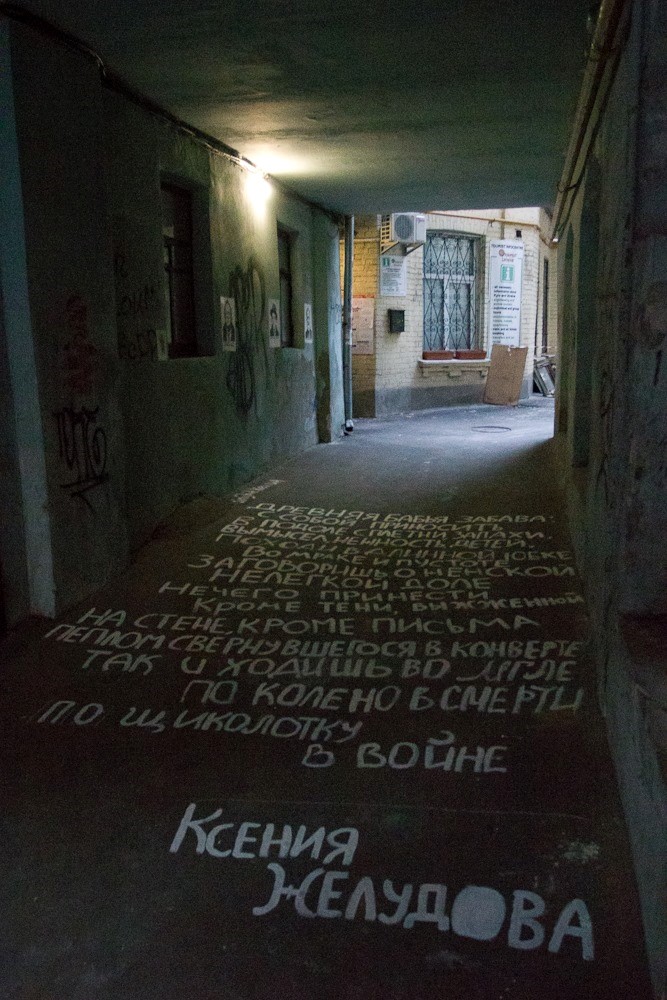
Ksenia Zheludova: That’s a good question. When you live within the current historical context – that is, when you don’t live in a bunker – you naturally react to what’s going on in the world. I don’t like poetry that’s too “concrete,” poetry that mentions individual names, toponyms, or furnishes descriptions of specific events. Texts like that make me uncomfortable. I always try to set my poems in a more universal context and to cleanse them of any ties to a specific time and place. But sometimes it’s the text itself that becomes attached to some event or other, as if drawn by a magnet. The poem you mention actually became part of the events in Ukraine because, at some point, somebody wrote it on the asphalt in Kyiv.
It seemed to fall into step with the events, and many people from Ukraine wrote to express their gratitude or simply make contact. The poem was in the right place at the right time, and it became important to those people. But did I write it specifically in response to the events? No, I didn’t. It’s not a reaction to the war in Ukraine. But perhaps the war had such an impact on my emotional state that the poem was born? In contrast, the poem on Belarus that I mentioned was written in reaction to a concrete situation, even a specific day. I kept reading the news, and it left a strong impression; it really shocked me. And so I sat down to write a poem. I really wanted to write it in one go and publish it in the morning, and that’s exactly what I did. And yet it doesn’t contain any references to a specific country, event, or date.
Josephine von Zitzewitz: Was there ever a moment where readers perceived your work in a way that was completely unexpected?
Ksenia Zheludova: Sometimes. It mostly happens with texts that aren’t my favorites, or not even very successful in my eyes. Those poems start circulating very widely. Conversely, some texts I like very much and that are quite good – if I do say so myself – provoke hardly any reaction at all. To give an example, one poem that circulates very widely on the web is “Memo” (“Pamiatka,” 2011) and it’s mostly this poem that I see under my hashtag. Even when I google myself, I’m likely to find “Memo” (589 hits – Josephine von Zitzewitz). It really isn’t a very relevant text for me; I wouldn’t read it at a poetry reading now. At this point, I don’t find “Memo” all that interesting or important.
Josephine von Zitzewitz: I didn’t know that about “Memo,” but I translated it (Modern Poetry in Translation no. 6, 2017). That’s the first poem of yours that got me hooked! Have your poems ever caused controversy?
Ksenia Zheludova: Here is one recent example of a negative reaction. At some point, I wrote a text in a form I hadn’t used for some time – not quite free verse, but close to it, a very relaxed form. So, quite a free text, and I like it very much. It resonated with my emotional state at the time I wrote it. I published it with a sense of real accomplishment and used it to promote my group. Most comments were positive, but one young woman wrote: “Aren’t you ashamed of putting up such a low-quality text?” I was sitting there and really wanted to write: “No, I’m not ashamed.” But then I decided it would be a bit weird to enter into dialogue with a commenter like that, because it would seem like I was justifying my right to publish certain texts and defending their right to exist. The fact that I published that poem means I’m no longer ashamed of it.
Ksenia Zheludova is a St. Petersburg-based poet and producer who has been publishing poetry on the Internet since 2007. She maintains a dedicated feed on VKontakte to promote her work, and also uses Facebook and Instagram for this purpose. Her poetry collections, Slovno and Navernost’, have appeared in print and online.
Josephine von Zitzewitz is a scholar of Russian literature and translator specializing in Russian poetry. She is currently Marie Skłodowska Curie Fellow at UIT The Arctic University of Norway with a research project on the phenomenon of contemporary Russian poetry on the Internet.
Tomorrow, March 12, 2021, Columbia University’s Harriman Institute is hosting a virtual “Zoomposium” and a reading, featuring the poet Lida Yusupova. The event is hosted by Anastasiya Osipova and Mark Lipovetsky as a part of the Institute’s Contemporary Culture Series.
Organizers write: Lida Yusupova is a uniquely important voice in contemporary Russophone poetry and, in particular, a groundbreaking figure for contemporary feminist poetry. Often experimenting with documentary poetics, as in Verdicts, her poetic cycle based on transcripts of Russian court hearings, she unflinchingly investigates cruelty and violence, while, paradoxically, extending intimacy and sympathy to the most alienating situations. We are proud to welcome an international lineup of poets and poetry scholars to discuss Yusupova’s poetics and her new bilingual edition, The Scar We Know (edited by Ainsley Morse, Cicada Press, 2021). The event will conclude with a poetry reading by Yusupova.
I have previously written about this book in a post, dedicated to Lida Yusupova’s poem “The Center for Gender Problems” (Russian text) that appears in the book in Hilah Kohen’s translation. We have also published an interview with Ainsley Morse, the editor of this collection. The significance of Yusupova’s work for contemporary Russian literature is alluded to in this Time Magazine article by Suyin Haynes. Oksana Vasyakina and Galina Rymbu, featured in this article, will be participating in the Zoomposium, wonderful in its ability to unite translators, writers, and scholars from Russia and the diaspora.
I’m honored at the opportunity to deliver and expand my remarks on the poem “The Center for Gender Problems” as a part of the panel on Feminism in Yusupova’s work.
Please preregister for each individual panel as well as for the poet’s reading.
Maria Stepanova is a Moscow-based poet, essayist, and journalist. She’s also the editor-in-chief of Colta, a crowdfunded online publication that she created eight years ago and that has become a major outlet for long-form think pieces on contemporary Russian culture. Stepanova published ten books of poetry and three essay collections and has received numerous literary awards. In 2017, she wrote her first book of prose, In Memory of Memory. It’s a documentary novel that tells the story of the narrator who, after the death of her aunt, goes through the archive the aunt left behind, discovering her family’s history. In parts of this book, there’s no narration – just excerpts from diaries and letters written by Stepanova’s relatives; its other parts engage directly with other authors who wrote about memory – Osip Mandelstam, W. G. Sebald, and Susan Sontag. Despite or, maybe, because of the book’s non-traditional form, it gained a wide readership and won two major Russian literary prizes. On February 9, In Memory of Memory comes out in English from New Directions, translated by Sasha Dugdale, a British poet and playwright. This interview was conducted in Russian and subsequently translated to English by the interviewer.
In your novel, you quote someone saying that quite a lot of books have been written in English by people investigating their family histories. In Russian, though, your book is the only one of its kind.
Actually, it’s not the only one, which makes me very happy. To me, this is a discovery of sorts – that things we usually consider private and insignificant are turning out to be the most interesting not only for me, but also for a large number of people. And the stories they tend to tell sometimes are quite unexpected in their scope and variety. In some of them the twentieth century shows up in all its terrible glory, with all of its tragedies and disasters, but in a number of cases these are just regular domestic stories of how somebody’s grandmother arrived, or how someone left to work in the north, or how three sisters lived in a distant Hungarian village, but then decided to leave for the big city. And yet one can’t get enough of these stories. I think that this is a very important shift, this interest in familial memory. There’s an increasingly palpable hunger for contact with the past which grows stronger as the present becomes less acceptable to us. A couple of years ago, I worked in Berlin for a year, teaching memory writing in Humboldt University. I had large groups made up of different kinds of people, all of them hooked on this search for the past despite it sometimes being painful – because traveling to the past isn’t always pleasant. Moreover, this interest in memory is a global, international phenomenon, which is now shaping the outlines of a new community and works as a link between generations because it attracts people regardless of their age.
Do you have any idea why you became the first person to write about these things in Russian?
I wasn’t really the first one – writing one’s family history is something fairly normal in Russia, as elsewhere, and there is a good number books devoted to the legacy of the twentieth century and the traces it left in private lives…. Maybe the genre is something that makes a difference in my case: I was most interested in trying to shape a new territory between fiction and nonfiction: in my book, a novel, an essay, and a research project meet one another. I guess no one else wrote books like that at the time.
Do you think there isn’t a lot of experimentation happening in the Russian literary space?
This is how it works: since the beginning of the nineties, when literary awards appeared in Russia, the way contemporary fiction works has been largely determined by their existence. Winning one of them is the only opportunity for a prose writer in Russia to receive a substantial amount of money that can greatly improve their life. These awards, in one way or another, are geared towards finding the great Russian novel that is very similar to the great American novel. It’s a long, philosophical narrative without any stylistic nonsense – because it should be easy to read and digest – shaped within the mold of a nineteenth century novel. That is, the writer is forced to reinvent the wheel for the umpteenth time.
In other words, you didn’t expect that your book would become successful and would win two of these very same awards – NOS and Big Book?
I didn’t think about those things at all. I’ve been writing poetry all my life, and it always seemed to me that prose was the medium that wasn’t required of me, that if I wanted to write prose, I could easily write it in verse. And I did: I’ve written long narrative poems and all manner of ballads. At the same time, I always knew that someday I would write a book about my family, even though I didn’t know how I would go about it. I’d been meaning to write it from the age of ten, but I was taking a long time, endlessly getting distracted, looking for a chance to procrastinate a little while more. There came a point, however, when I realized that I had to do it. I set out to write a text that would be convincing to me, and there was one more goal that was even more important. You know, Brodsky has this essay called “To Please a Shadow.” This was what I wanted – to please my dead. I constructed my book in such a way that they would feel good in it. Maybe I could’ve written it in a completely different way, without all those historical and cultural references that work as a large structure into which my own stories then fit. I could’ve written a story about my family and nothing else, but I had in mind something that would belong to the realm of contemporary art. I wanted to create a space in which I could arrange the few remaining photographs, letters, and testimonies, and to make it so that they would feel good in this space, so that they would be seen and understood in the right way. This is how you work when curating an exhibition – you start with the space. I really didn’t think about anything else, and the fact that my book wound up being widely read was a shock both for me and for my publisher, who didn’t hope to sell more than three thousand copies, I think.
How did you arrive at this particular form for your book?
The book is about inconspicuous people, people whose lives resembled those of everyone else: they loved, they fell out of love, someone died, someone was born. As a family, they managed to survive many times, perhaps because they deliberately stayed on the sidelines. At the beginning of the twentieth century, they tried to be actors of history, but later they moved to its margins and spent almost a hundred years there. So, what worried me was the question of how to tell the story of people who didn’t really want to be noticed – and how to talk about people whose fates had nothing extraordinary about them.
I found the story of Lyodik who went to the front and died at the age of nineteen absolutely heartbreaking.
Lyodik’s letters have been in our family for as long as I can remember. When I was little, my mother told me about him sometimes and read his letters out loud. But it’s impossible to surmise from his letters what was actually happening to him and around him – he kept silent about that. In order to look beyond and understand what he kept silent about, I had to read a lot of historical literature on the blockade of Leningrad and the Leningrad front. A documentary novel is a genre in which there are a lot of gradations, that is, there’s a toggle switch that can be moved to the left, towards the documentary, or to the right, towards fiction. I’m probably keeping to the left of this spectrum. I have serious problems with the type of novel writing that uses people who are no longer alive as glove puppets to convey the writer’s own thoughts and emotions. I think and write a lot about the ethics and the etiquette of writing about the dead, about what is allowed and what isn’t, and at what point it turns into the exploitation of people who can no longer object to this treatment.
Have you come across books that dealt with the dead in a way that you liked?
There are a number of books that are great examples of how one can write about the dead without trying to make the story “interesting,” without trying to deceive, and at the same time doing this miraculous work of resurrection. First of all, I should mention W. G. Sebald because he balances on the border of fiction and essay writing in such a way that there’s a constant flicker. We want to, but we cannot ask: was this all real or not? Is this narrator Sebald or someone else with his mustache and his last name? It seems to me that a new type of literature is emerging which still doesn’t have a name, but it no longer fully belongs to either fiction or essay writing. The books I love most belong exactly to this type of writing that is gradually becoming more and more important.
You’ve mentioned in various interviews that fiction is becoming less and less interesting than documentary writing. Why, do you think?
Remember Mandelstam’s article “The End of the Novel”? It was written in 1923, almost a hundred years ago. He says in it that everything has changed, that the man of the nineteenth century had an individual fate and was therefore interested in the individual fate and its trajectories – hence the success and the significance of the novel as a genre in the nineteenth century and beyond, due to some kind of inertia. But we all know how the twentieth century dealt with these trajectories: it took these individual fates, collected them in a bundle, and broke them over its knee. Later, when the smoke cleared, it turned out that the individual survived, though not in the place where we kept looking. It’s no longer where the typical hero appears in the proposed circumstances and carries on their shoulders the novel construction. In the century in which people die in millions, one person isn’t quite the measure. An error, a detail, a very small thing – oddly enough, that’s the measure.
What kind of thing?
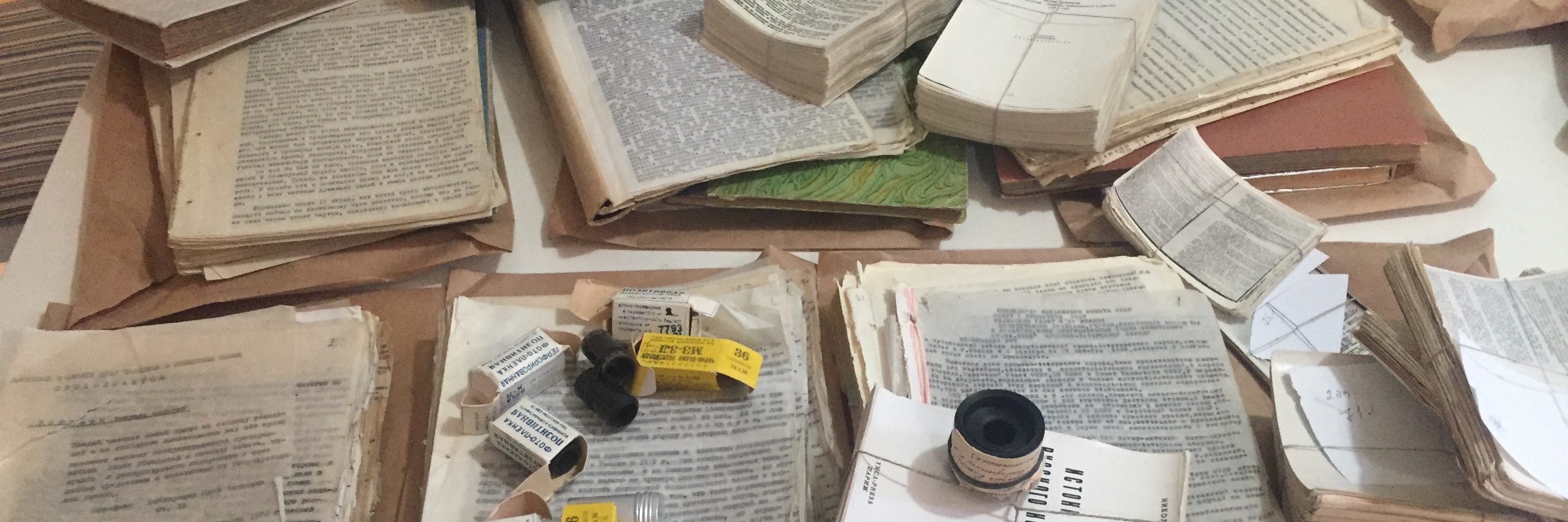
For example, a button that I saw at the Museum of the International Memorial in Moscow where they keep the belongings of the prisoners of Soviet camps. They have many remarkable things there, including an archive of drawings made by the prisoners. It amazed me – and I want to write about it sometime – because there are no scenes we remember so well from the Russian camp prose: no barbed wire, or German shepherds, or security officers on the watchtowers. But there’s a huge number of still lives with flowers as well as landscapes and portraits. For some reason, it was important to those people to create beauty rather than to give a realistic depiction of their circumstances. In this museum, I saw a button in which one of the prisoners had sent a note to his wife. This is a striking detail: they were horribly tortured, but they could give their overcoats to their wives for cleaning. This officer handed his overcoat to his wife, and from one of its buttons a corner of this note was sticking out slightly. On tissue paper, he wrote in microscopic letters about how he was arrested and beaten, and he added that he probably wouldn’t come back. The twentieth century is the time when life turns out to be so inhuman that people become speechless and can speak only for all of humanity, while objects do the speaking for them.
You’re fluent in English, and I assume that you’ve read Sasha Dugdale’s translation of your book. How did you like it?
I think it’s brilliant. Sasha is a wonderful poet and a close friend; she translated and still translates my poems – but my book is maybe the largest piece of prose she had ever translated. And what she did with this huge volume is, in my opinion, absolutely incredible. The Russian type of writing involves endless subordinate clauses that circle around the principal meaning until they finally find their way to it. The Russian syntax imitates the confusing, complex work of human thought, while English, it seems to me, entails a completely different logic and a completely different language etiquette. If you translate a Russian text aiming to convey mainly its syntactic features, it won’t deliver the intended message. What Sasha did was amazing: she found a balance between these two things. She delivered the message that is still the main objective of my work, and at the same time she created this English Russian that isn’t a literal reflection of the original, but somehow gives the reader an idea of how it works.
Your book has a subtitle – romance. In addition to its other meanings, this word designates a certain kind of song in Russian.
In the book, there are several definitions of the subtitle, and the reader can choose the explanation that they like best. To me, the English meaning of this word is the most important. I feel that this book is a love story, only it’s facing backward rather than forward, as is usually the case with love stories because love is always looking for some kind of completion in the future. Here, love is addressed to people who are no longer alive, so, on the one hand, my love is happy because I love them and I feel that they love me, but on the other hand, I can’t talk to them anymore, and this love is doomed in a sense.
Your book makes clear that your ancestors had to stifle their literary ambitions. Why was that?
When I began to sort through my archive, it struck me: they were all in one way or another people of the written word, even those of them who never intended to study literature. Therefore, there are parts in my book in which I don’t speak at all: I publish excerpts from letters or diaries to give my ancestors the opportunity to speak in their own voices. It seemed wrong and inappropriate to me to invent a voice for my great-grandmother where she had her own. On the contrary, I wanted them to say once again what they already said once, to get a final chance to be heard. My grandfather wrote poetry all his life, mostly comical, but when his daughter – my mother – began to write poetry too, he strictly forbade it, saying, “You’re Jewish, so you must have a profession.” My mother worked as an engineer all her life and never wrote poetry after that.
Was it the same way with you? Were you told not to write poetry?
In a sense, I’m the result of this half-century of their non-writing, because the first thing my mother taught me was to read and write. She was too shy to sing, so at night, instead of singing lullabies, she recited poetry to me. I turned out to be the completion of my family’s hope that someone could write and speak for everyone. It’s a lot of responsibility, because it’s like dragging around a suitcase full of family stories that haven’t been told, and I’m the knot in which they converge. I have to decide whether to talk about them or not, and what exactly to tell. On the other hand, I was infinitely happy, writing this book and doing almost nothing else for several years. I traveled to all the places where my ancestors once lived, and it was very strange and exciting. For example, I went to this microscopic village in the middle of nowhere, somewhere between Arzamas and Nizhny Novgorod, and there was no train there, only a bus that went there once a week, there was no hotel, no cafes, no nothing. And I looked at all of that and realized that there was some thread that connected me to that place.
Since nonfiction is more interesting to you than fiction, does this mean that you don’t read mainstream novels?
I have a very special reading routine: I read a book a day. This means that I constantly have to throw new texts into the furnace. I really love genre literature: for example, detective stories that have clear rules upon which the author agreed with me. It’s a game the author and I are playing. I also read complicated, experimental texts, and academic stuff. I do sometimes read mainstream psychological novels, but they don’t make up the bulk of my diet. If someone I love comes running and says, “Grab this new novel immediately and read it,” then, of course, I’ll grab it and read it. But when I’m in a bookstore, the shelf with freshly published novels isn’t the first one I’ll be looking at.
You don’t hide your political views: you oppose Putin’s regime. You must’ve had opportunities to leave Russia. Why have you stayed?
This is one of those questions that I have to ask myself every five years or so. When my parents left for Germany in the early nineties, I didn’t go with them. I stayed because I was fascinated by what was happening in Russia. It seemed odd to me to leave when the most interesting things began to happen. And now, I feel that someone has to love this place – with its monstrous situation into which we have driven ourselves, with Putin, with these comic-opera poisoners, with this “insane printer” [in colloquial Russian, this is what the Duma, or the state legislative body, is called – Punctured Lines] that passes these insane laws. Someone has to live here and to treat this space as their home, to make it meaningful. Which isn’t to say that I’ll grip this earth with my teeth and stay here under any circumstance. But as long as it’s possible to live here somehow, I would try to stay here. Because the worse it gets here, the more this place needs our love.
Svetlana Satchkova is a writer and journalist from Moscow, Russia, who currently lives in New York City and is working on her MFA at Brooklyn College. Her most recent novel People and Birds came out from Moscow-based Eksmo Press to popular and critical acclaim.







 Punctured Lines