Post-Soviet Literature in and outside the Former Soviet Union
Author: Olga Zilberbourg
Olga Zilberbourg’s English-language debut LIKE WATER AND OTHER STORIES (WTAW Press) explores “bicultural identity hilariously, poignantly,” according to The Moscow Times. It also dives into topics of bisexuality and immigrant parenthood. Anthony Marra called it “…a book of succinct abundance, dazzling in its particulars, expansive in its scope,” and Karen Bender said, “Olga Zilberbourg is a writer to read right now.”
Zilberbourg’s writing has appeared in World Literature Today, The Believer, Electric Literature, Lit Hub, Alaska Quarterly Review, and elsewhere. Born in Leningrad, USSR in a Russian-speaking Jewish family, she makes her home in San Francisco, California. She has published four collections of stories in Russia, including most recent Задержи дыхание [Hold Your Breath] from Vremya Press. She serves as a consulting editor at Narrative Magazine and as a co-facilitator of the San Francisco Writers Workshop. Together with Yelena Furman, she has co-founded Punctured Lines, a feminist blog about literature from the former Soviet Union. She is currently at work on her first novel.
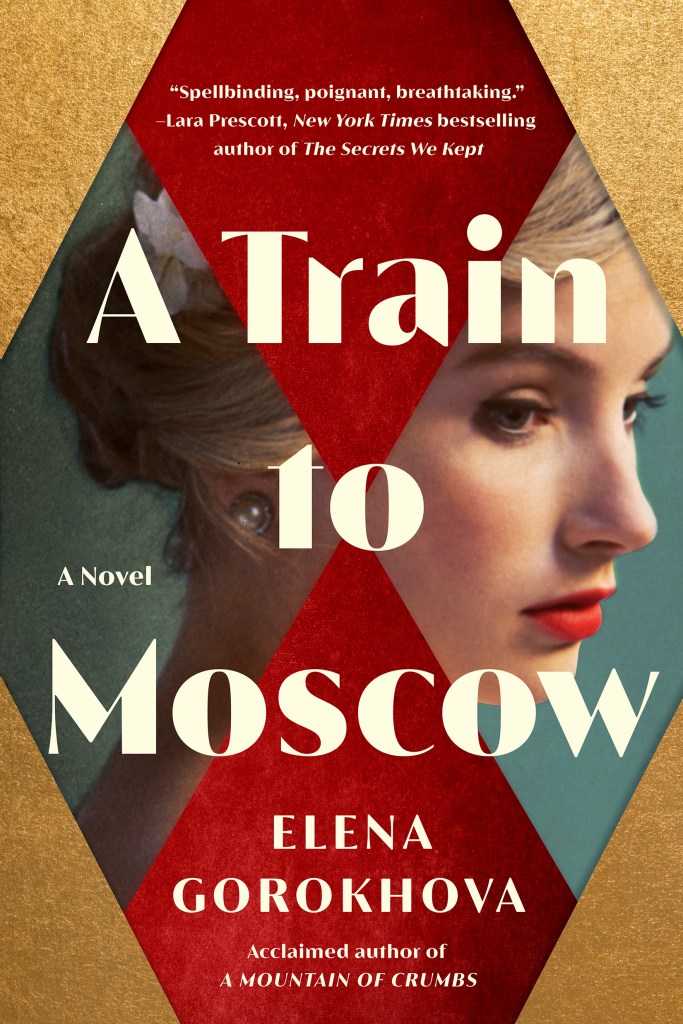
Elena Gorokhova’sA Train to Moscow (Lake Union Publishing) came out earlier this year to praise by J.M. Coetzee, Lara Prescott, and Kate Quinn, among others. Gorokhova was born and raised in Leningrad, Soviet Union, now St. Petersburg, Russia. After graduating from Leningrad State University, she moved to the United States, carrying one suitcase with twenty kilograms of what used to be her life. Elena is the author of two memoirs published by Simon & Schuster: A Mountain of Crumbs (2011) and Russian Tattoo (2015). A Train to Moscow is her first novel. Her work has appeared in The New York Times, The Daily Beast, New Jersey Monthly, and The Daily Telegraph, on NPR and BBC Radio, and in a number of literary magazines. She lives and teaches English as a Second Language in New Jersey.
Irina Mashinski’s The Naked World, recently published by MadHat Press after many years in the making, is an impressive achievement in the hybrid genre. The collection combines pieces of original and translated poetry and prose that together illuminate not only the author’s past but also her way of seeing. Thematically, this book centers four generations of a Soviet family from the Stalin era to the 1990s and immigration to the United States. Writer, translator, and editor Irina Mashinski has penned ten books of poetry in Russian, and this is her English-language debut that also includes her Russian-language poems in translation by Maria Bloshteyn, Boris Dralyuk, Angela Livingstone, Tony Brinkley, Alexander Sumerkin, and Daniel Weissbort. Mashinski is co-editor, with Robert Chandler and Boris Dralyuk, of The Penguin Book of Russian Poetry and of the Cardinal Points Journal.
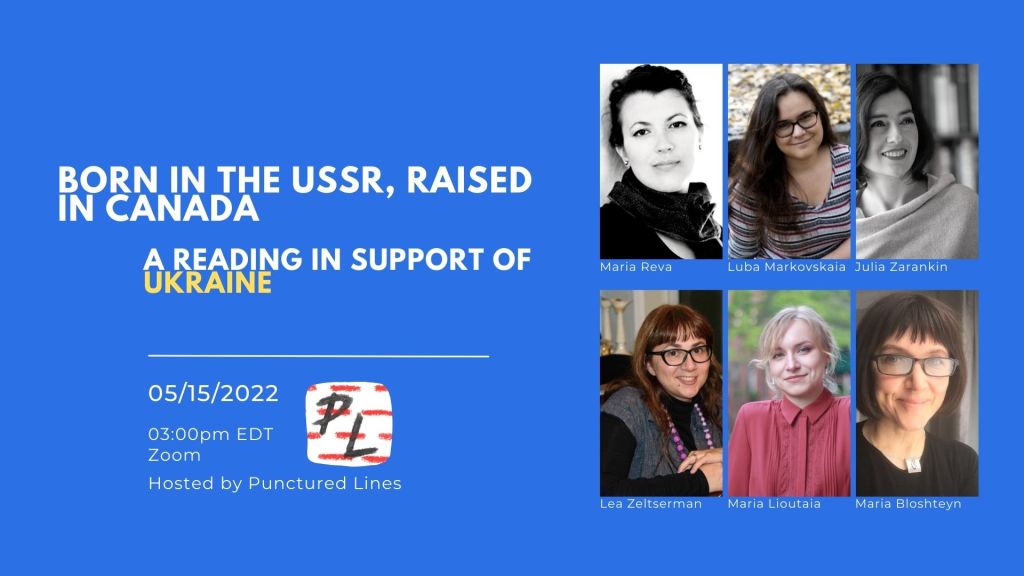
We’re happy to share the recording from the event we hosted on May 15, 2022, gathering writers who were born in the former Soviet Union and immigrated to Canada as children. Currently located all across Canada, from Montreal (Luba Markovskaia) to Vancouver (Maria Reva) with a definite hub around Toronto (Julia Zarankin, Lea Zeltserman, Maria Lioutaia, Maria Bloshteyn), these generous writers shared excerpts from their work and answered questions about living with hyphenated identities and building writing communities. Russia’s war in Ukraine was at the forefront of this conversation, as most of the writers and the participants have family and friends affected by the bombs. This event was a fundraiser, and we encourage everyone to continue donating to the organizations listed below.
Punctured Lines is delighted to bring you our next event–a reading and a Q&A with six established authors who were born in the former Soviet Union and immigrated to Canada as children. In their fiction and nonfiction they explore topics of multicultural identity, life under communism, Jewish culture, food, history, and making a home in a strange land.
We began planning this event before Russia’s renewed, full-scale attack on Ukraine, and we want to acknowledge that this war is resonating deeply throughout the diasporic community. We feel that it’s particularly important for us to come together at this time, to listen to each other’s stories and to amplify each other’s voices and resources in support of the people of Ukraine in their fight against the Russian totalitarian regime. We also want to extend our support to those citizens of the Russian Federation resisting and fleeing from this regime.
*** This event will be recorded. ***
*** This event is a fundraiser and we encourage everyone to donate money directly to organizations supporting Ukraine and Russian protesters. Suggested donation starts at $5.
Nataliya Meshchaninova is Russian filmmaker. In 2017, she published a book of autobiographical short stories that resonated with her audience, in part, because they supported the Russian #metoo movement. In February 2022, Deep Vellum brought out Fiona Bell’s translation of Meshchaninova’s book under the title Stories of a Life. We are honored to share with you an excerpt from this book, a section from the fourth chapter, “Secrets.”
The suburbs of Minsk, the Kurapaty forest, the night of October 29-30. Here, in 1937, the Soviet NKVD executed over one hundred Belarusian intellectuals, among them prominent writers and poets, including Aleś Dudar, Michaś Zarecki, Jurka Lavonny, and others. The brutally murdered Belarusians received no proper burial, and the tragedy was shrouded in silence until the late 1980s, when Belarusians began holding an annual action in memory of the Night of Executed Poets. This “forest of the unburied dead,” which is referred to in the poem “To Antigone, a Dispatch,” is the starting point for Valzhyna Mort’s third English-language poetry collection that lifts the curtain on history and life in Mort’s native Belarus. Starting from its title, Music for the Dead and Resurrected points to the cultural context where individual and national memories are constantly concealed, repressed, and distorted. Mort’s poems claim the remains of the past and attempt to reintegrate the fragmented national memories and narratives into the present.
Punctured Lines is grateful to Ivan Sokolov for the opportunity to publish his letter and a collection of links. Author’s idiom is preserved.
I am thankful to everyone who has reached out to me—I am safe and away from Russia at the moment. Let this post be an update for my anglophone contacts who have expressed concern about Russia’s ongoing war in Ukraine, possible sources of following the events and the lives, as well as means of giving aid.
I feel compelled to mention, however, just to be fair, that if I find myself displaced and unhinged in every sense of the word, it is far less so than the hundreds of thousands of other Russians evacuating these days to neighbouring countries—and doing so, unlike myself, without visas, academic affiliations, language skills or any experience of living abroad. I did not think I’d live to see (and run into!) my own acquaintances, mostly young, crowded in airports by random gates—the sheer extent of the exodus is mind-blowing. The fate of those who remain in Russia may look bleak—and even if a massive campaign of arrests and repressions does not ensue, the economic deterioration will hit everyone hard. But if we find our plans, ways of life and peace of mind disrupted and displaced, it is unthinkably more literal and cruel for the livelihoods of our friends within Ukraine and those that have managed to escape the war crimes being committed there.
– supplementing basic income for members whose income has dropped because they are focusing on emergency pro bono translation and interpreting
Natalia is herself in the city of Kalush in the west of Ukraine. She reports: “so far the fund has helped evacuate two people from Kharkiv and has helped cover the cost of special footwear and a safety vest for one of our colleagues who is now in the territorial defense; and provided funds to a single mother now in Kyiv for food and essentials for the child.” If you have questions about the UATI Support Fund, please contact Natalia at uati.org@gmail.com.
Find out how to contribute to the UATI Support Fund using PayPal, Venmo, check, or bank transfer here.
Our friends The Cheburashki, “a growing collective of women & nonbinary writers who are emigres/refugees/first-generation from countries that were once a part of the Eastern bloc,” are hosting a reading in Philadelphia next week. Here’s a great place to find some camaraderie in this time of war and donate money for Ukrainian refugees.
This event is happening in conjunction with AWP, a poets and writers conference that will include several important events with USSR diaspora writers. We made a list.
Most of these opportunities are currently provided by European institutions, and we urge our friends with any influence at North American institutions and those around the world to consider expanding existing opportunities and to establish new positions for writers fleeing the war in Ukraine, as well as for writers speaking out against their regimes in Belarus and Russia.