
Today we welcome Alina Adams back to the blog with an essay about her interracial family’s trip to Moscow (before the war in Ukraine) and its connection to her recently released novel, Go On Pretending (History Through Fiction, 2025), featuring a fictional interracial family. You can read our previous conversations with Alina here and here. As one of the excerpts below shows, a key element in her novel is the 1957 World Youth Festival in Moscow, during Khrushchev’s Thaw, which was meant to demonstrate the Soviet Union’s liberalization and racial tolerance (you can guess how that turned out). The reference to the festival immediately made me think of a different novel by another ex-Soviet Jewish immigrant writer in which it is an important plot element: Petropolis (Penguin Random House, 2008) by Anya Ulinich. If you would like to know more about this lesser-known event and about the Soviet Union/post-Soviet Russia and race, let Alina explain below and then order Go On Pretending (and Petropolis).
How Moscow’s 1957 World Youth Festival Inspired Me to Go On Pretending by Alina Adams
I was five years old, living in Odessa, then-USSR, when I saw my first Black man. “Look, Mama,” I exclaimed, delighted, “a CHOCOLATE person!”
“No,” she corrected me. “That’s a Negro.”
Two years later, we moved to the United States. And while San Francisco had fewer African-American residents than New York City, where I live now, I grew accustomed to seeing people of different backgrounds around me, Asians, Hispanics, and yes, Black people (I quickly learned that the Soviet term was not an acceptable one to use).
Growing up in the Soviet Union, the only African Americans I was familiar with were Paul Robeson and Angela Davis. But I had also heard about the “children of the rainbow,” those born to one Russian and one African (as well as many other ethnicities) parent after the 1957 World Youth Festival in Moscow, during the reign of Nikita Khrushchev, First Secretary of the Communist Party.
As a well-raised Soviet child I was, of course, also aware that famed authors Alexandre Dumas and Alexander Pushkin both had some African heritage. My Black husband was stunned that I knew that. “No one in America knows that!” he exclaimed.
He was particularly surprised when pretty much all of my parents’ friends instantly noted our two sons’ resemblance to Pushkin. “Wow,” he said. “You guys really love your Pushkin!”
It wasn’t until the summer of 2019 that my husband, our two younger children, and I left New York City to visit our oldest son, who was doing an internship in Moscow as part of his Princeton University degree in Public Policy and Slavic Studies. During his gap year between high school and college, my son lived in Moldova for a year, studying Russian as part of the US State Department’s National Security Language Initiative for Youth (NSLI-Y). There, he’d periodically get called the n-word on the street. He knew what he was getting into traveling to Moscow.
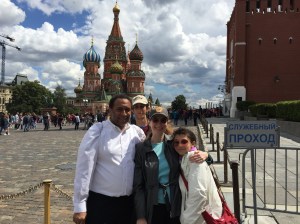
My son warned my husband to always wear a collared shirt and a sports jacket when we went out in public “so they won’t think you’re an African migrant, here to steal their jobs.” He also told him to stay out of sight when I bought museum and theater tickets, speaking Russian, so we wouldn’t get charged foreigner prices. It was OK for my son’s siblings to be seen, as long as they didn’t open their mouths to reveal the broken Russian they’d picked up growing up with me (for my daughter, everything is masculine and in the present tense).

Visiting the former USSR with my Black husband and biracial children was a very different experience from when I visited while working for ABC Sports. In 1996, as part of their European and World figure skating coverage team, I traveled to Moscow and St. Petersburg to interview champions like Ilia Kulik, Irina Slutskaya, Maria Butyrskaya, Berezhnaya and Sikharulidze, and Eltsova and Bushkov. Though I was technically there in a researcher/writer/producer capacity, I also served as the unofficial interpreter. My experience at ABC Sports is what inspired my figure skating murder mystery series. But it was the family visit in 2019 that gave birth to my most recent historical fiction novel, Go On Pretending, published on May 1, 2025 (yes, May Day; it’s not a coincidence).
In my 2022 book, My Mother’s Secret: A Novel of the Jewish Autonomous Region, I wrote about Jewish Americans who left in the 1930s to come to Birobidzhan, on the border of Russia and China, to build what they believed would be their only shot at an independent Jewish homeland. Readers had a hard time believing anyone would abandon the United States for the Soviet Union.
Which was why I decided to set a section of Go On Pretending during the 1957 World Youth Festival that took place during Khrushchev’s Thaw. This was a time when Khrushchev relaxed media censorship, exposed his predecessor Josef Stalin’s crimes, implemented economic reform, and advocated for peaceful coexistence with the West. The festival was thrown to demonstrate all of the above.
My novel features an American couple, Jewish Rose and African-American Jonas, who are so inspired by the promises of unity, peace, and brotherhood on display there, that it prompts them to defect:
Jonas walked Rose towards Red Square following the same path they’d taken when with their Komsomolnik friends. If possible, the streets were even more clogged with people now that the festival was officially underway than it had been during the run up. It was impossible to take a single step without bumping into a group of citizens and visitors in the midst of some convivial activity. Within a span of just a few minutes, Rose glimpsed a girl with Ukrainian ribbons in her hair handing a girl with an Indian dot in the middle of her forehead a bouquet of flowers from a basket carried by a dog in matching festive attire; a man in a turban playfully rubbing the head of a man in a colorful tunic with hair identical to Jonas’, and a boy in a three-cornered hat pulling a girl in a smart business suit not unlike ones Rose would wear to the office, out of a crowd and into his dance while those around them clapped and cheered. They put a white scarf on the ground, both knelt on their knees, and the boy kissed the girl on both cheeks in a ceremony Rose didn’t understand, but fervently wished she could be a part of. It was Rose’s greatest regret that, despite having arrived in Moscow ahead of most visitors, she hadn’t had the chance to experience the festival. She’d been locked inside the theater, working on her own project. She’d been forced to hear second-hand about the bonfires on the water, the American jazz concerts, the English brass bands, the French chemists’ demonstrations, the International Exhibition of Fine and Applied Modern Art, and, of course, the song, Moscow Nights, which was being sung and played everywhere, translated into foreign languages on the fly.
As a writer – especially one whose family fled the USSR in the 1970s – I had to ask myself: What could possibly motivate a pair of Americans to make such a radical move?
I looked at my own household, and it became obvious. In 1957, an interracial couple – a white-presenting Jewish woman and an African-American man – were precisely the people who could be taken in by the Soviet Union’s claim of a non-racist, non-antisemitic, non-sexist society. After all, those discriminatory practices had been outlawed. Which naturally meant they didn’t exist. Just look at all the fraternalism and camaraderie on the streets around you. Surely, Rose and Jonas would be much happier marrying and raising a family there than in the US, where Loving v. Virginia, which made interracial marriage the law of the land, was still a decade away.

Anyone who was living in the Soviet Union at the time could have told my fictional characters that the liberté, égalité, fraternité was a Potemkin illusion at best, a deliberate prevarication at worst. In fact, my fictional Americans meet up with a real-life historical one, who is trying to do precisely that in Red Square:
Jonas led Rose toward the front entrance to Lenin’s Tomb. A crowd of hundreds, maybe as many as two thousand, gathered around a lone man, medium height, stocky, dark-haired, Jewish, if Rose had to guess. She’d been hearing Russian for so long that it took Rose a minute to realize he was speaking English; New York accent with just a touch of Boston. Harvard, if Rose had to guess again.
[…]
“Why did you bring me here?”
“I thought you’d find it interesting. How could a writer not find this interesting? It’s an incredibly literate crowd. Yesterday, someone brought up the author Howard Fast, how he was a proud American Communist. George – his name is George, by the way, George Abrams, he’s a Harvard student – “ So Rose had been right about the Harvard and the Jewish – “George had to tell them how Fast quit the Party last February, after Khrushev revealed everything Stalin did in its name. They didn’t believe him. They heckled him. But, at the end of the night, after he’d been here so long the Metro trains stopped running, a bunch of people chipped in so he could take a cab back to his hotel.” Jonas was practically beaming. “Isn’t this amazing? It’s everything we’re always talking about. Self organizing, mutual cooperation. And today – wait till you hear what happened today! There was a huge argument yesterday about the Hungarian uprising. The crowd insisted the Hungarian government invited the Soviet Union to come in and help them quash a Fascist rebellion and restore the People’s Government. When George referred to the United Nations’ report contradicting that, he was shouted down. So he said he’d come today and read the entire report out loud. It’s a historic moment. I wanted to share it with you.”
[…]
“No.” Rose pivoted and pushed her way through the mob, Jonas in hot pursuit, their abandoned spaces quickly and gratefully filled in by those who wanted to draw closer. “We can’t stay here. We can’t keep listening to this.”
Even though many of my readers and pretty much everyone I know and am related to couldn’t conceive of an American relocating to the USSR, as a writer, I had to give Rose and Jonas a reason to do so. I found it in Rose’s belief that the Soviet Union would live up to its promises of equality and tolerance in a way she couldn’t imagine the United States ever doing.
Rose stakes her life, Jonas’ life, and eventually their daughter Emma’s life on an idealized future.
By 1964, Khrushchev had been deposed, the first head of the USSR not to die in office. Leonid Brezhnev came to power, undoing earlier reforms; the Thaw gave way to the era of Stagnation.
The Soviet Union Rose gave up her home country for was officially gone – not that it had ever existed in the first place.
Except Rose refuses to believe that. She insists on only seeing the USSR she was promised during the festival. No matter what she experiences, no matter what her husband and daughter are subjected to in this officially non-racist society, Rose will still go on pretending.
I was lucky. My parents rejected the Soviet Union’s lies of being a Socialist workers’ paradise with no racism, antisemitism, or sexism. (I asked my mother once how, if they were living in such poverty and oppression, they could believe the agitprop that said this was the best of all possible worlds. “Oh,” she said, “I assumed everywhere else was worse.”) My parents moved to America. My oldest son saw enough in Moldova and Moscow to be extremely cynical of any propaganda – Soviet or Russian. Thanks to our trip in 2019 – and Russia’s actions since then – the rest of my family now fully understands what my fictional Rose refused to accept.
Alina Adams is the NYT bestselling author of soap opera tie-ins, figure skating mysteries, and romance novels. Her Regency romance, The Fictitious Marquis, was named a first Jewish #OwnVoices Historical by The Romance Writers of America. Her Soviet-set historical fiction includes The Nesting Dolls, My Mother’s Secret: A Novel of the Jewish Autonomous Region, and the May 2025 Go On Pretending. More at: http://www.AlinaAdams.com

 Punctured Lines