We at Punctured Lines are thrilled to feature a conversation with Michele A. Berdy, longtime editor and columnist for The Moscow Times, now living in Riga, Latvia. Given both the political and personal upheavals of the last few years, this interview was long in the making. We are so glad to now publish this wide-ranging discussion about, among other things, cataclysmic changes, Soviet life hacks, art and culture, and of course, the war in Ukraine; there are many organizations you can support, including this one. This interview was conducted over email.
Yelena Furman: Let’s start with your intriguing reverse immigration story: you left the U.S. in 1978 to live in what was then the Soviet Union (the same year, as it happens, that my family left Soviet Ukraine for the U.S.). What inspired you to make that move, several years before the country began opening up under Gorbachev?

Michele A. Berdy: I wanted to become a translator. I had only a vague notion of what that would entail, but I did appreciate that it required fluency in Russian. Like just about everyone who graduated in Russian studies in those years — when no one was heading off to Novosibirsk to open a coffee shop — I could read Akhmatova and Chekhov but couldn’t have a telephone conversation. So I went to Moscow to study for a semester and then, because I still couldn’t function comfortably in the language, got a job with APN (Novosti Press Agency), one of the three publishing houses that hired foreigners as editors. As it turned out, editing translations was a good way to begin to learn how to translate.

I also learned how to be Soviet. I washed my clothes in my bathtub, stood in lines for hours and learned to glare (at people pushing, stepping on toes, jumping ahead in line…). Once when I bought unshelled walnuts before remembering that I didn’t have a nutcracker, I figured out how to crack them by putting them in the door hinge and opening the door. I thought I’d get the Nobel Prize for ingenuity and was bitterly disappointed to discover that everyone else had figured out that trick centuries ago.
Yelena Furman: Speaking of changes, you lived in Moscow through glasnost and perestroika, the collapse, the wild 1990s, and the return of authoritarianism (some would say totalitarianism). What were some of the highlights and the challenges of living through such momentous political events?
Michele A. Berdy: I have a lot of memories of foraging for food in the late 70s and early 80s (and spending ridiculous amounts of money at the still wonderful farmers’ markets and the Beriozka hard currency stores). But we weren’t all sitting and talking around the kitchen table with the phone buried under pillows in the next room. There were already cracks in the edifice of control: apartment art shows; rock bands playing in obscure restaurants; stand-up comics doing one approved routine on the books and another uncensored one for cash; films that made sly digs against the system.
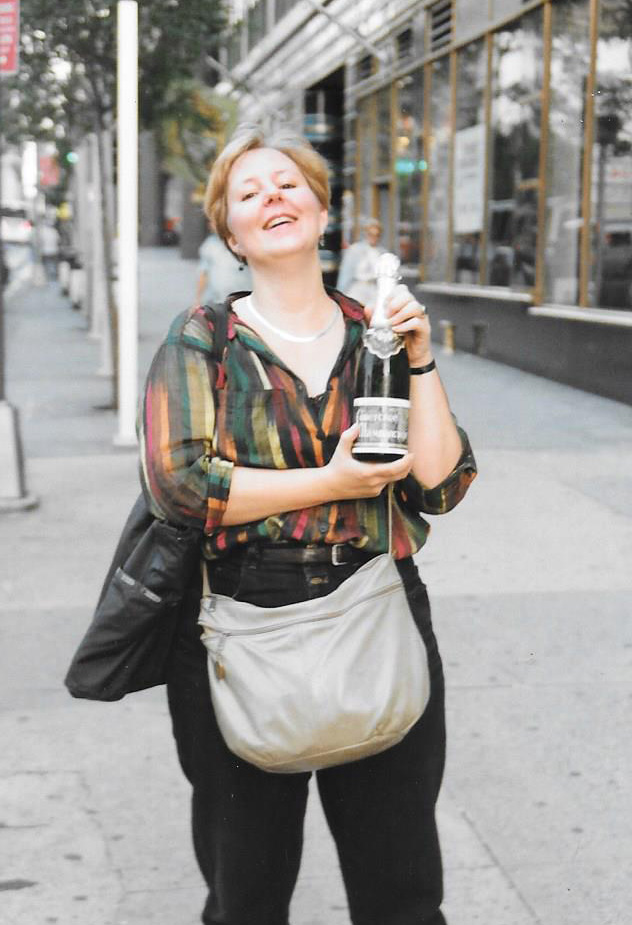
When Gorbachev came to power and the gates opened, I spent most of my days interpreting either in the U.S. or the USSR. I remember when Rolling Stone invited Yuri Shevchuk, the lead singer of the rock band DDT, to New York and took us to the restaurant in the Plaza Hotel where, after a lot of vodka, Yuri got up on the table and belted out “Rodina” while I played the drum on the table. The diners, in perfect New York style, politely put down their knives and forks, listened, applauded — and then went back to their steaks, completely unfazed.
In the 90s, I lost vast amounts of money (foreigners couldn’t exchange old bills for new), bought a lot of bad food in co-op stores, drove a Zhiguli with canisters of gas in the trunk that I filled from trucks parked on the embankment (not enough gas stations). I also seemed to fund one of my neighbors’ road trips: before every holiday he would break my special locking fuel tank cap and syphon off all my gas. I never discovered who it was.
In 1993, when the battle for power between the Parliament and executive branch hit a stalemate and parliamentary supporters attacked the mayor’s office and the Ostankino television broadcasting center, I spent a frightening night dozing on the floor, watching the Russian news being broadcast from an undisclosed location for safety, and listening to gunshots outside my windows. Later in the 90s, I got all my news — well-done, comprehensive news — from the new Russian media, spent every Sunday night watching the weekly talk shows, and got hooked on a Russian-made cop series. The first private shops — old train cars turned into food stands and small shops at metro stations — were torn down and pre-fab shops put up. Many of the original private stores and services were forced out, sometimes by bigger competition, sometimes because they were illegal in just about every way you could be illegal. (When the Armenian shoe and clothes repairman had to leave our neighborhood, I wept.)
Through all the years I lived in Moscow I led a very Russian life — three seasons in the city, one season at a tiny dacha, which had electricity, hot and cold running water, and even cable TV — but also an outhouse. I had almost no American or non-Russian friends. Once I was invited to a “foreigners’ party” and, like a normal Moscow woman, put on a chic black dress, Turkish jewelry, and lots of mascara. At the party everyone was in T-shirts and torn jeans. Обрусела [I became Russianized – YF].
And then — and then — Moscow sometimes slowly and sometimes instantly began to change into a developed, modern urban capital. I can’t say it entirely blinded us to the fact that at the same time all the political achievements of the developed, modern world were being chipped away. But I, at least, did not think it would come to what it came to.
What I was blinded by was the boom in culture: after decades of stagnation and a period of copying what people in the arts had just seen in the West and East, Russian culture was assimilating everything that had been seen abroad with its own historical traditions to create something new and marvelous.
And then — and then — it all came to a horrible, despicable end.
Yelena Furman: The most devastating impact of Russia’s war in Ukraine is of course on those in Ukraine, but in a much different way, those in Russia who are anti-war have also been affected. Living in Moscow when war broke out, you were at risk as a foreign journalist, and you poignantly described your departure, “clos[ing] the door on the life I’d lived for 44 years.” What has life been like two and a half years on, in your new home of Riga, Latvia? How has it been to work as part of the independent Russian media in Latvia, which has been home to several exiled outlets but also has contentious relations with Russia for historical/political reasons?
Michele A. Berdy: Latvia is attractive to us former Muscovites because you can communicate immediately with almost everyone in the big cities, since the older folks speak Russian and the younger folks speak English. The country has been very generous. It has taken in more than 50,000 Ukrainian refugees and nearly 1,000 (mostly) Russian journalists. They even created an organization to help us, providing workspace, podcast and filming/editing studios, and all kinds of activities, seminars and workshops, advice and support.
Riga is my ideal city — filled with everything you want in an old European capital: cobblestones, crooked streets and tiny ancient houses, grand Art Nouveau buildings held aloft by hundreds of caryatids and atlases — and yet with wooden houses downtown, a majestic river, and a 30-kilometer sand beach on the sea 15 kilometers away.
Are they nervous about Russia? Yes. The Soviet occupation, Siberian exile, camps, and executions are in living memory. It’s not like tales of 1917 that people read about; it’s people remembering the day their grandmother was taken away.


Yelena Furman: I fondly remember reading The Moscow Times while living in Moscow in the 1990s, when it was a print newspaper that I would pick up at various Western-oriented establishments (the Arbat Irish House was a particular favorite; I think I still have some copies in a box somewhere). In a move that surprises no one, given the anti-Western, anti-dissent atmosphere in today’s Russia, The Moscow Times has recently been declared “undesirable” by the Russian government. What does this mean logistically in terms of how it will continue to function? What is the degree of danger to journalists who continue to work for outlets that have been designated in this manner? What can those of us who live far away do most effectively to support Russian independent media and anti-war efforts (a reminder that you can support The Moscow Times here)?
Michele A. Berdy: All the media, Russian and foreign, covering Russia, works with brave people inside the country. For a long time Russian-based correspondents used their own names and sent articles through email. Sensitive material came through the platforms that were deemed safe, either written or orally. Now we barely use any bylines, and everyone is more careful about what and how they write. Now that The Moscow Times is an “undesirable organization,” it’s illegal to work for it, which means a contributor could be arrested and jailed. Some journalists working for media that is not on the undesirable list take short trips to Russia, but each month it seems more dangerous. A lot of information gets out, but to be honest, we are missing a lot, too.
The more people who read the Russian media in exile and contribute to our support, the better.
Yelena Furman: You were the arts editor at The Moscow Times from 2016 until earlier this year (while still occasionally reprising this role). What were some of the events on the Russian cultural scene (broadly defined) that have stood out to you over the years? Now that censorship has returned under the current regime for anyone speaking out against the war, many writers and artists have left the country in protest; a number of them, including such big names as Boris Akunin and Liudmila Ulitskaia, have been branded “foreign agents” in absentia, their books no longer allowed in Russia. Some artists who have stayed in the country are being imprisoned. Is it still possible to produce genuine artistic work, one that doesn’t conform to state dictates, in this atmosphere, or are we back to Soviet times, with the artistic underground? Does the existence of Russian-speaking diasporas abroad — i.e., those who continue to read banned authors, attend performances by banned musicians, etc. — help maintain the cultural scene in any way?
Michele A. Berdy: Your first question is very hard for me to answer because I was so thrilled by so much of Russia’s new cultural life, it is hard to choose a few really, really special events. I would say: every exhibition at my two favorite small Moscow museums — the Museum of Russian Impressionism and AZ Museum. When the former opened, many distinguished art critics snorted that there was no “Russian impressionism,” and insisted that it was all borrowed wholesale from the French. But time and again the curators found works we’d never seen before or put together art in such a way that each show was a revelation (oh, that show of works by Ukrainian artist David Burliuk…).
The AZ Museum (named in part for their large collection of works by Anatoly Zverev) felt like home, although a home that would become entirely transformed for each show of (mostly) late-ish Soviet non-conformist art. That is “my period” — the art of apartment exhibitions that I caught the tail end of in the 1970s and 80s.

The film that made the greatest impression was Dunya Smirnova’s The Story of an Appointment, mostly because it set off a firestorm in the media and on social media that went on for hundreds of pages — most of it debating whether Russia could change or was destined to be poor and mistreated by the powers-that-be.
Ah, those were the days.
Almost every play at Kirill Serebrennikov’s Gogol Center was a thrill, even if I sometimes got lost mid-way through the performance. There was one play that astonished me because I couldn’t figure out why it was so powerful. Gorbachev, directed by Alvis Hermanis at the Theater of Nations, was just two actors – Yevgeny Mironov and Chulpan Khamatova — performing as Mikhail and Raisa in vignettes from their life together. We knew all of it ahead of time. It was almost all talk and no action. And yet at the end we all leapt to our feet applauding, and an old man behind me wiped away tears.
Now that is all gone in Russia. I’m certain there are people writing, painting, composing, and filming works that are marvelous, but we can’t see them.
It took almost a year before exiled cultural figures began to work in the West (and East). Right now there is a lot of protest art of various forms, not separate threads of Russian culture. I hope the war and Russia’s current regime won’t last long enough for there to be a distinction between Russian in-country and Russian diaspora culture.
The most powerful performance of the Russian diaspora I’ve seen in Riga was Anatoly Bely’s I Am Here, a one-man play/performance about a “little man” buffeted by today’s heinous reality that I don’t even want to describe — it is a piece that slowly reveals itself to the audience. It left me speechless.
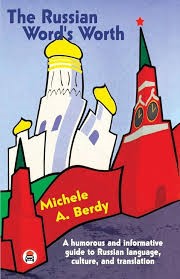
Yelena Furman: In addition to being the arts editor for The Moscow Times, you also wrote a long-running, popular language column, “The Word’s Worth,” for English-speaking expats living in Moscow, which, for fairly obvious reasons, you have recently ended. These were such witty, laughter-through-tears explanations of the complexities, not to say absurdities, of the Russian language, many of which are included in your book, The Russian Word’s Worth. In Speak, Memory, Nabokov describes that feeling familiar to those who become fluent in another language: “that promised land where, at last, words are meant to mean what they mean.” What did it take for you as a native English speaker to start feeling Russian words mean what they mean (asking on behalf of intrepid Russian-language instructors and their s/heroic students everywhere)?
Michele A. Berdy: I am very curious about languages, but I don’t think I have a natural knack for them. I came to Russia in love with lines of poetry and prose — words I loved the sound of (междусобойчик: “get-together,” lit., “a thing just among ourselves” with a cute-sounding Russian ending – YF), words that we like to call “untranslatable” (авось, тоска….). I spent the first six months in Moscow carrying around a battered English-Russian/Russian-English paperback dictionary and found a halting (on my side) conversation over dinner with Russians so exhausting I would practically beg them not to walk me to the metro station just so I could finally relax. But by the end of the first year I was comfortably conversant, using all those little words and phrases in the correct intonation that made me sound like a human being. I picked up a Moscow accent, to the disgust of my St. Petersburg friends.
Yelena Furman: Along with being a journalist, author, and editor, you are also a translator. What draws you to translation and what have been some of your favorite translation projects?
Michele A. Berdy: I think of myself as a translator first. In fact, I think that everything I do is a form of translation — conveying information from one language (including art, music, theater) into words comprehensible to someone who doesn’t know or didn’t experience the language of the original. It is both utterly confining and completely creative. You are both servant and star. With prose you have to create a text that seems like it was written in English without losing any of the Russianness. Which is impossible, but that’s my goal every time I begin a text.
Among fiction, I recently translated a short piece by Teffi (Nadezhda Lokhvitskaya) that describes her first stage of exile to Istanbul right after the 1917 Revolution. At first, she notices and makes fun of everything that seems odd or strange, as we all do when we are in a new place (“In Riga you don’t buy the bus ticket when you get on the bus, you get it in a convenience store…”). But over six little chapters, as she slowly falls in love with the city, her voice becomes more lyrical, more descriptive, more caressing. I loved translating it.
Yelena Furman: What are you reading now or have read recently that you would recommend (Latvian literature recommendations especially welcome)?
Michele A. Berdy: Lately I have been reading a lot of nonfiction, mostly almost all the new books on “why what happened in Russia happened.” At night, to escape all my problems (how to get all my possessions still in my Moscow apartment; what will happen with visas, work?; where am I going to live for the rest of my life? — you know, the everyday concerns of a forced migrant), I speed read murder mysteries. It’s so satisfying to get to the end where everything is solved and resolved. I have read some Latvian fiction in translation, but I don’t yet have a sense of the body of national fiction, so I’m hesitant to say anything about it. Lately, I’ve been rereading Vladimir Gilyarovsky’s Moscow and Muscovites for the joy of his Russian and for other obvious reasons.
Yelena Furman: If you can say without divulging any secrets, what are you working on at the moment?
Michele A. Berdy: Oh, no, I can’t say a thing. Чтобы не сглазить… [So as not to jinx it – YF.]

Michele A. Berdy lived and worked in Moscow for almost 45 years, beginning in 1978 with post-graduate work in the Russian language. For 22 years she wrote a weekly column on language, culture, and translation for The Moscow Times, and was Arts Editor from 2016 until 2024. She has also written features about culture, society, and politics for journals such as Politico, Foreign Policy, and London Magazine. Earlier in her career, she worked for nearly a decade in documentary and public service television production. She has had a parallel career in communications with over ten years’ experience designing and running public interest communications programs in Russia, the CIS, and Eastern Europe. She is an award-winning translator specializing in film subtitles, non-fiction, historical, art/culture, as well as contemporary and modern fiction. She has published hundreds of translated articles and short stories, as well as five books. She currently lives in Riga, Latvia.

 Punctured Lines
Great conversation, thank you.
LikeLiked by 2 people
Thank you so much for reading. Michele has such a fascinating life story.
LikeLike
Приветствую! Почитать бы вам Тайные записки 1836-1837 годов Пушкина, изданные в 25 странах и преследуемые в России
http://www.mipco.com/SJAd.html или на litres.ru
Не забудьте побродить по сайту издательства mipco.com
LikeLike
I’d love to know what, if any, has she liked from the new “why what happened happened” books. Has she found any of them revelatory?
LikeLiked by 2 people
Sasha, you should ask Michele on Twitter. Good question.
LikeLike
I revere Serhii Plokhy, all his books, and especially his writing voice – authoratative and calm. Timothy Snyder is always right about everything. I really like Jade McGlynn’s books, too, particularly how she shows how the Russian govt made a path from reality-enhanced reality-faked reality-fiction-fiction as reality. I also liked Elena Kostyuchenko’s book – very personal, but shows you everything. Also excellent is Alexander Etkind’s “Russia Against Modernity” and Sergei Medvedev’s earlier “The Return of the Russian Leviathan.” I’m sure I’m forgetting some – but those come immediately to mind.
LikeLiked by 2 people
Thank you for that reading list, Michele!
LikeLike