I met Naomi Marcus through a mutual friend in San Francisco last year. Speaking fluent Russian, Naomi shared that in her youth she’d spent many years in the Soviet Union as a tour guide and interpreter. A journalist by training, when she returned to the US in the 1990s, she translated a book by a veteran of the Soviet-Afghan war; more recently, she has been reporting for Mission Local and San Francisco Senior Beat and helping Ukrainian refugees find their footing in the US. She told me that as she first landed in the USSR back in 1979, Leningrad was experiencing purportedly the coldest winter since WWII, a shock for a Californian. She felt very scared and alone, but soon fell in with underground rock musicians, and they helped her survive that winter. On her guitar, Naomi played for me Boris Grebenshchikov and Bob Dylan in alternating couplets, illustrating the paths of “influence.”
I’m so pleased to be able to share with our readers a story—fiction—that Naomi wrote in the late 1980s or early 90s, based on events in her life. Similar to Erica, the protagonist of her story, Naomi walked out on a translation try-out at Progress Publishers, a state-run technical publishing enterprise. She’d thought she wanted to live and work in the USSR, but changed her mind. Another interesting job interview she had at that time was for a position of a nanny with a US Consular official’s family, but they turned her down. Naomi adds: “I had a few affairs with moody musicians in Russian rock bands. They did call me the Extraterrestrial. But the whole story, that never happened. I made it up.”
This is her first published work of fiction.
What Drives Me Nuts by Naomi Marcus
The same thing always happens to me when I land in Moscow or Leningrad: I get sick to my stomach at customs. This is significant because I am never sick to my stomach in the normal course of affairs. Sometimes I get what my brother calls Erica’s Atomic Flashes, where I see a little triangle of light blinking on and off at the corner of my eye. But sick to my stomach, never. Only at Soviet customs. And in Leningrad especially, when I see the “komandir brigady” (chief of customs) coming to personally look through my things, then my belly just goes through hoops. By the time I’m ensconced in the familiar, dingy but sheltering backseat of an Intourist car, the symptoms subside. I’ve tried different things to fool myself into not falling victim to my pattern. I’ve tried psychic bravado (I am a Californian after all), like positive thinking or meditating on my favorite peaceful places just before my turn in line comes, but nothing works. So now I accept the fact that I’ll be somewhat ill at Soviet customs, the way I accept my atomic flashes, though they are far less easy to predict.
Another thing I know about arriving: the floor maids are kind at the big Intourist hotel where I officially stay—they will chat me through my sleepless, anxious first nights in the country. Before I’m able to contact close friends, I feel fragile, disoriented. When I’m jet-lagged like that, my voice gets high and tight, and I leave my room to pace the corridor. I’m looking for these hard-working pretty women who lurk in the ironing room or at their posts near the elevators. I want them to tell me how many children they have, and that men are no good, and that I shouldn’t worry because whatever business I’ve come on will turn out alright. I like them to praise my Russian, and my dark hair, and I like knowing in advance the questions they’ll ask me (Married? Children? Ethnicity?). I have my answers ready. I like the tea they will offer me in Intourist porcelain cups with painted roses. We envy each other: I, their domesticity and they, my travels.
The first night in is the longest.
Last winter, I had a particularly acute bout of first-night malaise. My tenth-floor ladies were perplexed; maybe they should call an ambulance. Instead, they called down their colleague from the eleventh floor, who spoke Russian with a soft Ukrainian accent and fed me spoonfuls of her homemade blackberry jam. She told me about the medicinal qualities of blackberries (good for the nerves), then about her husband’s drinking. My heart stopped racing.
I was in Moscow to take a tryout translation exam at a big Soviet publishing house. If I passed, I got a job and an apartment and a Moscow residence permit. I imagined I’d become a quiet expatriate, marry my Leningrad lover, fly home to have the babies, return to Moscow and raise binational bilingual children, learn to ski.
Working as a freelance interpreter, I’d put in years commuting between America and various Soviet republics. I was tired, and starting to think about lines on my face. Dry airplane air, etc.
I was sure I had arrived at a judicious decision: I was a good translator, I was mostly comfortable in the Soviet Union (with my blue passport in my pocket), and, I figured, we could spend winters in California.
History seemed to be, for the moment, anyway, on my side. My decision to seek a permanent job in the USSR hadn’t created too much of a stir among friends and family. The country was becoming appallingly fashionable and I guessed everyone thought they would pay me fashionable visits, go to the ballet, check out “glasnost,” etc., etc.
So. I was in Moscow to get a job.
I arrived two days before my appointment, to have time to get over my nerves, and still enjoy a few Moscow rituals. By noon the day after I landed, I was fine and looking forward to hitting the snow. I’d called Leningrad.
“Are you sure about this? Sure sure, I mean?” my sweetheart had asked. “You are aware that one of our Soviet years is equal to three, maybe four, of your American years? Physicists know this.”
The long-distance line clicked and hiccupped. I grasped the receiver and shouted, “Do we have an understanding, or what? We agreed: no heroics, no unnecessary sacrifices. I mean, for god’s sake, here I am in the capital of Our Motherland, resolved to apply for the job, and now you are giving me outs. I don’t want outs.”
Andrei was in the fourth of a six year program at the Leningrad Conservatory. We’d agreed I would work for the Motherland until he finished. After he graduated, then we’d see what was what.
There was always this Harriet Tubman Freedom-Railroad-Exit-Visa-Express aspect to a potential American-Soviet pairing. I knew this. He knew this. But, so what, I wanted him and was fairly sure, after three years of coming and going, that he wanted me. I brought him violin strings and Celestial Seasonings teas. But I thought he loved me for my mind as well.
“Alright, imperialistka”—he called me that in high good humor—“I’m coming on the Red Arrow overnight express to cheer you on.”
And I, as usual, in my all-caution-to-the-wind style, signed off, “I love you madly-madly, only a fool or a woman in love would come into the Russian winter.”
After we talked, I always felt anchored. I layered up and blew out the door. “Look who’s back,” sang out the hearty doorman, “haven’t seen you in a few months. How’s Reagan?”
I’m bound for my refuge, my favorite eucalyptus-scented steam bath near Pushkin Square. I need to steam the grit of the long plane ride away; I steam doubts, stomach aches, my palpitations, all, all away.
Outside, I immediately set my face in Moscow-mode: kind of determined, pushy but polite, I’ve got it down. My secret, of course, is that underneath Moscow-mode I am American. I’ve walked across the Golden Gate Bridge and flinched at the smells in the New York subway. I know supermarkets and freeways and muzak, and perfume-scented toilet paper and talk shows. I am riding the Moscow trolleys, but I am an extraterrestrial. That’s another thing Andrei calls me. When we were introduced, years ago, he said, pleasantly enough, “Ah yes, the extraterrestrial. Just in from Mars, I presume? Or New York, was it?”
I have learned to walk on ice, to carry my dollars in cash and change them on the black market, and I know that there always are cucumbers, even when they say there are no vegetables. (When they say there is no fruit, however, they aren’t kidding.)
It’s okay with me when they think I’m a “tsyganka” or a Georgian, but it drives me nuts when they take me for a Bulgarian. That’s when I want to whip out my USA passport and say, “see, see? I’m from giant enemy number one, not some puny Bulgaria!”
Andrei comes to Moscow in a slouch. He slouches off the train and growls, “I really hate this city, it’s the seat of all evil. Here, evil is percolating.” He comes to meet me in evil Moscow as if it were a big sacrifice, leaving his beloved Petersburg (he never calls it Leningrad) a few hundred kilometers behind. I left my home one ocean, one continent, and eleven time zones away, no big deal; like most Americans of my generation, I move around the world easily. Russians of Andrei’s generation sing a popular song, “Hello, my dream America, which I will never ever see.”
I bring him me, my delightful self from beyond the sea; he brings me a book of Pasternak’s poems, a box of chocolates and three carnations: one pink, one white, one red. Carnations in the winter are five rubles each—and he lives on a monthly 50-ruble stipend from the conservatory, which barely covers bread and cigarettes, those two essentials for life.
His friend Daniel has a studio/workshop high above Gorky Street, where he handcrafts and repairs musical instruments. This is our Moscow harbor, off the main workroom: an odd little kitchen that features a bathtub along one wall and a bed under the window. We rest there, among rich smells of wood and resin, strong Russian tobacco, and paint.
“Ah, and if it isn’t Romeo and Juliet,” Daniel greets us as we walk in. He is sanding one half of a violin. Two other young men look up from the cellos they are cutting out. They wave shyly, brushing wood shavings from their blue aprons. Icicles crust the windows. Snow puddles melt around the doorway, and damp wool mufflers drip on the radiator, but it is blessedly, almost humidly, warm inside. Andrei stomps around. “Is there tea here? We are lovelorn and thirsty and freezing,” he says, holding me with one arm and his violin with the other.
Daniel makes us tea and leaves us. (There are days in Russia when I feel I’m stuck at an endless Mad Hatter’s tea party.)
“So, I was remembering you all the time,” Andrei says to me, and I am stricken with the long road I take to end up physically beside him. Sometimes it seems to take forever. Airport delays in Helsinki, for instance, when I’m so close and yet so far, really drive me nuts.
“Faith,” he says, pushing the cracked sugar bowl across the table to me, “I always have faith that you’ll come back, but I never quite believe it.” And, to my chagrin, he’s off on one of his favorite themes: “Faith. Belief. You know, Russian has only one word for those two concepts. And then there’s privacy, which we don’t have at all. Literally or metaphorically. In this country or in this kitchen. Russian has no word for privacy, remember?”
Of course, I know, I taught him that. Our English lessons got bogged down forever on that one fascinating point. I want him to shut up and kiss me and he wants to philosophize. I’ve learned that is how he gets used to me all over again; he talks a lot until he feels I’m tangibly there, materialized, beside him. It seems that the world (the big wide one beyond Soviet borders) clings to me like lint, like an alien perfumed cloud which he loses his way in and has to claw through to find me. Perhaps that is why he smokes acrid pungent Soviet cigarettes when we meet. They establish his presence and his place and his smells in the face of my overwhelming foreignness. Whatever, those cigarettes drive me nuts. Lots of things drive me nuts. He says I am the most unbland person he knows. I’d like to see him do this Soviet-American highwire balancing act. It’s damn hard on the spirit, let alone what I said earlier about lines on my face from dry airplane air.
Daniel comes in with a warm, greasy bag of pelmeni, meat-filled dumplings (Soviet wontons), from a working man’s cafeteria down the street. He shrugs away our thanks. “Well, here’s dinner. We’re going to be quitting early today, you’re lucky. And I’m leaving the keys here. No one will be around. Thank me later, Romeo and Juliet. You owe me your firstborn son.”
We eat hot pelmeni submerged in sour cream. And we are calm again, finally, finally calm together. In the night, I tell him about bank cards and how cash rolls out of money-walls. He laughs so hard he can barely hold on to me.
The next morning, I have an appointment to take the translation test at Progress Publishers, a big state publishing firm that prints academic tomes by Soviet sociologists, historians, and linguists. Andrei offers to come along, but I know he enjoys baiting academics and bureaucrats. So, I go in alone, while he goes to the zoo. It is his favorite place in Moscow. While he eats sunflower seeds and wanders, brooding, among the bears, I am filling out life history forms and questioning my good sense.
The head of the English Department of Progress Publishers is a fidgety guy. He speaks rapidly, ushering me into his office, nervously fingering his tie, then his glasses, then his thinning hair. He has a checkerboard mouth of gold-capped teeth. He speaks a clipped BBC-tapes English:
“We will give you twenty pages of manuscript and a Russian-English dictionary. Yes? Then we will not time you. Well, we are looking for accuracy and fluency. The main thing is the American style. Make it American English, please.” He flutters around me.
“We have a Canadian working for us, well, and two Englishmen. But we are sending more and more of our books to the U.S. It is very nice for us, and so, well, we need that kind of English.”
His English is like the Duke of Manchester’s.
My test: a carbon manuscript inside a flimsy, grey cardboard folder. The Russian typescript is barely, bluishly legible. My eyes glaze over as I read about recent oil reserve discoveries in Siberia.
A stout woman with her hair dyed inimitable Moscow fire engine red comes for me. “My dear, I’ll take you to an office where you can work. I am Vera Alexandrovna, and I edit all English translations.”
She escorts me down the corridor to a communal office where other Soviet editors and translators are working in pleasant torpor. They greet me lazily, curiously: “So, what do you want to work here for?”
I think about this. “It’s to improve my Russian, you know. So, what do you all do here?”
A pretty woman pushes her bangs up, rubs her eyes, and looks around. “What do we do here? This is what: I look out the window and I see people going by with grapes in their shopping bags. I shout to Galina, ‘Hey, Galina, guess what, somewhere around they are selling grapes. Who’ll go?’ We argue, briefly, about whose turn for shopping. Then, quickly (after all, they could run out of grapes while we’re arguing), we pool our money and one of us goes out carrying five string bags. Then we discuss when we last saw sausages for sale.”
I laugh. She raises her eyebrows, and her expression is unreadable.
“You laugh. But that is what we do here.”
Embarrassed, I bend over my translation. The text is turgid, thick, lumpy. How many months could I read language-dead pages like these, I wonder? While Andrei plays Hayden and Irish jigs in his beloved Petersburg, I’d be shackled to these killing pages in Moscow. It would drive me nuts.
Couldn’t I find a boy like that, an embrace as tender, somewhere closer to my own hemisphere? I make a hardship list: I can do the winters, no problem. I’m an ace on Soviet public transportation, no problem. I’m very good up and down the long stairways, and I don’t need meat.
But the banality and gracelessness of this work is giving me serious pause. I turn the pages miserably, moving from Siberian oil reserves to a Bulgarian Communist Party conference, ending up two hours later in the swamps of peace and friendship: translating the credo of the Soviet Committee for the Defense of Peace.
When I walk out of there, past sleeping doormen in their rumpled grey suits and World War II medals, the blast of Moscow-frost on my face doesn’t even revive me. It seems to be coming down to a question of love versus aesthetics.
I can’t move to Leningrad because there’s no place there. Andrei lives in a communal apartment with his mathematician mother, who suffers my visits as if I were a benign chronic disease. I’ve tried to be sensitive. I never come without an armful of lipsticks and California dried fruit. She takes my gifts stoically and says, “But remember, girl, my son is Russian. He won’t flourish anywhere else. He will be lost in your wild country.” Andrei’s mother drives me nuts.
It’s Moscow for me, or no place. And I’m just an extraterrestrial here. Out on crowded Gorky Street, I try to get into Moscow-mode: set my face, pick up the pace, but I am ricocheting off fur coats like a pinball. People glare at me. My rhythm is off. I lumber along the boulevards and my melancholy, oblivious manner attracts frowns. Moscow is not for lumbering. I lumber back to my hotel, crawl into bed, and when they call to tell me I’ve passed the test and they’d like me to sign a two-year contract, I cry. My floor lady, who has been examining the available merchandise in my suitcase (stockings, shoes, toothpaste), hushes me: “What is it, little pigeon, bad news?”
That evening I meet Andrei at a popular cafe, where the menu is limited to champagne, ice cream, cognac, and chocolates. Usually this place, with its sugarplum decadence, gives me a real lift, but I’m in a cabbage-gruel mood tonight.
“Uh oh,” he says when he sees me. “Are we celebrating or grieving?”
I ask him to take a good long look at my face and tell me how bad the lines are. I talk in my low, controlled interpreter voice. Does he think I’ll be pretty if I keep flying around for another year, I ask? He drums his fingers on his violin case as he listens. The waiters are mad, so we order fifty grams of ice cream. It melts.
Does he think I’m a fool to come all this way and change my mind, I ask? He tells me he dropped out of the conservatory once, to trek to the Altai Mountains in Siberia. He planned to take a year and live with the shepherds and their flocks. He lasted two weeks. Well! The waiters are mad, so we order tea. It cools. I feel light, light, light. I leave a fistful of rubles on the table; I won’t be needing them after all. We return to our music studio/kitchen, where we are uncommonly sweet to each other all the long winter night.
Moscow looks good to me again, a city I go to and go away from, a city for trysts, but not for domesticity. Andrei and I do the rounds, a week of long, smoky, musical evenings, with his Moscow crowd. He calls friends on the phone to set up dinners and he says, “I’m with the most unusual American girl. You’ll really like her, she’s not like an American at all.”
I’m feeling so expansive, I just let that go right by.
We celebrate the extravagance of my abortive quest for work with Crimean wine and string quartets. We talk, Chekhov-style, without a lot of adjectives, but very deep, till dawn. We’re both witty and giddy with relief. I briefly wonder if I should be offended by his relief, but I don’t waste the time. I’m happy on the subway as, swaying together in Moscow-mode, we speed past the chandeliers and stained-glass windows. Our goodbye is swift, unsentimental. We make plans to meet in Yalta, in June. I’ll be squiring a congressional delegation. The tips will be lousy.
At Sheremetyevo airport, I’m elated. I walk boldly ahead to customs, into the breach. I’m clean as a whistle. Come at me, you pink-cheeked soldiers at passport control, just try and upset my stomach. I’ve nothing left in my suitcase, and I didn’t bring a diary or an address book for your reading pleasure. I have no cassettes, no written material, no black-market caviar. I’m not carrying out letters, photographs, icons, or Faberge eggs. I’ve got the right attitude for once: the hell with you!
And they don’t even glance at me; they wave me through. I can’t believe it. It’s not fair. I’ve spent almost two weeks squatting illegally in a non-Intourist approved kitchen with a Soviet fiddler, and they don’t even make me empty my purse. You think you know a place! It drives me nuts.
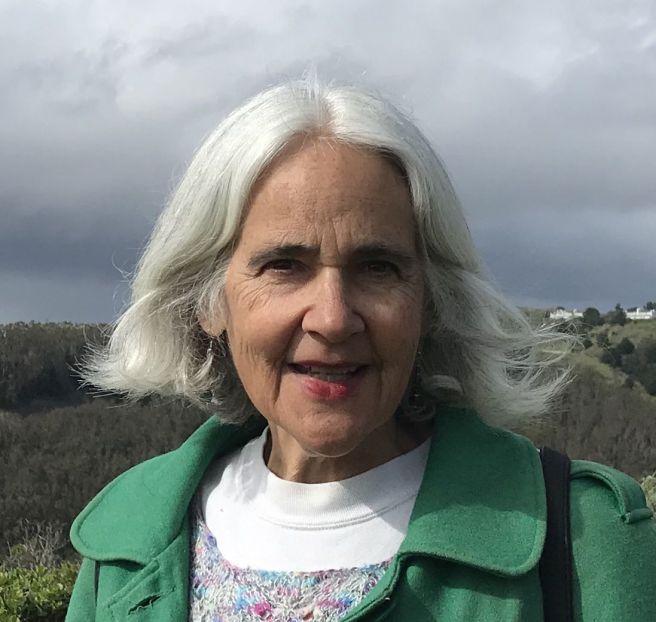
After getting her undergrad degree in Russian at UC Santa Cruz, Naomi Marcus trained as a journalist at Columbia University. (Her J-school class was the last class to use typewriters!) She worked as a tour guide, translator and freelance reporter (back in the) USSR, 1983-89. She then returned home to the Bay Area, and for the past 30 years, worked as a vocational counselor with refugees, immigrants, the formally incarcerated, the mentally ill. She worked at City College, UCSF’s Department of Psychiatry, and also as a producer on KQED-FM’s program FORUM. Currently, she reports for Mission Local and San Francisco Senior Beat.

 Punctured Lines
Lovely piece by the very talented writer, Naomi Marcus. She has really recreated a time and place long gone. Lots of wonderful sensory details give a sense of Moscow when it was the capital of the USSR. Great story!
LikeLiked by 1 person
Thank you for reading!
LikeLike
What a wonderfully evocative piece about the looking-glass world of the final years of the USSR — from the deep perspective of someone living with a foot on each side of the rabbit hole.
The great experiment of the twentieth century was socialism/capitalism, with Russians its gradually-suspecting lab rats. Their never-give-in heroism in WWII turned the USSR into a military superpower — but one with no sausages, no fruit, just cucumber, underneath. With little in the way of food or apartments, people were still making cellos and studying violin for six subsidized years at conservatory. The extraordinary Russian soul led men to want to be shepherds in the Altai or live wild on the shores of Baikal or forage deep in the taiga — where they lasted, yes, for just a few summer weeks. As a stupefied world regards the war against Ukraine, this story touches on the fractured realities with which Russia rejoined the West in 1992. While its violinists, scientists and oil could flow abroad, its chandeliered subway stations and crumbling housing stock remained behind. Unsurprisingly, kleptocracy flourished.
Like Erica, the West came, saw, fell in love with the beauty it found, but ultimately, faced with the mechanics of the Potemkin village, had to leave.
LikeLiked by 1 person
Thank you for reading!
LikeLike
Didn’t drive me nuts. I loved the mix of the “extraterrestrial”-like life of old Soviet times and the story of romance, its mad hatter episodes around Moscow, and the relief of escaping romance from a world with its many ways of closing one in. Provided a nice relief to the humanity of Russia at a time when I’m reading a tome on the history up to the current war.
LikeLike