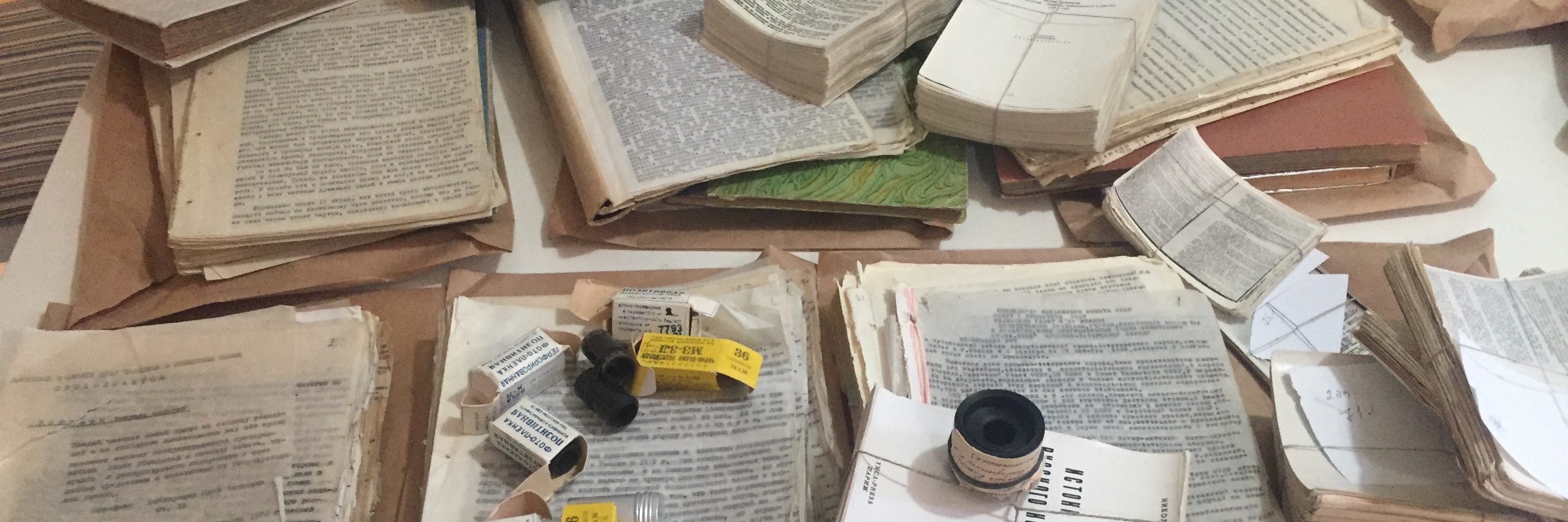
We at Punctured Lines are grateful to Emma Pratt for her review of Oksana Zabuzhko’s Your Ad Could Go Here (trans. Nina Murray and others). This review was planned before the war broke out and was delayed, among other things, by my inability to focus on much when it did. I am thankful to Emma for her patience with this process and for bringing Zabuzhko’s work to the attention of our readers. Please donate here to support Ukrainian translators and here to support evacuation and relief efforts.
Continue reading “The Everyday and Invisible Histories of Women: A Review of Oksana Zabuzhko’s Your Ad Could Go Here by Emma Pratt”Tag: Ukrainian literature
Voices for Ukraine: Video from the Words Together Worlds Apart Reading
Here’s a video from yesterday’s poetry reading featuring poets from Ukraine and their English-language translators. Thanks to poets Olga Livshin and Julia Kolchinsky Dasbach who organized this event 800 people from across the globe came together for Ukraine. This event, put together as a part of an ongoing poetry series Words Together Worlds Apart was a fundraiser, and it’s not too late to DONATE to UNICEF.
Here’s a more comprehensive list of organizations that accept donations for Ukraine.
*Words Together Worlds Apart spearheaded by poet Julia Kolchinsky Dasbach is a virtual reading series. Its mission is: “To maintain & build literary community across distance through our shared love of words. Featured readers will share their work around a weekly theme, followed by interactive discussion.”
Voices for Ukraine: A Words Together Worlds Apart Reading
Many of us have been wondering how to help Ukrainians who are under a renewed attack from Russia. Poets Olga Livshin and Julia Kolchinsky Dasbach have put together a reading by poets from Ukraine writing in Ukrainian and Russian, and translated to English. Read the event description below and register for the event happening March 1 at 12:30pm ET. This message includes links to organizations where you can make donations to support Ukraine in this time of war.
*Words Together Worlds Apart spearheaded by poet Julia Kolchinsky Dasbach is a virtual reading series. Its mission is: “To maintain & build literary community across distance through our shared love of words. Featured readers will share their work around a weekly theme, followed by interactive discussion.”

From Olga and Julia:
Amid the current catastrophe in Ukraine, a brutal invasion of a sovereign nation, it is more urgent than ever to listen to the voices of its people. While media provides overwhelming coverage, literature, poetry, and art are just as important for processing, coping, and surviving trauma.
Hosts Julia Kolchinsky Dasbach and Olga Livshin unite Ukrainian poets and their translators alongside US poet-allies in Voices for Ukraine–a transatlantic reading spanning from Kyiv, Odesa, and Lviv, to LA, Atlanta, Philly, and Little Rock, as well as recordings Ukrainian poets have sent in the event they are unable to join us live due to internet outages and air raids.
***Please note that you need to register on Zoom. Another way to register is through event page on Facebook.
Readers include:
Ilya Kaminsky
Katie Farris
Carolyn Forché
Boris Khersonsky *
Lyudmyla Khersonska *
Lyuba Yakimchuk *
Iya Kiva *
Oksana Lutsyshyna
Oksana Maksymchuk *
Dzvinia Orlowsky
Vitaly Chernetsky
Yuliya Chernyshova *
Danyil Zadorozhnyi *
Ostap Slyvynsky *
Katherine E Young
Boris Dralyuk
Olena Jennings
Amelia Mukamel Glaser
Yuliya Ilchuk
Hilah Kohen
Joy David
Victoria Juharyan
We need their voices and they need our support and collective action. Our solidarity! (*indicates poets speaking from Ukraine).
There is a suggested $5 donation to support the reading series, which can be paid via Venmo @ Julia-Dasbach or PayPal: jkolch@gmail.com. Contributions are always welcome but never required, anything you give, big or small, helps. 90% of all the funds collected today go towards https://www.unicefusa.org/stories/unicef-children-are-bearing-brunt-intensifying-crisis-ukraine/39481 getting humanitarian aid to the children in Ukraine. For more reputable organizations you can donate to, see the following list: https://helpukrainewin.org/?ref=producthunt&fbclid=IwAR0z0tCZO_rqfVKHThRbwptC3VaSwVC9aHrXxFvTwsn550f7jjxk-UYtOMU
Even through this unbearable ache, let’s try to find solace in each other’s words together, as we stay worlds apart.
Maybe Esther, A Family Story by Katja Petrowskaja, translated from the German by Shelley Frisch
Katja Petrowskaja grew up in Kiev, studied in Estonia and Moscow, and lives in Berlin. Maybe Esther was written in German and first published in Germany, in 2014. It was translated to English by Shelley Frisch and published in 2018. She came to the Bay Area Book Festival about a year ago, and I went to her talk and picked up this book. When I started reading it, frankly, I wasn’t sure I was going to finish it. As far as family stories go, this one felt too similar to my own–and why read about something I already know so well, from living it?
I stuck with it because Petrowskaja’s a good storyteller, and a tenacious one, because she has followed her family story several more steps than I have ever done with mine, and because on the page she’s able to capture the complex emotions of following these heartbreaking stories. Of course, in actuality, her family’s story isn’t anything like mine. The similarities begin and end with this: We both grew up in Jewish families in the Soviet Union and emigrated after the Soviet Union fell apart. I write in English, she in German. If it felt like a familiar story at first, it’s precisely because I haven’t read enough books like this. I’ve only read just a few that focus on the Soviet Jewish family saga with any degree of depth (Margarita Khemlin’s Klotsvog in Lisa C. Hayden’s translation being the most recent, and wildly different from Maybe Esther), and they feel the same only because the gap between Kiev and Leningrad Jews in the 1980s is a lot narrower than, say, between Petersburg Jews and New York Jews. That is, it feels close enough to home.
There are a few main characters in Petrowskaja’s family saga. The story of Grandmother Rosa provides the main through-line. She grew up in a Jewish family, and her father, Ozjel Krzewin was born in Vienna, lived in Poland, and then died in Kiev, and ran a private school for deaf-mute children throughout his life–Rosa, too, inherited the profession of educating deaf-mute children. Rosa’s husband and Katja’s grandfather, Ukrainian Vasily Ovdiyenko during WWII was captured and became a prisoner of war in German labor camps. When he returned from the war, he met his wife briefly, but then went to live with another woman and stayed with her for more than forty years. Shortly before his death, he came home to Rosa–who was still waiting for him.
In writing the book, Petrowskaja follows the story of the Jewish side of the family, and then she also traces Vasily’s journey through the German labor camp system throughout Austria–it was a brutal three-year journey that few survived. She visits several labor camps that also served as death camps for Hungarian Jews, to arrive at an epiphany: it must’ve been something that Vasily witnessed in the camps that made his return to his loving family, a wife and two children, impossible after the war.
I don’t know where this conviction stemmed from, but it was right here in this small camp that something happened after everything that had happened already that made my grandfather’s return home impossible, so that he, back in Kiev, could not stay with his family, not with his daughter and not with his wife, Rosa, whose mother and sister lie in Babi Yar, which makes a person Jewish forever, I know that his failure to return had something to do with the death march of the Hungarian Jews
That sentence doesn’t have a period and it doesn’t need one. I should add, that actually this relative’s experience Katja and I, too, have in common: my grandfather, Jewish, was a POW in a German labor camp, and survived. He did return to the family, and one of the things I’m forever trying to write about is what his survival looked to the rest of us, his family, living with him. I finished the book grateful to Katja Petrowskaja for finding the words to unpack some of her experiences.
For a more formal review of this book, please read Linda Kinstler’s review in LARB.
 Punctured Lines