Update: there has been a venue change. This event is now happening at Stage Werx Theatre, 446 Valencia Street.
Punctured Lines is co-hosting a Lit Crawl reading by six Bay Area writers born in Ukraine, Russia, and Moldova. Shaken by the horrific tragedy of the Russian invasion of Ukraine, we will read pieces exploring our connections, direct and indirect, to the part of the world we associate with home and exile, and where many of our friends and relatives are suffering as a result of the war. We work in the genres of nonfiction, literary and historical fiction, YA, flash, and other literary forms to tell our stories, and will read excerpts from our published and new work.
This event will take place at 5 pm on October 22nd at Blondie’s BarStage Werx Theatre, 446 Valencia Street in San Francisco .
Punctured Lines is happy to host a conversation between Ian Ross Singleton, author of Two Big Differences (M-Graphics Publishing, 2021) and Kristina Gorcheva-Newberry, author of The Orchard (Ballantine Books, 2022). The novels’ synopses are below, and you can listen to the writers read excerpts here. Both of these works feature post-/late Soviet space, Ukraine in Two Big Differences and late Soviet/post-Soviet Russia in The Orchard. To support Ukraine in its fight against Russia, you can donate here and here, as well as to several other organizations doing work on the ground. If in addition you would like to support Russian protesters, you can donate for legal help here.
Taking your beloved books with you into immigration is intimately familiar to those of us who left the Soviet Union. My parents’ двухсоттомник—”200-volume set”—of Russian and world literature, was quite literally my lifeline to the language and culture that I may have otherwise forgotten, and they are still the editions I turn to today. The covers of the volumes are different colors, and some key moments of my life are associated with them, such as the dark green of Gogol’s Мертвые души (Dead Souls) when I started college. Reading Maria Bloshteyn’s essay was genuinely heart-wrenching, because the experience she describes is that of an acute loss of books that mean so much to us, not just for their content, but perhaps even more so because they have made the immigrants’ journey with us and sustained us in our new homes. In the current moment, this poignant essay is framed by the war in Ukraine, where people like us are losing not just their books, but their lives. If you are able to help, please support translators who are struggling due to the war and this initiative to give Ukrainian-language books to refugee children in Poland. Ukraine’s cultural sphere has been badly damaged by Russian forces, and we will continue to look for ways in which those of us in the West can help. Maria recently participated in the Born in the USSR, Raised in Canada event hosted by Punctured Lines, and you can listen to her read from an essay about reacting to the war in Ukraine while in the diaspora.
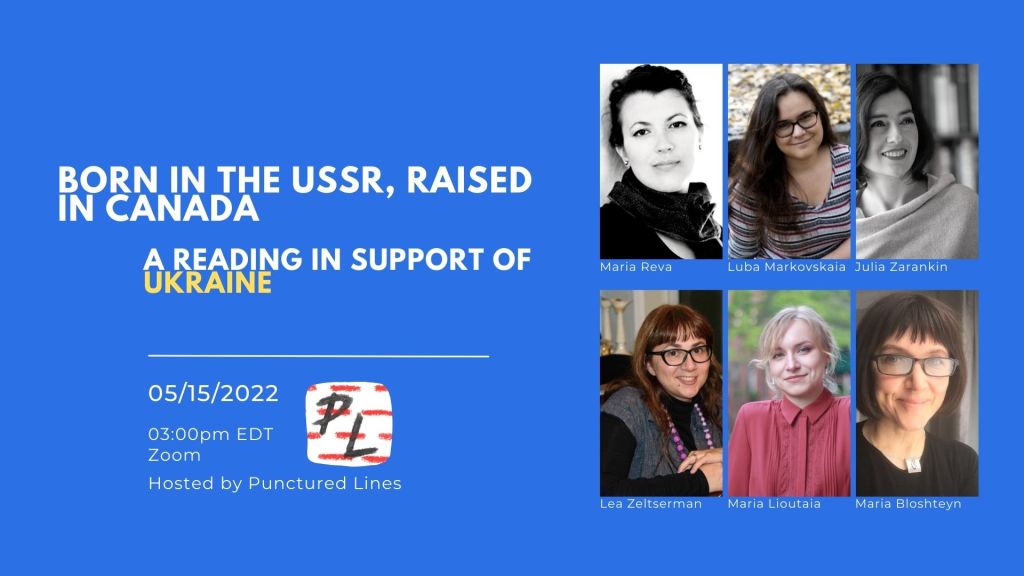
We’re happy to share the recording from the event we hosted on May 15, 2022, gathering writers who were born in the former Soviet Union and immigrated to Canada as children. Currently located all across Canada, from Montreal (Luba Markovskaia) to Vancouver (Maria Reva) with a definite hub around Toronto (Julia Zarankin, Lea Zeltserman, Maria Lioutaia, Maria Bloshteyn), these generous writers shared excerpts from their work and answered questions about living with hyphenated identities and building writing communities. Russia’s war in Ukraine was at the forefront of this conversation, as most of the writers and the participants have family and friends affected by the bombs. This event was a fundraiser, and we encourage everyone to continue donating to the organizations listed below.
Punctured Lines is delighted to bring you our next event–a reading and a Q&A with six established authors who were born in the former Soviet Union and immigrated to Canada as children. In their fiction and nonfiction they explore topics of multicultural identity, life under communism, Jewish culture, food, history, and making a home in a strange land.
We began planning this event before Russia’s renewed, full-scale attack on Ukraine, and we want to acknowledge that this war is resonating deeply throughout the diasporic community. We feel that it’s particularly important for us to come together at this time, to listen to each other’s stories and to amplify each other’s voices and resources in support of the people of Ukraine in their fight against the Russian totalitarian regime. We also want to extend our support to those citizens of the Russian Federation resisting and fleeing from this regime.
*** This event will be recorded. ***
*** This event is a fundraiser and we encourage everyone to donate money directly to organizations supporting Ukraine and Russian protesters. Suggested donation starts at $5.
Punctured Lines is grateful to Ivan Sokolov for the opportunity to publish his letter and a collection of links. Author’s idiom is preserved.
I am thankful to everyone who has reached out to me—I am safe and away from Russia at the moment. Let this post be an update for my anglophone contacts who have expressed concern about Russia’s ongoing war in Ukraine, possible sources of following the events and the lives, as well as means of giving aid.
I feel compelled to mention, however, just to be fair, that if I find myself displaced and unhinged in every sense of the word, it is far less so than the hundreds of thousands of other Russians evacuating these days to neighbouring countries—and doing so, unlike myself, without visas, academic affiliations, language skills or any experience of living abroad. I did not think I’d live to see (and run into!) my own acquaintances, mostly young, crowded in airports by random gates—the sheer extent of the exodus is mind-blowing. The fate of those who remain in Russia may look bleak—and even if a massive campaign of arrests and repressions does not ensue, the economic deterioration will hit everyone hard. But if we find our plans, ways of life and peace of mind disrupted and displaced, it is unthinkably more literal and cruel for the livelihoods of our friends within Ukraine and those that have managed to escape the war crimes being committed there.
Our friends The Cheburashki, “a growing collective of women & nonbinary writers who are emigres/refugees/first-generation from countries that were once a part of the Eastern bloc,” are hosting a reading in Philadelphia next week. Here’s a great place to find some camaraderie in this time of war and donate money for Ukrainian refugees.
This event is happening in conjunction with AWP, a poets and writers conference that will include several important events with USSR diaspora writers. We made a list.
Most of these opportunities are currently provided by European institutions, and we urge our friends with any influence at North American institutions and those around the world to consider expanding existing opportunities and to establish new positions for writers fleeing the war in Ukraine, as well as for writers speaking out against their regimes in Belarus and Russia.
For those watching in horror the atrocities committed by Russian troops in Ukraine and wondering what can be done from afar, here is a list of various types of organizations to support. Given the rapidly developing situation and the number of appeals from various channels, this list is by definition incomplete. If you know of other organizations please add them, and we will be updating, as well. We stand with the citizens of Ukraine, the Russian protesters, and members of the various diasporas who have family, friends, and ties in one or both places.
Here’s a video from yesterday’s poetry reading featuring poets from Ukraine and their English-language translators. Thanks to poets Olga Livshin and Julia Kolchinsky Dasbach who organized this event 800 people from across the globe came together for Ukraine. This event, put together as a part of an ongoing poetry series Words Together Worlds Apart was a fundraiser, and it’s not too late to DONATE to UNICEF.
*Words Together Worlds Apart spearheaded by poet Julia Kolchinsky Dasbach is a virtual reading series. Its mission is: “To maintain & build literary community across distance through our shared love of words. Featured readers will share their work around a weekly theme, followed by interactive discussion.”


 Punctured Lines