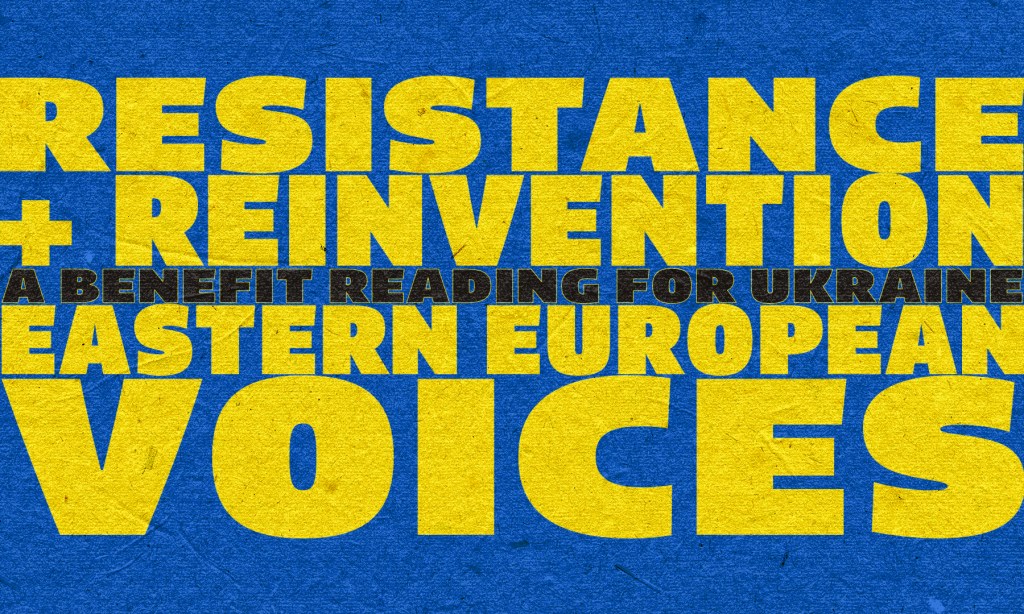
This one-of-a-kind reading brings together writers from Eastern Europe and the post-Soviet countries who now make their homes across the United States. Taking place during the 2026 AWP Conference, the event celebrates a growing circle of poets, prose writers, and translators from complex, cross-cultural identities whose work is shaped by displacement and immigration, survival and resilience.
More essential than ever, nuanced storytelling is our compass toward understanding and community. Writing from and beyond histories marked by authoritarianism and censorship, the authors center free expression, creative freedom, and democratic dialogue. Through stories of reinvention, loss, and belonging, we build cultural and intergenerational bridges, reclaiming the power of connection and voice.
** This event is a fundraiser for Ukraine ** Free admissions ** Book sales by Bergstrom Press & Books ** Please register on Eventbrite **Arrive early to get a seat! **
This event is co-hosted by Turkoslavia, a translation collective and a journal celebrating literature in Turkic and Slavic languages.
* Thank you to Ena Selimović for designing the promotional materials
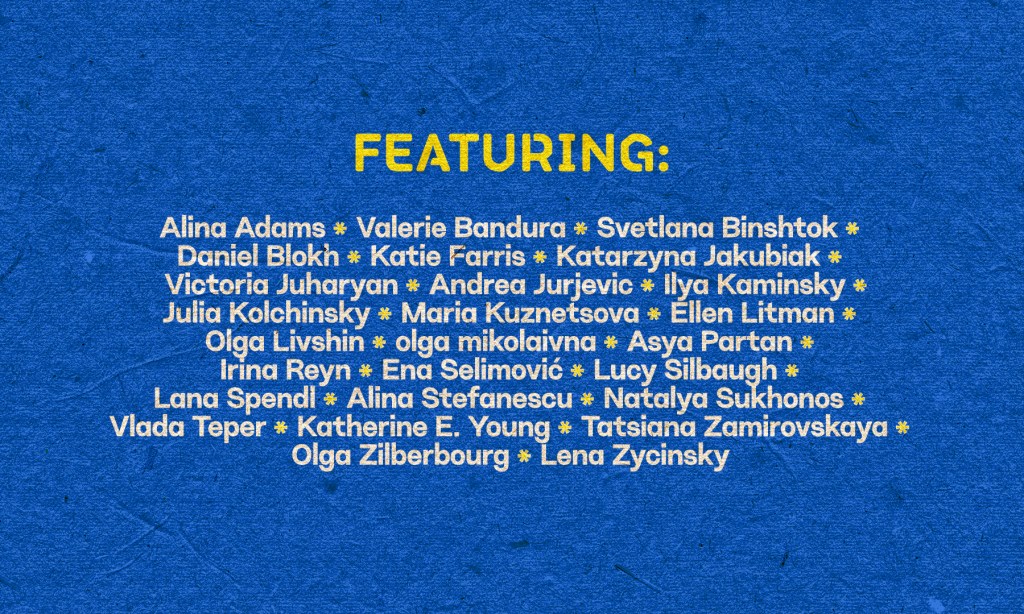
Featured Readers:
Alina Adams is the NYT best-selling author of soap opera tie-ins, figure skating mysteries and romance novels. Her Soviet historical fiction includes The Nesting Dolls, My Mother’s Secret: A Novel of the Jewish Autonomous Region and Go On Pretending. www.AlinaAdams.com
Born in the former Soviet Union, Valerie Bandura is the author of two collections of poems, Human Interest and Freak Show. Her poems have appeared in American Poetry Review, The Gettysburg Review, and Ploughshares, among others. She teaches writing at Arizona State University. https://valeriebandura.com/
Svetlana Binshtok is a writer and storyteller whose work has appeared in The Louisville Anthology, The Second City, 80 Minutes Around the World, and Fillet of Solo Festival.
Danya Blokh is a poet from Birmingham, Alabama. He received his bachelor degree in Comparative Literature and Russian from Yale University, and is now pursuing an MFA in Poetry at Johns Hopkins.
Katie Farris’s work has appeared in Poetry & The New York Times. Her latest book, Standing in the Forest of Being Alive (Alice James 2023) was shortlisted for the 2023 TS Eliot Prize. She co-translates from Ukrainian, including Lesyk Panasiuk’s Letters of the Alphabet Go to War (Sarabande 2026).
Katarzyna Jakubiak’s recent nonfiction collection is Obce stany (Alien States; Poland, 2022). She is also a short story writer, translator, scholar, and Associate Professor of English at Millersville University.
Victoria Juharyan teaches literature and philosophy at Johns Hopkins University. She has been writing poetry since she was three years old but first time she agreed to read her work in public was in 2022 after Russia’s invasion of Ukraine, at a similar event during AWP. Consequently, her poems were published in Symposeum Magazine (https://api.symposeum.us/author/victoria/) and set to music.
Andrea Jurjević is a poet, translator, and painter from the Adriatic coast of Croatia. Her latest collection is In Another Country (2022 Saturnalia Books Prize). Read her Substack Lovesong to Elsewhere: https://andreajurjevic.substack.com/
Ilya Kaminsky was born in Odesa, Ukraine and lives in New Jersey. He is the author of Dancing in Odessa (Tupelo) and Deaf Republic (Graywolf) and translator & editor of many other books.
Julia Kolchinsky is the author of four poetry collections, most recently, PARALLAX (The University of Arkansas Press, 2025). Her next book, When the World Stopped Touching (YesYes Books, 2027) is a collaborative collection of letter-poems with Luisa Muradyan, written during the first year of COVID . She is Assistant Professor of English and Creative Writing at Denison University.
Maria Kuznetsova was born in Kyiv, Ukraine. She is the author of the novels Oksana, Behave! and Something Unbelievable and is an Associate Professor at Auburn University. https://mariakuznetsova.com/
Ellen Litman is the author of two novels, The Last Chicken in America and Mannequin Girl. She teaches at UConn. Born in Moscow, she immigrated to the US in 1992.
Olga Livshin’s poetry appears in Poetry magazine, the Southern Review, and Ploughshares. She is the author of A Life Replaced: Poems with Translations from Anna Akhmatova and Vladimir Gandelsman. olgalivshin.com
olga mikolaivna was born in Kyiv and works in the (intersectional/textual) liminal space of photography, word, translation, and installation. Her debut chapbook cities as fathers is out with Tilted House and “our monuments to Southern California,” she calls them is forthcoming with Ursus Americanus Press. She lives in Philadelphia and teaches at Temple University. https://www.olgamikolaivnapetrus.org
Asya Partan’s writing appears in The Boston Globe, The Rumpus, Pangyrus, NPR‘s Cognoscenti, and The Brevity Blog, and is forthcoming from Liberties. An MFA (Emerson College) and a memoir are in the works. www.asyapartan.com
Irina Reyn is the author of three novels: Mother Country, The Imperial Wife, and What Happened to Anna K, which won the Goldberg Prize for Debut Fiction. Her work has appeared in One Story, Ploughshares, Tin House, and other publications. She teaches fiction writing at the University of Pittsburgh.
Ena Selimović is a writer, translator, and co-founder of Turkoslavia, a translation collective and literary journal. Her work has appeared in Words Without Borders, The Paris Review, and elsewhere. https://www.turkoslavia.com/
Lucy Silbaugh is an MFA student in poetry at Johns Hopkins. Her poems have appeared in the TLS and Gulf Coast and are forthcoming in the TheIowa Review and The Bennington Review. She has published essays on Nabokov, Gazdanov, and Henry James.
Lana Spendl’s work has appeared in The Threepenny Review, World Literature Today, The Rumpus, and other journals. She is the author of a chapbook of fiction and reads for Crab Creek Review. Her childhood was divided between Bosnia and Spain prior to her immigration to the States. Read her work at lanaspendl.com/writing.
Alina Stefanescu is a unique poetic voice of the Romanian American diaspora. Her poetry collection Dor won the Wandering Aengus Press Prize (September, 2021). In the collection, My Heresies (Sarabande, 2025), she has “translated” Romanian childhood myths into the present as spaces for ontology.
Natalya Sukhonos is a poet who was born in Odesa, Ukraine and now lives in Upstate NY. She is the author of Sunlight Trapped in Stone (Green Writers Press 2026) and two other collections. natalyasukhonos.com
Vlada Teper is a writer and educator from Moldova. Her work has appeared in Newsweek, NPR, World Literature Today, and others. She is the founder of the nonprofit Inspiring Multicultural Understanding. www.vladateper.com
Katherine E. Young is the author of Day of the Border Guards and Woman Drinking Absinthe and served as the inaugural Poet Laureate of Arlington, VA. She translates Azerbaijani, Kazakh, Russian, and Ukrainian writers. https://katherine-young-poet.com/
Tatsiana Zamirovskaya is a bestselling Belarusian author who writes metaphysical and socially charged fiction. She is the author of three short story collections in Russian and two highly acclaimed novels, The Deadnet and Candles of Apocalypse.She worked for Voice of America as an editor and journalist until its shutdown in March 2025.
Olga Zilberbourg is the author of LIKE WATER AND OTHER STORIES (WTAW Press). She co-facilitates the San Francisco Writers Workshop and co-founded Punctured Lines, a blog about literatures from the former USSR. https://zilberbourg.com/
Lena Zycinsky is a Belarusian-American poet and artist, working across languages and disciplines. The author of several poetry collections and art exhibitions in Russian, Lena holds an MFA from New York University. Her work has been published in the New York Times and selected for the Poetry Archive. Born in Minsk, Lena has lived in the United States, the United Kingdom, and Greece, and is currently based in London. More at: www.lenazycinsky.com
Avdotya Panaeva was born in 1820 and first began publishing her work in one of Russia’s premier literary magazines, Sovremennik, in 1846. The author of numerous short stories, novels, memoirs, as well as collaborative projects, she has only recently begun to achieve the recognition that she deserves in the English-speaking world.
On October 8, 2024, Columbia University Press published Fiona Bell’s translation of Panaeva’s first novel,The Talnikov Family. This became the second full-length translation of Panaeva’s work to English. In my review of the book inOn the Seawall, I mention several social and historical factors that have kept this delightful novel from English-language readers for so long. In writing about this book, I have relied, in part, on Bell’s introduction to the novel and on the research by Margarita Vaysman, whose book Self-Conscious Realism: Metafiction and the Nineteenth-Century Russian Novel devotes a section to Panaeva’s work, including an excerpt that ran in Punctured Lines.
Today, it is my pleasure to discuss this novel and Panaeva’s work more broadly with her translator Fiona Bell and scholar Margarita Vaysman.
This is a translation of a Russian-language interview conducted by Svetlana Satchkova and published by Storytel on June 16, 2020. The translation is by Fiona Bell.
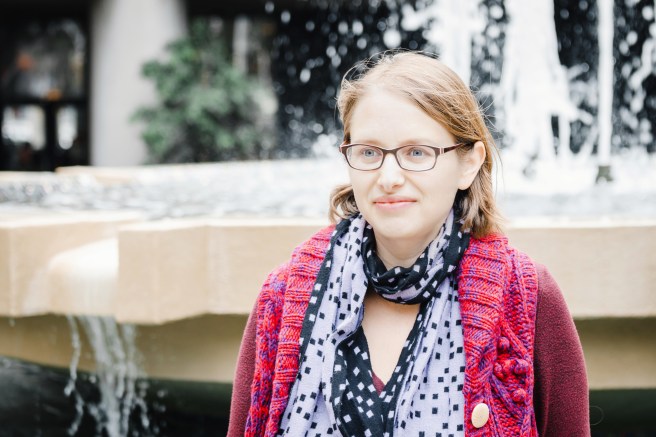
Tatsiana Zamirovskaya is a writer from Belarus who has lived in New York for the past five years. She writes in Russian and English. Her short story collection, TheLand of Random Numbers (Земля случайных чисел, AST, Russia, 2019) was nominated for the National Bestseller prize and compared by critics to works by premier authors of metaphysical science fiction, from Ursula K. Le Guin to the Strugatskii brothers. She recently completed a new novel about memory and digital immortality.
Svetlana Satchkova spoke with Tatsiana about how her interest in fantasy developed, how she came up with the idea to move to the United States, and what the Belarusian language means to her.
Photo: Furkan Uzunsac
What was your childhood like?
I was born in Borisov, a small city where Napoleon’s army was defeated in 1812. Nothing else has happened there, which is why all local culture revolves around Napoleon: there are regular battle reenactments on the floodplain of the Berezina river, where the army drowned, and guys walk around with metal detectors looking for Napoleon’s golden carriage, and drunk high school graduates go to Brilevskoe field to watch the sunrise. Borisov is also famous because Hitler came there during his only visit to the Nazi-occupied parts of the Soviet Union, in 1943. When I was a kid, the neighbors once told me that he probably stayed in our house, since it was one of the only brick houses in the city at that time…
My parents were pretty ordinary: in Soviet times, my mother was a music teacher at a music school and my dad was an engineer at a factory, where he designed tanks. After the collapse of the Soviet Union, he tried to survive in any way he could. Belarus is a transit territory, which is why Belarusians survived thanks to these huge overnight bags, which they used to carry all sorts of junk to sell across the border in Poland. So I grew up among mountains of junk: for example, thousands of crystal swans from the Borisov Crystal Factory, or boxes of dichlorvos.
I went to a great school that specialized in English. We periodically went on exchange trips to London. The British kids also visited us, bringing all the new music on cassette tapes, which we then copied from each other. I listened to all the Brit Pop albums of the nineties right when they came out, and back then, that was a huge accomplishment – living in contemporary music culture. Borisov was also a hub for violent youth groups, kids who actually lived by the laws of the street. So, my childhood was a mix of prison aesthetics, elite education, and difficult, post-perestroika life.
What did you want to be when you grew up?
I always wanted to become a writer or a musician. My parents hung out with a great crowd of rock-intellectuals. One of them, the famous musician Oleg Minakov, who sang in the German group Inspector back then, told me I should study journalism because, with my interest in music and desire to write, I could become a music critic. I thought that sounded like a really cool life, so I decided to study journalism at Belarusian State University in Minsk.
Then, at the end of the 90s, Lukashenko changed the constitution so that he could be president without interruption or term limits — in fact, Russia recently took a page from his book. But the journalism department at my university was very liberal: I was accepted, writing in my entrance exam essay about how I dreamed of working for the opposition newspaper Name (Имя). When my mom found out, she cried for two days. Then we heard that I’d gotten the highest score of all the applicants. The journalism department was a cool crowd, everything was suffused with the spirit of freedom and hope for a different future. I went to protest rallies, rock concerts – basically, it was a great time.
When did you become a working journalist?
The same time I started doing everything else – university. When I was 19, my friends and I published a completely out-there newspaper for an opposition party that got a grant for it. One time we were paid in NATO pilot jumpsuits, since humanitarian aid had been sent that consisted of canned food and these jumpsuits. I only published one article in Name (Имя)– I handed it over to the legendary journalist Irina Khalip, she published it, and two weeks later the newspaper closed down. The article was about a Rolling Stones concert in Moscow, and Khalip even remembered me later. In one of her interviews she said: “I remember this first-year student Zamirovskaya coming to me with her article on a sheet of paper.” It made me so happy to read that.
Even at that time, professional music media in Belarus was well-established, in the spirit of publications like Q and NME: Music News Weekly (Музыкальная газета), the magazine Legion (Легион), and the magazine Jazz Quad (Джаз-квадрат). I wrote for all three and was the editor at Jazz Quad. That was my first job after university. We worked directly with labels, who had a lot of respect for us and sent us new albums to review. You have to remember that in 1997 Minsk, getting a review copy of OK Computer, when no one else had heard it, was very cool. I spent hours on the phone and did interviews with all sorts of famous musicians, which allowed me to make up for the English I hadn’t been taught in school.
When did you start writing prose?
While I was studying journalism, I wrote short surrealist stories and, without telling my friends, sent them to the Dnipropetrovsk cult contemporary art magazine, Ours (Hаш). People like Linor Goralik and Mikhail Elizarov started publishing there. I didn’t get a response, but one day the magazine sent all its contacts a letter saying that their work mail had gotten messed up and everything had been lost, but that some girl from Minsk’s journalism department had sent them a story about a guy who fucked a pyramid. They wanted to publish that story but didn’t know how to find the girl.
The next day, everyone in the department kept looking at me. It turns out we had all been secretly sending things to Ours (Hаш). My piece was an homage to Ray Bradbury, who had a story about a man and a woman who give birth to a pyramid and then decide to move to the land of pyramids to live on the same wavelength as their child. Now I have three published short story collections, the most recent of which, The Land of Random Numbers, came out in 2019 with AST, Moscow.
What made you decide to move to the U.S.?
At 35, I felt like I had already lived a full life. I didn’t know where to go next. I’d worked as a journalist for a long time, applying an apocalyptic perspective to everything: first to music, then politics, culture, and contemporary art. I’d hosted a jazz program on Polish radio and edited a glossy men’s magazine with friends. We’d even had Sergey Mostovshchikov, who we all idolized at the time, as a guest editor in a joint issue with Crocodile (Крокодил).
My time in Belarusian journalism had run its course and I thought it would be cool to get an education in the arts – I worried that I wasn’t writing deeply enough about contemporary art – and simultaneously improve as a writer. I set out to do an MFA in New York because it was my favorite city, where I’d been as a tourist but wanted to live.
Was it difficult to adapt to a new place?
My friends couldn’t understand my decision to move, since in Minsk I lived in my own apartment and worked as a content editor at an ad agency – my life was great. And now I’d decided to spend all the money I had saved to go to some art school and live in a tiny, screened-off corner of a puppeteer’s apartment in Bushwick. While I was earning my MFA, I had all kinds of weird side hustles: writing texts and sometimes even being a pet sitter. It was really cool because I got to spend time in the fancy apartments of some artist or another, lying on their couch with their dog and looking at their art books. But I always saw this as forward movement: I immediately realized that in the U.S., education is a huge investment in yourself, even if it’s not the sort of education that gives you the opportunity to find the perfect job right now.
What types of opportunities does it offer?
A Master of Fine Arts degree legitimizes you as a practitioner in an artistic field. This degree is so expensive because it gives you access to circles that you wouldn’t otherwise be able to get into. After I graduated from Bard College, I went to several prestigious writers’ residencies, where people would ask me who I was and where I was from. “Belarus,” I’d say. “Oh, they kill journalists there, don’t they? Or is that Bulgaria?” they’d say. “Alexievich, Chernobyl,” I’d say. They would nod, still unsure. Then I started saying that I’d graduated from Bard, and they would immediately reply, “Oh, Bard!” Their attitude towards me changed instantly: they no longer needed to know what I wrote or whether I was any good.
The fact that I’d received an MFA meant that I had already been verified by someone somewhere and that I was, roughly speaking, part of their circle. This program also helped me understand what I do more generally. At Bard MFA, they teach you to be aware of all the stages of creative work: so, it’s not that I sit down, and the universe hands me a text because thus is its divine will. They teach you to understand your own practices, how they relate to your life story and your identity, what is borrowed and what is your own. I learned how to write grant applications, to put myself in context, and basically to understand what I want. If I hadn’t gone there, I’m not sure I would still be writing.
What’s special about Bard College?
Bard is one of the oldest liberal arts colleges in New York and it has a Graduate School of the Arts with a focus on interdisciplinarity. Its founders decided to bring together professors from various disciplines – sculpture, painting, photography, film and video, music, and literature – and educate students so that they interact as much as possible. There aren’t many students, so people from various faculties can visit each other’s caucuses. It really opens up your perspective, especially as a writer. For instance, I’ve never done normal readings of my texts – they’ve always been performances.
Could you describe one of them?
I did a performance on the impossibility of translation. I handed audience members pages of a surrealist short story that I – someone with very synthetic English – had self-translated into English and told them to follow along with the text. Then I took the microphone and read the story in Russian with periodic pauses. My classmate Anastasia Kolas, who was hiding in a closet, translated each phrase live. She emigrated from Belarus as a teenager and knows English like a native speaker, but she has kind of torn herself away from Russian. This was the first time she had heard my story. Naturally, my translation was very different from what Anastasia came up with. In this way, the audience simultaneously heard three different versions of this text through three different channels of perception. I was later told that this was a totally psychedelic experience.
Do MFA graduates manage to make a living as artists?
I don’t have the naïve belief that if I make good art, that means I can make a living off of it. But at the same time, I don’t think that if you can’t make money off of it, that means you should be ashamed of it. For artists, generally speaking, it’s normal to be poor and unsettled – maybe it was actually Bard that taught me to feel this way. Basically, I see it like a sort of gambling: you can win the jackpot or not win anything at all, but that’s where the nice sense of excitement comes from.
There are people who have achieved conventional success: Salley Rooney, for example. She clearly didn’t set out to write a bestseller, her prose just coincided with something and set off a reaction. It’s all about chance and synchronicity, themes that are very close to me. But, as far as I know, some of my former classmates work as assistants to more successful artists or writers, teach at colleges, or work as copywriters, journalists, or PR professionals. But some are lucky: they get a book contract or are exhibited in MoMA, like Martine Syms – a classmate of mine who is a superstar in the contemporary art world.
What are you writing now, in Russian and in English?
I’m finishing a novella in English that was originally my thesis project. It’s about false testimonies: people who talk about persecutions and abuse that they never actually experienced. It’s experimental prose – something at the intersection of prose and poetry. Since I’ve been writing it for a long time, my English has evolved in the process. The reader can trace the improvement of the author’s language. The first chapters are really shaky, and now I can’t even edit those because my English has noticeably improved. Maybe by the end it will be quite natural.
Anna Moschovakis, my professor, came up with the idea. She said that I would never have another chance to write a text in a language that was poor at the beginning, but then improved. To waste that transitional moment would be stupid. In Russian, I wrote a novel about how a person’s consciousness continues to exist after their death, or rather, not the consciousness itself, but its digital copy. This is a very important difference because it’s impossible to maintain consciousness after death – you completely disappear. But if you have a digital copy, it considers itself to be you. It’s a kind of post-apocalyptic utopia about people who copy their consciousness, and the copies go to some sort of afterlife, thinking that they themselves are people.
You are from Belarus and identify as a Belarusian writer, but you write in Russian and English. Why?
I can’t write literary prose in Belarusian because I only learned it at school as a second language, although I consider it my native language and that’s something I always emphasize. Like many Belarusians, I grew up in a Russian-speaking environment and I think in Russian, and I respect Belarusian too much for it to just be a target language for mental translations from Russian. I’m planning to write something in Belarusian that won’t require this sort of code conversion – maybe a memoir about working as a journalist in Minsk.
I think it’s important to note that the identity of a Russian-speaking Belarusian is that of a person who, though they grew up in a Russian-speaking culture, very clearly separates themselves from Russia because Russophone culture doesn’t only include Russia. When I studied journalism in the nineties, if you spoke Belarusian, it meant that you were against Lukashenko, that you went to protests and, more often than not, wrote poetry. This was the language of the artistic intelligentsia. I worked at Belarusian radio stations for many years, I speak Belarusian as well as I would a first language, and I always switch to it when I’m with Belarusians. But I haven’t used it in literature. I’ve always thought it would be an opportunistic act on my part, since authors who write in Belarusian are rightly given more support. Svetlana Alexievich, for example, also writes in Russian and, in so doing, emphasizes the fact that she is not Russian.
Belarusian has been in a difficult position for a long time, since Stalin destroyed practically the entire Belarusian cultural elite in 1937. Perhaps our culture would be different if those hundreds of writers and poets hadn’t been taken to the forest and shot. Nowadays it’s very important to understand the terminology at play. The way I see it, I work in the field of international culture and Russian is a convenient tool I use. Just because Belarusians write in Russian doesn’t mean they’re a part of Russian culture. I want to be treated in Russia – and for other Belarusian authors to be treated – like any other foreign author, one who happens to write in Russian simply due to historical circumstance. In any case, native speakers of Russian are lucky – they can read our work in the original.
Svetlana Satchkova is a writer and journalist from Moscow, Russia, who currently lives in New York City and is working on her MFA at Brooklyn College. Her new novel People and Birds is coming out from Eksmo in September.
Fiona Bell is a literary translator and scholar of Russophone literature. Her translation of Stories by Nataliya Meshchaninova received a 2020 PEN/Heim Translation Fund grant. She is from St. Petersburg, Florida and currently lives in New Haven, Connecticut.


 Punctured Lines