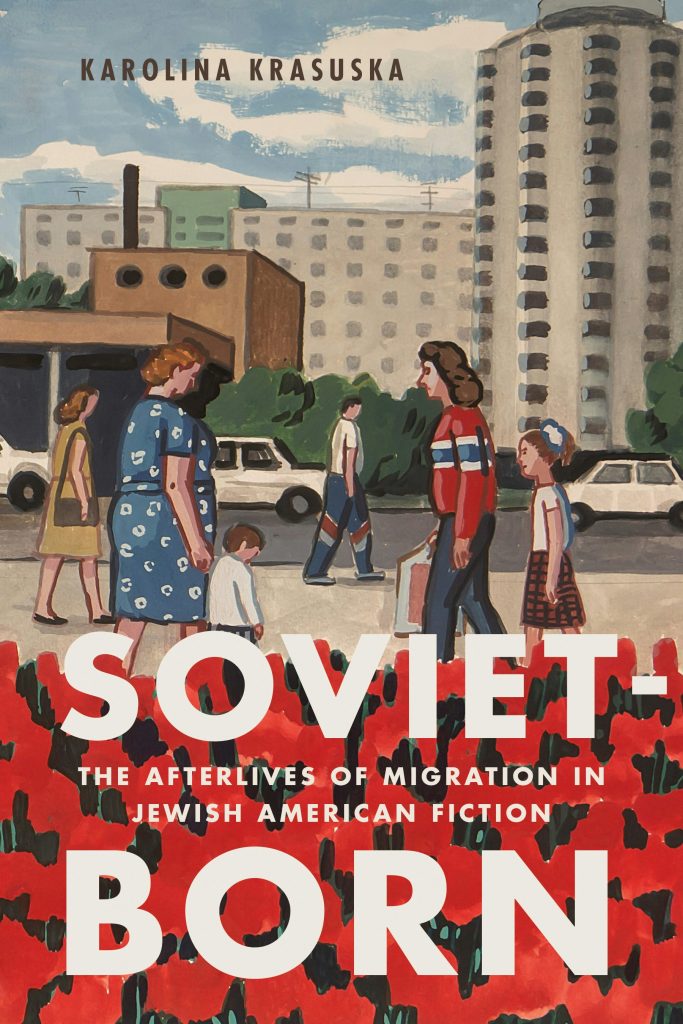
Today we are featuring an excerpt from Soviet-Born: The Afterlives of Migration in Jewish American Fiction (Rutgers UP, 2024) by Karolina Krasuska, associate professor at the American Studies Center and co-founder of the Gender and Sexuality MA Program at the University of Warsaw, Poland. Starting in the early 2000s, Jewish immigrant writers from the former Soviet Union have appeared on the US literary scene in increasing numbers. While Gary Shteyngart, who can give lessons in self-promotion, is the most well known, the list comprises more women, including Lara Vapnyar (a Q&A with whom we have featured on this blog), Anya Ulinich, Irina Reyn, and Ellen Litman, to name only a few. As their books continued to be published, academics began to take note, organizing conference panels and writing on the subject (I am happy to have contributed to this field of study from its inception). The first and foundational monograph was Adrian Wanner’s Out of Russia: Fictions of a New Translingual Diaspora (Northwestern UP, 2011), which discussed the global phenomenon of ex-Soviet immigrant writers in the various countries to which they immigrated. Krasuska’s is the first academic volume specifically devoted to ex-Soviet Jews living and writing in the US, where the largest number of such immigrants resides.
Continue reading “Queering Peripheries: Lara Vapnyar’s “Lydia’s Grove”: Soviet-Born: The Afterlives of Migration in Jewish American Fiction by Karolina Krasuska”Tag: Soviet Jewish fiction
How Moscow’s 1957 World Youth Festival Inspired Me to Go On Pretending: Guest Essay by Alina Adams
Today we welcome Alina Adams back to the blog with an essay about her interracial family’s trip to Moscow (before the war in Ukraine) and its connection to her recently released novel, Go On Pretending (History Through Fiction, 2025), featuring a fictional interracial family. You can read our previous conversations with Alina here and here. As one of the excerpts below shows, a key element in her novel is the 1957 World Youth Festival in Moscow, during Khrushchev’s Thaw, which was meant to demonstrate the Soviet Union’s liberalization and racial tolerance (you can guess how that turned out). The reference to the festival immediately made me think of a different novel by another ex-Soviet Jewish immigrant writer in which it is an important plot element: Petropolis (Penguin Random House, 2008) by Anya Ulinich. If you would like to know more about this lesser-known event and about the Soviet Union/post-Soviet Russia and race, let Alina explain below and then order Go On Pretending (and Petropolis).
Continue reading “How Moscow’s 1957 World Youth Festival Inspired Me to Go On Pretending: Guest Essay by Alina Adams”A Character with a Secret Is an Easy Sell: A Conversation with Sasha Vasilyuk, by Olga Zilberbourg
A new novel set in World War II enters a crowded and hotly contested field. It is a particularly remarkable feat for a debut novelist that Sasha Vasilyuk’s Your Presence Is Mandatory (Bloomsbury, 2024) earned universal praise from celebrated writers across the former USSR diaspora community and far beyond. Gary Shteyngart wrote, “Wonderfully written, elegiac and necessary, Sasha Vasilyuk uncovers the history behind the recent headlines with great skill and grace.” Susanne Pari, author of In the Time of Our History and The Fortune Catcher, wrote, “An outstanding novel of sacrifice, love, and forgiveness.”
We celebrate this novel’s arrival with particular pleasure. A contributor to Punctured Lines, Vasilyuk participated in a number of events we’ve hosted over the years, and we’ve heard excerpts from this novel as she was working on one draft after another. In May 2024, Olga Zilberbourg interviewed Vasilyuk during a book release event at Telegraph Hill Books in San Francisco. The following Q&A is a follow-up to that in-person conversation.
Continue reading “A Character with a Secret Is an Easy Sell: A Conversation with Sasha Vasilyuk, by Olga Zilberbourg”