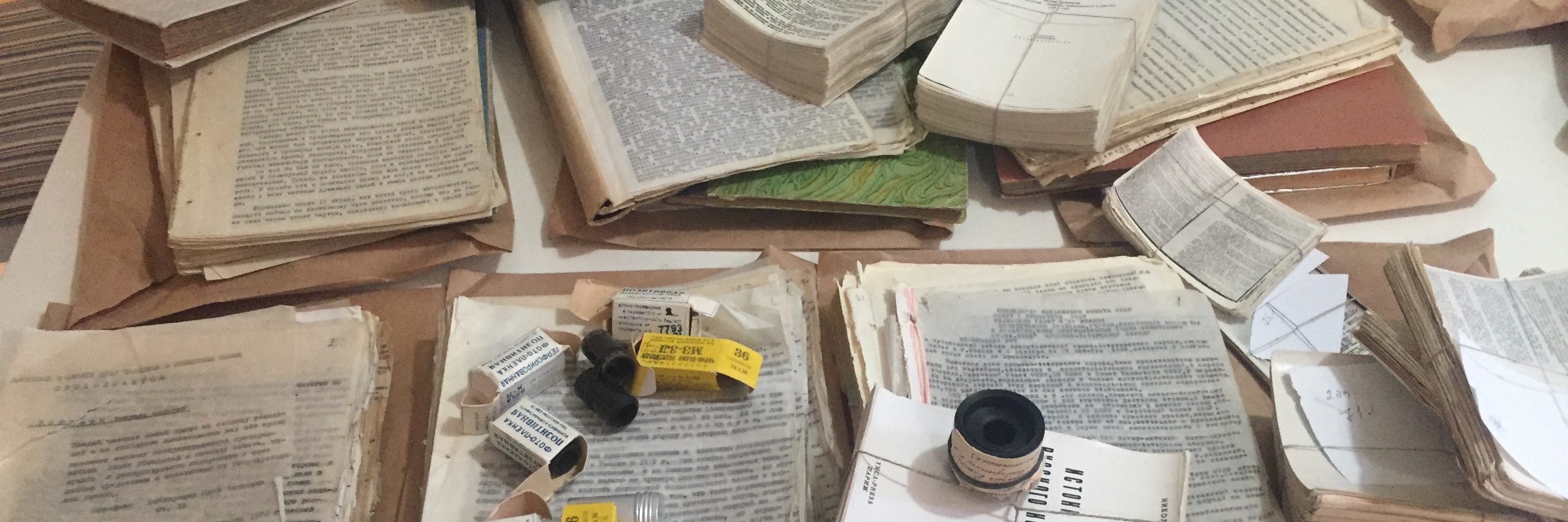
Lida Yusupova’s Poetry Collection The Scar We Know

In the spring of 2007, in St. Petersburg to visit my parents and to promote my first collection of stories, I decided to attend a graduation party of the Gender Studies program at the European University. I’d been a semi-active participant in the Russian-language feminist blogs, where I learned about this program. I contemplated applying; or, at least, since by then I lived in San Francisco, I dreamed about befriending the students and the faculty and making myself useful to them. I had just graduated from a Master’s program in Comparative Literature in San Francisco, where I learned a few things about feminism. I thought my experience could be useful and interesting to my Russian peers. My ideas were somewhat far-fetched.

European University building until 2017

Established in 1994, European University had the reputation of a progressive institution, focusing on social studies, including history, anthropology, economics, politics. I had never been there before, and I was imagining something akin the American universities that I knew: welcoming signage, flyers everywhere, friendly faces ready to help. I forgot to account for one small thing: my native city’s culture.

The address of European University took me to a grand old palace in the old part of town. The entrance should’ve been obvious, but there were a few young men smoking right outside. Intimidated by the smokers (there was very little smoking on campus in the San Francisco by then) and confused by where one palace ended and another began, I’d walked past the door, before eventually turning around. The smokers–students, presumably there for their exams–stared at me in a way that was evaluative and none too friendly. Once finally inside, I had instructions about where to go, but the instructions simply said “auditorium,” or some such thing; not very descriptive. I remember walking up and down the halls and stairs of this labyrinthine building, feeling very sorry for myself. Did I ask somebody for directions? I can’t remember, but I remember my fear that if I did, the response would be dismissive. “If you don’t know where you’re going, you’ll never get there”–something along these lines. I never made it to the auditorium. I was doomed to being an outsider.

Ok, this was a low moment, but I wasn’t really doomed. The next day, I turned to my aunt Maya for help. She, a librarian, helped me find a bookstore where I could buy the books written by the program’s faculty, and later still I was able to meet some of my LiveJournal friends at cafes and conferences in Russia, Ukraine, in the US. These relationships shaped much of my writing.

Many years later, continuing to lurk on the Russian-language feminist sites, I came across Lida Yusupova’s poem “the center for gender problems” (link to the Russian-language version):

i called an organization by the name of the center for gender problems
could i come to your library
it was January of 1999
i had come back to Russia
from Canada
where i had read a whole lot of books
about feminism
in English
i thought i had a lot of useful knowledge i could share

Though it’s not set in European University, the space that the poet describes is socially and geographically very much adjacent to it (the poem includes a physical address!). I felt absolutely seen by this poem; moreover, the poet had managed to capture and deliver lines I’d been too scared to even fully form in my head: Yusupova’s poem is also about the speaker’s realization that she’s a lesbian and the desire to meet other lesbians. Her words gave me courage and opened a few doors in my mind for me. I became a devotee and sought out Yusupova’s Russian-language book Dead Dad and read everything I could find online.

Given the above, you can imagine what an honor it was to be asked to contribute a blurb to Yusupova’s first English-language collection, The Scar We Know, forthcoming from Cicada Press on March 1, 2021. I had to hold myself back from gushing, and nevertheless wrote the three paragraphs below. The editors, advisedly, picked one sentence for the book cover. One benefit of co-editing a feminist blog is that Punctured Lines gives me lots of space to gush…
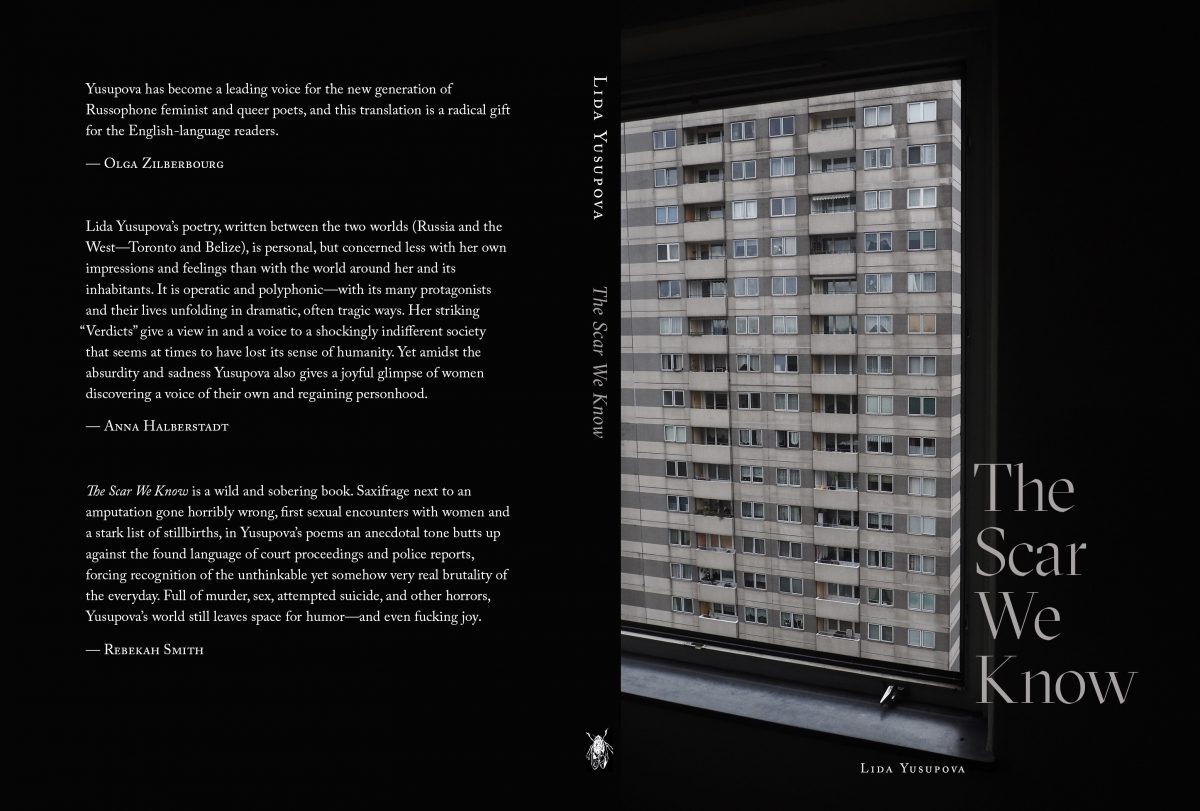
The “blurb”:

Arriving to the literary scene as the USSR disintegrated into the new Russia, Yusupova gathered her poetic influences both from within and from far outside the mainstream Russian literary tradition. Writing in free verse and relying on line breaks and the blank space of the page for emotional effect, Yusupova anchors her poems in the physical human body. Edited by Ainsley Morse, The Scar We Know is a celebration of Lida Yusupova’s groundbreaking poetry by a community of translators. Madeline Kinkel, Hilah Kohen, Ainsley Morse, Bela Shayevich, Sibelan Forrester, Martha Kelly, Brendan Kiernan, Joseph Schlegel, Stephanie Sandler all contributed to this collection.

The bodies in this book have vaginas and penises, they suffer from dog bites and rape and mental illness and brutal murder, they deliver dead children and alive children that they don’t know what to do with; and they experience occasional bursts of joy, those, too, provoked by the physical bodily sensations: a touch, a look, a good fuck. The poet brings the dead close to us and allows us to grieve for the ways they died, no matter how far away and long ago. Yusupova frequently draws on the language of news reports and court summaries, transforming our relationship with the bureaucratese. In English, her translators juxtapose vocabulary from different registers and patterns of speech and incorporate Russian to insist that the reader looks closely at the subjects of these poems in both their familiarity and uniqueness.

Yusupova has become a leading voice for the new generation of feminist and queer poets in Russia and in the global Russian diaspora, and this translation is a radical gift for the English-language readers, offering us an opportunity to draw deeper connections with the transnational humans who have been marginalized and othered, and to do so while dismantling the accepted patriarchal narratives and systems of value.

Finally, three more links:

In October, Punctured Lines ran a piece about contemporary feminist and queer Russophone poetry, and it included an in-depth interview with Ainsley Morse, the editor and one of the translators of The Scar We Know. Lots more there about Yusupova and the way this book came together.

On January 25, 2021, Globus Books will be holding an online event to celebrate the publication of this book. This event will be held on Zoom at 9.00 am PDT, 12.00 pm EDT and will be streaming on the Globus Books YouTube channel. To register for the Zoom conference, please send a private message to Globus Books Facebook page.

Please preorder and buy the book from Cicada Press or your local bookstore!

Q&A with Olga Livshin: A Life Replaced (Poets and Traitors Press, 2019)

Today on Punctured Lines, our Q&A with Olga Livshin, author of the recently released A Life Replaced: Poems with translations from Anna Akhmatova and Vladimir Gandelsman. We announced the book’s arrival here and you can listen to a podcast discussing it here. She and Olga Zilberbourg will be reading from their collections at an upcoming event in Rochester, NY on November 9, 2019. Olga answered our questions by email.

You wrote a book in which you both translated Akhmatova’s and Gandelsman’s work and wrote original poems that are, directly or indirectly, in dialogue with them. Describe, briefly, your writing process. 

I like the idea of going beyond the one voice–the idea of poetry as a play, and of a book as a porous object, absorbing other energies. There are three characters here: I translated two modernist Russian poets, and then I wrote responses to their work, some of which are imitations. Poets & Traitors Press has this format that fit what I was doing really well. They publish poems based on translations, poems that speak to these translations. So rather than publish a typical poetry collection, which, if you think about it, is this continuous solo for something like 50 or 80 pages, these Poets & Traitors books are a bit like jazz. They’re inclusive. They invent and improvise. Their dynamics are pluralistic and lively.

What were the differences in how you approached writing vs. translating poetry? 

It’s pretty seamless. When I translate, it’s a bit like giving a voice, and it’s also implicit dialogue, of course, since translation is interpretation–it’s full of choices. And when I write back, or talk back, the dialogue goes further. All of this, though, is part of the same kind of play: where the characters depend on one another and echo each other.  

What about translating/“talking to” Akhmatova? 

Yeah, “talking to,” for sure! Akhmatova is an author that a lot of mothers who grew up in the 1960s and 1970s quoted to their daughters–my mom quoted her to me. And I think a lot of people thought–still think–of her as a symbol of stoicism and of grieving wisdom, a model for how to live with dignity and defend fellow others under repressive regimes. In our family, she was like this Lilith, great mother, forever strong and even raging. It was rather difficult: you know, she was someone you could quote, but never be, right? Then I went to grad school to get my PhD in Slavic Studies, and I learned that some prominent literary scholars had showed that she was no angel, she was a full human with flaws, and–they wished to show–that she was rather a monster. I think both of these extremes are kind of silly. In my book I don’t so much aim to dethrone as to discover.  There’s a different Akhmatova than the one people know: brazen and humorous behind all that mighty moral raging. She’s a perpetual child, even in her later work, trusting love for love’s sake, no matter what life did to her. “To me, in poetry, everything should be out of line,” she writes, “Not how these things are done. / I wish you knew what garbage sprouts poems….” I want to know about this bold, hidden girl, and I want people to know her.

How about translating/“talking to” Gandelsman?

He is closer to me and thus less hidden. Vladimir Gandelsman was born in 1948 and came of age in Leningrad before it turned into St. Petersburg and before he left for the United States, where he lives now. He’s an immigrant like me, and he has similar instances of alienation. So when it comes to his work, I’m basically a devotee. I aim to push this writer forward and amplify his voice. Gandelsman’s work has such a unique way of balancing human emotions such as irritation and anxiety with this amazing appreciation of small joyful moments, which are just sublime in his work. Gandelsman, to my eye, transcends what so many poets and writers in Russia had: this hatred of byt, the everyday.  There was a bunch of visionary philosophers a hundred years ago, they all wished to go beyond our biological and biographical limitations. Beyond the body, beyond the home. On the other hand, Gandelsman is the supreme discoverer of light in the dust of the domestic. And in nature, which he paints in some beautifully minimalist ways. And in one’s own family, even in some difficult moments. He is a very generous poet. Where I write in parallel are poems of small joy: he has a small bird in the sky, I have little mushrooms; he has a hallowed moment of immigrant recognition of oneself in an American-grown boy, I have recognition of a Syrian immigrant’s stories in our own tales of self. I want to help this voice be in the world and take on new forms, in English, and in my little sprouts off it.

Other than Gandelsman, what is your relationship with contemporary Russian literature in general?

I enjoy some voices. Maria Stepanova. Vassia Borodin. Polina Barskova, in the US. And then in Ukraine, so much great and heartbreaking poetry in Russian is coming out from people writing about the war. Boris Khersonsky and Lyudmyla Khersonska. I really like Anastasia Afanasieva’s work. Iya Kiva’s poetry. There is an incredible urgency to these voices, and they’re profoundly intertextual, in dialogue with other language about war and violence, going all the way back to the Bible and all the way forward to how Russian and Ukrainian TV talks about war.

In addition to the two in your book, who are some of the writers that inspire you?

There is a flowering of immigrant and first-generation American poetry now. So many rich voices. From the better known, such as Chen Chen and Ocean Vuong, to those that should be better known. Ahmad Almallah’s recent book Bitter English addresses issues of writing in English as an immigrant. Jenna Le has gorgeous poems that capture the intersection of girlhood and growing up Vietnamese-American in Minnesota. Ananda Lima has made fine, strange, surrealist prose as well as poetry that looks at issues of home and motherhood in the context of being an immigrant. I love how these poets echo certain ruins of their cultural past with not-quite utopias of their American present. 

Do you find yourself working against some Russian cultural stereotypes?

Ha! I have carried so much shame about these for so many years. It’s kind of gone, but of course you can’t quite get rid of it. But that’s what writing is for–finding a voice that is more complicated than these stereotypes and insisting on maintaining that voice. Both in your writing and also, once you find it, the beautiful thing is, you can take it wherever you find it relevant. 

As a writer one of whose major topics is immigration, do you find yourself connecting with other diaspora writers?

I like Boris Fishman’s prose. Julia Kolchinsky Dasbach is one of my favorite Russian American poets. A fellow Russian-speaking Ukrainian Jew, she just published a fiery poetry collection called The Many Names for Mother. It’s such a bittersweet exploration of motherhood and the infinite in the context of her origins, both feminine and Soviet/ Ukrainian/Jewish. It’s so, so good.

How do you relate to feminist ideas and navigate the gap between the different gender expectations in American vs. Russian cultures? Do you see any shift of Russian gender norms in the diaspora?

So I got pretty lucky: I grew up with a mother who has a strong personality and who worked at this beautiful glorious music school in Moscow, where we lived from when I was 7 to when I was 14 and we moved to the US. To me, she channeled powerful feminist thought, although that’s not language she used. Yes, we dressed up, but it was to strut our stuff and have fun, not in order to please a man. I also grew up in a family where everyone had worked: both grandmas, my mom, all her female ancestors were peasants. So there was a version of Soviet and Russian homespun feminism that may be problematic and all, it wasn’t perfect, the guys didn’t necessarily help out, but at least there’s that gender modeling of strong women. There is this concept of the matriarchy, and also of women working for generations. 

I find it more irksome to navigate some situations with expectations for women from white Anglo-American upper middle class and upper class backgrounds. There’s an awful lot of stuff that I have trouble relating to, not only helicopter parenting or beautiful thin appearances in beautiful thin yoga pants, but also stay-at-home motherhood. That stuff is hard! It’s really a terrible thing when you know people who live according to those expectations–fraught with depression and with not being recognized as a human being. And when I was a stay-at-home–uh, poet–in our rather affluent suburb, I didn’t wear that identity, but the expectations were quite definite. But I think that the Russian strong woman, not unlike one that Akhmatova wanted people to think she was, wanted people to believe she could be, it’s an ideal and all, but it’s really a fantastic thing to embody. It’s a bigger expectation than the “little woman” that’s stuck around in our America. The resilient, powerful Russian lady–that’s a tall expectation, and it calls on us to stand tall, and I’m proud of that idea.

Maybe Esther, A Family Story by Katja Petrowskaja, translated from the German by Shelley Frisch

Katja Petrowskaja grew up in Kiev, studied in Estonia and Moscow, and lives in Berlin. Maybe Esther was written in German and first published in Germany, in 2014. It was translated to English by Shelley Frisch and published in 2018. She came to the Bay Area Book Festival about a year ago, and I went to her talk and picked up this book. When I started reading it, frankly, I wasn’t sure I was going to finish it. As far as family stories go, this one felt too similar to my own–and why read about something I already know so well, from living it?

I stuck with it because Petrowskaja’s a good storyteller, and a tenacious one, because she has followed her family story several more steps than I have ever done with mine, and because on the page she’s able to capture the complex emotions of following these heartbreaking stories. Of course, in actuality, her family’s story isn’t anything like mine. The similarities begin and end with this: We both grew up in Jewish families in the Soviet Union and emigrated after the Soviet Union fell apart. I write in English, she in German. If it felt like a familiar story at first, it’s precisely because I haven’t read enough books like this. I’ve only read just a few that focus on the Soviet Jewish family saga with any degree of depth (Margarita Khemlin’s Klotsvog in Lisa C. Hayden’s translation being the most recent, and wildly different from Maybe Esther), and they feel the same only because the gap between Kiev and Leningrad Jews in the 1980s is a lot narrower than, say, between Petersburg Jews and New York Jews. That is, it feels close enough to home.

There are a few main characters in Petrowskaja’s family saga. The story of Grandmother Rosa provides the main through-line. She grew up in a Jewish family, and her father, Ozjel Krzewin was born in Vienna, lived in Poland, and then died in Kiev, and ran a private school for deaf-mute children throughout his life–Rosa, too, inherited the profession of educating deaf-mute children. Rosa’s husband and Katja’s grandfather, Ukrainian Vasily Ovdiyenko during WWII was captured and became a prisoner of war in German labor camps. When he returned from the war, he met his wife briefly, but then went to live with another woman and stayed with her for more than forty years. Shortly before his death, he came home to Rosa–who was still waiting for him.

In writing the book, Petrowskaja follows the story of the Jewish side of the family, and then she also traces Vasily’s journey through the German labor camp system throughout Austria–it was a brutal three-year journey that few survived. She visits several labor camps that also served as death camps for Hungarian Jews, to arrive at an epiphany: it must’ve been something that Vasily witnessed in the camps that made his return to his loving family, a wife and two children, impossible after the war.

I don’t know where this conviction stemmed from, but it was right here in this small camp that something happened after everything that had happened already that made my grandfather’s return home impossible, so that he, back in Kiev, could not stay with his family, not with his daughter and not with his wife, Rosa, whose mother and sister lie in Babi Yar, which makes a person Jewish forever, I know that his failure to return had something to do with the death march of the Hungarian Jews

That sentence doesn’t have a period and it doesn’t need one. I should add, that actually this relative’s experience Katja and I, too, have in common: my grandfather, Jewish, was a POW in a German labor camp, and survived. He did return to the family, and one of the things I’m forever trying to write about is what his survival looked to the rest of us, his family, living with him. I finished the book grateful to Katja Petrowskaja for finding the words to unpack some of her experiences.

For a more formal review of this book, please read Linda Kinstler’s review in LARB.

Notable Books: Russian Titles in English Translation, 2009-2019

The impetus for creating this post came from a recent Twitter discussion. We at Punctured Lines decided to accept a dare and came up with a list of notable Russian titles available in English translation from the last decade. This has been an opportunity to take stock of the years 2009-2019, both to remember the books we’ve read and to look back at those that we might have missed.

In this task, we relied heavily on Lisa Hayden’s blog, Lizok’s Bookshelf, where Lisa keeps chronological track of the English translations – our deep gratitude for creating and maintaining this resource. Our methodology for choosing among all those works was based on several factors. Rather obviously, for our purposes we only considered works by women. We also wanted to highlight writers whose names may not be very familiar to English-speaking readers but whose work we feel deserves wider exposure and shows the range of contemporary Russian women’s literature.

For this reason, we chose not to include writers who are well-known in the Anglophone world, but of course we love them too. We note proudly the women whose work has been translated into English numerous times: Anna Akhmatova, Svetlana Alexievich, Eugenia Ginzburg, Ludmilla Petrushevskaya, Dina Rubina, Olga Slavnikova, Marina Tsvetaeva, Ludmila Ulitskaya, and Tatyana Tolstaya (whose problematic views on women and feminism may be less known).

One or both of us have read many of titles below, and we’re happy to report that the field is larger than our reading capacity. We included a few books we haven’t read because they sparked our curiosity and to encourage ourselves and our followers to return to these publications. An important factor for consideration was translators whose work we’re interested in. Here we would like to say a huge thank you to translators for their often unacknowledged efforts that allow English speakers to know Russian literature.

Our list has four categories: Contemporary Prose, Contemporary Poetry, Recent Translations of Earlier Prose Works, and a rather catch-all Drama, a Graphic Novel, and an Anthology. The titles in each category are given chronologically by year of the translation. This list reflects our personal opinions and is in no way meant to be comprehensive or conclusive. We welcome your comments and suggestions about these and other titles by Russian women who you think should be on this list. This is, hopefully, the beginning of that conversation.

Contemporary Prose

Elena Chizhova, The Time of Women, translated by Simon Patterson and Nina Chordas; Glagoslav, 2012. 

Linor Goralik, Found Life: Poems, Stories, Comics, a Play, and an Interview, edited by Ainsley Morse, Maria Vassileva, and Maya Vinokur; Columbia University Press, 2017.

Ksenia Buksha, The Freedom Factory, translated by Anne Fisher; Phoneme Media, 2018.

Alisa Ganieva, Bride and Groom, translated by Carol Apollonio; Deep Vellum, 2018.

Margarita Khemlin, Klotsvog, translated by Lisa C. Hayden; Columbia University Press, 2019.

Guzel Yakhina, Zuleikha, translated by Lisa C. Hayden; Oneworld Publications, 2019.

Contemporary Poetry

Anzhelina Polonskaya, Paul Klee’s Boat, translated by Andrew Wachtel; Zephyr Press, 2012. 

Polina Barskova, Anna Glazova, and Maria Stepanova, Relocations: Three Contemporary Russian Women Poets, translated by Catherine Ciepiela, Anna Khasin, and Sibelan Forrester; Zephyr Press, 2013.

Maria Rybakova, Gnedich, translated by Elena Dimova; Glagoslav, 2015.

Inna Kabysh, Blue Birds and Red Horses, translated by Katherine E. Young; Toad Press, 2018.

Aigerim Tazhi, Paper-Thin Skin, translated by James Kates; Zephyr Press, 2019.

Olga Livshin, A Life Replaced: Poems with Translations from Anna Akhmatova and Vladimir Gandelsman, Poets & Traitors Press, 2019.

Recent Translations of Earlier Prose Works

Teffi, Memories: From Moscow to the Black Sea, translated by Robert Chandler and Elizabeth Chandler, Anne Marie Jackson, and Irina Steinberg; NYRB Classics and Pushkin Press, 2016.

Sofia Khvoshchinskaya, City Folk and Country Folk, translated by Nora Seligman Favorov; Columbia University Press, 2017.

Olga Berggolts, Daytime Stars: A Poet’s Memoir of the Revolution, the Siege of Leningrad, and the Thaw, translated by Lisa A. Kirschenbaum; University of Wisconsin Press, 2018.

Doba-Mera Medvedeva, Daughter of the Shtetl: The Memoirs of Doba-Mera Medvedeva, translated by Alice Nakhimovsky; Academic Studies Press, 2019.

Karolina Pavlova, A Double Life, translated by Barbara Heldt; Columbia University Press, 2019.

Irina Odoevtseva, Isolde, translated by Bryan Karetnyk and Irina Steinberg; Pushkin Press, 2019.

Drama, a Graphic Novel, and an Anthology

Yaroslava Pulinovich, Olga Rimsha, Ksenia Stepanycheva, Ekaterina Vasilyeva, Russian Drama: Four Young Female Voices, translated by Lisa Hayden; Glas, 2014.

Victoria, Lomasko, Other Russias, translated by Thomas Campbell; Penguin and n+1, 2017.

Teffi, Marina Tsvetaeva, Anna Akhmatova, Lydia Ginzburg, Galina Scherbakova, Ludmila Ulitskaya, Svetlana Alexievich, Olga Slavnikova, Irina Muravyova, Ludmila Petrushevskaya, Margarita Khemlin, Slav Sisters: The Dedalus Book of Russian Women’s Literature, edited by Natasha Perova; Dedalus, 2018.

A Soviet YA Classic: Aleksandra Brushtein’s Дорога уходит в даль (The Road Goes off into the Distance)

It is hard to overstate just how much Aleksandra Brushtein’s autobiographical novel about Aleksandra (Sasha) Yanovskaya, a young Jewish girl growing up in Vilna at the turn of the century, was beloved by generations of Soviet children. At a time when I have completely forgotten plots of books I read much later, I can still recall various episodes from this one. A copy of the book, which my family took with us when we left the Soviet Union, is one of my prized possessions. My mom loved this book so much she wanted to name me Sasha (an attempt ended by my great-grandmother Aleksandra’s announcement post my birth that Ashkenazi Jews cannot name children after living relatives). A remarkable thing about this novel is that it has a Jewish protagonist and depicts Jewish life but still became so popular in a country as anti-Semitic as the Soviet Union. Its popularity has endured in contemporary Russia, where “since 2005, a new printing of the book by different publishers has appeared almost every two years,” including an annotated edition.

Yet as Liza Rozovsky’s article notes, Brushtein “is barely known outside the Russian-speaking world.” To date, there is no English translation. If there is a translator out there who could take on this project, many in the diaspora would be eternally grateful on behalf of their children and their English-speaking friends’ children. In any case, it’s great to see this book being written about at length and we — and our inner younger selves — are thrilled to highlight it on Punctured Lines.

“The book that is imprinted in my memory as a moral and political compass, and the book I would like my children to know, is a Soviet-era work for children and juveniles titled “The Road Slips Away into the Distance.” It’s an autobiographical trilogy by the Jewish children’s playwright and memoirist Aleksandra Brushtein, who is barely known outside the Russian-speaking world. The first volume of the work was translated into Hebrew in the 1980s, but Brushtein (1884-1968) remains unknown in Israel, too. In the Soviet Union, where it ran through many editions of tens of thousands of copies each, the trilogy achieved cult status.”

The Novel That Introduced Soviet Jews to Their Forgotten History

Olga Zilberbourg on Teffi’s Memories: From Moscow to the Black Sea

“Teffi, nom de plume of Nadezhda Lokhvitskaya, was born in 1872 into a prominent Russian family. Following in the footsteps of her older sister Maria—poet Mirra Lokhvitskaya—Teffi published poetry and prose from the age of 29. She soon rose to fame by practicing a unique brand of self-deprecating humor and topical social satire.”

https://www.thecommononline.org/review-memories-from-moscow-to-the-black-sea/?fbclid=IwAR2VI663kHbmhMarVRRwhcusvCmxG_KFMLKu7MtIRnHLUpUTBZs7dZmQnK8

Unfortunately, I Care: Joanna Chen Interviews Olga Livshin (BLARB)

Read Joanna Chen’s beautiful and insightful interview with poet and translator Olga Livshin about her just-released book A Life Replaced: Poems with translations from Anna Akhmatova and Vladimir Gandelsman:

“And so for me, even when I write in English, it’s as if I am writing in Russian because I’m releasing something that was the first fourteen years of my life, it’s like I carry this genie inside me and I need to let it out occasionally. Let it walk around a little before I bottle it back up.” https://blog.lareviewofbooks.org/poetry/unfortunately-care-joanna-chen-interviews-olga-livshin/

Yelena Furman on Sofia Khvoshchinskaya’s “City Folk and Country Folk”

“IN HER INFORMATIVE introduction to Sofia Khvoshchinskaya’s City Folk and Country Folk, Hilde Hoogenboom writes, ‘In the 1860s […] Russia had its own trio of writing sisters. Like the Brontës, the Khvoshchinskaya sisters wrote under male pseudonyms, endured hardships, and lived in the provinces.’ The analogy is fitting, but, as Hoogenboom notes, only to a point: ‘The Brontë sisters became well known not long after their deaths, [but t]he story of the Khvoshchinskaya sisters remains to be told.'”  https://lareviewofbooks.org/article/dont-we-know-our-own-minds-a-rediscovered-russian-woman-writer-of-the-19th-century/