Narrating a Violent Childhood: A Q&A with Fiona Bell and Margarita Vaysman about Avdotya Panaeva’s The Talnikov Family

Avdotya Panaeva was born in 1820 and first began publishing her work in one of Russia’s premier literary magazines, Sovremennik, in 1846. The author of numerous short stories, novels, memoirs, as well as collaborative projects, she has only recently begun to achieve the recognition that she deserves in the English-speaking world.

On October 8, 2024, Columbia University Press published Fiona Bell’s translation of Panaeva’s first novel, The Talnikov Family. This became the second full-length translation of Panaeva’s work to English. In my review of the book in On the Seawall, I mention several social and historical factors that have kept this delightful novel from English-language readers for so long. In writing about this book, I have relied, in part, on Bell’s introduction to the novel and on the research by Margarita Vaysman, whose book Self-Conscious Realism: Metafiction and the Nineteenth-Century Russian Novel devotes a section to Panaeva’s work, including an excerpt that ran in Punctured Lines.

Today, it is my pleasure to discuss this novel and Panaeva’s work more broadly with her translator Fiona Bell and scholar Margarita Vaysman.

Continue reading “Narrating a Violent Childhood: A Q&A with Fiona Bell and Margarita Vaysman about Avdotya Panaeva’s The Talnikov Family”

A Motherland of Books: An Essay by Maria Bloshteyn

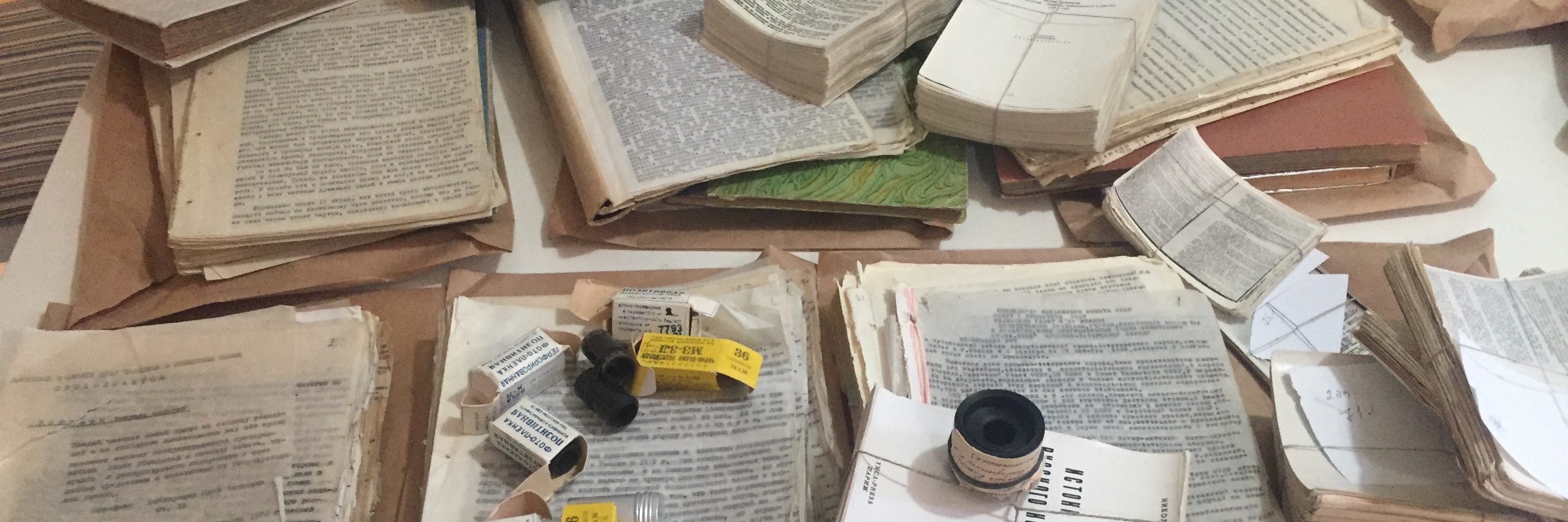
Taking your beloved books with you into immigration is intimately familiar to those of us who left the Soviet Union. My parents’ двухсоттомник—”200-volume set”—of Russian and world literature, was quite literally my lifeline to the language and culture that I may have otherwise forgotten, and they are still the editions I turn to today. The covers of the volumes are different colors, and some key moments of my life are associated with them, such as the dark green of Gogol’s Мертвые души (Dead Souls) when I started college. Reading Maria Bloshteyn’s essay was genuinely heart-wrenching, because the experience she describes is that of an acute loss of books that mean so much to us, not just for their content, but perhaps even more so because they have made the immigrants’ journey with us and sustained us in our new homes. In the current moment, this poignant essay is framed by the war in Ukraine, where people like us are losing not just their books, but their lives. If you are able to help, please support translators who are struggling due to the war and this initiative to give Ukrainian-language books to refugee children in Poland. Ukraine’s cultural sphere has been badly damaged by Russian forces, and we will continue to look for ways in which those of us in the West can help. Maria recently participated in the Born in the USSR, Raised in Canada event hosted by Punctured Lines, and you can listen to her read from an essay about reacting to the war in Ukraine while in the diaspora.

Continue reading “A Motherland of Books: An Essay by Maria Bloshteyn”