Dear Punctured Lines community — please help us spread the word about the next San Francisco Bay Area reading by writers born in the former USSR. This event is a part of San Francisco’s annual Lit Crawl festival and will take place at Ruth’s Table (3160 21st Street) on October 25, 2025 at 5 pm.
Thanks to those of you who could attend our event, Born in the USSR: Diaspora Writers Against War, hosted by the Wende Museum on March 28. We loved having you as our audience and hope to continue the conversations in various ways.
Thank you for donating to Ukraine Trust Chain. Ukraine needs all of our support. Please continue to spread the word and donate here: https://www.ukrainetrustchain.org/
This one of a kind reading brings together Soviet-born writers as they weave together an intricate story of identity, memory, cultural intersections, immigration, and war. From fiction to poetry, memoir and journalism, and work in translation, the reading presents a deep dive into the individual and collective experiences of the Soviet-born diaspora in the U.S. This free event includes a fundraiser in support of humanitarian aid in Ukraine and aligns with The Wende Museum’s current exhibition “Undercurrents II: Archives and the Making of Soviet Jewish Identity.” Autographed books will be on sale, courtesy of Village Well.
Hosted by The Wende Museum, readers include poets, writers, and translators: Katya Apekina, Yelena Furman, Kristina Gorcheva-Newberry, Julia Kolchinsky, Arina Kole, Maria Kuznetsova, Olga Livshin, Ruth Madievsky, Ainsley Morse, Luisa Muradyan, Jane Muschenetz, Asya Partan, Irina Reyn, Diana Ruzova, Timmy Straw, Vlada Teper, Sasha Vasilyuk, and Olga Zilberbourg.
Avdotya Panaeva was born in 1820 and first began publishing her work in one of Russia’s premier literary magazines, Sovremennik, in 1846. The author of numerous short stories, novels, memoirs, as well as collaborative projects, she has only recently begun to achieve the recognition that she deserves in the English-speaking world.
On October 8, 2024, Columbia University Press published Fiona Bell’s translation of Panaeva’s first novel,The Talnikov Family. This became the second full-length translation of Panaeva’s work to English. In my review of the book inOn the Seawall, I mention several social and historical factors that have kept this delightful novel from English-language readers for so long. In writing about this book, I have relied, in part, on Bell’s introduction to the novel and on the research by Margarita Vaysman, whose book Self-Conscious Realism: Metafiction and the Nineteenth-Century Russian Novel devotes a section to Panaeva’s work, including an excerpt that ran in Punctured Lines.
Today, it is my pleasure to discuss this novel and Panaeva’s work more broadly with her translator Fiona Bell and scholar Margarita Vaysman.
Anna Natalia Malachowskaja is a well-known Soviet and Russian author, feminist, and dissident. In 1979, together with Tatiana Goricheva, Tatiana Mamonova, and Julia Voznesenskaya, she wrote and edited a feminist samizdat publication Женщина и Россия [Woman and Russia] and later Maria. These publications were deemed anti-Soviet; the women were questioned by the KGB and forced to emigrate. Having settled in Austria, Malachowskaja completed her Ph.D. at the University of Salzburg. She turned her research into the Russian folklore character of Baba Yaga into a series of published books where she argues that the fairy tale character is a marginalization and amalgamation of three goddesses of the ancient world. In addition to her scholarship, Malachowskaja is the author of novels, collections of stories, and poems. Malachowskaja’s fiction is frequently accompanied by art. As an artist, she has exhibited her work in St. Petersburg, Vienna, and Salzburg.
On February 9, 2013, Akram Aylisli’s books were burned in his native village. For more than six decades, Azerbaijan’s most prominent writer has written fiction about the mountain village of Aylis, from which he took his pen name; Aylisli called the day of the burning “the most terrible day of my life.” Why were his books burned? Aylisli had published a novella, Stone Dreams, that challenged official propaganda erasing the role played by Armenians in the history of Azerbaijan, a country currently dominated by ethnic Azeris (Azerbaijan and neighboring Armenia have engaged in military hostilities since before the collapse of the Soviet Union). Stone Dreams is among the first fictional works in the greater Turkic-speaking world to depict both historical and contemporary violence against ethnic Armenians, and it includes sympathetic portrayals of Armenian villagers residing in Azerbaijan. The novella also portrays the corruption and authoritarianism of modern-day Azerbaijan. In the uproar that greeted the novella’s publication, Aylisli was stripped of his presidential honors and pension. An empty coffin was paraded around the courtyard of his residence, and a bounty—later rescinded under international pressure—was offered to anyone who would cut off the writer’s ear. In 2014, international supporters nominated Aylisli for the Nobel Peace Prize for “his efforts to reconcile Azerbaijani and Armenian people.” In 2016, trumped-up legal charges were filed against Aylisli by the Azerbaijani government, a case that is still pending. Ten years after his books were burned, Akram Aylisli continues to live under de facto house arrest in Azerbaijan, unable to leave the city of Baku. He is 85.
Nataliya Meshchaninova is Russian filmmaker. In 2017, she published a book of autobiographical short stories that resonated with her audience, in part, because they supported the Russian #metoo movement. In February 2022, Deep Vellum brought out Fiona Bell’s translation of Meshchaninova’s book under the title Stories of a Life. We are honored to share with you an excerpt from this book, a section from the fourth chapter, “Secrets.”
Punctured Lines is grateful to Ivan Sokolov for the opportunity to publish his letter and a collection of links. Author’s idiom is preserved.
I am thankful to everyone who has reached out to me—I am safe and away from Russia at the moment. Let this post be an update for my anglophone contacts who have expressed concern about Russia’s ongoing war in Ukraine, possible sources of following the events and the lives, as well as means of giving aid.
I feel compelled to mention, however, just to be fair, that if I find myself displaced and unhinged in every sense of the word, it is far less so than the hundreds of thousands of other Russians evacuating these days to neighbouring countries—and doing so, unlike myself, without visas, academic affiliations, language skills or any experience of living abroad. I did not think I’d live to see (and run into!) my own acquaintances, mostly young, crowded in airports by random gates—the sheer extent of the exodus is mind-blowing. The fate of those who remain in Russia may look bleak—and even if a massive campaign of arrests and repressions does not ensue, the economic deterioration will hit everyone hard. But if we find our plans, ways of life and peace of mind disrupted and displaced, it is unthinkably more literal and cruel for the livelihoods of our friends within Ukraine and those that have managed to escape the war crimes being committed there.
In the fall of 2021, Deep Vellum Press brought out a new translation of Ludmilla Petrushevskaya’s stories, her collection The New Adventures of Helen, in translation by Jane Bugaeva. Our own Yelena Furman reviewed this translation for the Los Angeles Review of Books:
This collection gathers Petrushevskaya’s fairy tales for adults, published under one cover in Russian in 1997; some other selections from that Russian volume have previously appeared in There Once Lived a Woman Who Tried to Kill Her Neighbor’s Baby: Scary Fairy Tales. To be sure, there are still plenty of human vices in these pages. But instead of a world in which degradation reigns supreme, here goodness prevails, aided by a large dose of magic.
We love and admire Petrushevskaya’s writing and would love to have more responses to her work on our blog. Feel free to pitch us your reviews, and formal or creative essay ideas at puncturedlines [at] gmail.com.
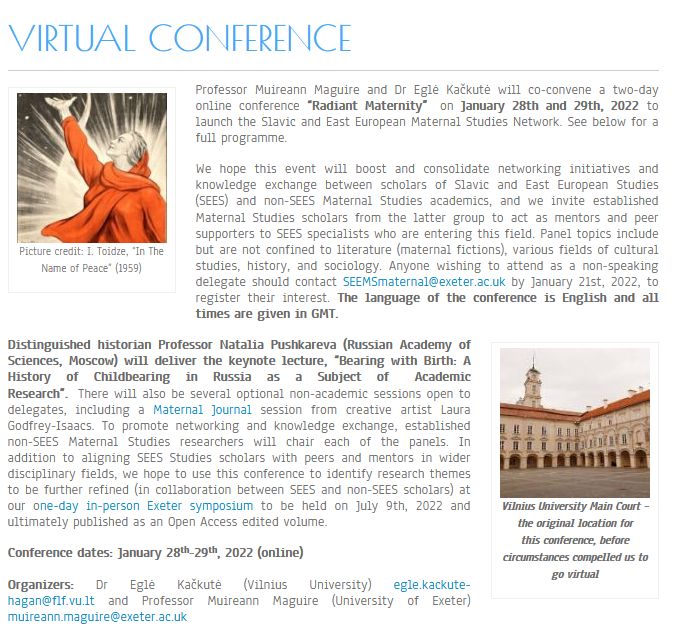
As readers, feminists, and ourselves parents, we at Punctured Lines are happy to learn that Drs. Muireann Maguire and Eglė Kačkutė are organizing a two-day conference to launch the Slavic and East European Maternal Studies Network. The conference is to take place on January 28 and 29, 2022, and the stellar list of presenters and topics includes our contributor Natalya Sukhonos’s paper on Motherhood, Math, and Posthumous Creativity in Lara Vapnyar’s Russian-American novel Divide Me by Zero. We ran a Q&A with Lara Vapnyar shortly upon the publication of that novel.
Our contributor Svetlana Satchkova will participate in an online discussion on Motherhood, Gender, Translation and Censorship in Eastern European Women’s Writing, and scholar and translator Muireann Maguire will present a paper on Breastfeeding and Female Agency in the Nineteenth-Century Russian Novel.
The full listing of events is available on the conference’s website. To register, please email SEEMSmaternal @ exeter.ac.uk by January 21st, 2022. The sessions will be conducted in English.


 Punctured Lines