How Moscow’s 1957 World Youth Festival Inspired Me to Go On Pretending: Guest Essay by Alina Adams

Today we welcome Alina Adams back to the blog with an essay about her interracial family’s trip to Moscow (before the war in Ukraine) and its connection to her recently released novel, Go On Pretending (History Through Fiction, 2025), featuring a fictional interracial family. You can read our previous conversations with Alina here and here. As one of the excerpts below shows, a key element in her novel is the 1957 World Youth Festival in Moscow, during Khrushchev’s Thaw, which was meant to demonstrate the Soviet Union’s liberalization and racial tolerance (you can guess how that turned out). The reference to the festival immediately made me think of a different novel by another ex-Soviet Jewish immigrant writer in which it is an important plot element: Petropolis (Penguin Random House, 2008) by Anya Ulinich. If you would like to know more about this lesser-known event and about the Soviet Union/post-Soviet Russia and race, let Alina explain below and then order Go On Pretending (and Petropolis).

Continue reading “How Moscow’s 1957 World Youth Festival Inspired Me to Go On Pretending: Guest Essay by Alina Adams”

Video from Born in the USSR: Diaspora Writers Against War

Thanks to those of you who could attend our event, Born in the USSR: Diaspora Writers Against War, hosted by the Wende Museum on March 28. We loved having you as our audience and hope to continue the conversations in various ways.

Thank you for donating to Ukraine Trust Chain. Ukraine needs all of our support. Please continue to spread the word and donate here: https://www.ukrainetrustchain.org/

The video from our event is now online:

Continue reading “Video from Born in the USSR: Diaspora Writers Against War”

Born in the USSR: Diaspora Writers Against War

This one of a kind reading brings together Soviet-born writers as they weave together an intricate story of identity, memory, cultural intersections, immigration, and war. From fiction to poetry, memoir and journalism, and work in translation, the reading presents a deep dive into the individual and collective experiences of the Soviet-born diaspora in the U.S. This free event includes a fundraiser in support of humanitarian aid in Ukraine and aligns with The Wende Museum’s current exhibition “Undercurrents II: Archives and the Making of Soviet Jewish Identity.” Autographed books will be on sale, courtesy of Village Well.

Hosted by The Wende Museum, readers include poets, writers, and translators: Katya Apekina, Yelena Furman, Kristina Gorcheva-Newberry, Julia Kolchinsky, Arina Kole, Maria Kuznetsova, Olga Livshin, Ruth Madievsky, Ainsley Morse, Luisa Muradyan, Jane Muschenetz, Asya Partan, Irina Reyn, Diana Ruzova, Timmy Straw, Vlada Teper, Sasha Vasilyuk, and Olga Zilberbourg.

Continue reading “Born in the USSR: Diaspora Writers Against War”

A Character with a Secret Is an Easy Sell: A Conversation with Sasha Vasilyuk, by Olga Zilberbourg

A new novel set in World War II enters a crowded and hotly contested field. It is a particularly remarkable feat for a debut novelist that Sasha Vasilyuk’s Your Presence Is Mandatory (Bloomsbury, 2024) earned universal praise from celebrated writers across the former USSR diaspora community and far beyond. Gary Shteyngart wrote, “Wonderfully written, elegiac and necessary, Sasha Vasilyuk uncovers the history behind the recent headlines with great skill and grace.” Susanne Pari, author of In the Time of Our History and The Fortune Catcher, wrote, “An outstanding novel of sacrifice, love, and forgiveness.”

We celebrate this novel’s arrival with particular pleasure. A contributor to Punctured Lines, Vasilyuk participated in a number of events we’ve hosted over the years, and we’ve heard excerpts from this novel as she was working on one draft after another. In May 2024, Olga Zilberbourg interviewed Vasilyuk during a book release event at Telegraph Hill Books in San Francisco. The following Q&A is a follow-up to that in-person conversation. 

Continue reading “A Character with a Secret Is an Easy Sell: A Conversation with Sasha Vasilyuk, by Olga Zilberbourg”

My Mother’s Teeth by Anna Fridlis

My Mother’s Teeth

were prone to cavities from childhood.

In my mind’s eye, I see her gaps-for-teeth, hand cupping mouth, handkerchief clasped to lips after an extraction — that euphemism that stinks of silent Soviet disappearances, people pulled from dark rooms at night, never returning.

Once healed, the gaps were filled variously with dental implants and partial dentures: my mother’s mouth is not quite her own.

The extracted people were never returned, which my mother made it her duty to remember. If she is passionate about anything, it is decrying Stalinism and its travesties. For years, her stories transfixed me, but by my teens they stoked a growing rage. There was not much more to her mothering than the passing down of Soviet horrors. I was starving for something which she couldn’t give. 

My mother drilled her coming-of-age, late-1970s, music-conservatory-student revelations about the Soviet dystopia — learned at the knee of a rather radical anti-communist professor — into my brain, into the new millennium, into a new hemisphere. 

My mother’s mouth is filled with ghosts.

My own cavities began before elementary school. Baba took me to the dentist, an old friend of hers, Eleanora Aleksanna, whose son had long before been Baba’s elementary school student. We entered a large open hall full of dental chairs and short-haired women in white lab coats and face masks leaning over screaming children.

I was praised for being so good and so brave and for my beautiful braid only to bite Eleanora Aleksanna’s finger to bleeding moments later.

We returned to her several times, without incident, before our own great extraction from Russia found us in the United States.

American dentists peered into my mouth, as into my mother’s, in awe, studying its contents as though it were an archeological site revealing pre-modern dental composites.

I was taking after my mother.

***

In 2019, a year after my mother and I became estranged, I had to have an incisor pulled. It had gotten infected and pain had grown beyond the treatment of all available drugs.
  

The procedure took hours. The dentist coaxed out my tooth little by little from my numbed gum. My partner held my hand, then drove me home to mashed potatoes and tea.

I smiled big for my phone, beaming almost to a scowl into the camera. It was tooth number 4 that they took — I had been so worried about how the gap would look — but it was barely visible on my American smile. I sent pictures to everyone but my mother. 

The gap left by my mother is surreal. It throbs and whirls to Tchaikovsky, it weeps to Chopin; it weeps so much more than it dances. I shut my mouth on the commotion.

The gap left by my mother is older than our estrangement.

It is a socket dressed in layers of scarlet and mauve scar tissue, pulsing and aching from time to time but calming, calming as the years tick by. 

I exorcise the ghosts from my mouth, my mother’s legacy, through the power of my breath, the vibration of my voice, the speaking of myself into being. I was never supposed to do these things: she raised me to carry on her burdens, to be an organ of her body, a part of her, not out of malice but limitation. A limitation I am still trying to parse. 

Sometimes I Google potential diagnoses to explain my mother’s absence — the way she seemed never really there even when she stood in front of me, the way she needed me to lead, even as a child, to parent her. When I find myself doing this futile exercise, I have learned it means I’m hurting, struggling, and it’s time to take care of me. 

In broad strokes, I know the problem: a combination of Soviet political oppression, anti-Semitism, patriarchy, family dysfunction, and a prolonged separation from Baba in Mama’s toddlerhood. When you put it all together, it’s called complex trauma. I know a lot about it because it was passed to me. Unconsciously, unintentionally, brutally, ceaselessly.
  

My teeth, my mother’s teeth: tombstones to the bones of Soviet ghosts who couldn’t find a way to scream but through our mouths. 
Anna Fridlis is a memoirist, poet, and essayist based in Newark, NJ on indigenous Lenape land. She lives and writes at the intersection of multiple identities: Jewish, Soviet immigrant, white, disabled, neurodivergent, and queer. Her work addresses the impact of intergenerational trauma on the trajectory of a life, tracking trauma’s creeping effects on mental and physical health, family relationships, creative output, and the scope of the imagination. Anna’s work captures one version of a Soviet Jewish immigrant story that both faces its utter devastation and searches for answers and deep healing in self-expression, nature, and somatics. Anna teaches first-year writing at Parsons the New School for Design and cohabits with her bunny Willow, who also happens to be her muse.

Irina Mashinski’s The Naked World, Three Excerpts

Irina Mashinski’s The Naked World, recently published by MadHat Press after many years in the making, is an impressive achievement in the hybrid genre. The collection combines pieces of original and translated poetry and prose that together illuminate not only the author’s past but also her way of seeing. Thematically, this book centers four generations of a Soviet family from the Stalin era to the 1990s and immigration to the United States. Writer, translator, and editor Irina Mashinski has penned ten books of poetry in Russian, and this is her English-language debut that also includes her Russian-language poems in translation by Maria Bloshteyn, Boris Dralyuk, Angela Livingstone, Tony Brinkley, Alexander Sumerkin, and Daniel Weissbort. Mashinski is co-editor, with Robert Chandler and Boris Dralyuk, of The Penguin Book of Russian Poetry and of the Cardinal Points Journal.

Continue reading “Irina Mashinski’s The Naked World, Three Excerpts”

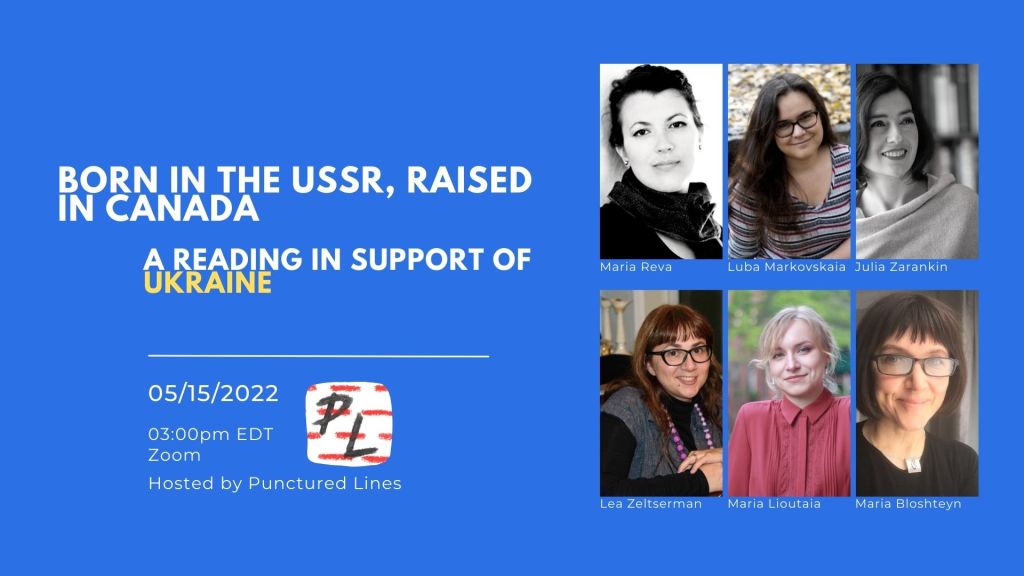
Born in the USSR, Raised in Canada: A Reading in Support of Ukraine

Punctured Lines is delighted to bring you our next event–a reading and a Q&A with six established authors who were born in the former Soviet Union and immigrated to Canada as children. In their fiction and nonfiction they explore topics of multicultural identity, life under communism, Jewish culture, food, history, and making a home in a strange land.

Please register on Eventbrite: https://www.eventbrite.com/e/born-in-the-ussr-raised-in-canada-a-reading-in-support-of-ukraine-tickets-315030252967

We began planning this event before Russia’s renewed, full-scale attack on Ukraine, and we want to acknowledge that this war is resonating deeply throughout the diasporic community. We feel that it’s particularly important for us to come together at this time, to listen to each other’s stories and to amplify each other’s voices and resources in support of the people of Ukraine in their fight against the Russian totalitarian regime. We also want to extend our support to those citizens of the Russian Federation resisting and fleeing from this regime.

*** This event will be recorded. ***

*** This event is a fundraiser and we encourage everyone to donate money directly to organizations supporting Ukraine and Russian protesters. Suggested donation starts at $5.

Organizations to support:

Donate directly to Ukraine’s military: https://bank.gov.ua/en/news/all/natsionalniy-bank-vidkriv-spetsrahunok-dlya-zboru-koshtiv-na-potrebi-armiyi

UNHCR Ukraine Emergency Relief Fund: https://give.unhcr.ca/page/100190/donate/1

JIAS Ukraine Refugee Response: https://jiastoronto.org/ukraine-crisis-update/

ROLDA, helping stranded animals/pets: https://rolda.org/breaking-news-ukraine/

Ukraine Trust Chain, helping evacuate civilians out of war zones: https://www.ukrainetrustchain.org/

Continue reading “Born in the USSR, Raised in Canada: A Reading in Support of Ukraine”

Born in the USSR, Raised in California: Immigrant Writers Read From Their Work

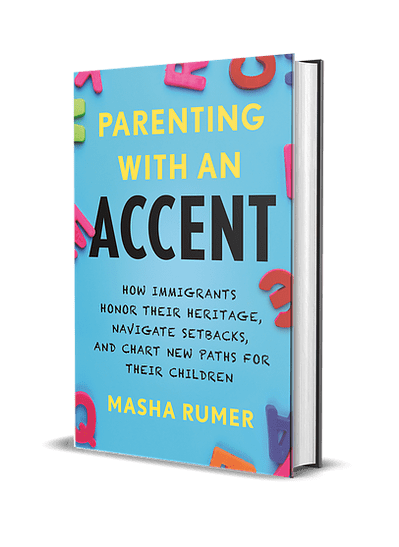
Dear Punctured Lines readers — come meet us on Zoom, and help us celebrate the publication of Masha Rumer’s book! (In San Francisco? Come meet us in person, details below.) We’re so happy to welcome Masha’s newly published Parenting With an Accent: How Immigrants Honor Their Heritage, Navigate Setbacks, and Chart New Paths for Their Children (Beacon Press). Punctured Lines published a Q&A with Masha when this book was still in the proposal stage, and we’ve been following Masha’s Twitter posts about its development with great interest and anticipation. Now that this book is out and available for all to read we are ready to party (and encourage all of our readers to buy it)!

Continue reading “Born in the USSR, Raised in California: Immigrant Writers Read From Their Work”

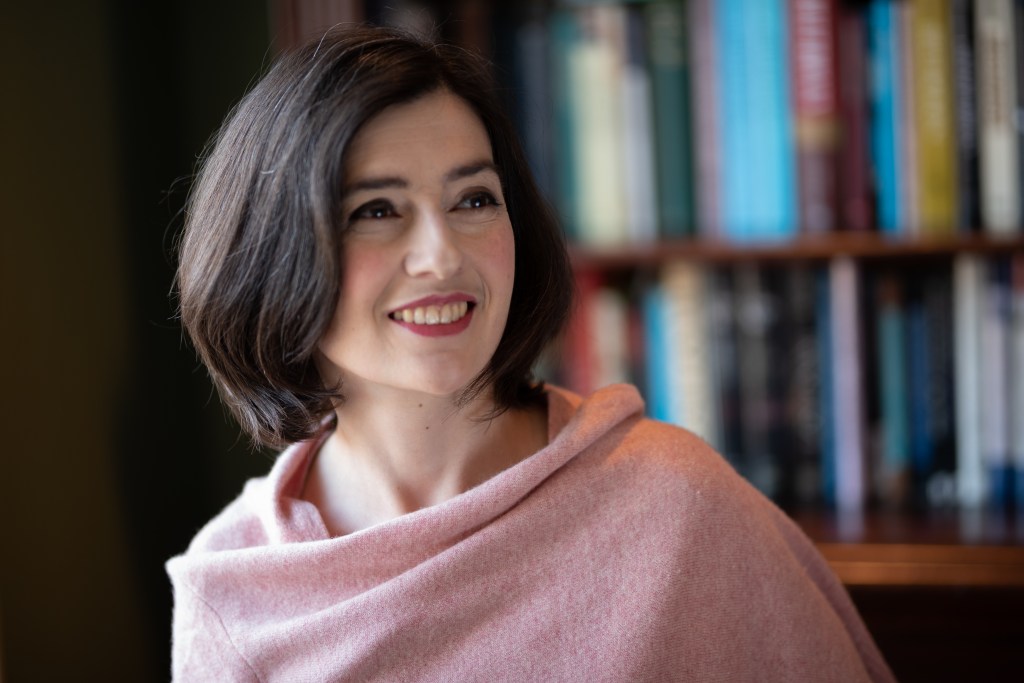
Cultivating the Habit of Looking: A Q&A with Julia Zarankin

Julia Zarankin is the author of a memoir Field Notes from an Unintentional Birder (Douglas & McIntyre, 2020) that was warmly welcomed by both the birding and the literary communities. She was born in the Soviet Union and as a child immigrated to Canada with her family as part of the Jewish refugee movement. She received her Ph.D. in Comparative Literature and taught in the US before returning to Canada. She lives in Toronto and publishes essays and short fiction in English-language magazines both in Canada and in the United States.

Continue reading “Cultivating the Habit of Looking: A Q&A with Julia Zarankin”

Crowded Lives and Crowded Stories: Alina Adams and Maria Kuznetsova Discuss their Recent Novels

We are delighted to present a conversation between Alina Adams and Maria Kuznetsova, whose recent critically acclaimed novels make significant contributions to the body of Russian-American literature. Both Adams and Kuznetsova were born in the USSR and immigrated to the US with their families as children, though some years apart. In their novels, the authors turn to USSR’s history to tell their stories. Adams is a professional writer on topics from figure skating to parenthood and a New York Times bestselling author of soap-opera tie-ins. In The Nesting Dolls (Harper, 2020), she focuses on three generations of Soviet-Jewish women in a story that moves from Odessa to Siberian exile to the Brighton Beach immigrant community. Kuznetsova is a writer, an academic, and a literary editor. In her second novel, Something Unbelievable (Random House, 2021), she alternates between the perspectives of a grandmother and a granddaughter: between the story of a WWII-era escape from the Nazis taking over Kiev and the experiences of a contemporary New Yorker adjusting to new motherhood. 

Continue reading “Crowded Lives and Crowded Stories: Alina Adams and Maria Kuznetsova Discuss their Recent Novels”