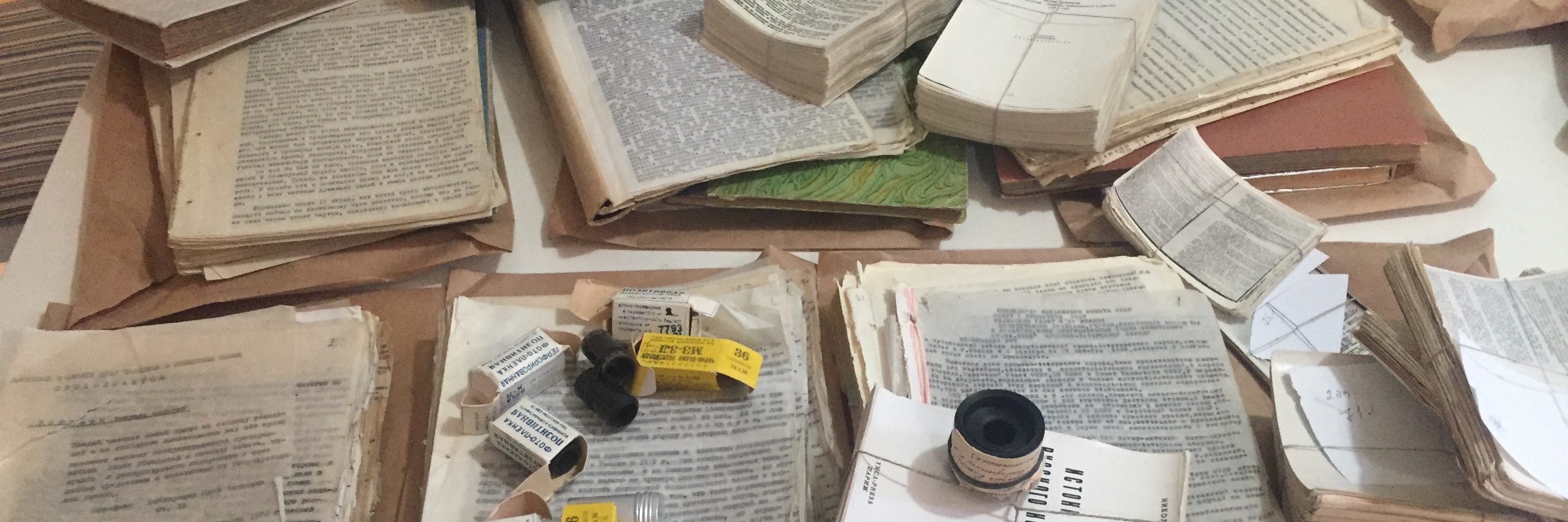
For those watching in horror the atrocities committed by Russian troops in Ukraine and wondering what can be done from afar, here is a list of various types of organizations to support. Given the rapidly developing situation and the number of appeals from various channels, this list is by definition incomplete. If you know of other organizations please add them, and we will be updating, as well. We stand with the citizens of Ukraine, the Russian protesters, and members of the various diasporas who have family, friends, and ties in one or both places.
Tag: Highlights
Voices for Ukraine: Video from the Words Together Worlds Apart Reading
Here’s a video from yesterday’s poetry reading featuring poets from Ukraine and their English-language translators. Thanks to poets Olga Livshin and Julia Kolchinsky Dasbach who organized this event 800 people from across the globe came together for Ukraine. This event, put together as a part of an ongoing poetry series Words Together Worlds Apart was a fundraiser, and it’s not too late to DONATE to UNICEF.
Here’s a more comprehensive list of organizations that accept donations for Ukraine.
*Words Together Worlds Apart spearheaded by poet Julia Kolchinsky Dasbach is a virtual reading series. Its mission is: “To maintain & build literary community across distance through our shared love of words. Featured readers will share their work around a weekly theme, followed by interactive discussion.”
Born in the USSR, Raised in California: Video Recording
Thanks to everyone who could attend our event on Saturday, December 4th, and thank you all for your engagement and for your wonderful questions. For those of you who couldn’t make it, here’s the video recording from the event and links to our work.
Seven immigrant writers read their fiction and nonfiction related to immigration, identity, family history and the mother tongue(s). Let’s talk about buckwheat and pickled herring with beets. What do you do if your children refuse to eat traditional foods? Or when your dying grandmother forgets English and Russian and begins speaking to you in Yiddish? Does a Soviet-era secret still matter when the country no longer exists? We explore love, life, loss and the nuances of living with a hybrid identity.
Continue reading “Born in the USSR, Raised in California: Video Recording”Writing and Reviewing Queer Russian Literature: A Conversation with Konstantin Kropotkin
We’re delighted to publish our conversation with Konstantin Kropotkin, an author and literary and film critic who reviews LGBT books and movies, as well as trends in Russian culture. Kropotkin’s novels and collections of short stories centering queer lives are available on Amazon, in Russian. His commentary on queer culture appears daily on his Telegram blog “Sodom i umora,” and he contributes full-form critical essays to top Russian-language publications. Kropotkin lives in Germany and this conversation was conducted in English and Russian over email, and subsequently translated by the interviewer.
Olga Zilberbourg: Much of your fiction has been focused on portraying the lives of gay men, and as a critic you pay particular attention to LGBT literature and film. Your popular Telegram blog “Sodom i umora” is dedicated to queer books and movies in Russian or in translation to Russian. Despite the retrograde homophobic laws that Russia has passed in recent years, and horrific persecution of gay people in Chechnya, you have shown that Russophone queer literature is a vibrant field. In your blog you seem to strive for balance: you write about various forms of homophobia and also about the many creators that are participating in Russophone queer culture. How would you describe your cultural project as a critic? Does this project change in any way when you turn to fiction?
Continue reading “Writing and Reviewing Queer Russian Literature: A Conversation with Konstantin Kropotkin”Telling the Story of People Who Didn’t Want to Be Noticed: An Interview with Maria Stepanova
By Svetlana Satchkova
Maria Stepanova is a Moscow-based poet, essayist, and journalist. She’s also the editor-in-chief of Colta, a crowdfunded online publication that she created eight years ago and that has become a major outlet for long-form think pieces on contemporary Russian culture. Stepanova published ten books of poetry and three essay collections and has received numerous literary awards. In 2017, she wrote her first book of prose, In Memory of Memory. It’s a documentary novel that tells the story of the narrator who, after the death of her aunt, goes through the archive the aunt left behind, discovering her family’s history. In parts of this book, there’s no narration – just excerpts from diaries and letters written by Stepanova’s relatives; its other parts engage directly with other authors who wrote about memory – Osip Mandelstam, W. G. Sebald, and Susan Sontag. Despite or, maybe, because of the book’s non-traditional form, it gained a wide readership and won two major Russian literary prizes. On February 9, In Memory of Memory comes out in English from New Directions, translated by Sasha Dugdale, a British poet and playwright. This interview was conducted in Russian and subsequently translated to English by the interviewer.

In your novel, you quote someone saying that quite a lot of books have been written in English by people investigating their family histories. In Russian, though, your book is the only one of its kind.
Actually, it’s not the only one, which makes me very happy. To me, this is a discovery of sorts – that things we usually consider private and insignificant are turning out to be the most interesting not only for me, but also for a large number of people. And the stories they tend to tell sometimes are quite unexpected in their scope and variety. In some of them the twentieth century shows up in all its terrible glory, with all of its tragedies and disasters, but in a number of cases these are just regular domestic stories of how somebody’s grandmother arrived, or how someone left to work in the north, or how three sisters lived in a distant Hungarian village, but then decided to leave for the big city. And yet one can’t get enough of these stories. I think that this is a very important shift, this interest in familial memory. There’s an increasingly palpable hunger for contact with the past which grows stronger as the present becomes less acceptable to us. A couple of years ago, I worked in Berlin for a year, teaching memory writing in Humboldt University. I had large groups made up of different kinds of people, all of them hooked on this search for the past despite it sometimes being painful – because traveling to the past isn’t always pleasant. Moreover, this interest in memory is a global, international phenomenon, which is now shaping the outlines of a new community and works as a link between generations because it attracts people regardless of their age.
Do you have any idea why you became the first person to write about these things in Russian?
I wasn’t really the first one – writing one’s family history is something fairly normal in Russia, as elsewhere, and there is a good number books devoted to the legacy of the twentieth century and the traces it left in private lives…. Maybe the genre is something that makes a difference in my case: I was most interested in trying to shape a new territory between fiction and nonfiction: in my book, a novel, an essay, and a research project meet one another. I guess no one else wrote books like that at the time.
Do you think there isn’t a lot of experimentation happening in the Russian literary space?
This is how it works: since the beginning of the nineties, when literary awards appeared in Russia, the way contemporary fiction works has been largely determined by their existence. Winning one of them is the only opportunity for a prose writer in Russia to receive a substantial amount of money that can greatly improve their life. These awards, in one way or another, are geared towards finding the great Russian novel that is very similar to the great American novel. It’s a long, philosophical narrative without any stylistic nonsense – because it should be easy to read and digest – shaped within the mold of a nineteenth century novel. That is, the writer is forced to reinvent the wheel for the umpteenth time.
In other words, you didn’t expect that your book would become successful and would win two of these very same awards – NOS and Big Book?
I didn’t think about those things at all. I’ve been writing poetry all my life, and it always seemed to me that prose was the medium that wasn’t required of me, that if I wanted to write prose, I could easily write it in verse. And I did: I’ve written long narrative poems and all manner of ballads. At the same time, I always knew that someday I would write a book about my family, even though I didn’t know how I would go about it. I’d been meaning to write it from the age of ten, but I was taking a long time, endlessly getting distracted, looking for a chance to procrastinate a little while more. There came a point, however, when I realized that I had to do it. I set out to write a text that would be convincing to me, and there was one more goal that was even more important. You know, Brodsky has this essay called “To Please a Shadow.” This was what I wanted – to please my dead. I constructed my book in such a way that they would feel good in it. Maybe I could’ve written it in a completely different way, without all those historical and cultural references that work as a large structure into which my own stories then fit. I could’ve written a story about my family and nothing else, but I had in mind something that would belong to the realm of contemporary art. I wanted to create a space in which I could arrange the few remaining photographs, letters, and testimonies, and to make it so that they would feel good in this space, so that they would be seen and understood in the right way. This is how you work when curating an exhibition – you start with the space. I really didn’t think about anything else, and the fact that my book wound up being widely read was a shock both for me and for my publisher, who didn’t hope to sell more than three thousand copies, I think.

How did you arrive at this particular form for your book?
The book is about inconspicuous people, people whose lives resembled those of everyone else: they loved, they fell out of love, someone died, someone was born. As a family, they managed to survive many times, perhaps because they deliberately stayed on the sidelines. At the beginning of the twentieth century, they tried to be actors of history, but later they moved to its margins and spent almost a hundred years there. So, what worried me was the question of how to tell the story of people who didn’t really want to be noticed – and how to talk about people whose fates had nothing extraordinary about them.
I found the story of Lyodik who went to the front and died at the age of nineteen absolutely heartbreaking.
Lyodik’s letters have been in our family for as long as I can remember. When I was little, my mother told me about him sometimes and read his letters out loud. But it’s impossible to surmise from his letters what was actually happening to him and around him – he kept silent about that. In order to look beyond and understand what he kept silent about, I had to read a lot of historical literature on the blockade of Leningrad and the Leningrad front. A documentary novel is a genre in which there are a lot of gradations, that is, there’s a toggle switch that can be moved to the left, towards the documentary, or to the right, towards fiction. I’m probably keeping to the left of this spectrum. I have serious problems with the type of novel writing that uses people who are no longer alive as glove puppets to convey the writer’s own thoughts and emotions. I think and write a lot about the ethics and the etiquette of writing about the dead, about what is allowed and what isn’t, and at what point it turns into the exploitation of people who can no longer object to this treatment.
Have you come across books that dealt with the dead in a way that you liked?
There are a number of books that are great examples of how one can write about the dead without trying to make the story “interesting,” without trying to deceive, and at the same time doing this miraculous work of resurrection. First of all, I should mention W. G. Sebald because he balances on the border of fiction and essay writing in such a way that there’s a constant flicker. We want to, but we cannot ask: was this all real or not? Is this narrator Sebald or someone else with his mustache and his last name? It seems to me that a new type of literature is emerging which still doesn’t have a name, but it no longer fully belongs to either fiction or essay writing. The books I love most belong exactly to this type of writing that is gradually becoming more and more important.
You’ve mentioned in various interviews that fiction is becoming less and less interesting than documentary writing. Why, do you think?
Remember Mandelstam’s article “The End of the Novel”? It was written in 1923, almost a hundred years ago. He says in it that everything has changed, that the man of the nineteenth century had an individual fate and was therefore interested in the individual fate and its trajectories – hence the success and the significance of the novel as a genre in the nineteenth century and beyond, due to some kind of inertia. But we all know how the twentieth century dealt with these trajectories: it took these individual fates, collected them in a bundle, and broke them over its knee. Later, when the smoke cleared, it turned out that the individual survived, though not in the place where we kept looking. It’s no longer where the typical hero appears in the proposed circumstances and carries on their shoulders the novel construction. In the century in which people die in millions, one person isn’t quite the measure. An error, a detail, a very small thing – oddly enough, that’s the measure.
What kind of thing?
For example, a button that I saw at the Museum of the International Memorial in Moscow where they keep the belongings of the prisoners of Soviet camps. They have many remarkable things there, including an archive of drawings made by the prisoners. It amazed me – and I want to write about it sometime – because there are no scenes we remember so well from the Russian camp prose: no barbed wire, or German shepherds, or security officers on the watchtowers. But there’s a huge number of still lives with flowers as well as landscapes and portraits. For some reason, it was important to those people to create beauty rather than to give a realistic depiction of their circumstances. In this museum, I saw a button in which one of the prisoners had sent a note to his wife. This is a striking detail: they were horribly tortured, but they could give their overcoats to their wives for cleaning. This officer handed his overcoat to his wife, and from one of its buttons a corner of this note was sticking out slightly. On tissue paper, he wrote in microscopic letters about how he was arrested and beaten, and he added that he probably wouldn’t come back. The twentieth century is the time when life turns out to be so inhuman that people become speechless and can speak only for all of humanity, while objects do the speaking for them.
You’re fluent in English, and I assume that you’ve read Sasha Dugdale’s translation of your book. How did you like it?
I think it’s brilliant. Sasha is a wonderful poet and a close friend; she translated and still translates my poems – but my book is maybe the largest piece of prose she had ever translated. And what she did with this huge volume is, in my opinion, absolutely incredible. The Russian type of writing involves endless subordinate clauses that circle around the principal meaning until they finally find their way to it. The Russian syntax imitates the confusing, complex work of human thought, while English, it seems to me, entails a completely different logic and a completely different language etiquette. If you translate a Russian text aiming to convey mainly its syntactic features, it won’t deliver the intended message. What Sasha did was amazing: she found a balance between these two things. She delivered the message that is still the main objective of my work, and at the same time she created this English Russian that isn’t a literal reflection of the original, but somehow gives the reader an idea of how it works.
Your book has a subtitle – romance. In addition to its other meanings, this word designates a certain kind of song in Russian.
In the book, there are several definitions of the subtitle, and the reader can choose the explanation that they like best. To me, the English meaning of this word is the most important. I feel that this book is a love story, only it’s facing backward rather than forward, as is usually the case with love stories because love is always looking for some kind of completion in the future. Here, love is addressed to people who are no longer alive, so, on the one hand, my love is happy because I love them and I feel that they love me, but on the other hand, I can’t talk to them anymore, and this love is doomed in a sense.
Your book makes clear that your ancestors had to stifle their literary ambitions. Why was that?
When I began to sort through my archive, it struck me: they were all in one way or another people of the written word, even those of them who never intended to study literature. Therefore, there are parts in my book in which I don’t speak at all: I publish excerpts from letters or diaries to give my ancestors the opportunity to speak in their own voices. It seemed wrong and inappropriate to me to invent a voice for my great-grandmother where she had her own. On the contrary, I wanted them to say once again what they already said once, to get a final chance to be heard. My grandfather wrote poetry all his life, mostly comical, but when his daughter – my mother – began to write poetry too, he strictly forbade it, saying, “You’re Jewish, so you must have a profession.” My mother worked as an engineer all her life and never wrote poetry after that.
Was it the same way with you? Were you told not to write poetry?
In a sense, I’m the result of this half-century of their non-writing, because the first thing my mother taught me was to read and write. She was too shy to sing, so at night, instead of singing lullabies, she recited poetry to me. I turned out to be the completion of my family’s hope that someone could write and speak for everyone. It’s a lot of responsibility, because it’s like dragging around a suitcase full of family stories that haven’t been told, and I’m the knot in which they converge. I have to decide whether to talk about them or not, and what exactly to tell. On the other hand, I was infinitely happy, writing this book and doing almost nothing else for several years. I traveled to all the places where my ancestors once lived, and it was very strange and exciting. For example, I went to this microscopic village in the middle of nowhere, somewhere between Arzamas and Nizhny Novgorod, and there was no train there, only a bus that went there once a week, there was no hotel, no cafes, no nothing. And I looked at all of that and realized that there was some thread that connected me to that place.
Since nonfiction is more interesting to you than fiction, does this mean that you don’t read mainstream novels?
I have a very special reading routine: I read a book a day. This means that I constantly have to throw new texts into the furnace. I really love genre literature: for example, detective stories that have clear rules upon which the author agreed with me. It’s a game the author and I are playing. I also read complicated, experimental texts, and academic stuff. I do sometimes read mainstream psychological novels, but they don’t make up the bulk of my diet. If someone I love comes running and says, “Grab this new novel immediately and read it,” then, of course, I’ll grab it and read it. But when I’m in a bookstore, the shelf with freshly published novels isn’t the first one I’ll be looking at.
You don’t hide your political views: you oppose Putin’s regime. You must’ve had opportunities to leave Russia. Why have you stayed?
This is one of those questions that I have to ask myself every five years or so. When my parents left for Germany in the early nineties, I didn’t go with them. I stayed because I was fascinated by what was happening in Russia. It seemed odd to me to leave when the most interesting things began to happen. And now, I feel that someone has to love this place – with its monstrous situation into which we have driven ourselves, with Putin, with these comic-opera poisoners, with this “insane printer” [in colloquial Russian, this is what the Duma, or the state legislative body, is called – Punctured Lines] that passes these insane laws. Someone has to live here and to treat this space as their home, to make it meaningful. Which isn’t to say that I’ll grip this earth with my teeth and stay here under any circumstance. But as long as it’s possible to live here somehow, I would try to stay here. Because the worse it gets here, the more this place needs our love.
###
Please support writers by buying their books.
Svetlana Satchkova is a writer and journalist from Moscow, Russia, who currently lives in New York City and is working on her MFA at Brooklyn College. Her most recent novel People and Birds came out from Moscow-based Eksmo Press to popular and critical acclaim.
Feminist and Queer Russophone Poetry
This year, English-speaking readers will be introduced to three books in translation from Russian, each of which is groundbreaking on its own terms; taken together, these books showcase the aesthetic potential of feminism in contemporary Russian-language poetry. The feminist and queer voices in these books are amplified by the group of poet-translators, whose own politics and identities allow them to negotiate the cultural gap between russophone and anglophone contexts, enriching both. Punctured Lines is proud to introduce the three books and our conversation with Ainsley Morse, Eugene Ostashevsky, and Joan Brooks, who as editors and translators served to bring these books to English-language readers.
Update: This post was originally published on October 14, 2020. Subsequently, Joan Brooks asked us to remove their answers to the questionnaire, and we’ve done so on December 11, 2020.
The Books
Lida Yusupova’s collection, The Scar We Know, edited by Ainsley Morse, with translations by Madeline Kinkel, Hilah Kohen, Ainsley Morse, Bela Shayevich, Sibelan Forrester, Martha Kelly, Brendan Kiernan, Joseph Schlegel and Stephanie Sandler
(Cicada Press, Winter 2020/21)
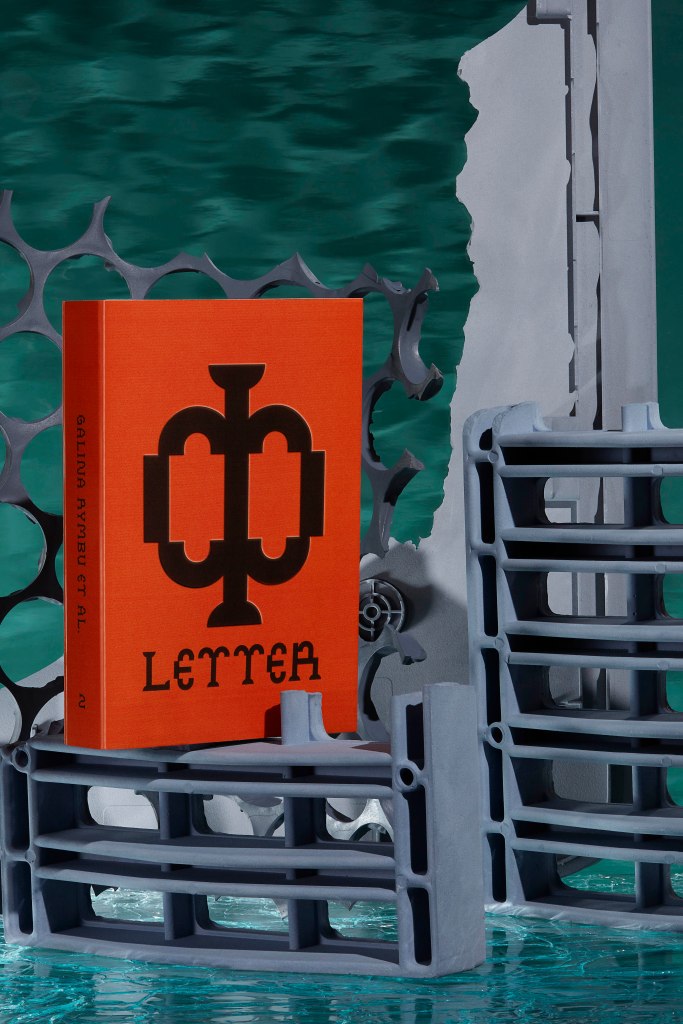
F Letter: New Russian Feminist Poetry, an anthology edited by Galina Rymbu, Eugene Ostashevsky and Ainsley Morse, with original poems by Lolita Agamalova, Oksana Vasyakina, Elena Georgievskaya, Egana Dzhabbarova, Nastya Denisova, Elena Kostyleva, Stanislava Mogileva, Yulia Podlubnova, Galina Rymbu, Daria Serenko, Ekaterina Simonova and Lida Yusupova; translated by Eugene Ostashevsky, Ainsley Morse, Helena Kernan, Kit Eginton, Alex Karsavin, Kevin M. F. Platt, and Valzhyna Mort
(isolarii, October 2020)
Galina Rymbu’s collection, Life in Space, translated by Joan Brooks with an introduction by Eugene Ostashevsky and contributions by other translators
(Ugly Duckling Presse, 2020)
NB: Dear readers, please pre-order and buy these books and request that your local libraries purchase them for their collections. This directly supports the work of everyone involved in their making.
Conversation
PL: These are Rymbu’s and Yusupova’s first poetry collections in English, and many authors in the anthology are being published in English for the first time. How did these books come to be? What’s the story–or stories–behind their near simultaneous publication in the US?
Ainsley Morse: I met Yusupova in 2017, when we invited her as the “poetic guest” to AATSEEL (the annual conference of the Association of American Teachers of Slavic and East European Languages)–when funds allow, we like to invite a poet to have translators workshop some of their poems and to give a reading. The idea of making a book started then but really took shape as, over the ensuing couple of years, I kept encountering other translators who were interested in Lida’s work and wanted to take on various texts. (I am the editor of the book and did some of the translations, but really couldn’t have done this project on my own.) Most of the other books I’ve done have been labors of love–me wanting to bring something strange that I love into English, but not always with a huge resonance–but my sense of Yusupova’s book is that it almost made itself; it sensed its English-language audience ready and waiting.
Eugene Ostashevsky: It’s both a coincidence and not a coincidence. Historically, it’s not a coincidence. It has to do with the emergence of feminist and queer poetry in Russia in this decade, mostly written by the young poetry generation, i.e. by people who did not live in the USSR. Yusupova, who is older and did live in the USSR, was the inspiration for some of this poetry. Rymbu is currently its most visible representative. I first came across a poem of hers by chance, online: it was during Maidan, in February 2014. It was the Lesbia poem, about the coming of fascism to Russia. It was obviously the work of somebody who had a vast poetic erudition but was doing something new with it, and something wildly compelling. So I did a feature on her in Music and Literature with Joan’s translations. Sebastian and India, the publishers of isolarii, read the feature and contacted me. We decided to do an anthology that she would edit and that would represent some of the people from her circle. It just so happened that all three books–the anthology and Rymbu’s and Yusupova’s English-language books–are coming out simultaneously. I think we have COVID to thank for it, because they all got held up by the lockdown in different ways.

PL: There have been a number of writers in the russophone space who wrote to queer and feminist themes in the past, including Yusupova herself, who published her first collection in 1995. In 2017, a collective of poet-activists launched “Ф-Письмо [F-Writing],” an online platform, specifically dedicated to feminist poetry. F Letter: New Russian Feminist Poetry gathers the work of poets associated with the F-Writing collective who intentionally blur the lines between poetry and activism. They do this both by breaching taboo topics–for instance, the physiology of the female body (as in Galina Rymbu’s recently published poem “My Vagina”)–as well as by breaking with tradition in Russian-language poetry by moving away from rhyme and meter. What do you see as some of the most exciting and innovative aspects of the poems you worked with?
Ainsley Morse: A noticeable shift away from rhyme and meter has been underway in Russian poetry for at least twenty years now, probably more like thirty (depending on how you understand “noticeable”). But this shift has had a political charge, since it certainly coincided with other, more noticeable rapprochements with the West, and to this day the majority of Russians would certainly tell you that poetry is something that rhymes. Some of the poets in the anthology, particularly the ones with personal experience of life in the USSR–Ekaterina Simonova, or Elena Georgievskaya, for instance–started out writing much more traditional-sounding verse. Lida Yusupova (b. 1963) certainly grew up in a poetic environment dominated by rhyme and meter, but her years of living (and reading) abroad have also surely affected her general sense of poetry. In any case, when she gives specific instructions to translators / editors to “let the lines run on as long as the page will let them”–you know this is someone who has a sense of the constrictions imposed by a neat stanza, such that these unhinged rambling lines are a really meaningful part of her poetics. I’d say, though, that most of the poets represented in the anthology came of age as poets in an (admittedly rarefied) environment that saw free-verse as the new normal; as Eugene describes, their innovations are happening more in the realm of selfhood, subjectivity, identity.
Eugene Ostashevsky: Feminist and queer work–and left-wing political work in general–is what’s exciting in Russian poetry now, at least as far as movements are concerned. Russian poetry has for many generations generally tended to avoid politics. There were a number of deep reasons for it, from the cultural policy of the state to ideologies about poetry held even by people who were deeply anti-establishment. Of course, the aim of the state was to knock out the political instinct altogether, or rather the critical political instinct, to make people believe that politics is corrupt, so that conformism may rule. (This is still the current strategy because it works.) At the same time, stylistic experimentation sufficed to demonstrate your anti-establishment colors, because stylistically interesting work generally could not be published under the Soviets. In the aughts, during Putin’s first decade, some poetry started to break away from the general aversion to political engagement. And it was also a poetry that started breaking other taboos–including talking about the body, and about sexuality in ways that ultimately turned out to be socially impermissible and politically volatile. This poetry moved towards reflecting upon the self in new ways, towards constructing the self differently, and that self would very obviously no longer be a Soviet self, and not even a post-Soviet self. So it was anthropologically innovative, which made it politically innovative also.
However, it was the state that took the crucial step of making such poetry necessarily and obviously political. The state politicized sexuality by associating LGBTQ+ issues with the decadent West, pretending that LGBTQ+ posed a danger to Russian society, as if they were some sort of rainbow-colored NATO special forces, largely criminalizing them and positioning itself as the defender of family values. Once that happened–once Putin, as dictators everywhere, consciously threw in his lot with defense of patriarchy–feminist and queer poetry automatically got shoved onto the political frontline, and automatically became–it’s perhaps unsuitable to use military metaphors here but in Russia we/they like military metaphors–the vanguard of resistance to Putin or the putative Putin or the state.
PL: Most of the poets included in the three books are closely connected to each other by personal and artistic ties. F Letter: New Russian Feminist Poetry was edited and includes work by Galina Rymbu as well as Lida Yusupova’s poetry. What connections between the three books strike you as the most meaningful?
Ainsley Morse: As someone who teaches / tries to teach Russian poetry to American undergraduates, I love that these books are coming out in hot succession–it’s a rare moment when the slow and painstaking world of translation publishing comes a little closer to the pace of the “real life” of this subset of Russian poetry, where these poets are all constantly releasing work that is in conversation with, responding to, each other. Single-author books always give a broader and deeper sense of a writer than a couple of poems in an anthology, but here we also have this anthology providing a whole additional level of context to both Rymbu’s and Yusupova’s work; I would hope, too, that readers intrigued by some of the anthology authors might feel empowered to suggest further translations of some of them. Another rare treat (pedagogical and otherwise) is the possibility, at least with the anthology and Yusupova’s solo book, to compare the voices of different translators grappling with the same poet’s work. I’m also excited and curious about the way English-language readers will react to all three of them being available at once: it seems like an unusual opportunity for a more in-depth and nuanced cross-cultural poetic dialogue, more or less in real time.
Eugene Ostashevsky: Well, it’s the same corpus. Poems don’t really get written individually. They are always collaborations. When you’re a loner, you collaborate with dead people. But here you have work by contemporaries responding to each other–you have a conversation of the living, who are trying to make sense of themselves and of their surroundings. The F Letter: New Russian Feminist Poetry anthology has an incredible poem by Oksana Vasyakina, “These People Didn’t Know My Father,” which starts by talking about the importance of Yusupova as a catalyst. For me, I love Galya Rymbu’s slightly earlier, more anthemic poems in White Bread, that Joan translated, and it’s really interesting to see her return to the same area in “My Vagina” but years later, as a different person. But she works in a number of different directions, and another direction picks up, for example, on the poetics of Arkadii Dragomoshchenko, a Petersburg poet of an older generation, who died a decade ago, and a lot of whose images are apophatic, nonvisualizable.
PL: Despite their similarities, these are three very distinct books, published by three separate presses and presumably aimed at different, albeit partially overlapping audiences. What are some of the unique aspects of each of these books?
Ainsley Morse: As I said earlier, I really have this sense that the Yusupova book “made itself”–I don’t ever remember having a serious conversation about the contents, it just came together in what now feels like a strikingly harmonious and well-balanced structure. All the texts were proposed by the individual translators, with the exception of one poem (“Patchwork Quilt”) that Lida asked us to add (otherwise she did not comment on the contents, except to say how delighted she was). I suspect that the excellent quality of the translations and the overall pleasing shape of the book comes out of this shared creative satisfaction, the fact that everyone was following individual inspiration. Perhaps I should also add that we took our time and agreed on deadlines collectively–no one was rushed.
Eugene Ostashevsky: One aspect that F Letter: New Russian Feminist Poetry shares with Rymbu’s Life in Space, as well as with Yusupova’s collection, is that all three are bilingual. The bilingualism of the books means they are addressed to several audiences at once–to poetry audiences in the US and UK (not at all the same audience), as well as to English-speakers globally, because we, or at least I, aren’t writing for just American readers now. Being bilingual, the books are also addressed to Russians–to global Russians also, meaning to Russians outside of Russia, to people fluent in Russian, and to people just beginning to learn Russian. I ended the introduction to Life in Space with a request that readers who don’t read Russian at least learn the letters so that they can pick up some of the materiality of the language on the facing page. It’s not because I have a Russian fetish, it’s because I think poems are material things, and especially material in the original. Just reading the translation is not enough for me. But I digressed and said nothing about the differences between the books, only the similarities. Sorry.
PL: Though Russian is the common language from which these poems originated, most of the poets have lived experiences in a number of cultural and linguistic contexts. Having grown up in Petrozavodsk, Karelia, Lida Yusupova lived in St. Petersburg and Jerusalem, and currently divides her time between Canada and Belize. Galina Rymbu was born in Omsk, Siberia, and Oksana Vasyakina further East, in Ust-Ilimsk, Irkutsk oblast. Lolita Agamalova was born in Chechnya and Egana Dzhabbarova spent her childhood in Georgia and currently lives in Yekaterinburg. What do you think these complex mobilities contribute to their poetics?
Ainsley Morse: In Yusupova’s case, I would say complex mobility makes her poetics. A lot of the poems in her 2013 book Ritual C-4 (excerpts from which open The Scar We Know) are outright multilingual and/or strongly gesturing toward other cultures, histories, languages, etc. This is a really interesting problem for translation, since part of what makes these poems powerful and strange is the simple fact that they tell these stories in Russian, and Yusupova–as someone who spent several decades living in Russia–is fully aware of how dramatically different these (Belizean, Canadian, American, etc.) scenarios and names sound and mean when they are transplanted into Russian. To some extent she is playing around with exoticism in a way that can seem not entirely politically correct. But both in Ritual and in more recent work, she also uses the distance gained from her own personal displacement to look back to Russia (to her own past and the present day alike) from an estranged position. I think this crucial shift in viewpoint is one of the moves that made Lida’s work so inspiring for some of the younger poets in the anthology.
Eugene Ostashevsky: It makes them modern. Modernity is displacement. But, on the less slogany level, it also shows that Russia is not just Moscow and Petersburg anymore, because Russia, with its history of absolutism, used to be like France–just Paris.
PL: Translators have played a very active role in bringing these books to English-language audiences. Some of the translators are themselves poets and activists, and many were born in the Soviet Union or to USSR-born parents. Considering that poetry translation is the act of co-creation in the new language, what do you think these complex identities of the translators contribute to the shape of these books?
Ainsley Morse: I have to say that I still don’t know very much about the personal background of the translators who did the bulk of the work on the Yusupova book–Madeline Kinkel and Hilah Kohen. I know that they’re both younger than me (by how much, I don’t know), hard-working, bright, responsive, creative and generous, and driven by a vested interest in the work.
With the anthology, I do remember feeling that we needed to involve younger translators–many of the poets there were born in the 1990s, and it seemed important to me that the English come from people reasonably coeval with them. But that was an easy task because there are so many fantastic young(er) Ru-En translators out there right now! I suppose that does bring the conversation back around to the question of family background, since for some of the translators growing up with Russian in the family probably means they achieved a greater degree of bilingual fluency at a younger age (without years of study). But we also worked with several marvelous translators who have just learned Russian from scratch.
The question of translators-cum-activists is interesting. In some ways the history of twentieth-century Ru-En translation is one of activism, since the Cold War narrative of oppressed writers drove much Russian literature publishing for a long time. To some extent this anthology will draw attention precisely because of the persistence of the Cold War model: Russia’s government is still/again villainous, and some of these poems call direct attention to this fact. In the internet age, though, translators have an easier time finding writers they find compelling for whatever reason–they don’t just automatically translate prominent dissidents and Nobel Prize winners. Also, although many of the translators whose work is featured in these books identify as queer, the problems that are relevant for queer poets in the US right now are not necessarily the same ones being grappled with in Russia. So it’s probably more important that the translator has a connection with the poems than necessarily with the poet / the poet’s self-identification.
Eugene Ostashevsky: Since translation is, at bottom, work with language, before you get to gender, ethnic or other identities, the translator needs to know how to write in the target language and how to read in the source language. The translator also needs self-control–you need to check even things you think you understand and you need to make sure you are not smothering the text with your own ideas. Having said that, it is also important–in fact, it’s crucial–for the translator to have an internal connection with the author. This can happen on any level. It can happen on the more existential level of shared, say, gender or sexual preference, although this kind of internal connection strikes me as impossibly broad if unsupported by others.
I personally need a connection through poetics. I really wanted to translate Lolita Agamalova’s Dilige, et quod vis fac, although it’s a lesbian sex poem, and I’m neither young nor a lesbian. But I also know what it’s like to use philosophy, even Neoplatonic philosophy, to talk about sex, I am at home in the kind of metaphysical poetry that she writes. And my job is not to imitate what she, as a character, is doing with another character, but to imitate in English what she, as a poet, is doing with the Russian language. We did aim for a range of “complex identities” of translators in our anthology but I don’t know to what extent that shows up on the page. Like, my “complex identity” is probably differently complex from the “complex identity” of Alex Karsavin, who is a terrific translator I first met working on this book–inventive, thoughtful, precise–but can you read the difference in our word choice? Translation is not the same as original poetry. It’s not about the translator, or rather it’s about the translator very, very obliquely. So identities don’t work in the same way.
PL: In the anglophone world, we have seen a growing interest on the part of translators and editors to give space to Russian queer and female writers. In 2019, for instance, Brooklyn Rail’s InTranslation folio “Life Stories, Death Sentences,” was co-edited by Anne O. Fisher and Margarita Meklina. This increased interest came on the wings of the reportage about the socially regressive laws passed in Russia that decriminalize domestic violence and criminalize “gay propaganda” (conveniently loosely defined), and most notoriously the persecution of gay men in Chechnya. On the geopolitical scale, we’re seeing Russian leadership align itself with the socially conservative values maintained in the US by the political far-right, upholding patriarchy and heteronormativity. In the Russian context, many if not most of these authors have engaged in acts of dissent. What do you think of the potential for these books to also act as works of activism in the anglophone context by, for instance, helping to build socially progressive alliances?
Ainsley Morse: I don’t know how much activism these books are capable of bringing about in the anglophone context. I am very glad they are all bilingual, because I think they are definitely capable of sending small shock-waves out into the Russian-reading community–because many of these texts really are earth-shaking and unprecedented in Russian. But my sense is that many of the poems come across as much less shocking in English, where women in particular have been writing the body and sex, etc. for a while now. I’d make an exception for Yusupova’s cycle “Verdicts,” composed of found poems made using court documents she accessed on various Russian legal websites. Several of these are extremely graphic and brutal, in English just as much as in Russian. But I worry too that the English-language poetry reading public has this special category for “brutal Eastern European art” and there’s a kind of automatic distancing that neatly sections off the visceral violence and pain there as the sort of thing that happens elsewhere. Ironically, I think the more programmatic work, which highlights the legal and social differences between the US and Russia, can be less effective at bridging that gap. That said, I recently taught Vasyakina’s “These People Didn’t Know my Father” to a class of non-Russian-speaking students and several people really responded–not as much to the narrator’s fantasies of an underground feminist-terrorist organization, but to her nuanced portrait of economic disparities and social-medical stigma. The “feminist poets” in the anthology are really addressing so much in their work–their “feminism” is often so far-reaching in its calls for human rights and general decency, it almost seems limiting to use that designation (even as we can see the crucial importance of specific demands for women’s rights).
Eugene Ostashevsky: Especially now, given Russian interference in elections in the US, the EU, and elsewhere, and given international cooperation among extreme-right-wing parties and the Russians, the enemy seems to be the same in many locations all over the world, and the systems seem increasingly similar. But that may be an optical illusion. Let me think about it. Well, Russia is just more patriarchal than the US, because the Russian state depends on the traumatization of men–of all of its male citizens–during army service, as well as by the casual violence of the family, of the street. Being a Russian man–a “common,” “normal” Russian man–has to do with the internalization of violence directed at you, with directing violence at others, with accepting it as the natural economy of manhood. I think in the US, which does not have the draft, but does have gun ownership, there exists systematic abuse of men in order to rule them, but it’s directed at a smaller subset of men and it’s organized differently. Just think of American prisons and of the likelihood that an African-American man will go to prison, as opposed to a representative of another group. But it’s less obvious how it works in the US, because oppression in the US tends to be by the indirect, alienated violence of money, rather than by simple beatings or shootings. I understand about police brutality, but there is also money brutality, and I hope I am not downplaying real physical violence if I say that money brutality is more in charge. Anyway, I don’t live in Russia and I don’t even live in the US now, and I’m not a sociologist, so my pontificating is not to be taken too seriously. What I was trying to get at is the obvious point–well, obvious to you and me but clearly not for everybody–that feminism and queerness are extremely good for “straight” men also, because these ideologies aim at constructing a different body politic, one where the men also would not be brutalized, where the state would not depend on the brutalization of men, and of others by means of men, to survive. As it does in Russia. As it does in part in the US, although the violence of money is so much more complicated and less clear cut, and maybe to some extent compatible with nonpatriarchal thinking. Maybe. I don’t know.
But I didn’t answer your question. Do I think these books can act as a work of resistance in an anglophone context? No doubt. I never say “no doubt,” but this is really no doubt. Much of the material in all three books translates pragmatically as well as semantically.
PL: In the process of translating and editing these books, what images, concepts, and/or words have emerged as some of the trickiest to carry over into English?
Ainsley Morse: Encroaching multilingualism! I talked about this some in relation to Yusupova above; her poems have words from English, Spanish, Kriol (in one poem, Inuktitut), as well as a persistent orientation toward a kind of “other” or foreign space (even when they’re written in plain Russian). Likewise some of the anthology poets use foreign words or phrases, and it’s always so hard to get–and then convey–a sense of how that feels and means in Russian (especially since the “other” language is so often English).
The legal language in Yusupova’s “Verdicts” cycle also offered a technically tricky problem. We, non-lawyers, were not familiar with this kind of language in English, and the Russian legal code is just different. In one case we had to redo a significant chunk because Lida pointed out that there isn’t a manslaughter charge (this had been our approximation of what was, crucially, “causing death by negligence”). Even “Verdicts” should technically be “Rulings,” but we went for the etymological rhyme (the root of the Russian word, Prigovory, is speaking or saying, di(c)t-).
For me, the “Verdicts” cycle also entailed a different kind of difficulty because of the extremely brutal and graphic violence toward women and LGBT+ people depicted in most of the poems. I should acknowledge right away that Madeline Kinkel is the translator of the cycle, for which I’m very grateful–I always knew they would need to be a big part of the book, but was reticent to translate them myself because simply reading them was such a viscerally wrenching experience. Since translating entails getting deep inside of texts and reading them over and over again, translating the “Verdicts” was sure to be hard going (of course, as editor of the book, I ended up working closely with them anyway). I remember Bela Shayevich told me that while she was translating Svetlana Alexievich’s Secondhand Time, which abounds in tales of relentless and horrific suffering, she would cry pretty much every day.
Eugene Ostashevsky: Relatively speaking, this is not hard material to translate. Older poetry is much harder, both because of greater linguistic materiality, especially in the case of classical forms, and because of greater conceptual dissimilarity. With contemporary Russian feminist poetry, though, we all live more or less in the same world, or at least we live in a world whose parts are kind of legible from the vantage point of other parts. Maybe the hardest part of the anthology was the title. F-pis’mo really translates as F-Writing, referring to écriture feminine, but to translate it as F-Writing into English would be like living in the 70s all over again, because the idea of poetry as écriture, which appeared in Russia only recently, becomes a key idea in experimental poetry in the US with Language poetry. So I translated F-pis’mo materially, because pis’mo originally means letter, the kind you send, but if you combine it with F, its meaning alters once again, to letter like ABC. So the title became F Letter: New Russian Feminist Poetry. The F is actually a Russian F, Ф, because it’s a what’s-the-f-you-lookin-at letter, and there’s even an obsolete expression, стоять фертом, to stand like an Ф, which is to have your elbows out and your hands by your waist, but figuratively it means to stand in a what’s-the-f-you-lookin-at pose. It’ll be a tiny book with an Ф on the cover. This kind of translation may be called a double sdvig.

Ainsley Morse translates from Russian and Bosnian/Croatian/Serbian and teaches at Dartmouth College. In addition to F Letter and The Scar We Know, she has worked mostly on Soviet-era poetry, prose and theory, including Vsevolod Nekrasov’s I Live I See and Igor Kholin’s Kholin 66: Diaries and Poems (both with Bela Shayevich, published by Ugly Duckling Presse), Andrei Egunov-Nikolev’s Beyond Tula: A Soviet Pastoral and Yuri Tynianov’s Permanent Evolution: Selected Essays on Literature, Theory and Film (with Philip Redko, published by Academic Studies Press).

Eugene Ostashevsky‘s books of poetry include The Pirate Who Does Not Know the Value of Pi (NYRB 2017), wonderfully translated into the language of German by Uljana Wolf and Monika Rinck, and into the language of music by Lucia Ronchetti, and The Life and Opinions of DJ Spinoza (UDP 2008), now available in digital copy here. As translator from Russian, he works primarily with OBERIU, the 1920s-1930s underground circle led by Daniil Kharms and Alexander Vvedensky. He has edited the first English-language collection of their writings, called OBERIU: An Anthology of Russian Absurdism (Northwestern UP, 2006). His collection of Alexander Vvedensky’s poetry, An Invitation for Me to Think (NYRB Poets, 2013), with contributions by Matvei Yankelevich, won the 2014 National Translation Award from the American Literary Translators Association. He is “against translation.”
“Just because Belarusians write in Russian doesn’t mean they’re a part of Russian culture”: An Interview with Tatsiana Zamirovskaya
This is a translation of a Russian-language interview conducted by Svetlana Satchkova and published by Storytel on June 16, 2020. The translation is by Fiona Bell.
Tatsiana Zamirovskaya is a writer from Belarus who has lived in New York for the past five years. She writes in Russian and English. Her short story collection, The Land of Random Numbers (Земля случайных чисел, AST, Russia, 2019) was nominated for the National Bestseller prize and compared by critics to works by premier authors of metaphysical science fiction, from Ursula K. Le Guin to the Strugatskii brothers. She recently completed a new novel about memory and digital immortality.
Svetlana Satchkova spoke with Tatsiana about how her interest in fantasy developed, how she came up with the idea to move to the United States, and what the Belarusian language means to her.

What was your childhood like?
I was born in Borisov, a small city where Napoleon’s army was defeated in 1812. Nothing else has happened there, which is why all local culture revolves around Napoleon: there are regular battle reenactments on the floodplain of the Berezina river, where the army drowned, and guys walk around with metal detectors looking for Napoleon’s golden carriage, and drunk high school graduates go to Brilevskoe field to watch the sunrise. Borisov is also famous because Hitler came there during his only visit to the Nazi-occupied parts of the Soviet Union, in 1943. When I was a kid, the neighbors once told me that he probably stayed in our house, since it was one of the only brick houses in the city at that time…
My parents were pretty ordinary: in Soviet times, my mother was a music teacher at a music school and my dad was an engineer at a factory, where he designed tanks. After the collapse of the Soviet Union, he tried to survive in any way he could. Belarus is a transit territory, which is why Belarusians survived thanks to these huge overnight bags, which they used to carry all sorts of junk to sell across the border in Poland. So I grew up among mountains of junk: for example, thousands of crystal swans from the Borisov Crystal Factory, or boxes of dichlorvos.
I went to a great school that specialized in English. We periodically went on exchange trips to London. The British kids also visited us, bringing all the new music on cassette tapes, which we then copied from each other. I listened to all the Brit Pop albums of the nineties right when they came out, and back then, that was a huge accomplishment – living in contemporary music culture. Borisov was also a hub for violent youth groups, kids who actually lived by the laws of the street. So, my childhood was a mix of prison aesthetics, elite education, and difficult, post-perestroika life.
What did you want to be when you grew up?
I always wanted to become a writer or a musician. My parents hung out with a great crowd of rock-intellectuals. One of them, the famous musician Oleg Minakov, who sang in the German group Inspector back then, told me I should study journalism because, with my interest in music and desire to write, I could become a music critic. I thought that sounded like a really cool life, so I decided to study journalism at Belarusian State University in Minsk.
Then, at the end of the 90s, Lukashenko changed the constitution so that he could be president without interruption or term limits — in fact, Russia recently took a page from his book. But the journalism department at my university was very liberal: I was accepted, writing in my entrance exam essay about how I dreamed of working for the opposition newspaper Name (Имя). When my mom found out, she cried for two days. Then we heard that I’d gotten the highest score of all the applicants. The journalism department was a cool crowd, everything was suffused with the spirit of freedom and hope for a different future. I went to protest rallies, rock concerts – basically, it was a great time.
When did you become a working journalist?
The same time I started doing everything else – university. When I was 19, my friends and I published a completely out-there newspaper for an opposition party that got a grant for it. One time we were paid in NATO pilot jumpsuits, since humanitarian aid had been sent that consisted of canned food and these jumpsuits. I only published one article in Name (Имя) – I handed it over to the legendary journalist Irina Khalip, she published it, and two weeks later the newspaper closed down. The article was about a Rolling Stones concert in Moscow, and Khalip even remembered me later. In one of her interviews she said: “I remember this first-year student Zamirovskaya coming to me with her article on a sheet of paper.” It made me so happy to read that.
Even at that time, professional music media in Belarus was well-established, in the spirit of publications like Q and NME: Music News Weekly (Музыкальная газета), the magazine Legion (Легион), and the magazine Jazz Quad (Джаз-квадрат). I wrote for all three and was the editor at Jazz Quad. That was my first job after university. We worked directly with labels, who had a lot of respect for us and sent us new albums to review. You have to remember that in 1997 Minsk, getting a review copy of OK Computer, when no one else had heard it, was very cool. I spent hours on the phone and did interviews with all sorts of famous musicians, which allowed me to make up for the English I hadn’t been taught in school.
When did you start writing prose?
While I was studying journalism, I wrote short surrealist stories and, without telling my friends, sent them to the Dnipropetrovsk cult contemporary art magazine, Ours (Hаш). People like Linor Goralik and Mikhail Elizarov started publishing there. I didn’t get a response, but one day the magazine sent all its contacts a letter saying that their work mail had gotten messed up and everything had been lost, but that some girl from Minsk’s journalism department had sent them a story about a guy who fucked a pyramid. They wanted to publish that story but didn’t know how to find the girl.
The next day, everyone in the department kept looking at me. It turns out we had all been secretly sending things to Ours (Hаш). My piece was an homage to Ray Bradbury, who had a story about a man and a woman who give birth to a pyramid and then decide to move to the land of pyramids to live on the same wavelength as their child. Now I have three published short story collections, the most recent of which, The Land of Random Numbers, came out in 2019 with AST, Moscow.
What made you decide to move to the U.S.?
At 35, I felt like I had already lived a full life. I didn’t know where to go next. I’d worked as a journalist for a long time, applying an apocalyptic perspective to everything: first to music, then politics, culture, and contemporary art. I’d hosted a jazz program on Polish radio and edited a glossy men’s magazine with friends. We’d even had Sergey Mostovshchikov, who we all idolized at the time, as a guest editor in a joint issue with Crocodile (Крокодил).
My time in Belarusian journalism had run its course and I thought it would be cool to get an education in the arts – I worried that I wasn’t writing deeply enough about contemporary art – and simultaneously improve as a writer. I set out to do an MFA in New York because it was my favorite city, where I’d been as a tourist but wanted to live.
Was it difficult to adapt to a new place?
My friends couldn’t understand my decision to move, since in Minsk I lived in my own apartment and worked as a content editor at an ad agency – my life was great. And now I’d decided to spend all the money I had saved to go to some art school and live in a tiny, screened-off corner of a puppeteer’s apartment in Bushwick. While I was earning my MFA, I had all kinds of weird side hustles: writing texts and sometimes even being a pet sitter. It was really cool because I got to spend time in the fancy apartments of some artist or another, lying on their couch with their dog and looking at their art books. But I always saw this as forward movement: I immediately realized that in the U.S., education is a huge investment in yourself, even if it’s not the sort of education that gives you the opportunity to find the perfect job right now.
What types of opportunities does it offer?
A Master of Fine Arts degree legitimizes you as a practitioner in an artistic field. This degree is so expensive because it gives you access to circles that you wouldn’t otherwise be able to get into. After I graduated from Bard College, I went to several prestigious writers’ residencies, where people would ask me who I was and where I was from. “Belarus,” I’d say. “Oh, they kill journalists there, don’t they? Or is that Bulgaria?” they’d say. “Alexievich, Chernobyl,” I’d say. They would nod, still unsure. Then I started saying that I’d graduated from Bard, and they would immediately reply, “Oh, Bard!” Their attitude towards me changed instantly: they no longer needed to know what I wrote or whether I was any good.
The fact that I’d received an MFA meant that I had already been verified by someone somewhere and that I was, roughly speaking, part of their circle. This program also helped me understand what I do more generally. At Bard MFA, they teach you to be aware of all the stages of creative work: so, it’s not that I sit down, and the universe hands me a text because thus is its divine will. They teach you to understand your own practices, how they relate to your life story and your identity, what is borrowed and what is your own. I learned how to write grant applications, to put myself in context, and basically to understand what I want. If I hadn’t gone there, I’m not sure I would still be writing.
What’s special about Bard College?
Bard is one of the oldest liberal arts colleges in New York and it has a Graduate School of the Arts with a focus on interdisciplinarity. Its founders decided to bring together professors from various disciplines – sculpture, painting, photography, film and video, music, and literature – and educate students so that they interact as much as possible. There aren’t many students, so people from various faculties can visit each other’s caucuses. It really opens up your perspective, especially as a writer. For instance, I’ve never done normal readings of my texts – they’ve always been performances.
Could you describe one of them?
I did a performance on the impossibility of translation. I handed audience members pages of a surrealist short story that I – someone with very synthetic English – had self-translated into English and told them to follow along with the text. Then I took the microphone and read the story in Russian with periodic pauses. My classmate Anastasia Kolas, who was hiding in a closet, translated each phrase live. She emigrated from Belarus as a teenager and knows English like a native speaker, but she has kind of torn herself away from Russian. This was the first time she had heard my story. Naturally, my translation was very different from what Anastasia came up with. In this way, the audience simultaneously heard three different versions of this text through three different channels of perception. I was later told that this was a totally psychedelic experience.
Do MFA graduates manage to make a living as artists?
I don’t have the naïve belief that if I make good art, that means I can make a living off of it. But at the same time, I don’t think that if you can’t make money off of it, that means you should be ashamed of it. For artists, generally speaking, it’s normal to be poor and unsettled – maybe it was actually Bard that taught me to feel this way. Basically, I see it like a sort of gambling: you can win the jackpot or not win anything at all, but that’s where the nice sense of excitement comes from.
There are people who have achieved conventional success: Salley Rooney, for example. She clearly didn’t set out to write a bestseller, her prose just coincided with something and set off a reaction. It’s all about chance and synchronicity, themes that are very close to me. But, as far as I know, some of my former classmates work as assistants to more successful artists or writers, teach at colleges, or work as copywriters, journalists, or PR professionals. But some are lucky: they get a book contract or are exhibited in MoMA, like Martine Syms – a classmate of mine who is a superstar in the contemporary art world.
What are you writing now, in Russian and in English?
I’m finishing a novella in English that was originally my thesis project. It’s about false testimonies: people who talk about persecutions and abuse that they never actually experienced. It’s experimental prose – something at the intersection of prose and poetry. Since I’ve been writing it for a long time, my English has evolved in the process. The reader can trace the improvement of the author’s language. The first chapters are really shaky, and now I can’t even edit those because my English has noticeably improved. Maybe by the end it will be quite natural.
Anna Moschovakis, my professor, came up with the idea. She said that I would never have another chance to write a text in a language that was poor at the beginning, but then improved. To waste that transitional moment would be stupid. In Russian, I wrote a novel about how a person’s consciousness continues to exist after their death, or rather, not the consciousness itself, but its digital copy. This is a very important difference because it’s impossible to maintain consciousness after death – you completely disappear. But if you have a digital copy, it considers itself to be you. It’s a kind of post-apocalyptic utopia about people who copy their consciousness, and the copies go to some sort of afterlife, thinking that they themselves are people.
You are from Belarus and identify as a Belarusian writer, but you write in Russian and English. Why?
I can’t write literary prose in Belarusian because I only learned it at school as a second language, although I consider it my native language and that’s something I always emphasize. Like many Belarusians, I grew up in a Russian-speaking environment and I think in Russian, and I respect Belarusian too much for it to just be a target language for mental translations from Russian. I’m planning to write something in Belarusian that won’t require this sort of code conversion – maybe a memoir about working as a journalist in Minsk.
I think it’s important to note that the identity of a Russian-speaking Belarusian is that of a person who, though they grew up in a Russian-speaking culture, very clearly separates themselves from Russia because Russophone culture doesn’t only include Russia. When I studied journalism in the nineties, if you spoke Belarusian, it meant that you were against Lukashenko, that you went to protests and, more often than not, wrote poetry. This was the language of the artistic intelligentsia. I worked at Belarusian radio stations for many years, I speak Belarusian as well as I would a first language, and I always switch to it when I’m with Belarusians. But I haven’t used it in literature. I’ve always thought it would be an opportunistic act on my part, since authors who write in Belarusian are rightly given more support. Svetlana Alexievich, for example, also writes in Russian and, in so doing, emphasizes the fact that she is not Russian.
Belarusian has been in a difficult position for a long time, since Stalin destroyed practically the entire Belarusian cultural elite in 1937. Perhaps our culture would be different if those hundreds of writers and poets hadn’t been taken to the forest and shot. Nowadays it’s very important to understand the terminology at play. The way I see it, I work in the field of international culture and Russian is a convenient tool I use. Just because Belarusians write in Russian doesn’t mean they’re a part of Russian culture. I want to be treated in Russia – and for other Belarusian authors to be treated – like any other foreign author, one who happens to write in Russian simply due to historical circumstance. In any case, native speakers of Russian are lucky – they can read our work in the original.
The Russian-language original of this interview is available on Storytel.
Svetlana Satchkova is a writer and journalist from Moscow, Russia, who currently lives in New York City and is working on her MFA at Brooklyn College. Her new novel People and Birds is coming out from Eksmo in September.
Facebook: https://www.facebook.com/svetlana.satchkova
Fiona Bell is a literary translator and scholar of Russophone literature. Her translation of Stories by Nataliya Meshchaninova received a 2020 PEN/Heim Translation Fund grant. She is from St. Petersburg, Florida and currently lives in New Haven, Connecticut.
Twitter: @fiona_ina_bell
Readings on Blackness, Racism, and Russian and Eurasian Studies
This post reproduces and documents a Twitter thread that began on June 3, 2020, with articles by Aisha Powell, Sarah Valentine, B. Amarilis Lugo de Fabritz, and Jennifer Wilson. Various members of the Eurasian Studies community gradually added to the thread, creating an informal list of resources that, while useful, would also be ephemeral and difficult to find if left on social media. Here, in Punctured Lines’s more easily searchable archive, these resources are available for you to use and remix through a Creative Commons Attribution 4.0 International License. This license applies only to the tweets by Hilah Kohen below and not to any of the content linked to them. You can use the license to create your own version of this resource list for a specific community or publication.
Both the Jordan Center for the Advanced Study of Russia at NYU and the American Association of Teachers of Slavic and East European Languages (AATSEEL) have also published organized lists of texts, lectures, and podcasts relating to race and racism. While these databases intersect with the Twitter thread reproduced here, they focus on offering additional materials that are relevant to scholars and teachers of Eurasian languages and cultures.
To keep things maximally readable, we chose to preserve Twitter’s format for some posts and to transpose others to a text-based layout. We welcome all feedback and links to additional resources. To access the thread below directly on Twitter, click here.
Especially for fellow Eurasianists just starting out, tho, this is work to read as we wade into the bs going forward. Not comprehensive– just what comes to mind re: student experiences, teaching, and what our field does on a systemic level. Less material here on research. /2
“Black Bread: A look inside the world of black Slavic studies scholars” by @AishaPowell_ for @trumplandiamag /3
“Russian Studies’ Alt-Right Problem” by Sarah Valentine for the Chronicle (paywalled but important– if anyone has a non-paywalled link or is willing to share access, please say so) /4
“Race, Diversity, and Our Students in Russia” by @boricuaslavist for @NYUJordanCenter /5
.@JenLouiseWilson‘s 2014-2015 series “Teaching Race in Russia” plus “Is Slavic ready for Minorities?” for @NYUJordanCenter (more links below) /6
“Teaching Race in Russia: Dispatches from ‘The Harlem Renaissance: From New York to Tashkent'” by @JenLouiseWilson /7
“Teaching Race in Russia Part II: From Harlem to the ‘Soviet South'” by Jennifer Wilson /8
“Teaching Race in Russia Part III: Sartre, Jazz, and the Cossack Dance” by Jennifer Wilson /9
“Teaching Race in Russia: Some Conclusions” by Jennifer Wilson /10
Material for listening & then further research: “The Global Alt-Right: Race and U.S.-Russia Relations” @NYUJordanCenter: http://youtube.com/watch?v=4DeKIKG-HX0… /11
Loads of posts and articles on @raceineurasia /12
Please add more if you have time/energy somehow (I’ve only read narrowly & also haven’t included any books here) and add your essential readings related to research on race in Eurasian and Russian studies /13
One last “goes without saying” is that this thread is an addendum to concrete monetary/physical/logistical action right now and in the coming weeks. Thanks for reading /15
Adding “#BlackOctober Reading List: The Russian Revolution and the African Diaspora” by @JenLouiseWilson and @mightykale. Super thorough starting point for reading on the Black diaspora and the USSR plus some temporally broader pieces
Am learning that I don’t know how to keep up with Twitter replies very well, so I’m sorry if I miss something! I really appreciate the words of thanks, but they should be directed elsewhere. I respect all of you beyond words, but there’s a misunderstanding of scale here.
For white scholars who want the field to change, these conversations about race in the field have so far meant working on ourselves, supporting students, and responding to individual incidents. Necessary steps. This category of responses to the thread is passing by another:
Black scholars and scholars of color have worked constantly for years against the racism of a thousands-strong field and gotten crap in return. Our field’s record is one of forcing all Black scholars out. That there are still meaningful experiences to be had doesn’t change this.
That’s the scale we’ve got to be on. I don’t know how to frame this rhetorically– I fit into the first tweet above, not the second. This is just a total split in the responses to this thread, and it’s also (quite sickeningly) evident in the thread itself.
Our colleagues have pushed the field’s leadership & their mentors out of personal necessity and at daily personal cost; built successful, growing programs at their institutions from precarious positions; written numerous papers about the concept of them having room in the field.
Sometimes, we don’t know we even can do things on that scale because we don’t have to be on that scale to stay in the field, plus the field doesn’t ask it of us. Meanwhile, there’s prolific work being done under extreme pressure. We have to be on that scale.
I feel ill writing these things in this bizarre tone and as if from outside. Obviously, nobody has denied all this; you know this; everybody here is being so supportive. The question is what’s next & can it possibly be enough.
I should add– useful assuming a considerate and broadly informed approach.

Archipelagic Model of Global post-Soviet Cultures (*)
About a year ago, when Yelena Furman and I decided to get serious about our ongoing Twitter conversation about Russian literature and to start this blog, I read Maria Rubins’s essay “A Century of Russian Culture(s) ‘Abroad’: The Unfolding of Literary Geography,” published in Global Russian Cultures (edited by Kevin M. F. Platt; a volume in which Yelena Furman’s own essay “Rewriting Gender: Russian-American Women Writers and the Challenge to Russian Femininity” also appears). In this programmatic essay, Rubins argues that “A polycentric, nonhierarchical model of global Russian cultures may be visualized as an archipelago, a chain of islands that appear independent and isolated but in fact are interconnected in space, as well as time, often owing their origins to a series of volcanic eruptions.” In this model, Rubins argues, “the metropolitan Russian ‘continent,’ … can be seen as just the largest island within the global archipelago of Russian culture.”
Prior to encountering this essay, I had heard of archipelagic studies from a friend and a colleague, Olga Blomgren, who is working on her dissertation in Comparative Literature. Olga pointed me toward this theory and to the ideas of de-colonization, as distinct from post-colonization, as promising ways of conceptualizing literatures born of multiple languages and cultural influences. In her own work, Olga discusses the writing of the multilingual authors from the Caribbean, Rosario Ferré and Edwidge Danticat. The notion of an “archipelago” offers a compelling vision and a path to undoing the hierarchies of values imposed by colonial regimes. “Landmasses traditionally conceived of as continents may be reframed as islands that are constituent parts, rather than continental administrators, of the global meta-archipelago,” write scholars Brian Russel Roberts and Michelle Stephens in their essay “Archipelagic American Studies and the Caribbean.” Just because a traditionally conceived continent is physically larger than an island, its claim on culture and influence isn’t more valid than that of an island.
Rubins applies these ideas to Russophone literature, including in Paris during the interwar period, literature created in the US during the Cold War Era, and in Israel in the more recent times. She quotes from the famed theorist Homi Bhabha, who argued in his book The Location of Culture that “peripheral locations are rich in innovation and can destabilize and refashion stagnating ‘centers’.” In fact, with the introduction of the archipelagic model, the very terms for “center” and “periphery” (so important to the 19th Century Russian writers, from Gogol to Chekhov) may become obsolete. “Diasporic authors and communities contest their alleged marginality and assert their hybrid character. Yet diasporic consciousness and patterns of writing inevitably spill over into the metropolitan world, eroding monolithic identities and discourses even as they participate in transnational literary systems,” Rubins suggests.
These ideas deeply influenced my thinking about what I wanted to accomplish with Punctured Lines, and it was exciting to find that Yelena was thinking along the same lines. In her draft of our mission statement, she wrote that we want to amplify the traditionally underrepresented voices from the post-Soviet diasporas. If I were to translate this into the language of the archipelagic theory, the idea is to unsettle the colonial maps of literary value that tend to place Russia at the center of the Soviet literary space and that of the Russian Empire, and to treat Russophone literature as one island among many of the metaphorical post-Soviet archipelago. This work feels all the more necessary to me on the personal level because in the earlier draft of this post (displayed in the comments), I have unconsciously defaulted to the colonialist language while actively seeking to avoid it. I’m very grateful to the comments that Shelley Fairweather-Vega, Christopher Fort, Mirgul Kali, and Kevin M. F. Platt offered on this post that helped me to unpack my own unconscious bias and tendency to conflate “Russia” and “the Soviet Union.”
(*) Title and content have been edited; the original version is in the comments below.
Moving from theory to practice, here’s a few recently published and upcoming books from the post-Soviet archipelago to read this summer.
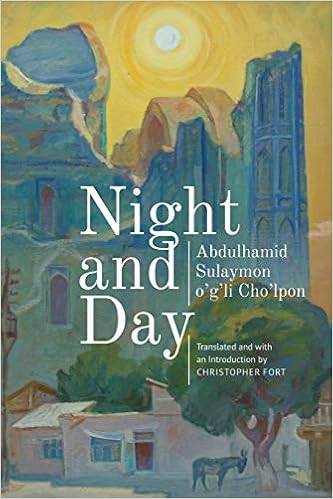
Night and Day by Abdulhamid Sulaymon o’g’li Cho’lpon, translated from Uzbek by Christopher Fort. This novel comes to us from the 1930s and is set at an earlier time, in Turkestan under Russian Imperial rule. “Despite increasing censorship and previous arrests by Soviet authorities, Cholpon subtly employs a variety of techniques including satire and farce to undermine the legitimacy of the Soviet government that was being established around him. Bitterly portraying the hypocrisy and collusion of jadid reformists, Muslim clerics and local Russian officials, this unfinished novel, which was halted by the author’s execution in 1938, remains as one of the darkest comments on Soviet Central Asian history in the Uzbek language,” wrote Shawn T. Lyon about this novel. An illuminating interview with the translator aired on a podcast New Books Network.
Pub Date: November 26, 2019
Publisher: Academic Studies Press

Translated from Uzbek by Shelley Fairweather-Vega, Hamid Ismailov’s GAIA, Queen of Ants is set in England in the milieu of Central Asian immigrants. ” The pivotal relationship in the novel is that between septuagenarian Uzbek émigré Gaia and Domrul, her young Turkish carer. Readers may recognize hints of Harold and Maude,” writes Joshua Bird in a review of this novel. “Contact with Gaia brings up [for Domrul] conflicting feelings of lust, shame and longing, and through their complex relationship, Gaia draws the young man into her dark world of infidelity, sexuality and secrets.”
Pub date: February 11, 2020
Publisher: Syracuse University Press

Good Citizens Need Not Fear is the first book by Maria Reva, who was born in Ukraine and grew up in Canada, and has published a number of the stories from this linked collection in the most prestigious journals of the English-language world, including Electric Literature, Granta, McSweeney’s, The Atlantic, and others. “Set in the Ukrainian town of Kirovka in the 1980s and starring a set of characters who live in the same block of flats, Maria Reva’s enthralling debut of interlinked short stories achieves the double effect of timelessness and timeliness,” Kapka Kassabova writes in The Guardian.
In addition to her fiction writing, Reva translates from French and writes opera libertti!
Pub date: March 10, 2020
Publisher: Doubleday Books

Nino Haratishvili’s The Eighth Life, translated from German by Ruth Martin and Charlotte Collins has been probably the best publicized book on my list. It is currently listed as #11 in “Russian Literature” on Amazon — woo hoo! This book opens in contemporary Berlin, but the family saga begins in Georgia, at the turn of the 20th Century, and follows the central characters to St. Petersburg during the Russian Revolution, and then on through time and geographical locations. “The Eighth Life is narrated by Niza Jashi, a Georgian expatriate living in Berlin, as she writes a history of her family for Brilka, her niece. The novel explores the ways that various characters are fated not only by the political tumult and government brutality of 20th-century Georgia but also by the legacy of a family curse,” explains Lori Feathers in an interview with Haratishvili on Lit Hub.
Pub Date: April 14, 2020
Publisher: Scribe US

Three Apples Fell From the Sky by Narine Abgaryan comes to English in translation by Lisa C. Hayden. Abgaryan was born in a small town in Soviet Armenia, and later moved to the capital of Armenia, Yerevan, and from there, to Moscow. Abgaryan fictionalizes her hometown in her work with tenderness and care, showing us a range of fascinating characters and a lifestyle that seems as though of a different century. This is Abgaryan’s seventh novel, and the first to be translated to English. Due to the pandemic, the pub date for this novel has been delayed to late August, but I encourage all of our readers to pre-order this book (it is already available for pre-order).
While we wait, read Katherine E. Young’s translation of an excerpt from Abgaryan’s earlier novel, People Who Are Always With Me, in Two Lines 31.
Pub Date: August 4, 2020
Publisher: ONEWorld Publications
Don’t forget to order from your favorite local bookshop, they need our help! Bookshop.org is a good second choice.
Help Independent Bookstores Survive Quarantine
In the approximately month and a half that California has been on lockdown, I have barely read anything. This seems counter-intuitive, since I basically read for a living. It also feels like a particularly vulnerable admission, given how much of my personal identity is tied to being a serious reader of “high” literature; not reading feels like failing somehow. But all I’ve managed in the last few weeks is Pushkin’s very short “Пир во время чумы” (“A Feast in Time of Plague”) because it was mentioned on Twitter, a few pages of Proust’s Swann’s Way (thanks to a Twitter reading challenge), and skimming the Chekhov stories I’m teaching this quarter (which I’ve read many times before because I would never skim for teaching. Just to be clear.). My concentration, which was bad even before the pandemic, is abysmal. Zoom has taken over my life. I spend too much time on Twitter, where I envy all the people capable of reading right now.
But I’ve been writing. And every Tuesday and Thursday, my students and I bridge the divide of our Zoom screens by discussing Chekhov’s works. And my Twitter conversations are about literature, which means they’re about a lot of different things. I may not be actively reading at the moment, but books are, like always, very much a part of my life. They’re like that close friend who you might not be in touch with for a long time, but who, unfailingly and warmly, will be there when you finally reach out.
Independent bookstores are having a really hard time. They were having a really hard time before the pandemic, but now they are only able to exist online in a climate of drastically reduced general spending, as so many people have lost their jobs (while we’re at it: if you can, please support your local foodbanks, restaurants, healthcare workers, the post office, etc., etc.). Due to a surge in support, Powell’s hired back some of their employees, while City Lights’ GoFundMe campaign saved them from closing permanently. We’re thrilled for them and want all independent bookstores to have this kind of success.
Below are some of the bookstores we love and would love to help. If you are in the fortunate position to be able to, please order from them and/or support their fundraising efforts. Chekhov – both the writer and the humanitarian, who provided free medical treatment, built schools, donated to libraries, helped with famine relief and a cholera epidemic, and went all the way to Sakhalin Island to write about conditions in a penal colony that led to some reforms – would, I’m sure, appreciate it very much.
Alley Cat Books, San Francisco, CA: This bookstore holds a special place in Punctured Lines’ heart. Olga co-hosts the weekly San Francisco’s Writing Workshop there. The workshop is free and open to the public and is the longest continually running workshop in San Francisco–and, having started in 1946, maybe anywhere. (They are meeting on Zoom at the moment.) Last year, Alley Cat graciously hosted our first Punctured Lines reading. They have a GoFundMe campaign and a Patreon page.
Book Soup, West Hollywood, CA: Many of my family members and friends, and occasionally myself, have received gifts from this local-to-me institution.
City Lights, San Francisco, CA: An iconic beat-era bookstore and a related indie press that published Allen Ginsberg’s “Howl.” This bookstore is a tourist destination, and it’s also a destination for locals. They boast a dedicated poetry room and an amazing collection of books in translation. Their GoFundMe campaign is still running.
McNally Jackson, NYC. The fact that they’re in New York, one of the worst-hit areas of the pandemic, is reason enough. We can fight over whether New York is still the center of U.S. publishing or whether CA is making them very nervous later. We love you, New York. Please get well soon.
Powell’s Books, Portland, OR: If I’m ever in Portland again, I’m going here because I want to see this giant of a bookstore for myself. Until then, I will do what I’ve been doing for years: redeeming gift certificates from family members who know me well.
Skylight Books: Los Angeles, CA: My first-ever reading was here, organized for our class by my amazing creative writing instructor.
The Last Bookstore, Los Angeles, CA: I’ve only browsed here, but it’s pretty amazing.
Vroman’s, Pasadena, CA: I honestly can’t remember if I’ve ever been here, an oversight that needs to be rectified when it’s safe.
If you can’t decide, here’s a way to support Bay Area bookstores collectively.
If you want to help laid-off employees directly, you can give here.
Do you have a favorite indie bookstore not on this list? Let us know and we’ll help spread the word.
 Punctured Lines