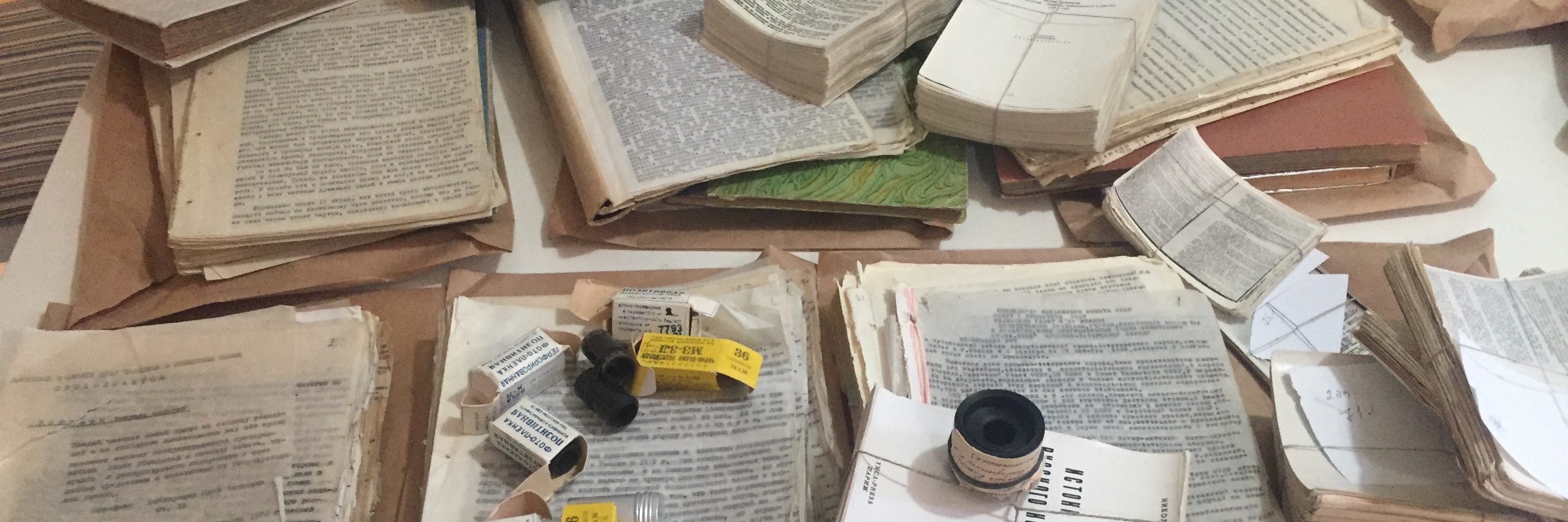
Today we welcome Masha Rumer and Lea Zeltserman back to Punctured Lines. They have both done Q&As with us previously (here and here), and each has participated in one of two different readings we organized by FSU immigrant writers (the recordings are here and here). We are extremely grateful to them for generating both the thought-provoking questions and answers in this exchange. This piece was a long time in the making, as all of us dealt, in various combinations, with the pandemic, the war, cross-country moves, and personal upheavals. We are thrilled to feature their wide-ranging and poignant conversation about immigration, writing, food, and more.
Continue reading “The Soviet-Jewish Experience in North America: A Conversation Between Masha Rumer and Lea Zeltserman”Tag: Beacon Press
Born in the USSR, Raised in California: Immigrant Writers Read From Their Work
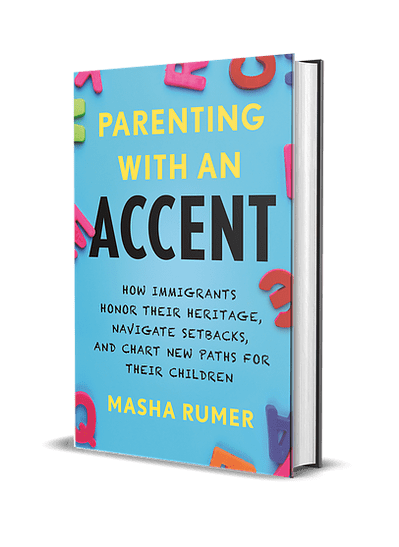
Dear Punctured Lines readers — come meet us on Zoom, and help us celebrate the publication of Masha Rumer’s book! (In San Francisco? Come meet us in person, details below.) We’re so happy to welcome Masha’s newly published Parenting With an Accent: How Immigrants Honor Their Heritage, Navigate Setbacks, and Chart New Paths for Their Children (Beacon Press). Punctured Lines published a Q&A with Masha when this book was still in the proposal stage, and we’ve been following Masha’s Twitter posts about its development with great interest and anticipation. Now that this book is out and available for all to read we are ready to party (and encourage all of our readers to buy it)!
Q&A with Masha Rumer: Parenting with an Accent (forthcoming from Beacon Press)
Today on Punctured Lines, we have a Q&A with Masha Rumer, author of Parenting with an Accent: An Immigrant’s Guide to Multicultural Parenting, whose arrival we previously announced here and are very excited about. Masha answered our questions by email.
Punctured Lines: Describe, briefly, your process in writing this book.
Masha Rumer: My decision to write the book was pretty simple: I wished there was something like that when I became a parent, and since there wasn’t, I figured I’d write it. I was born in Russia and my partner was born in the U.S., so in addition to navigating differences common to a multicultural relationship, having a baby brought up questions, nostalgia and my awareness of straddling multiple cultural identities. How do I teach my kids Russian, without forcing it? How do I connect with other parents, even if I lack certain shared childhood experiences? Is a peanut butter sandwich an acceptable meal? How much borscht is too much? The more I spoke to others, parents or not, the more I realized that these concerns are very much shared, but people don’t always feel comfortable discussing it.
Surprisingly, I found no nonfiction book about the contemporary immigrant parenting experience, even though there is a record high of 43 million immigrants in America today and over 18 million kids with at least one foreign-born parent.
I realized there needs to be a research-driven, accessible look at what it’s like for immigrants to raise kids in the U.S., not a “how-to” parenting manual, but a realistic portrait of sorts. The book will have a bit of everything: candid conversations with families across the U.S., personal narrative and interviews with experts in psychology, language development and sociology. And beets. Lots of beets.
PL: What is your relationship with contemporary Russian literature? Who are some of the writers that inspire you?
MR: I really wish I’d read more contemporary Russian literature, but a significant chunk of my reading is in English (unless we’re talking news or kid lit – I try to read Russian books with my children daily). That said, I’ve recently been enjoying the work of Dina Rubina and of the investigative journalist Svetlana Alexievich, and have been getting into translation more (just finished a delightful Russian translation of A Man Called Ove [PL: This Swedish title by Fredrik Backman has also been translated into English]).
PL: Do you find yourself working against some Russian cultural stereotypes?
MR: Sometimes I find myself dodging jokes about being a spy, especially in the wake of the 2016 presidential election (I’m not a spy). I’ve also been questioned whether I came to the U.S. “on my own” and “with papers” or if my husband ordered me via a catalog. The people who ask are demure and almost apologetic, but they want to know. Recently, though, a job recruiter was pretty explicit about questioning my immigration status and any political connections. And something many female-identifying Russian speakers have probably experienced – there’s often an assumption that our closets have this secret compartment where we stash sable fur coats and leather outfits from a James Bond movie.
PL: As a writer who addresses stories of immigrant families, do you find yourself connecting with other diaspora writers?
MR: I definitely find myself connecting with other diaspora writers. It’s probably due to the shared immigrant experiences of reinventing and translating yourself and the trauma of having been uprooted. I love the work of Lara Vapnyar and Dinaw Mengestu; they both write so incisively and honestly about diaspora realities. Eva Hoffman and Jhumpa Lahiri were among the first contemporary immigrant authors I read, and it felt so validating. Then there’s the work of Edwidge Danticat, Anya Ulinich and Natalia Sylvester, particularly her recent essay on being bilingual, and the Foreignish blog, run by Yaldaz Sadakova. I’m also excited to read the new collection Like Water by Olga Zilberbourg. It’s thrilling to see that the contemporary immigrant narratives are no longer othered as “niche,” but are becoming a part of the “mainstream” literary canon.
Forthcoming Book Announcement: Masha Rumer, Parenting with an Accent: An Immigrant’s Guide to Multicultural Parenting
From Masha Rumer comes the following announcement:
“Very excited to share that my nonfiction book, Parenting with an Accent, will be published by Beacon Press and distributed by Penguin Random House. There’s no better time for this book, which will explore the everyday stories and challenges of immigrant families as they raise kids in their adopted American home. (And yes, there will be beets.)”
Agent Katelyn Hales, Robin Straus Agency
We’re very excited too. Having read Masha’s work before, we know this will be an insightful and engagingly written book. If you haven’t read her yet, you can do so here:
What Do You Do When Your Beloved Childhood Books Scare the Crap Out of Your Kids?
 Punctured Lines