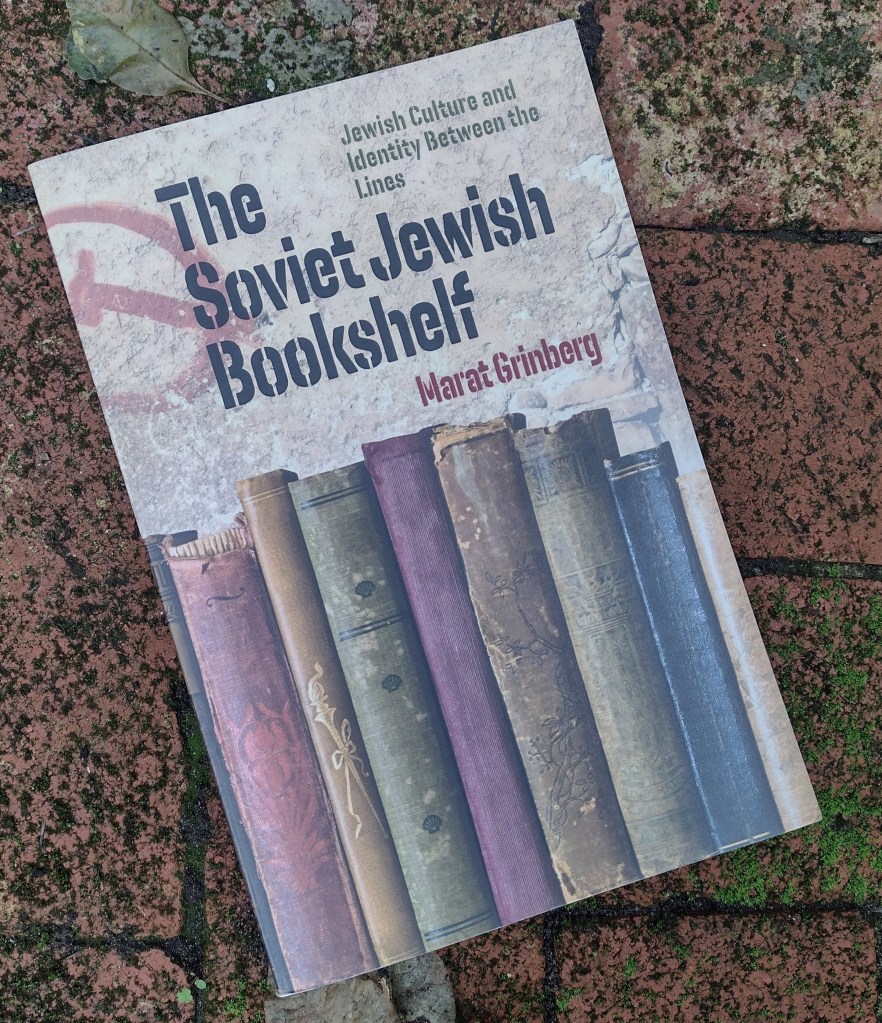
Responding to Marat Grinberg’s The Soviet Jewish Bookshelf

Marat Grinberg’s academic volume The Soviet Jewish Bookshelf (The Tauber Institute Series for the Study of European Jewry, Brandeis UP, 2022) is an important book for the authors of this blog for personal and professional reasons as it reflects on a large body of work that we grew up with and have returned to in professional contexts. In its contributions toward re-defining Soviet Jewish identity in positive terms–as thick and multidirectional–it allows us to reshape our personal narratives and forge a path toward future research and creative projects.

Today we’re highlighting our responses to this book and encourage our readers to continue this conversation.

Continue reading “Responding to Marat Grinberg’s The Soviet Jewish Bookshelf”

2025 Books by Post-Soviet Authors

2025 is going to be a big year for books written by immigrant authors hailing from the Soviet Union who now call North America home. Since 2021, I’ve kept a running list of books coming out from our community as a way to keep tabs and, frankly, because no one else was doing it. Last year, when my own debut novel came out, there were only 7 books out from our community, a couple of them paperback editions of 2023 novels. This year, however, we have twelve new titles, plus three books–including my own–being released in paperback. A recent record! I imagine the war in Ukraine might have had something to do with this increased output as several of the authors below engage with the war and the resulting refugee crisis. As the war drags on and the public’s attention on it wanes, this feels like an especially critical time for our voices to be heard. This is why I’m glad to see that our books are finding publishers and readers, and I hope that the incredible variety of books on this list is encouraging to other writers in our community. From poetry to dystopian novels to short story collections, nonfiction, and a cookbook memoir, check out the list of FSU books and please support these authors by pre-ordering.

Continue reading “2025 Books by Post-Soviet Authors”

I Think that Everything I Do Is a Form of Translation: A Conversation with Michele A. Berdy

We at Punctured Lines are thrilled to feature a conversation with Michele A. Berdy, longtime editor and columnist for The Moscow Times, now living in Riga, Latvia. Given both the political and personal upheavals of the last few years, this interview was long in the making. We are so glad to now publish this wide-ranging discussion about, among other things, cataclysmic changes, Soviet life hacks, art and culture, and of course, the war in Ukraine; there are many organizations you can support, including this one. This interview was conducted over email.

Yelena Furman: Let’s start with your intriguing reverse immigration story: you left the U.S. in 1978 to live in what was then the Soviet Union (the same year, as it happens, that my family left Soviet Ukraine for the U.S.). What inspired you to make that move, several years before the country began opening up under Gorbachev?

Continue reading “I Think that Everything I Do Is a Form of Translation: A Conversation with Michele A. Berdy”

A Character with a Secret Is an Easy Sell: A Conversation with Sasha Vasilyuk, by Olga Zilberbourg

A new novel set in World War II enters a crowded and hotly contested field. It is a particularly remarkable feat for a debut novelist that Sasha Vasilyuk’s Your Presence Is Mandatory (Bloomsbury, 2024) earned universal praise from celebrated writers across the former USSR diaspora community and far beyond. Gary Shteyngart wrote, “Wonderfully written, elegiac and necessary, Sasha Vasilyuk uncovers the history behind the recent headlines with great skill and grace.” Susanne Pari, author of In the Time of Our History and The Fortune Catcher, wrote, “An outstanding novel of sacrifice, love, and forgiveness.”

We celebrate this novel’s arrival with particular pleasure. A contributor to Punctured Lines, Vasilyuk participated in a number of events we’ve hosted over the years, and we’ve heard excerpts from this novel as she was working on one draft after another. In May 2024, Olga Zilberbourg interviewed Vasilyuk during a book release event at Telegraph Hill Books in San Francisco. The following Q&A is a follow-up to that in-person conversation. 

Continue reading “A Character with a Secret Is an Easy Sell: A Conversation with Sasha Vasilyuk, by Olga Zilberbourg”

Queer Encounters in the USSR and Russia, A Conversation with Sonja Franeta

Born in New York to Yugoslav parents, Sonja Franeta is a writer, educator, translator, and activist. In 1991, she was a delegate to the first Russian Lesbian and Gay Symposium, organized by International Gay and Lesbian Human Rights Commission (IGLHRC), and she helped facilitate LGBTQ film festivals in Russia.

From 1992 until 1996, Franeta collected video interviews with Russian gay, lesbian, and transgender people. Before Russia repealed its sodomy laws in 1993, some of the people she interviewed had served criminal sentences for homosexuality, while others experienced forced psychiatric treatment. In 2004, Franeta published the edited transcripts of these interviews in Russia, and later translated them to English in a book called Pink Flamingos: 10 Siberian Interviews (Dacha Books, 2017). These in-depth conversations allow us to learn her subjects’ life stories, as well as to understand the way they evaluated their experiences and conceptualized questions of identity and belonging.

In her second book, My Pink Road to Russia: Tales of Amazons, Peasants and Queers (Dacha Books, 2015), Franeta collected her essays on a wide range of topics. They include her childhood in the Bronx with a Croat mother and Serb father, her coming out story, her experiences as a female machinist and labor activist, and studying Russian literature, becoming a writer, and extensive travels across the former Soviet Union and the deep friendships she has formed there. Franeta’s writing is often very personal, exceptionally frank, and deeply insightful. Coming from a working-class background, she studied at NYU and UC Berkeley before rejecting the traditional academic path. In the 1990s, she taught English in Moscow and spent several years in Novosibirsk, working on a project for people with disabilities. 

Continue reading “Queer Encounters in the USSR and Russia, A Conversation with Sonja Franeta”

My Mother’s Teeth by Anna Fridlis

My Mother’s Teeth

were prone to cavities from childhood.

In my mind’s eye, I see her gaps-for-teeth, hand cupping mouth, handkerchief clasped to lips after an extraction — that euphemism that stinks of silent Soviet disappearances, people pulled from dark rooms at night, never returning.

Once healed, the gaps were filled variously with dental implants and partial dentures: my mother’s mouth is not quite her own.

The extracted people were never returned, which my mother made it her duty to remember. If she is passionate about anything, it is decrying Stalinism and its travesties. For years, her stories transfixed me, but by my teens they stoked a growing rage. There was not much more to her mothering than the passing down of Soviet horrors. I was starving for something which she couldn’t give. 

My mother drilled her coming-of-age, late-1970s, music-conservatory-student revelations about the Soviet dystopia — learned at the knee of a rather radical anti-communist professor — into my brain, into the new millennium, into a new hemisphere. 

My mother’s mouth is filled with ghosts.

My own cavities began before elementary school. Baba took me to the dentist, an old friend of hers, Eleanora Aleksanna, whose son had long before been Baba’s elementary school student. We entered a large open hall full of dental chairs and short-haired women in white lab coats and face masks leaning over screaming children.

I was praised for being so good and so brave and for my beautiful braid only to bite Eleanora Aleksanna’s finger to bleeding moments later.

We returned to her several times, without incident, before our own great extraction from Russia found us in the United States.

American dentists peered into my mouth, as into my mother’s, in awe, studying its contents as though it were an archeological site revealing pre-modern dental composites.

I was taking after my mother.

***

In 2019, a year after my mother and I became estranged, I had to have an incisor pulled. It had gotten infected and pain had grown beyond the treatment of all available drugs.
  

The procedure took hours. The dentist coaxed out my tooth little by little from my numbed gum. My partner held my hand, then drove me home to mashed potatoes and tea.

I smiled big for my phone, beaming almost to a scowl into the camera. It was tooth number 4 that they took — I had been so worried about how the gap would look — but it was barely visible on my American smile. I sent pictures to everyone but my mother. 

The gap left by my mother is surreal. It throbs and whirls to Tchaikovsky, it weeps to Chopin; it weeps so much more than it dances. I shut my mouth on the commotion.

The gap left by my mother is older than our estrangement.

It is a socket dressed in layers of scarlet and mauve scar tissue, pulsing and aching from time to time but calming, calming as the years tick by. 

I exorcise the ghosts from my mouth, my mother’s legacy, through the power of my breath, the vibration of my voice, the speaking of myself into being. I was never supposed to do these things: she raised me to carry on her burdens, to be an organ of her body, a part of her, not out of malice but limitation. A limitation I am still trying to parse. 

Sometimes I Google potential diagnoses to explain my mother’s absence — the way she seemed never really there even when she stood in front of me, the way she needed me to lead, even as a child, to parent her. When I find myself doing this futile exercise, I have learned it means I’m hurting, struggling, and it’s time to take care of me. 

In broad strokes, I know the problem: a combination of Soviet political oppression, anti-Semitism, patriarchy, family dysfunction, and a prolonged separation from Baba in Mama’s toddlerhood. When you put it all together, it’s called complex trauma. I know a lot about it because it was passed to me. Unconsciously, unintentionally, brutally, ceaselessly.
  

My teeth, my mother’s teeth: tombstones to the bones of Soviet ghosts who couldn’t find a way to scream but through our mouths. 
Anna Fridlis is a memoirist, poet, and essayist based in Newark, NJ on indigenous Lenape land. She lives and writes at the intersection of multiple identities: Jewish, Soviet immigrant, white, disabled, neurodivergent, and queer. Her work addresses the impact of intergenerational trauma on the trajectory of a life, tracking trauma’s creeping effects on mental and physical health, family relationships, creative output, and the scope of the imagination. Anna’s work captures one version of a Soviet Jewish immigrant story that both faces its utter devastation and searches for answers and deep healing in self-expression, nature, and somatics. Anna teaches first-year writing at Parsons the New School for Design and cohabits with her bunny Willow, who also happens to be her muse.

Vinegret, a Recipe for Disaster by Jane Muschenetz

I want to tell you something small, in the great turning of this world, intimate as your grandmother’s soup. When you boil beets, carrots, and potatoes together, the potatoes will soften first, even if they are bigger than the other vegetables.

It is summer 2020, and my hands are Shakespearian (“out, damned spot!”)—beet stained. Our mid-century dining table is a stage set for “Salat Vinegret,” the Soviet-era culinary staple featuring ingredients that are readily available and inexpensive, even in wintertime. The supporting cast of bowls, knives, etc., isn’t from the old country, but is well practiced in recipes that travel back to my early childhood in L’viv, Ukraine.

Continue reading “Vinegret, a Recipe for Disaster by Jane Muschenetz”

Punctured Lines Authors at San Francisco’s Lit Crawl

San Francisco Bay Area readers, take note: for the second year in a row, Punctured Lines is producing an event during San Francisco’s Lit Crawl.

On Saturday, October 21, 5 pm at 518 Valencia, a group of Bay Area authors will come together with poetry, stories and essays centered on Ukraine. Several of these authors have been regulars on our blog, and we’re delighted to introduce a few new names to our line up from last year.

Continue reading “Punctured Lines Authors at San Francisco’s Lit Crawl”

Ugrinovich and the Sex Giant: Fiction by Anna Natalia Malachowskaja, translated by Anastasia Savenko-Moore

Anna Natalia Malachowskaja is a well-known Soviet and Russian author, feminist, and dissident. In 1979, together with Tatiana Goricheva, Tatiana Mamonova, and Julia Voznesenskaya, she wrote and edited a feminist samizdat publication Женщина и Россия [Woman and Russia] and later Maria. These publications were deemed anti-Soviet; the women were questioned by the KGB and forced to emigrate. Having settled in Austria, Malachowskaja completed her Ph.D. at the University of Salzburg. She turned her research into the Russian folklore character of Baba Yaga into a series of published books where she argues that the fairy tale character is a marginalization and amalgamation of three goddesses of the ancient world. In addition to her scholarship, Malachowskaja is the author of novels, collections of stories, and poems. Malachowskaja’s fiction is frequently accompanied by art. As an artist, she has exhibited her work in St. Petersburg, Vienna, and Salzburg.

Continue reading “Ugrinovich and the Sex Giant: Fiction by Anna Natalia Malachowskaja, translated by Anastasia Savenko-Moore”