A Fantastical Traffic Jam by Akram Aylisli (Excerpt) Translated from the Russian by Katherine E. Young

From National Translators Month Page:

“We’re thrilled to share with you today an excerpt from the novella A Fantastical Traffic Jam by Azerbaijani political prisoner Akram Aylisli, translated from the Russian by the award-winning poet and translator Katherine E. Young. In her own words, “Many knowledgeable observers, including Aylisli himself, believe it was this novella that provoked the wrath of Azerbaijan’s current rulers and led to Aylisli’s persecution. He currently lives under de facto house arrest; his books have been burned, his wife and son were fired from their jobs, and at one time a bounty was offered to whomever would cut off his ear.” At NTM, we take pride in publishing brave works that speak truth to power, and this excerpt accomplishes exactly that.”

Excerpt on National Translators Month page.

Kritika’s Feminist Issue

Kritika is “a leading journal of Russian and Eurasian history and culture, Kritika is dedicated to internationalizing the field and making it relevant to a broad interdisciplinary audience,” and this particular issue features many voices of women who have contributed to Russian feminist criticism.

Of particular interest are personal essays by Natalia Pushkareva, Barbara Engel, Eve Levin, David L. Ransel, and Christine D. Worobec.

From the introduction to this section of the issue:

Russian women’s history—and we use the qualifier “Russian” advisedly, as focused analysis of the intersection of gender with imperial contexts and identities mainly began in the 1990s—formed in dialogue with these broader developments, drawing many of its inspirations and models from non-Russian fields.5 At the same time, it also evolved within the particular context of the Cold War—which had both practical ramifications, such as limited access to archival sources, and more complex political and ideological ones. In the Soviet Union, the “woman question” had long been relegated to a secondary status before class and social structure, which helped marginalize the history of women institutionally and as a topic of study. Early contributions to the field in the United States, such as Richard Stites’s important monograph on what he called “the women’s liberation movement,” tended to focus on activists and elites; the sources were more readily available, as was an abiding interest in radical politics, if told here with an original focus on women that included the powerful movement of so-called “bourgeois” feminism.6 Although Cold War politics and ideological differences helped shape distinctive academic cultures between east and west, scholarly exchange and travel also began to break down some of these barriers during the 1970s, a process that accelerated in the 1980s and after.

This academic publication is accessible here through Project Muse and your nearest academic (and some public) library subscription.
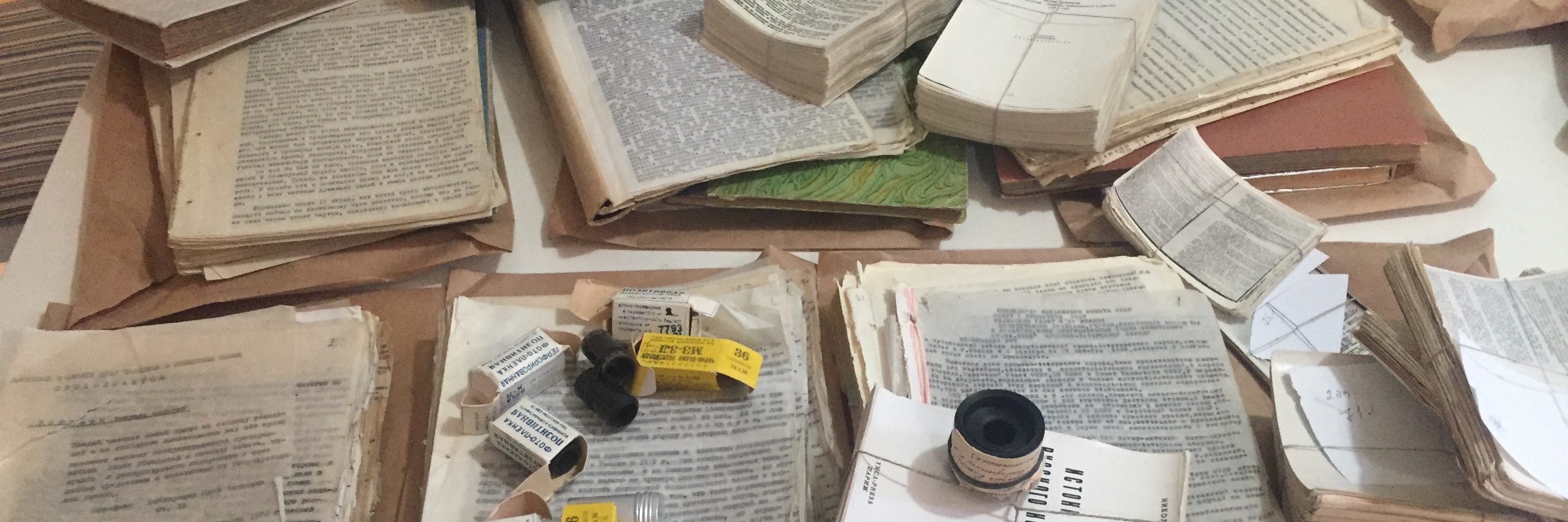
New Book Alert: Elena Fanailova’s The Russian Version (2nd Edition)

Author: Elena Fanailova

Translators: Genya Turovskaya and Stephanie Sandler

Publisher: Ugly Duckling Presse

Website: https://uglyducklingpresse.org/publications/the-russian-version-2nd-edition/

Small Press Distribution announcement: ” Poetry. Translated from the Russian by Genya Turovskaya and Stephanie Sandler. THE RUSSIAN VERSION is a collection of poems that spans Russia’s post-Soviet era. Acclaimed journalist and poet, Elena Fanailova tells stories about the various social layers of a stratified and conflicted nation, reclaiming the poet’s role as social critic, while scrutinizing her own position as citizen and poet. Fanailova’s political lyricism casts personal pain into the net of historical suffering.”

Published in 2009 by Ugly Duckling Presse, it received Best Translated Book Award for Poetry from Three Percent. The 2019 second edition of THE RUSSIAN VERSION includes a more recent long poem, ‘Lena and Lena.’

I Want a Baby and Other Plays

I’m delighted to hear that Glagoslav published a volume of Sergei Tretiakov’s plays, including “I Want a Baby!” in translation by Robert Leach and Stephen Holland.

Tretiakov was one of the most innovative and exciting playwrights and thinkers of the Soviet Union in the 1920s. I doubt that we would describe his work as feminist or even proto-feminist today, but he definitely had fascinating ideas about rethinking gender roles.

Back in grad school, I wrote a paper on this one. Here’s a description of the central character from this play: Milda Grignau, a woman at the center of Tretiakov’s text, is very successful in the public sphere: she is a specialist in agronomy, a respected member of the Communist Party, and a social organizer. She does not have a family and does not want one; what she does want is to have a child. The main conflict of the play revolves around Milda’s desire to give birth without getting married. She requires a man’s help in order to conceive, but protests against the tradition requiring women to be married before giving birth. “Having a husband isn’t important. What’s important is who produces the baby,” Milda Grignau proclaims at a community meeting called to discuss her abnormal sexual practices.

Order this book here: http://www.glagoslav.com/en/Book/1/208/I-Want-a-Baby-and-Other-Plays.html

“What’s the difference between a word and a sigh?” #marcchagall

Marc Chagall’s book is, in part, a fascinating portrait of the life in the stetl.

kaggsysbookishramblings's avatarKaggsy's Bookish Ramblings

My Life by Marc Chagall
Translated by Dorothy Williams

When I was rushing through St. Pancras station in the summer, en route to the Midlands and a visit to the Aged Parent and the Offspring, I made time to pop into their little branch of Hatchards. It’s a small but perfectly formed shop which always has interestingly-themed tables, and I rarely come out empty-handed. This occasion was no different, and I was tempted specifically by this lovely Penguin Modern Classics version of Marc Chagall’s “My Life”. It called to me particularly as I was heavily absorbed in Victor Serge’s Notebooks; and Chagall’s book deals also with exile from Russia. So of course I picked up a copy… To be honest, though, you couldn’t really get two more dissimilar books than the Notebooks and this one. In size, writing style and subject Chagall and Serge are complete opposites; though both…

View original post 458 more words

Decolonising and demystifying Central Asian literature through translation

Writing from Central Asia is virtually unknown to English readers. Shelley Fairweather-Vega, who translates Uzbek and Kazakh literature, is trying to change that: “I’d love to move readers away from thinking, ‘how unusual!’ to thinking ‘how beautiful!’” Read her interview here:https://globalvoices.org/2019/09/02/decolonising-and-demystifying-central-asian-literature-through-translation/

Lessons From Nabokov: Finding Freedom in a Foreign Language: Rajia Hassib on Mastering a Third Language

A Russian immigrant helped an Egyptian immigrant start writing in English. Then she found her own voice:

“To Nabokov, who probably would neither have approved of nor cared about my writing, I say this: thank you for opening this door through which I now walk.

Now, I make my own path.”

Profile of Lisa Hayden

One of our star translators from Russian got a lovely write-up in the Portland Press Herald. Personally, I first came to know Lisa through her amazing blog, dedicated to Russian literature, Lizok’s Bookshelf. It’s somehow wonderful to learn that Lisa grew up in a town called Norway, Maine. That’s such a big name for a town, and I’ve always wondered what it’s like to grow up in these places that are named after other places. (I say this, having spent considerable amount of time in my childhood thinking about Lenin’s relationship with Leningrad.)

Hayden grew up mostly in Norway, in Oxford County, where her family moved from New Hampshire when she was about 9. She first became interested in Russia and Russian history as a child because of stories published in Jack and Jill magazine based on the Russian fairy tale Baba Yaga. Baba Yaga is a Slavic folklore tale about a “grandmother witch” who lives deep in the forest and is not very good, but is not entirely evil.


When she was in the sixth grade, Hayden read her first English translation of Russian literature, a short story called “The Bet” by Anton Chekhov.

To learn more about Lisa Hayden, read the story here.