Yelena Furman on Alisa Ganieva’s “Bride and Groom”

“ALISA GANIEVA’S APPEARANCE in the world of Russian literature took everyone by surprise, in the literal sense. A critic by training, she published her first work of fiction, the novella Salam, Dalgat! (Salam tebe, Dalgat!), when she was 25, under a male pseudonym; when the novella received the Debut Prize in 2009, Ganieva outed herself as a woman at the awards ceremony.”

https://lareviewofbooks.org/article/a-voice-from-the-caucasus-on-alisa-ganievas-bride-and-groom/


Yelena Furman on Sofia Khvoshchinskaya’s “City Folk and Country Folk”

“IN HER INFORMATIVE introduction to Sofia Khvoshchinskaya’s City Folk and Country Folk, Hilde Hoogenboom writes, ‘In the 1860s […] Russia had its own trio of writing sisters. Like the Brontës, the Khvoshchinskaya sisters wrote under male pseudonyms, endured hardships, and lived in the provinces.’ The analogy is fitting, but, as Hoogenboom notes, only to a point: ‘The Brontë sisters became well known not long after their deaths, [but t]he story of the Khvoshchinskaya sisters remains to be told.'”  https://lareviewofbooks.org/article/dont-we-know-our-own-minds-a-rediscovered-russian-woman-writer-of-the-19th-century/

Yelena Furman on Elena Chizhova’s “The Time of Women”

THE TIME OF WOMEN is Simon Patterson and Nina Chordas’s translation of Elena Chizhova’s 2009 Russian Booker-winning novel Vremia zhenshchin. (Modeled on the Booker Prize in Britain, the Russian Booker is given to the best Russian-language text; Chizhova had been nominated for the award twice before). Set in Chizhova’s native St. Petersburg, mostly in the 1960s, when the city was known as Leningrad, this most beautiful, yet most maddening city emerges as a central focus of the narrative, as it often has in Russian literature, from Gogol to Dostoevsky to Andrey Bely.” https://lareviewofbooks.org/article/soviet-scars-yelena-furmans-the-time-of-women/

Olga Zilberbourg on Keith Gessen’s “A Terrible Country”

” Novels about Russia written in English for a U.S. audience are numerous enough that they could be grouped into a genre of their own. Keith Gessen’s second novel, “A Terrible Country,” is a solid contribution to this genre, particularly promising because of the author’s deep personal connection to the country and his prior body of work as a journalist, an analyst and a critic of Russia.”

https://www.sfchronicle.com/books/article/A-Terrible-Country-by-Keith-Gessen-13184005.php

How Should We Review Translations? Part I

The beginning of an important, thoughtful, and often maddening conversation by Asymptote journal about the state of translated literature in the U.S. and the role of reviewers writing about it. Shocker: there is relatively little international literature being translated, published, reviewed, and read in this country. There is even less by women/non-Western European writers. A question we have been asking ourselves, each other, and anyone who would listen is what can be done about changing this situation. It is one of the main reasons we started this blog. This is a collective endeavor, which doesn’t have a simple answer. Suggestions welcome.

“For instance, only six of the nearly one hundred books reviewed on my watch were written by African writers. A whole 17% were translated either from Spanish or French. Moreover, only 16% were books of poetry rather than prose […] exactly two thirds of contributors to the Criticism section were men, and […] close to two thirds of the authors reviewed were men.”

https://www.asymptotejournal.com/blog/2019/09/23/how-should-we-review-translations-part-i/?fbclid=IwAR3Qh_3jCPSwCo2iXqO9vSZ2Pb_Wdra4rCt7r5ds4BQvGY0pkrOkRbaul54

Matter | A (somewhat) monthly journal of political poetry and commentary

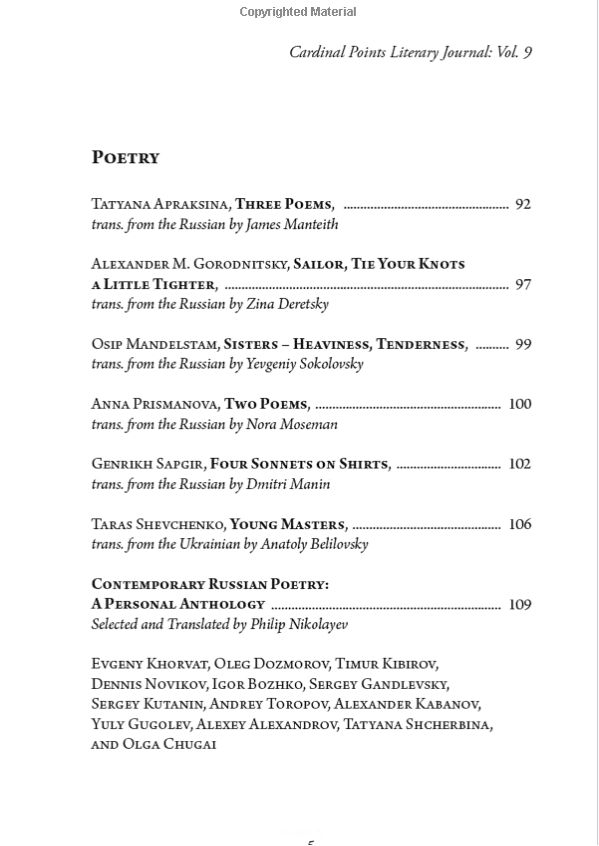
Guest-edited by Larissa Shmailo and Philip Nikolaev, Issue 26 is dedicated to political poetry and prose in translation from Russian and written originally in English by writers with Russian affiliations.

In the spirit of 2019, at least two poets (Anna Halberstadt and Katia Kapovich) write about Stalin: “O motherland. O motherfuckerland,” sighs-screams Kapovich.

Olga Livshin and Polina Barskova (translated by Philip Nikolaev) are in conversation with Akhmatova.

Katherine E. Young translates Inna Kabysh:

O, Moscow, Tatar sack of gold:
obedient and cunning,
boyar’s beard, son-of-a-bitch,
matchmaker, drunk in the morning

More treasures here:

Sinead Morrissey’s Soviet Poems

September 2019 issue of AWP’s The Writer’s Chronicle includes Chapman Hood Frazier’s interview with poet Sinead Morrissey, a highly decorated poet hailing from Northern Ireland. Her collection Parallax (which won the T.S. Eliot Prize) includes a poem titled “Shostakovich” in a group of a few others that directly reference the Soviet Union.

In the interview, Morrissey explains that her parents were members of the Communist Party. “Growing up in a Communist household and having, as a consequence, a rosier view of the Soviet Union and the Communist project than neraly everyone else around me, gave me a particular world-view which came under strain as an adult, when I began to read Russian history and to understand some of the atrocities which had taken place. This is one of the most important instances of parallax in my own life, and one which Parallax as a body of work is also most exercised with. The Soviet poems are kinds of punctuation marks throughout the book, and all of them are different. In the end I think the subject itself is unknowable–what we see is always so determined by where we stand–and it is the fraught act of perception itself which interests me most of all.”

The interview is in the print issue of the magazine and is available online with subscription.
Upcoming Book Announcement: Alex Halberstadt’s Young Heroes of the Soviet Union

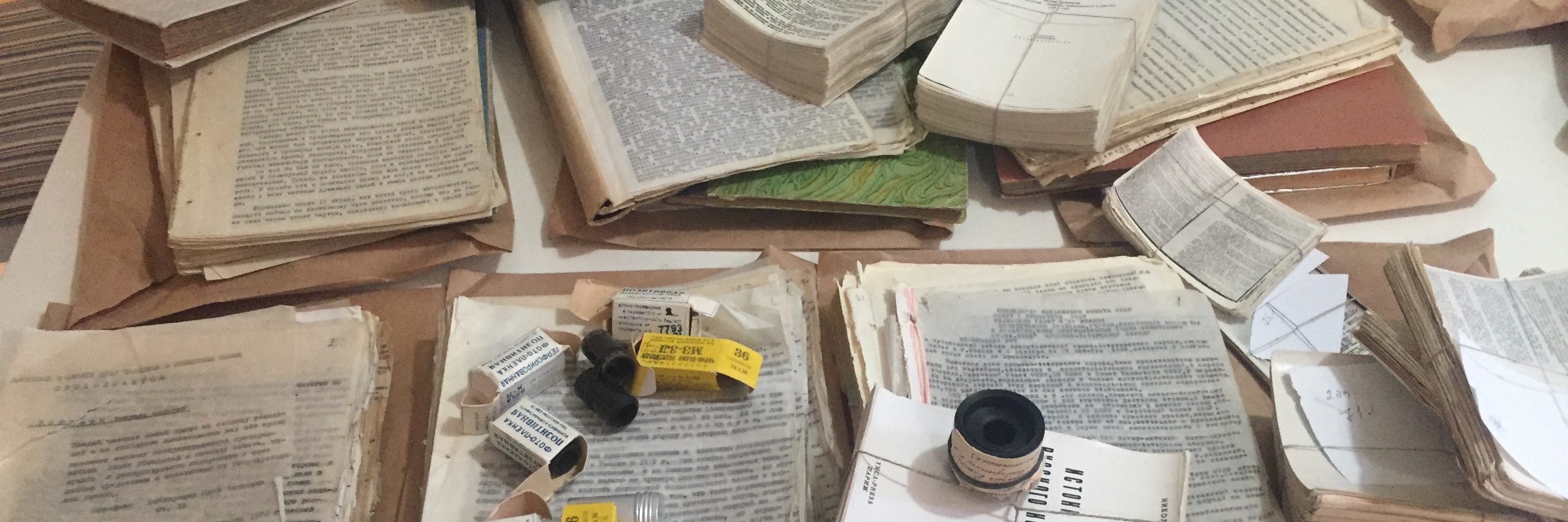
From the publisher: “In Young Heroes of the Soviet Union, Russian-American author and journalist Alex Halberstadt sets out on a quest to name and acknowledge a legacy of familial trauma, and to end a cycle of estrangement that afflicts his family. This journey leads him to track down his grandfather–one of the last living bodyguards of Joseph Stalin–and to examine the ways in which The Great Terror and decades of Soviet totalitarianism indelibly shaped three generations of his family. He goes back to Lithuania, where his Jewish mother’s family was from, to revisit the trauma of the Holocaust and a pernicious legacy of anti-Semitism that has yet to be reckoned with. And he explores his own story, as a fatherless immigrant who arrived in America–to a housing project in Queens–as a twelve-year-old boy and struggled with feelings of rootlessness, identity, and yearning for home.”

Publisher: Random House

Agent: The Wylie Agency

Pub date: March 10, 2020