How Should We Review Translations? Part II

Asymptote journal continues its discussion about translating and reviewing literature. The focus this time is on Korean poetry, but the issues raised are relevant to other translated literatures.

“To me, the most interesting aspect of reviewing a translation—above and beyond the accurate and thoughtful accounting of the book in question that all reviews require—is imagining how it will affect and be affected by its reception within the standards of specific reading communities. Or to put it another way: how the translation speaks to the context of a reading community and how that community speaks to the translation.”

https://www.asymptotejournal.com/blog/2019/09/25/how-should-we-review-translations-part-ii/
A profile of Ilya Kaminsky

The Guardian has published a lovely profile of Ilya Kaminsky, related to Deaf Republic, his second collection of poetry.

Odessa was a cosmopolitan place, a “city of laughter” in which poetry was revered, and from an early age Kaminsky wrote and learned it by heart. When he was 12 his prose writing was published in the local newspaper, after he answered a call-out to schoolchildren to contribute, because the paper had no money to pay journalists. At 15, though he thought of poetry as “a private thing”, he produced his first chapbook. He had graduated from school by the time the family was forced into exile.

Interview with Sophia Shalmiyev

Sophia Shalmiyev’s (Mother Winter) interview with Katie Collins Guinn in Nailed magazine is remarkable for the way it allows Shalmiyev’s voice to come through. There’s a sense of true intimacy between the interviewer and interviewee that allows us to dive deeply into Shalmiyev’s writing, and her relationship with art and family.

A fantastic read, this piece also offers us photographs of Shalmiyev’s art.

I have only wanted for women and girls to pick up the book and find other women to follow and emulate and try on and discover and research and then pass the torch. That was part of the goal. There are codes and messages in a bottle and secret passageways but nothing that’s sacred or hidden in a sadistic way. So much of the cannon is about saying that some piling on of allusions is sophisticated and enlightened and a test of whether you are in the club. I read a bunch of the club. I don’t hate it. Ezra Pound is problematic on so many levels but I did get what I needed from him. He is not my people. And so I wished to do something in the same vein but for my own tribe. Sappho is my mother. She is a legend because a stitching is performed around her words and persona every day. It’s a parallel process for me.

https://nailedmagazine.com/interview/interview-sophia-shalmiyev/

An early reader’s review of Hamid Ismailov’s Of Strangers and Bees in Shelley Fairweather-Vega’s translation

David Chaffetz writes for Asian Review of Books:

“One could characterize the overall effect as Master and Margarita comes to the Uzbek Cultural Center of Queens, NY. The poet’s profusion of words underscores his passion for his experience as a child growing up in the fields of Transoxiana, the insouciance of being a state-sponsored intellectual, the desperation of being a stateless person in rigidly bourgeois Europe.”

Upcoming Book: Cold War Casual

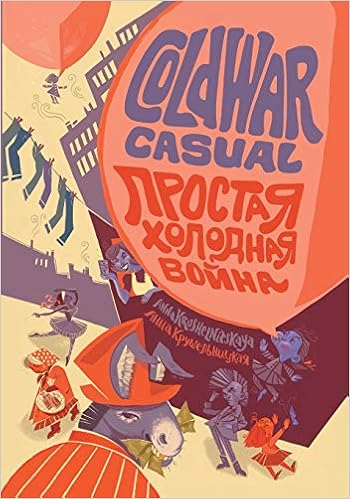
Anna Krushelnitskaya’s book, Cold War Casual/Простая холодная война is a bilingual work that collects oral testimony and interviews about the ways the events of the Cold War and the government propaganda affected people in the US and in the USSR. This seems of tremendous interest to all of us who have lived through that epoch and/or write about it.

Krushelnitskaya has translated the testimony and interviews so that each piece is available in both Russian and English. The announcement reads: “The interviews were conducted in the native languages of the respondents in a casual, friendly format to record the subjective evaluations of the Cold War period in an attempt to establish whether, and how, the lived experiences and memories of the respondents influenced their sense of national pride, instilled a fear of war or the enemy, invited cultural openness or isolation and participated in forming personal long-term ideological stances.”

This books is available for pre-order.

Pub date: October 22, 2019

Publisher: Front Edge Publishing, LLC

Upcoming Book: Lara Vapnyar’s Divide Me by Zero

I’m thrilled to report that Tin House is publishing Lara Vapnyar’s new novel. It’s available on pre-order, and I recommend that you pre-order it now to make sure to reserve your copy!

As a reformed math school student (Leningrad, 239 shkola), I can never get enough of math stories in fiction. The publisher’s description makes this book sound delicious:

As a young girl, Katya Geller learned from her mother that math was the answer to everything. Now, approaching forty, she finds this wisdom tested: she has lost the love of her life, she is in the middle of a divorce, and has just found out that her mother is dying. Half-mad with grief, Katya turns to the unfinished notes for her mother’s last textbook, hoping to find guidance in mathematical concepts.

With humor, intelligence, and unfailing honesty, Katya traces back her life’s journey: her childhood in Soviet Russia, her parents’ great love, the death of her father, her mother’s career as a renowned mathematician, and their immigration to the United States. She is, by turns, an adrift newlywed, an ESL teacher in an office occupied by witches and mediums, a restless wife, an accomplished writer, a flailing mother of two, a grieving daughter, and, all the while, a woman in love haunted by a question: how to parse the wild, unfathomable passion she feels through the cool logic of mathematics?

Olga Zilberbourg: To Understand Russia’s Complexities, Turn to Its Contemporary Literature

“A FRIEND’S TEN-YEAR-OLD SON son recently came up to me at a party to ask, ‘You’re from Russia, right?’ Sensing caution in my assent, the boy hesitated before asking the next question, clearly trying to phrase it in a way that wouldn’t cause offense but would express his curiosity. He finally came up with, ‘It’s a very violent place, isn’t it?'”

http://epiphanyzine.com/features/understand-russias-complexities?fbclid=IwAR35rzgR1U6dFXsYJM6ueL6nid8S9R6BR0Qr44elOeHnU2HwPtyzVpxJ0RY

Olga Zilberbourg on Teffi’s Memories: From Moscow to the Black Sea

“Teffi, nom de plume of Nadezhda Lokhvitskaya, was born in 1872 into a prominent Russian family. Following in the footsteps of her older sister Maria—poet Mirra Lokhvitskaya—Teffi published poetry and prose from the age of 29. She soon rose to fame by practicing a unique brand of self-deprecating humor and topical social satire.”

https://www.thecommononline.org/review-memories-from-moscow-to-the-black-sea/?fbclid=IwAR2VI663kHbmhMarVRRwhcusvCmxG_KFMLKu7MtIRnHLUpUTBZs7dZmQnK8

Olga Zilberbourg on Michael Honig’s The Senility of Vladimir P.

“Nikolai Sheremetev, the protagonist of British novelist’s Michael Honig’s second book, is a Moscow nurse. For six years, he’s been looking after a private patient suffering from dementia. The patient’s condition is deteriorating. Prior to his illness, Vladimir P. had been a president of Russia.”

https://www.thecommononline.org/review-the-senility-of-vladimir-putin/?fbclid=IwAR0wjiXM582L9x-iBEY33OQKvmvJy5LAF4r4gpwErg3SZTeM743IhYvHPI4


Lizok’s Bookshelf: Yasnaya Polyana Finalists, 2019

Previously, we posted Lisa Hayden’s blog post about the longlist for this prize, noting the gender disparity in terms of who is nominated for and, especially, awarded Russia’s literary prizes. The shortlist just came out and out of the six nominees, one is a woman. Of course, no one is suggesting nominations and/or awards should be based on gender alone nor is this meant to disparage the quality of the other nominated titles in any way. But it is important to note the imbalance, and even more so, to keep asking what can be done about it.

http://lizoksbooks.blogspot.com/2019/09/yasnaya-polyana-finalists-2019.html