NYC, October 30: Meet Jill! a bimonthly Women+ in Translation reading series

http://www.penandbrush.org/event/jill-reading

We love to see the growing momentum for the conversation about gender in translation. We particularly love to see how creative these initiatives have been.

A New York City group is starting up Jill!, a bimonthly Women+ in Translation reading series that spotlights women or nonbinary translators or translators of women or nonbinary authors (or both!).

The inaugural reading will take place this coming Wednesday, October 30th, at 7 pm. Location: Pen and Brush. 29 East 22nd street, New York, New York 10010.

The readers will be: Charlotte Whittle, reading work by the mid-century Argentinian avant-garde novelist and poet Norah Lange; Hilah Kohen, reading from a narrative poem by contemporary Russian author Lida Yusupova; and Larissa Kyzer, reading an excerpt from the novel A Fist or a Heart by Icelandic poet, playwright, and novelist Kristín Eiríksdóttir.

For more details and full bios, check out announcement on Pen and Brush’s website. RSVP on Facebook.

Russian Literature Podcasts, a roundup

I am a recent convert into the world of podcasts. Once I’d heard a few New Yorker Fiction Podcasts (highly recommend) and the Paris Review podcasts and the Kenyon Review podcasts, among others, I started looking for Russian literature podcasts.

Castbox, the app that I use to listen, turned up very little when I searched for “Russian Literature” in English — well, it turns up audio books from War and Peace to Memoirs of a Revolutionist. Russian-language search connected me with Radio Mayak and Evgeniy Stakhovskiy who, on his podcast Chtenie (I’m transliterating Russian titles for this English-language blog) reads short fiction in Russian. Most often, these are works by foreign authors, from O’Henry to Hu Bo to Herta Müller, in Russian translation. Not exactly what I was looking for, but fascinating nevertheless. I’ve become a dedicated listener and am loving this exposure to world literature through the short form.

Of course, I wanted more and reached out to the Russian Literary Twitter community for their recommendations. Michele Berdy of The Moscow Times sent in this list of podcasts:

  • Арзамас — Radio Arzamas provides a seemingly inexhaustible list of cultural topics, only some of which are directly related to literature. Here’s a link to their intro to literary theory.
  • Полка — Polka is a project by literary critics Yuriy Saprykin, Varvara Babitskaya, Lev Oborin, and Polina Ryzhova and defines itself as a podcast about the way literature is connected to life, in its everyday challenges and existential dilemmas. I’m yet to listen, and look forward to it.
  • Ковен дур — Coven dur — starting from the title, this podcast seems to be very much of the contemporary, millennial approach to literature. It’s a podcast by four female authors, Kozinaki, Spashchenko, Stepanova, and Ptiseva who work in the mode of “literary standup.” I haven’t tuned in yet, but am very excited to check it out.
  • Чтение — Chtenie (see my note above).
  • Читатель — Chitatel. This podcast is hosted by Bookmate, an ebook reading app with a subscription service. The host, Pavel Grozny, invites guests from different walks of life (often book industry related) to talk about the books that have changed them. I have listened to a few episodes and have enjoyed them a great deal. This podcast gives me a glimpse into a whole different Russia (Moscow?) that feels open and connected to the global marketplace of ideas and trends. I particularly enjoyed Grozny’s conversation with Sasha Shchadrina, who started a No Kidding feminist reading group and writing seminars Write Like A Grrrl Russia. So inspiring!
  • (Apparently, there was also a Чтец — Chtets podcast, by Radio Mayak, that featured a colloquial reading situation, a host reading a story to a friend in the recording studio. It looks like they no longer record regular episodes. I’ve listened to a few and found them engaging.) (In Russian, chtenie means to read, chitatel is the person who reads, and chets is the same thing except usually it means the person who reads out loud in public settings.)

I’m sure this list is not exhaustive. If you know more Russian lit podcasts, send them my way, and I’ll follow up on this post soon. BTW, anyone wants to start a contemporary post-Soviet lit podcast in English? There seems to be an opportunity out there!

The NOS(E) Award’s 2019 Longlist

Thank you, as always, to Lisa Hayden of Lizok’s Bookshelf for keeping us all up to date on prize-related announcements. We are happy to share the list here, particularly as it contains her very helpful, and entertaining, descriptions of the nominated works. Less happy is the subject we’ve talked about previously on this blog (and which, in the wake of the Nobel, some of us have debated in a – let’s go with “spirited” – manner on Twitter): of the sixteen titles, only three are by women. While no one in their right mind would suggest that gender should be the sole criterion for anything, really, there is a real issue with Russian literary prizes being overwhelmingly skewed toward male writers (googling the major award winners will confirm this in short order). This is not meant as a slight to any of the men on the list, but it is a question that needs to be asked, over and over, until we arrive at a workable solution: how do we honor good writing whoever the writer may be while at the same time ensure more balanced representation in terms of nominations and winners? Suggestions welcome; perhaps someone can forward them to the Russian prize committees.

http://lizoksbooks.blogspot.com/2019/10/the-nose-awards-2019-longlist.html

Lara Vapnyar’s Essay: On Being a Cool Parent

*Post updated to include a second excerpt from Vapnyar’s Divide Me by Zero.

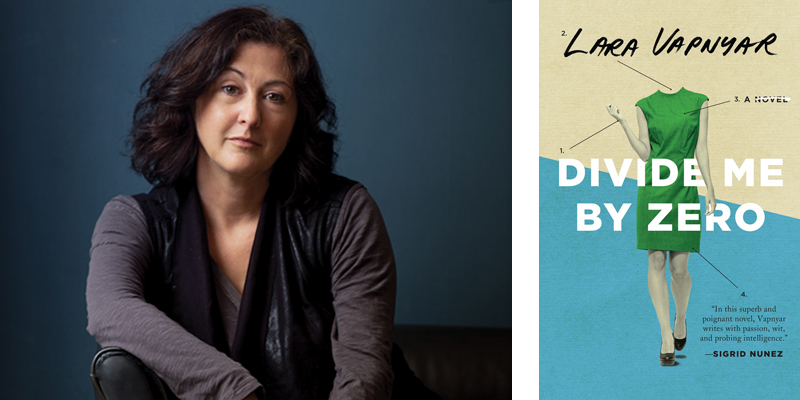
In a Facebook post, Lara Vapnyar mentioned that she adapted this touching, lyrical essay into a chapter in her new book, Divide Me by Zero. Read the piece and use Powells.com to order the novel.

Shortly after my mother died, the kids and I established the routine of taking long beach walks about an hour before sundown. We lived on Staten Island then, the long beautiful stretch of Great Kills beach was only seven minutes away by car. My husband and I had separated just a few months before my mother’s death, and all three of us were still reeling from these two blows. David was almost 18 then, Stephanie had just turned 15; I would look at our shadows and see that they were about the same lengths. We looked like three orphaned siblings rather than a mother and her kids.

https://www.powells.com/post/original-essays/on-being-a-cool-parent

An excerpt from a different chapter of Vapnyar’s Divide Me by Zero appears in Lit Hub:

One week before my mother died, I went to a Russian food store on Staten Island to buy caviar. I was brought up in the Soviet Union, where caviar was considered a special food reserved for children and dying parents. I never thought of it as extravagant or a romantic delicacy. My mother would offer me some before important tests in school, because it was chock-full of phosphorus that supposedly stimulated brain cells. I remember eating caviar before school, at seven am, still in my pajamas, shivering from the morning cold, seated in the untidy kitchen of our Moscow apartment, yawning and dangling my legs, bumping my knees against the boards of our folding table, holding that piece of bread spread with a thin layer of butter and thinner layer of caviar.

https://lithub.com/divide-me-by-zero/

On a personal note, this observation about caviar did hold up in my family, in part. When my grandmother was dying, my mother fed her caviar sandwiches. (Before the tests, though, I got a chocolate bar.) I’ve never seen this detail about caviar captured in prose before–it resonates so deeply.

A Soviet YA Classic: Aleksandra Brushtein’s Дорога уходит в даль (The Road Goes off into the Distance)

It is hard to overstate just how much Aleksandra Brushtein’s autobiographical novel about Aleksandra (Sasha) Yanovskaya, a young Jewish girl growing up in Vilna at the turn of the century, was beloved by generations of Soviet children. At a time when I have completely forgotten plots of books I read much later, I can still recall various episodes from this one. A copy of the book, which my family took with us when we left the Soviet Union, is one of my prized possessions. My mom loved this book so much she wanted to name me Sasha (an attempt ended by my great-grandmother Aleksandra’s announcement post my birth that Ashkenazi Jews cannot name children after living relatives). A remarkable thing about this novel is that it has a Jewish protagonist and depicts Jewish life but still became so popular in a country as anti-Semitic as the Soviet Union. Its popularity has endured in contemporary Russia, where “since 2005, a new printing of the book by different publishers has appeared almost every two years,” including an annotated edition.

Yet as Liza Rozovsky’s article notes, Brushtein “is barely known outside the Russian-speaking world.” To date, there is no English translation. If there is a translator out there who could take on this project, many in the diaspora would be eternally grateful on behalf of their children and their English-speaking friends’ children. In any case, it’s great to see this book being written about at length and we — and our inner younger selves — are thrilled to highlight it on Punctured Lines.

“The book that is imprinted in my memory as a moral and political compass, and the book I would like my children to know, is a Soviet-era work for children and juveniles titled “The Road Slips Away into the Distance.” It’s an autobiographical trilogy by the Jewish children’s playwright and memoirist Aleksandra Brushtein, who is barely known outside the Russian-speaking world. The first volume of the work was translated into Hebrew in the 1980s, but Brushtein (1884-1968) remains unknown in Israel, too. In the Soviet Union, where it ran through many editions of tens of thousands of copies each, the trilogy achieved cult status.”

The Novel That Introduced Soviet Jews to Their Forgotten History

National Book Award Finalist: Julia Phillips

A debut novel by Julia Phillips, Disappearing Earth, set on the Kamchatka peninsula, was recently selected as a finalist for a major US book award. It’s one of the five books from which a panel of judges will pick a winner, to be announced at a ceremony on November 20.

Fun fact: the largest active volcano in the Northern Hemisphere, Klyuchevskaya Sopka, is located on Kamchatka. (Apparently, there are 29 active volcanoes there altogether.)

USSR’s Impact on the lives of Muslim Women in Central Asia

Here’s a fascinating study about the role that the Soviet Union played in the lives of Muslim women from Central Asia. This was filed by Özge Öz Döm, a scholar at Yildirim Beyazit University in Anakara, Turkey. Her thesis is that “even though the Soviet officials had a genuine intention for the emancipation of Central Asian women from the patriarchal structure both in the public and private spheres of life, the policies and their implementation were shaped in accordance with the basic motive of regime survival. In the first years of the Soviet regime, mostly ideological intentions shaped the women’s emancipation project. However, in time, the Soviet officials needed to make more reforms in the political, economic and socio-cultural areas not just for the ideological aims such as emancipation of the women, but also for the survival of the Soviet Union.”

Muslim Women in Central Asia

In fiction, I have seen this conflict reflected most directly in Guzel Yakhina’s novel, Zuleikha, recently translated to English by Lisa Hayden. This history also provides useful context for Akram Aylisli‘s work, in particular his trilogy from the 1960s, People and Trees (I read this book in Russian under the title Люди и деревья).

The researcher makes a point in this paper that seems relevant for Punctured Lines: “The studies about women in the Soviet and post-Soviet eras are mostly concerned with the European parts of the Soviet Union, and neglect the Muslim women under Soviet rule. Therefore, the first problem related to the literature regarding Central Asian women is that there are insufficient numbers of studies regarding this area; and the second problem is that the Western scholars studying this subject sometimes fail to understand the meaning of Islamic based customs and traditions to Central Asian women as well as men. So, this study also attempts to make a contribution to gender studies literature regarding Central Asian women “

Yelena Furman on Olga Zilberbourg’s Like Water and Other Stories

“In ‘Rubicon,’ which opens Olga Zilberbourg’s Like Water and Other Stories, the narrator, on her way to pick up her son from preschool, says, ‘spring came on hard and much too early this year, which must be why the dimensions of reality shifted.’ If the story’s realistic beginning gives the impression that this shift is figurative, it soon becomes apparent that reality really does alter: on a street in San Francisco, a young man she knew back in 1990s Russia, who is ‘still seventeen on this day in 2018,’ drives up to hand her a ‘TDK compact cassette, the exact kind he and I used to exchange in high school.'”

http://jordanrussiacenter.org/news/review-olga-zilberbourgs-english-language-debut-like-water-and-other-stories/#.XaItf0ZKiyI  

Yelena Furman on Ksenia Buksha’s “The Freedom Factory”

“A NOVEL ABOUT a Soviet military factory whose workers must eventually adjust to a post-Soviet way of life does not sound like a thrilling read. Yet there’s a very good reason why Ksenia Buksha’s The Freedom Factory (Zavod “Svoboda”) won Russia’s National Bestseller Prize in 2014 (Buksha is only the second of three women to do so since the prize’s founding in 2001) and was also a finalist for the Big Book Award. In the author’s hands, this unpromising raw material is skillfully transformed into a genuinely and unexpectedly compelling narrative.” 

https://lareviewofbooks.org/article/shintity-fug-these-vulstes-on-ksenia-bukshas-the-freedom-factory

Olga Tokarczuk Wins the Nobel Prize

The Nobel winners have been announced and Olga Tokarczuk of Poland has won for 2018 (there was no prize given out last year because the Swedish Academy was mired in a sexual assault scandal; with the announcement of the winner for 2019, it quickly became mired in a genocide denial scandal). Tokarczuk is the author of Flights (trans. Jennifer Croft), which won the Man Booker International Prize in 2018, and Drive Your Plow Over the Bones of the Dead (trans. Antonia Lloyd-Jones; both out from Riverhead Books).

You can read Tokarczuk’s statement about receiving the prize here: https://lithub.com/read-olga-tokarczuks-response-to-winning-the-nobel-prize/

And here is an excerpt from Flights: https://www.asymptotejournal.com/fiction/olga-tokarczuk-flights/