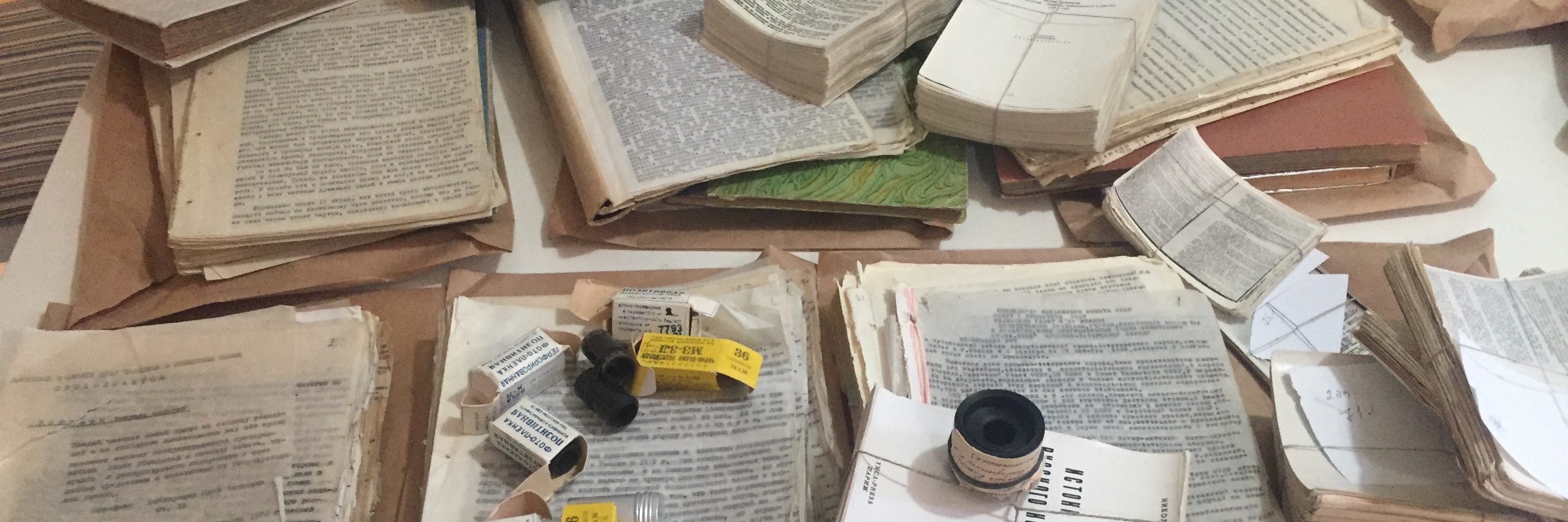
“THE TIME OF WOMEN is Simon Patterson and Nina Chordas’s translation of Elena Chizhova’s 2009 Russian Booker-winning novel Vremia zhenshchin. (Modeled on the Booker Prize in Britain, the Russian Booker is given to the best Russian-language text; Chizhova had been nominated for the award twice before). Set in Chizhova’s native St. Petersburg, mostly in the 1960s, when the city was known as Leningrad, this most beautiful, yet most maddening city emerges as a central focus of the narrative, as it often has in Russian literature, from Gogol to Dostoevsky to Andrey Bely.” https://lareviewofbooks.org/article/soviet-scars-yelena-furmans-the-time-of-women/
Category: Translated Literature
How Should We Review Translations? Part I
The beginning of an important, thoughtful, and often maddening conversation by Asymptote journal about the state of translated literature in the U.S. and the role of reviewers writing about it. Shocker: there is relatively little international literature being translated, published, reviewed, and read in this country. There is even less by women/non-Western European writers. A question we have been asking ourselves, each other, and anyone who would listen is what can be done about changing this situation. It is one of the main reasons we started this blog. This is a collective endeavor, which doesn’t have a simple answer. Suggestions welcome.
“For instance, only six of the nearly one hundred books reviewed on my watch were written by African writers. A whole 17% were translated either from Spanish or French. Moreover, only 16% were books of poetry rather than prose […] exactly two thirds of contributors to the Criticism section were men, and […] close to two thirds of the authors reviewed were men.”
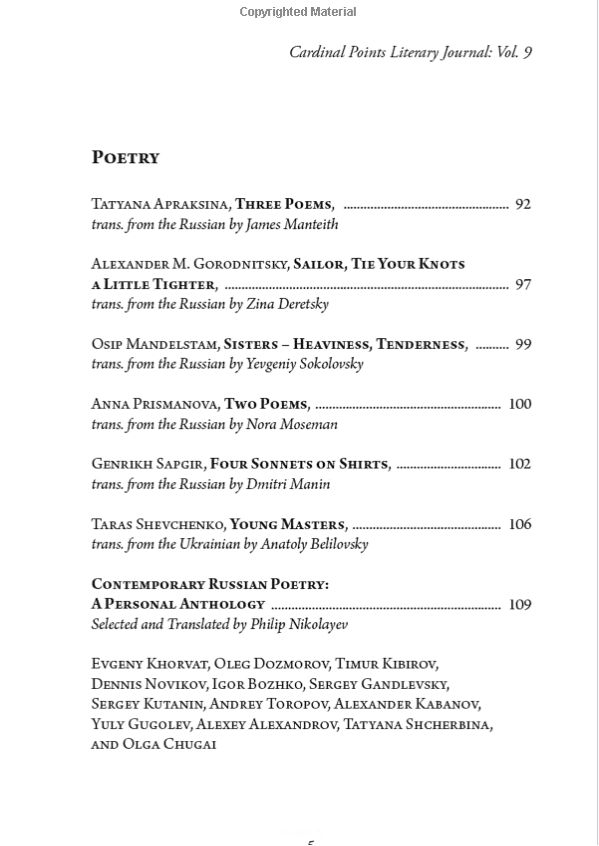
Cardinal Points, Issue 9
Cardinal Points is the Literary Journal of the Slavic Studies Department at Brown University. Issue editor: Boris Dralyuk. Editorial team includes: Boris Dralyuk, Irina Mashinski, Robert Chandler.
Issue 9 is now available for purchase:

Matter | A (somewhat) monthly journal of political poetry and commentary
Guest-edited by Larissa Shmailo and Philip Nikolaev, Issue 26 is dedicated to political poetry and prose in translation from Russian and written originally in English by writers with Russian affiliations.
In the spirit of 2019, at least two poets (Anna Halberstadt and Katia Kapovich) write about Stalin: “O motherland. O motherfuckerland,” sighs-screams Kapovich.
Olga Livshin and Polina Barskova (translated by Philip Nikolaev) are in conversation with Akhmatova.
Katherine E. Young translates Inna Kabysh:
More treasures here:
National Translation Month 2019: Featured Excerpts from Russian, French, and Uzbek Literature in Translation — Academic Studies Press
Academic Studies Press has published an impressive sampler that includes excerpts from their upcoming books and back catalogue. I can’t help but wish the list included more female writers, but I’m intrigued by Luba Jurgenson’s work–she’s a fellow bilingual, combining Russian and French.
https://www.academicstudiespress.com/asp-blog/national-translation-month-2019
The books included are:
Farewell, Aylis: A Non-Traditional Novel in Three Works by Akram Aylisli, translated from the Russian by Katherine E. Young
Night and Day by Abdulhamid Sulaymon o’g’li Cho’lpon, translated from the Uzbek by Christopher Fort
Beyond Tula: A Soviet Pastoral by Andrei Egunov-Nikolev, translated from the Russian by Ainsley Morse
Where There Is Danger by Luba Jurgenson, translated from the French by Meredith Sopher
21: Russian Short Prose from an Odd Century, edited by Mark Lipovetsky
The Raskin Family: A Novel by Dmitry Stonov, translated from the Russian by Konstantin Gurevich & Helen Anderson with a forward and afterword by Leonid Stonov
Russian Cuisine in Exile by Pyotr Vail and Alexander Genis, translated from the Russian by Angela Brintlinger and Thomas Feerick
My Lucky Day: The 2019 Yasnaya Polyana Longlist
Lisa Hayden of Lizok’s Bookshelf does a round-up of the longlist nominees for Russia’s Yasnaya Polyana award. There are several women on the longlist, including Alisa Ganieva and Guzel Yakhina. Russia’s literary prizes tend to disproportionately go to male writers. We’ll have to keep an eye on the shortlist, and the final result, of course, to see if this holds true here.
http://lizoksbooks.blogspot.com/2019/09/my-lucky-day-2019-yasnaya-polyana.html
Five Poems by Aleksandra Tsibulia in Jennifer Lobaugh’s translation
From the Summer 2019 edition of World Literature Today:
Tulips and their capricious labia, their indecent appeal.
The absolute shamelessness of the flowers, but also the sinlessness.
The lushness of the earth, as before the fall.<…>
The rest of this poem and more is available on World Literature Today’s website.
A Fantastical Traffic Jam by Akram Aylisli (Excerpt) Translated from the Russian by Katherine E. Young
From National Translators Month Page:
“We’re thrilled to share with you today an excerpt from the novella A Fantastical Traffic Jam by Azerbaijani political prisoner Akram Aylisli, translated from the Russian by the award-winning poet and translator Katherine E. Young. In her own words, “Many knowledgeable observers, including Aylisli himself, believe it was this novella that provoked the wrath of Azerbaijan’s current rulers and led to Aylisli’s persecution. He currently lives under de facto house arrest; his books have been burned, his wife and son were fired from their jobs, and at one time a bounty was offered to whomever would cut off his ear.” At NTM, we take pride in publishing brave works that speak truth to power, and this excerpt accomplishes exactly that.”
Decolonising and demystifying Central Asian literature through translation
Writing from Central Asia is virtually unknown to English readers. Shelley Fairweather-Vega, who translates Uzbek and Kazakh literature, is trying to change that: “I’d love to move readers away from thinking, ‘how unusual!’ to thinking ‘how beautiful!’” Read her interview here:https://globalvoices.org/2019/09/02/decolonising-and-demystifying-central-asian-literature-through-translation/
Profile of Lisa Hayden
One of our star translators from Russian got a lovely write-up in the Portland Press Herald. Personally, I first came to know Lisa through her amazing blog, dedicated to Russian literature, Lizok’s Bookshelf. It’s somehow wonderful to learn that Lisa grew up in a town called Norway, Maine. That’s such a big name for a town, and I’ve always wondered what it’s like to grow up in these places that are named after other places. (I say this, having spent considerable amount of time in my childhood thinking about Lenin’s relationship with Leningrad.)
Hayden grew up mostly in Norway, in Oxford County, where her family moved from New Hampshire when she was about 9. She first became interested in Russia and Russian history as a child because of stories published in Jack and Jill magazine based on the Russian fairy tale Baba Yaga. Baba Yaga is a Slavic folklore tale about a “grandmother witch” who lives deep in the forest and is not very good, but is not entirely evil.
When she was in the sixth grade, Hayden read her first English translation of Russian literature, a short story called “The Bet” by Anton Chekhov.
To learn more about Lisa Hayden, read the story here.
 Punctured Lines