Feminist and Queer Russophone Poetry

This year, English-speaking readers will be introduced to three books in translation from Russian, each of which is groundbreaking on its own terms; taken together, these books showcase the aesthetic potential of feminism in contemporary Russian-language poetry. The feminist and queer voices in these books are amplified by the group of poet-translators, whose own politics and identities allow them to negotiate the cultural gap between russophone and anglophone contexts, enriching both. Punctured Lines is proud to introduce the three books and our conversation with Ainsley Morse, Eugene Ostashevsky, and Joan Brooks, who as editors and translators served to bring these books to English-language readers. 

Update: This post was originally published on October 14, 2020. Subsequently, Joan Brooks asked us to remove their answers to the questionnaire, and we’ve done so on December 11, 2020.

The Books

Lida Yusupova’s collection, The Scar We Know, edited by Ainsley Morse, with translations by Madeline Kinkel, Hilah Kohen, Ainsley Morse, Bela Shayevich, Sibelan Forrester, Martha Kelly, Brendan Kiernan, Joseph Schlegel and Stephanie Sandler 
(Cicada Press, Winter 2020/21)

F Letter: New Russian Feminist Poetry, an anthology edited by Galina Rymbu, Eugene Ostashevsky and Ainsley Morse, with original poems by Lolita Agamalova, Oksana Vasyakina, Elena Georgievskaya, Egana Dzhabbarova, Nastya Denisova, Elena Kostyleva, Stanislava Mogileva, Yulia Podlubnova, Galina Rymbu, Daria Serenko, Ekaterina Simonova and Lida Yusupova; translated by Eugene Ostashevsky, Ainsley Morse, Helena Kernan, Kit Eginton, Alex Karsavin, Kevin M. F. Platt, and Valzhyna Mort
(isolarii, October 2020)

Galina Rymbu’s collection, Life in Space, translated by Joan Brooks with an introduction by Eugene Ostashevsky and contributions by other translators
(Ugly Duckling Presse, 2020)

NB: Dear readers, please pre-order and buy these books and request that your local libraries purchase them for their collections. This directly supports the work of everyone involved in their making.

Conversation

PL: These are Rymbu’s and Yusupova’s first poetry collections in English, and many authors in the anthology are being published in English for the first time. How did these books come to be? What’s the story–or stories–behind their near simultaneous publication in the US? 

Ainsley Morse: I met Yusupova in 2017, when we invited her as the “poetic guest” to AATSEEL (the annual conference of the Association of American Teachers of Slavic and East European Languages)–when funds allow, we like to invite a poet to have translators workshop some of their poems and to give a reading. The idea of making a book started then but really took shape as, over the ensuing couple of years, I kept encountering other translators who were interested in Lida’s work and wanted to take on various texts. (I am the editor of the book and did some of the translations, but really couldn’t have done this project on my own.) Most of the other books I’ve done have been labors of love–me wanting to bring something strange that I love into English, but not always with a huge resonance–but my sense of Yusupova’s book is that it almost made itself; it sensed its English-language audience ready and waiting.

Eugene Ostashevsky: It’s both a coincidence and not a coincidence. Historically, it’s not a coincidence. It has to do with the emergence of feminist and queer poetry in Russia in this decade, mostly written by the young poetry generation, i.e. by people who did not live in the USSR. Yusupova, who is older and did live in the USSR, was the inspiration for some of this poetry. Rymbu is currently its most visible representative. I first came across a poem of hers by chance, online: it was during Maidan, in February 2014. It was the Lesbia poem, about the coming of fascism to Russia. It was obviously the work of somebody who had a vast poetic erudition but was doing something new with it, and something wildly compelling. So I did a feature on her in Music and Literature with Joan’s translations. Sebastian and India, the publishers of isolarii, read the feature and contacted me. We decided to do an anthology that she would edit and that would represent some of the people from her circle. It just so happened that all three books–the anthology and Rymbu’s and Yusupova’s English-language books–are coming out simultaneously. I think we have COVID to thank for it, because they all got held up by the lockdown in different ways.

PL: There have been a number of writers in the russophone space who wrote to queer and feminist themes in the past, including Yusupova herself, who published her first collection in 1995. In 2017, a collective of poet-activists launched “Ф-Письмо [F-Writing],” an online platform, specifically dedicated to feminist poetry. F Letter: New Russian Feminist Poetry gathers the work of poets associated with the F-Writing collective who intentionally blur the lines between poetry and activism. They do this both by breaching taboo topics–for instance, the physiology of the female body (as in Galina Rymbu’s recently published poem “My Vagina”)–as well as by breaking with tradition in Russian-language poetry by moving away from rhyme and meter. What do you see as some of the most exciting and innovative aspects of the poems you worked with? 

Ainsley Morse: A noticeable shift away from rhyme and meter has been underway in Russian poetry for at least twenty years now, probably more like thirty (depending on how you understand “noticeable”). But this shift has had a political charge, since it certainly coincided with other, more noticeable rapprochements with the West, and to this day the majority of Russians would certainly tell you that poetry is something that rhymes. Some of the poets in the anthology, particularly the ones with personal experience of life in the USSR–Ekaterina Simonova, or Elena Georgievskaya, for instance–started out writing much more traditional-sounding verse. Lida Yusupova (b. 1963) certainly grew up in a poetic environment dominated by rhyme and meter, but her years of living (and reading) abroad have also surely affected her general sense of poetry. In any case, when she gives specific instructions to translators / editors to “let the lines run on as long as the page will let them”–you know this is someone who has a sense of the constrictions imposed by a neat stanza, such that these unhinged rambling lines are a really meaningful part of her poetics. I’d say, though, that most of the poets represented in the anthology came of age as poets in an (admittedly rarefied) environment that saw free-verse as the new normal; as Eugene describes, their innovations are happening more in the realm of selfhood, subjectivity, identity. 

Eugene Ostashevsky: Feminist and queer work–and left-wing political work in general–is what’s exciting in Russian poetry now, at least as far as movements are concerned. Russian poetry has for many generations generally tended to avoid politics. There were a number of deep reasons for it, from the cultural policy of the state to ideologies about poetry held even by people who were deeply anti-establishment. Of course, the aim of the state was to knock out the political instinct altogether, or rather the critical political instinct, to make people believe that politics is corrupt, so that conformism may rule. (This is still the current strategy because it works.) At the same time, stylistic experimentation sufficed to demonstrate your anti-establishment colors, because stylistically interesting work generally could not be published under the Soviets. In the aughts, during Putin’s first decade, some poetry started to break away from the general aversion to political engagement. And it was also a poetry that started breaking other taboos–including talking about the body, and about sexuality in ways that ultimately turned out to be socially impermissible and politically volatile. This poetry moved towards reflecting upon the self in new ways, towards constructing the self differently, and that self would very obviously no longer be a Soviet self, and not even a post-Soviet self. So it was anthropologically innovative, which made it politically innovative also. 

However, it was the state that took the crucial step of making such poetry necessarily and obviously political. The state politicized sexuality by associating LGBTQ+ issues with the decadent West, pretending that LGBTQ+ posed a danger to Russian society, as if they were some sort of rainbow-colored NATO special forces, largely criminalizing them and positioning itself as the defender of family values. Once that happened–once Putin, as dictators everywhere, consciously threw in his lot with defense of patriarchy–feminist and queer poetry automatically got shoved onto the political frontline, and automatically became–it’s perhaps unsuitable to use military metaphors here but in Russia we/they like military metaphors–the vanguard of resistance to Putin or the putative Putin or the state.  

PL: Most of the poets included in the three books are closely connected to each other by personal and artistic ties. F Letter: New Russian Feminist Poetry was edited and includes work by Galina Rymbu as well as Lida Yusupova’s poetry. What connections between the three books strike you as the most meaningful?

Ainsley Morse: As someone who teaches / tries to teach Russian poetry to American undergraduates, I love that these books are coming out in hot succession–it’s a rare moment when the slow and painstaking world of translation publishing comes a little closer to the pace of the “real life” of this subset of Russian poetry, where these poets are all constantly releasing work that is in conversation with, responding to, each other. Single-author books always give a broader and deeper sense of a writer than a couple of poems in an anthology, but here we also have this anthology providing a whole additional level of context to both Rymbu’s and Yusupova’s work; I would hope, too, that readers intrigued by some of the anthology authors might feel empowered to suggest further translations of some of them. Another rare treat (pedagogical and otherwise) is the possibility, at least with the anthology and Yusupova’s solo book, to compare the voices of different translators grappling with the same poet’s work. I’m also excited and curious about the way English-language readers will react to all three of them being available at once: it seems like an unusual opportunity for a more in-depth and nuanced cross-cultural poetic dialogue, more or less in real time.

Eugene Ostashevsky: Well, it’s the same corpus. Poems don’t really get written individually. They are always collaborations. When you’re a loner, you collaborate with dead people. But here you have work by contemporaries responding to each other–you have a conversation of the living, who are trying to make sense of themselves and of their surroundings. The F Letter: New Russian Feminist Poetry anthology has an incredible poem by Oksana Vasyakina, “These People Didn’t Know My Father,” which starts by talking about the importance of Yusupova as a catalyst. For me, I love Galya Rymbu’s slightly earlier, more anthemic poems in White Bread, that Joan translated, and it’s really interesting to see her return to the same area in “My Vagina” but years later, as a different person. But she works in a number of different directions, and another direction picks up, for example, on the poetics of Arkadii Dragomoshchenko, a Petersburg poet of an older generation, who died a decade ago, and a lot of whose images are apophatic, nonvisualizable.    
PL: Despite their similarities, these are three very distinct books, published by three separate presses and presumably aimed at different, albeit partially overlapping audiences. What are some of the unique aspects of each of these books? 

Ainsley Morse: As I said earlier, I really have this sense that the Yusupova book “made itself”–I don’t ever remember having a serious conversation about the contents, it just came together in what now feels like a strikingly harmonious and well-balanced structure. All the texts were proposed by the individual translators, with the exception of one poem (“Patchwork Quilt”) that Lida asked us to add (otherwise she did not comment on the contents, except to say how delighted she was). I suspect that the excellent quality of the translations and the overall pleasing shape of the book comes out of this shared creative satisfaction, the fact that everyone was following individual inspiration. Perhaps I should also add that we took our time and agreed on deadlines collectively–no one was rushed.

Eugene Ostashevsky: One aspect that F Letter: New Russian Feminist Poetry shares with Rymbu’s Life in Space, as well as with Yusupova’s collection, is that all three are bilingual. The bilingualism of the books means they are addressed to several audiences at once–to poetry audiences in the US and UK (not at all the same audience), as well as to English-speakers globally, because we, or at least I, aren’t writing for just American readers now. Being bilingual, the books are also addressed to Russians–to global Russians also, meaning to Russians outside of Russia, to people fluent in Russian, and to people just beginning to learn Russian. I ended the introduction to Life in Space with a request that readers who don’t read Russian at least learn the letters so that they can pick up some of the materiality of the language on the facing page. It’s not because I have a Russian fetish, it’s because I think poems are material things, and especially material in the original. Just reading the translation is not enough for me. But I digressed and said nothing about the differences between the books, only the similarities. Sorry. 

PL: Though Russian is the common language from which these poems originated, most of the poets have lived experiences in a number of cultural and linguistic contexts. Having grown up in Petrozavodsk, Karelia, Lida Yusupova lived in St. Petersburg and Jerusalem, and currently divides her time between Canada and Belize. Galina Rymbu was born in Omsk, Siberia, and Oksana Vasyakina further East, in Ust-Ilimsk, Irkutsk oblast. Lolita Agamalova was born in Chechnya and Egana Dzhabbarova spent her childhood in Georgia and currently lives in Yekaterinburg. What do you think these complex mobilities contribute to their poetics?  

Ainsley Morse: In Yusupova’s case, I would say complex mobility makes her poetics. A lot of the poems in her 2013 book Ritual C-4 (excerpts from which open The Scar We Know) are outright multilingual and/or strongly gesturing toward other cultures, histories, languages, etc. This is a really interesting problem for translation, since part of what makes these poems powerful and strange is the simple fact that they tell these stories in Russian, and Yusupova–as someone who spent several decades living in Russia–is fully aware of how dramatically different these (Belizean, Canadian, American, etc.) scenarios and names sound and mean when they are transplanted into Russian. To some extent she is playing around with exoticism in a way that can seem not entirely politically correct. But both in Ritual and in more recent work, she also uses the distance gained from her own personal displacement to look back to Russia (to her own past and the present day alike) from an estranged position. I think this crucial shift in viewpoint is one of the moves that made Lida’s work so inspiring for some of the younger poets in the anthology.

Eugene Ostashevsky: It makes them modern. Modernity is displacement. But, on the less slogany level, it also shows that Russia is not just Moscow and Petersburg anymore, because Russia, with its history of absolutism, used to be like France–just Paris.

PL: Translators have played a very active role in bringing these books to English-language audiences. Some of the translators are themselves poets and activists, and many were born in the Soviet Union or to USSR-born parents. Considering that poetry translation is the act of co-creation in the new language, what do you think these complex identities of the translators contribute to the shape of these books? 

Ainsley Morse: I have to say that I still don’t know very much about the personal background of the translators who did the bulk of the work on the Yusupova book–Madeline Kinkel and Hilah Kohen. I know that they’re both younger than me (by how much, I don’t know), hard-working, bright, responsive, creative and generous, and driven by a vested interest in the work. 

With the anthology, I do remember feeling that we needed to involve younger translators–many of the poets there were born in the 1990s, and it seemed important to me that the English come from people reasonably coeval with them. But that was an easy task because there are so many fantastic young(er) Ru-En translators out there right now! I suppose that does bring the conversation back around to the question of family background, since for some of the translators growing up with Russian in the family probably means they achieved a greater degree of bilingual fluency at a younger age (without years of study). But we also worked with several marvelous translators who have just learned Russian from scratch.

The question of translators-cum-activists is interesting. In some ways the history of twentieth-century Ru-En translation is one of activism, since the Cold War narrative of oppressed writers drove much Russian literature publishing for a long time. To some extent this anthology will draw attention precisely because of the persistence of the Cold War model: Russia’s government is still/again villainous, and some of these poems call direct attention to this fact. In the internet age, though, translators have an easier time finding writers they find compelling for whatever reason–they don’t just automatically translate prominent dissidents and Nobel Prize winners. Also, although many of the translators whose work is featured in these books identify as queer, the problems that are relevant for queer poets in the US right now are not necessarily the same ones being grappled with in Russia. So it’s probably more important that the translator has a connection with the poems than necessarily with the poet / the poet’s self-identification.  

Eugene Ostashevsky: Since translation is, at bottom, work with language, before you get to gender, ethnic or other identities, the translator needs to know how to write in the target language and how to read in the source language. The translator also needs self-control–you need to check even things you think you understand and you need to make sure you are not smothering the text with your own ideas. Having said that, it is also important–in fact, it’s crucial–for the translator to have an internal connection with the author. This can happen on any level. It can happen on the more existential level of shared, say, gender or sexual preference, although this kind of internal connection strikes me as impossibly broad if unsupported by others.

I personally need a connection through poetics. I really wanted to translate Lolita Agamalova’s Dilige, et quod vis fac, although it’s a lesbian sex poem, and I’m neither young nor a lesbian. But I also know what it’s like to use philosophy, even Neoplatonic philosophy, to talk about sex, I am at home in the kind of metaphysical poetry that she writes. And my job is not to imitate what she, as a character, is doing with another character, but to imitate in English what she, as a poet, is doing with the Russian language. We did aim for a range of “complex identities” of translators in our anthology but I don’t know to what extent that shows up on the page. Like, my “complex identity” is probably differently complex from the “complex identity” of Alex Karsavin, who is a terrific translator I first met working on this book–inventive, thoughtful, precise–but can you read the difference in our word choice? Translation is not the same as original poetry. It’s not about the translator, or rather it’s about the translator very, very obliquely. So identities don’t work in the same way. 

PL: In the anglophone world, we have seen a growing interest on the part of translators and editors to give space to Russian queer and female writers. In 2019, for instance, Brooklyn Rail’s InTranslation folio Life Stories, Death Sentences,” was co-edited by Anne O. Fisher and Margarita Meklina. This increased interest came on the wings of the reportage about the socially regressive laws passed in Russia that decriminalize domestic violence and criminalize “gay propaganda” (conveniently loosely defined), and most notoriously the persecution of gay men in Chechnya. On the geopolitical scale, we’re seeing Russian leadership align itself with the socially conservative values maintained in the US by the political far-right, upholding patriarchy and heteronormativity. In the Russian context, many if not most of these authors have engaged in acts of dissent. What do you think of the potential for these books to also act as works of activism in the anglophone context by, for instance, helping to build socially progressive alliances? 

Ainsley Morse: I don’t know how much activism these books are capable of bringing about in the anglophone context. I am very glad they are all bilingual, because I think they are definitely capable of sending small shock-waves out into the Russian-reading community–because many of these texts really are earth-shaking and unprecedented in Russian. But my sense is that many of the poems come across as much less shocking in English, where women in particular have been writing the body and sex, etc. for a while now. I’d make an exception for Yusupova’s cycle “Verdicts,” composed of found poems made using court documents she accessed on various Russian legal websites. Several of these are extremely graphic and brutal, in English just as much as in Russian. But I worry too that the English-language poetry reading public has this special category for “brutal Eastern European art” and there’s a kind of automatic distancing that neatly sections off the visceral violence and pain there as the sort of thing that happens elsewhere. Ironically, I think the more programmatic work, which highlights the legal and social differences between the US and Russia, can be less effective at bridging that gap. That said, I recently taught Vasyakina’s “These People Didn’t Know my Father” to a class of non-Russian-speaking students and several people really responded–not as much to the narrator’s fantasies of an underground feminist-terrorist organization, but to her nuanced portrait of economic disparities and social-medical stigma. The “feminist poets” in the anthology are really addressing so much in their work–their “feminism” is often so far-reaching in its calls for human rights and general decency, it almost seems limiting to use that designation (even as we can see the crucial importance of specific demands for women’s rights).

Eugene Ostashevsky: Especially now, given Russian interference in elections in the US, the EU, and elsewhere, and given international cooperation among extreme-right-wing parties and the Russians, the enemy seems to be the same in many locations all over the world, and the systems seem increasingly similar. But that may be an optical illusion. Let me think about it. Well, Russia is just more patriarchal than the US, because the Russian state depends on the traumatization of men–of all of its male citizens–during army service, as well as by the casual violence of the family, of the street. Being a Russian man–a “common,” “normal” Russian man–has to do with the internalization of violence directed at you, with directing violence at others, with accepting it as the natural economy of manhood. I think in the US, which does not have the draft, but does have gun ownership, there exists systematic abuse of men in order to rule them, but it’s directed at a smaller subset of men and it’s organized differently. Just think of American prisons and of the likelihood that an African-American man will go to prison, as opposed to a representative of another group. But it’s less obvious how it works in the US, because oppression in the US tends to be by the indirect, alienated violence of money, rather than by simple beatings or shootings. I understand about police brutality, but there is also money brutality, and I hope I am not downplaying real physical violence if I say that money brutality is more in charge. Anyway, I don’t live in Russia and I don’t even live in the US now, and I’m not a sociologist, so my pontificating is not to be taken too seriously. What I was trying to get at is the obvious point–well, obvious to you and me but clearly not for everybody–that feminism and queerness are extremely good for “straight” men also, because these ideologies aim at constructing a different body politic, one where the men also would not be brutalized, where the state would not depend on the brutalization of men, and of others by means of men, to survive. As it does in Russia. As it does in part in the US, although the violence of money is so much more complicated and less clear cut, and maybe to some extent compatible with nonpatriarchal thinking. Maybe. I don’t know. 

But I didn’t answer your question. Do I think these books can act as a work of resistance in an anglophone context? No doubt. I never say “no doubt,” but this is really no doubt. Much of the material in all three books translates pragmatically as well as semantically. 

PL: In the process of translating and editing these books, what images, concepts, and/or words have emerged as some of the trickiest to carry over into English?

Ainsley Morse: Encroaching multilingualism! I talked about this some in relation to Yusupova above; her poems have words from English, Spanish, Kriol (in one poem, Inuktitut), as well as a persistent orientation toward a kind of “other” or foreign space (even when they’re written in plain Russian). Likewise some of the anthology poets use foreign words or phrases, and it’s always so hard to get–and then convey–a sense of how that feels and means in Russian (especially since the “other” language is so often English). 

The legal language in Yusupova’s “Verdicts” cycle also offered a technically tricky problem. We, non-lawyers, were not familiar with this kind of language in English, and the Russian legal code is just different. In one case we had to redo a significant chunk because Lida pointed out that there isn’t a manslaughter charge (this had been our approximation of what was, crucially, “causing death by negligence”). Even “Verdicts” should technically be “Rulings,” but we went for the etymological rhyme (the root of the Russian word, Prigovory, is speaking or saying, di(c)t-).

For me, the “Verdicts” cycle also entailed a different kind of difficulty because of the extremely brutal and graphic violence toward women and LGBT+ people depicted in most of the poems. I should acknowledge right away that Madeline Kinkel is the translator of the cycle, for which I’m very grateful–I always knew they would need to be a big part of the book, but was reticent to translate them myself because simply reading them was such a viscerally wrenching experience. Since translating entails getting deep inside of texts and reading them over and over again, translating the “Verdicts” was sure to be hard going (of course, as editor of the book, I ended up working closely with them anyway). I remember Bela Shayevich told me that while she was translating Svetlana Alexievich’s Secondhand Time, which abounds in tales of relentless and horrific suffering, she would cry pretty much every day.

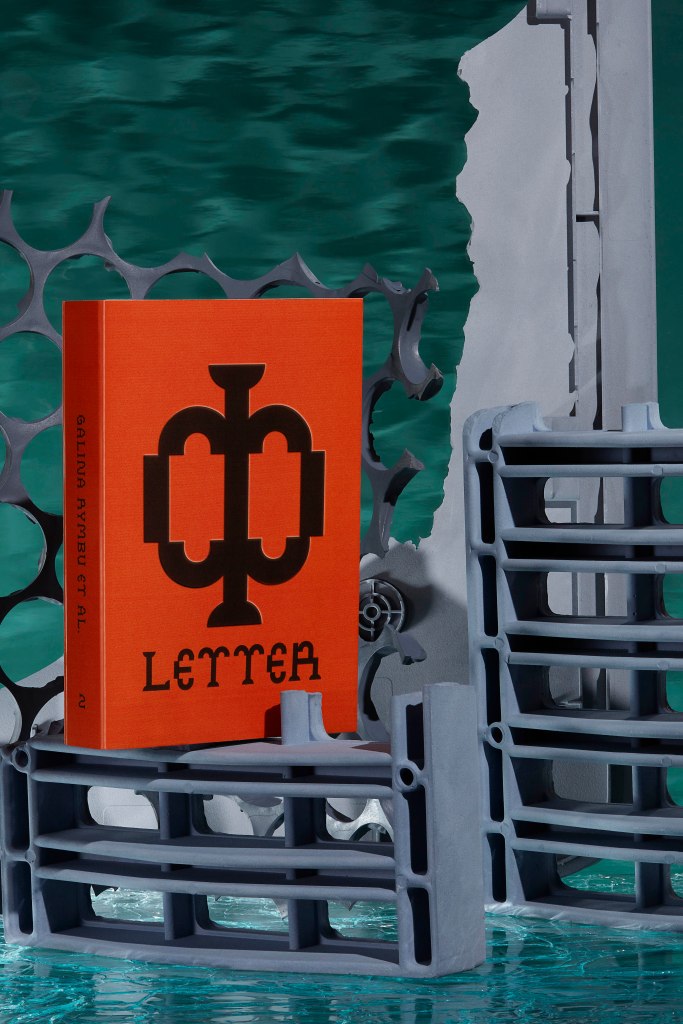
Eugene Ostashevsky: Relatively speaking, this is not hard material to translate. Older poetry is much harder, both because of greater linguistic materiality, especially in the case of classical forms, and because of greater conceptual dissimilarity. With contemporary Russian feminist poetry, though, we all live more or less in the same world, or at least we live in a world whose parts are kind of legible from the vantage point of other parts. Maybe the hardest part of the anthology was the title. F-pis’mo really translates as F-Writing, referring to écriture feminine, but to translate it as F-Writing into English would be like living in the 70s all over again, because the idea of poetry as écriture, which appeared in Russia only recently, becomes a key idea in experimental poetry in the US with Language poetry. So I translated F-pis’mo materially, because pis’mo originally means letter, the kind you send, but if you combine it with F, its meaning alters once again, to letter like ABC. So the title became F Letter: New Russian Feminist Poetry. The F is actually a Russian F, Ф, because it’s a what’s-the-f-you-lookin-at letter, and there’s even an obsolete expression, стоять фертом, to stand like an Ф, which is to have your elbows out and your hands by your waist, but figuratively it means to stand in a what’s-the-f-you-lookin-at pose. It’ll be a tiny book with an Ф on the cover. This kind of translation may be called a double sdvig.


Ainsley Morse translates from Russian and Bosnian/Croatian/Serbian and teaches at Dartmouth College. In addition to F Letter and The Scar We Know, she has worked mostly on Soviet-era poetry, prose and theory, including Vsevolod Nekrasov’s I Live I See and Igor Kholin’s Kholin 66: Diaries and Poems (both with Bela Shayevich, published by Ugly Duckling Presse), Andrei Egunov-Nikolev’s Beyond Tula: A Soviet Pastoral  and Yuri Tynianov’s Permanent Evolution: Selected Essays on Literature, Theory and Film (with Philip Redko, published by Academic Studies Press). 

Image credit:  Una Ostashevsky

Eugene Ostashevsky‘s books of poetry include The Pirate Who Does Not Know the Value of Pi (NYRB 2017), wonderfully translated into the language of German by Uljana Wolf and Monika Rinck, and into the language of music by Lucia Ronchetti, and The Life and Opinions of DJ Spinoza (UDP 2008), now available in digital copy here. As translator from Russian, he works primarily with OBERIU, the 1920s-1930s underground circle led by Daniil Kharms and Alexander Vvedensky. He has edited the first English-language collection of their writings, called OBERIU: An Anthology of Russian Absurdism (Northwestern UP, 2006). His collection of Alexander Vvedensky’s poetry, An Invitation for Me to Think (NYRB Poets, 2013), with contributions by Matvei Yankelevich, won the 2014 National Translation Award from the American Literary Translators Association. He is “against translation.”

Video from our book release celebration of LOOK AT HIM by Anna Starobinets, translated by Katherine E. Young

On September 27, 2020, Punctured Lines hosted our first ever Zoom event dedicated to the publication of LOOK AT HIM by Anna Starobinets, translated from Russian by Katherine E. Young. The author and the translator were joined on Zoom by scholar Dr. Muireann Maguire from the University of Exeter, UK to discuss this important book and the what it has to give to its English-language audiences.

The video of the event is now online:

Buy the book from the publisher Three String Books / Slavica.

To keep up with the conversation about Look at Him, including interviews, reviews, and other links, please visit translator Katherine E. Young’s website.

Anyone interested in the cover artist can find Ghislaine Howard’s work on her website.

“Just because Belarusians write in Russian doesn’t mean they’re a part of Russian culture”: An Interview with Tatsiana Zamirovskaya

This is a translation of a Russian-language interview conducted by Svetlana Satchkova and published by Storytel on June 16, 2020. The translation is by Fiona Bell.

Tatsiana Zamirovskaya is a writer from Belarus who has lived in New York for the past five years. She writes in Russian and English. Her short story collection, The Land of Random Numbers (Земля случайных чисел, AST, Russia, 2019) was nominated for the National Bestseller prize and compared by critics to works by premier authors of metaphysical science fiction, from Ursula K. Le Guin to the Strugatskii brothers. She recently completed a new novel about memory and digital immortality.

Svetlana Satchkova spoke with Tatsiana about how her interest in fantasy developed, how she came up with the idea to move to the United States, and what the Belarusian language means to her.

Photo: Furkan Uzunsac

What was your childhood like?

I was born in Borisov, a small city where Napoleon’s army was defeated in 1812. Nothing else has happened there, which is why all local culture revolves around Napoleon: there are regular battle reenactments on the floodplain of the Berezina river, where the army drowned, and guys walk around with metal detectors looking for Napoleon’s golden carriage, and drunk high school graduates go to Brilevskoe field to watch the sunrise. Borisov is also famous because Hitler came there during his only visit to the Nazi-occupied parts of the Soviet Union, in 1943. When I was a kid, the neighbors once told me that he probably stayed in our house, since it was one of the only brick houses in the city at that time…

My parents were pretty ordinary: in Soviet times, my mother was a music teacher at a music school and my dad was an engineer at a factory, where he designed tanks. After the collapse of the Soviet Union, he tried to survive in any way he could. Belarus is a transit territory, which is why Belarusians survived thanks to these huge overnight bags, which they used to carry all sorts of junk to sell across the border in Poland. So I grew up among mountains of junk: for example, thousands of crystal swans from the Borisov Crystal Factory, or boxes of dichlorvos.

I went to a great school that specialized in English. We periodically went on exchange trips to London. The British kids also visited us, bringing all the new music on cassette tapes, which we then copied from each other. I listened to all the Brit Pop albums of the nineties right when they came out, and back then, that was a huge accomplishment – living in contemporary music culture. Borisov was also a hub for violent youth groups, kids who actually lived by the laws of the street. So, my childhood was a mix of prison aesthetics, elite education, and difficult, post-perestroika life.

What did you want to be when you grew up?

I always wanted to become a writer or a musician. My parents hung out with a great crowd of rock-intellectuals. One of them, the famous musician Oleg Minakov, who sang in the German group Inspector back then, told me I should study journalism because, with my interest in music and desire to write, I could become a music critic. I thought that sounded like a really cool life, so I decided to study journalism at Belarusian State University in Minsk.

Then, at the end of the 90s, Lukashenko changed the constitution so that he could be president without interruption or term limits — in fact, Russia recently took a page from his book. But the journalism department at my university was very liberal: I was accepted, writing in my entrance exam essay about how I dreamed of working for the opposition newspaper Name (Имя). When my mom found out, she cried for two days. Then we heard that I’d gotten the highest score of all the applicants. The journalism department was a cool crowd, everything was suffused with the spirit of freedom and hope for a different future. I went to protest rallies, rock concerts – basically, it was a great time.

When did you become a working journalist?

The same time I started doing everything else – university. When I was 19, my friends and I published a completely out-there newspaper for an opposition party that got a grant for it. One time we were paid in NATO pilot jumpsuits, since humanitarian aid had been sent that consisted of canned food and these jumpsuits. I only published one article in Name (Имя) I handed it over to the legendary journalist Irina Khalip, she published it, and two weeks later the newspaper closed down. The article was about a Rolling Stones concert in Moscow, and Khalip even remembered me later. In one of her interviews she said: “I remember this first-year student Zamirovskaya coming to me with her article on a sheet of paper.” It made me so happy to read that.

Even at that time, professional music media in Belarus was well-established, in the spirit of publications like Q and NME: Music News Weekly (Музыкальная газета), the magazine Legion (Легион), and the magazine Jazz Quad (Джаз-квадрат). I wrote for all three and was the editor at Jazz Quad. That was my first job after university. We worked directly with labels, who had a lot of respect for us and sent us new albums to review. You have to remember that in 1997 Minsk, getting a review copy of OK Computer, when no one else had heard it, was very cool. I spent hours on the phone and did interviews with all sorts of famous musicians, which allowed me to make up for the English I hadn’t been taught in school.

When did you start writing prose?

While I was studying journalism, I wrote short surrealist stories and, without telling my friends, sent them to the Dnipropetrovsk cult contemporary art magazine, Ours (Hаш). People like Linor Goralik and Mikhail Elizarov started publishing there. I didn’t get a response, but one day the magazine sent all its contacts a letter saying that their work mail had gotten messed up and everything had been lost, but that some girl from Minsk’s journalism department had sent them a story about a guy who fucked a pyramid. They wanted to publish that story but didn’t know how to find the girl.

The next day, everyone in the department kept looking at me. It turns out we had all been secretly sending things to Ours (Hаш). My piece was an homage to Ray Bradbury, who had a story about a man and a woman who give birth to a pyramid and then decide to move to the land of pyramids to live on the same wavelength as their child. Now I have three published short story collections, the most recent of which, The Land of Random Numbers, came out in 2019 with AST, Moscow.

What made you decide to move to the U.S.?

At 35, I felt like I had already lived a full life. I didn’t know where to go next. I’d worked as a journalist for a long time, applying an apocalyptic perspective to everything: first to music, then politics, culture, and contemporary art. I’d hosted a jazz program on Polish radio and edited a glossy men’s magazine with friends. We’d even had Sergey Mostovshchikov, who we all idolized at the time, as a guest editor in a joint issue with Crocodile (Крокодил).

My time in Belarusian journalism had run its course and I thought it would be cool to get an education in the arts – I worried that I wasn’t writing deeply enough about contemporary art – and simultaneously improve as a writer. I set out to do an MFA in New York because it was my favorite city, where I’d been as a tourist but wanted to live.

Was it difficult to adapt to a new place?

My friends couldn’t understand my decision to move, since in Minsk I lived in my own apartment and worked as a content editor at an ad agency – my life was great. And now I’d decided to spend all the money I had saved to go to some art school and live in a tiny, screened-off corner of a puppeteer’s apartment in Bushwick. While I was earning my MFA, I had all kinds of weird side hustles: writing texts and sometimes even being a pet sitter. It was really cool because I got to spend time in the fancy apartments of some artist or another, lying on their couch with their dog and looking at their art books. But I always saw this as forward movement: I immediately realized that in the U.S., education is a huge investment in yourself, even if it’s not the sort of education that gives you the opportunity to find the perfect job right now.

What types of opportunities does it offer?

A Master of Fine Arts degree legitimizes you as a practitioner in an artistic field. This degree is so expensive because it gives you access to circles that you wouldn’t otherwise be able to get into. After I graduated from Bard College, I went to several prestigious writers’ residencies, where people would ask me who I was and where I was from. “Belarus,” I’d say. “Oh, they kill journalists there, don’t they? Or is that Bulgaria?” they’d say. “Alexievich, Chernobyl,” I’d say. They would nod, still unsure. Then I started saying that I’d graduated from Bard, and they would immediately reply, “Oh, Bard!” Their attitude towards me changed instantly: they no longer needed to know what I wrote or whether I was any good.

The fact that I’d received an MFA meant that I had already been verified by someone somewhere and that I was, roughly speaking, part of their circle. This program also helped me understand what I do more generally. At Bard MFA, they teach you to be aware of all the stages of creative work: so, it’s not that I sit down, and the universe hands me a text because thus is its divine will. They teach you to understand your own practices, how they relate to your life story and your identity, what is borrowed and what is your own. I learned how to write grant applications, to put myself in context, and basically to understand what I want. If I hadn’t gone there, I’m not sure I would still be writing.

What’s special about Bard College?

Bard is one of the oldest liberal arts colleges in New York and it has a Graduate School of the Arts with a focus on interdisciplinarity. Its founders decided to bring together professors from various disciplines – sculpture, painting, photography, film and video, music, and literature – and educate students so that they interact as much as possible. There aren’t many students, so people from various faculties can visit each other’s caucuses. It really opens up your perspective, especially as a writer. For instance, I’ve never done normal readings of my texts – they’ve always been performances.

Could you describe one of them?

I did a performance on the impossibility of translation. I handed audience members pages of a surrealist short story that I – someone with very synthetic English – had self-translated into English and told them to follow along with the text. Then I took the microphone and read the story in Russian with periodic pauses. My classmate Anastasia Kolas, who was hiding in a closet, translated each phrase live. She emigrated from Belarus as a teenager and knows English like a native speaker, but she has kind of torn herself away from Russian. This was the first time she had heard my story. Naturally, my translation was very different from what Anastasia came up with. In this way, the audience simultaneously heard three different versions of this text through three different channels of perception. I was later told that this was a totally psychedelic experience.

Do MFA graduates manage to make a living as artists?

I don’t have the naïve belief that if I make good art, that means I can make a living off of it. But at the same time, I don’t think that if you can’t make money off of it, that means you should be ashamed of it. For artists, generally speaking, it’s normal to be poor and unsettled – maybe it was actually Bard that taught me to feel this way. Basically, I see it like a sort of gambling: you can win the jackpot or not win anything at all, but that’s where the nice sense of excitement comes from.

There are people who have achieved conventional success: Salley Rooney, for example. She clearly didn’t set out to write a bestseller, her prose just coincided with something and set off a reaction. It’s all about chance and synchronicity, themes that are very close to me. But, as far as I know, some of my former classmates work as assistants to more successful artists or writers, teach at colleges, or work as copywriters, journalists, or PR professionals. But some are lucky: they get a book contract or are exhibited in MoMA, like Martine Syms – a classmate of mine who is a superstar in the contemporary art world.

What are you writing now, in Russian and in English?

I’m finishing a novella in English that was originally my thesis project. It’s about false testimonies: people who talk about persecutions and abuse that they never actually experienced. It’s experimental prose – something at the intersection of prose and poetry. Since I’ve been writing it for a long time, my English has evolved in the process. The reader can trace the improvement of the author’s language. The first chapters are really shaky, and now I can’t even edit those because my English has noticeably improved. Maybe by the end it will be quite natural.

Anna Moschovakis, my professor, came up with the idea. She said that I would never have another chance to write a text in a language that was poor at the beginning, but then improved. To waste that transitional moment would be stupid. In Russian, I wrote a novel about how a person’s consciousness continues to exist after their death, or rather, not the consciousness itself, but its digital copy. This is a very important difference because it’s impossible to maintain consciousness after death – you completely disappear. But if you have a digital copy, it considers itself to be you. It’s a kind of post-apocalyptic utopia about people who copy their consciousness, and the copies go to some sort of afterlife, thinking that they themselves are people.

You are from Belarus and identify as a Belarusian writer, but you write in Russian and English. Why?

I can’t write literary prose in Belarusian because I only learned it at school as a second language, although I consider it my native language and that’s something I always emphasize. Like many Belarusians, I grew up in a Russian-speaking environment and I think in Russian, and I respect Belarusian too much for it to just be a target language for mental translations from Russian. I’m planning to write something in Belarusian that won’t require this sort of code conversion – maybe a memoir about working as a journalist in Minsk.

I think it’s important to note that the identity of a Russian-speaking Belarusian is that of a person who, though they grew up in a Russian-speaking culture, very clearly separates themselves from Russia because Russophone culture doesn’t only include Russia. When I studied journalism in the nineties, if you spoke Belarusian, it meant that you were against Lukashenko, that you went to protests and, more often than not, wrote poetry. This was the language of the artistic intelligentsia. I worked at Belarusian radio stations for many years, I speak Belarusian as well as I would a first language, and I always switch to it when I’m with Belarusians. But I haven’t used it in literature. I’ve always thought it would be an opportunistic act on my part, since authors who write in Belarusian are rightly given more support. Svetlana Alexievich, for example, also writes in Russian and, in so doing, emphasizes the fact that she is not Russian.

Belarusian has been in a difficult position for a long time, since Stalin destroyed practically the entire Belarusian cultural elite in 1937. Perhaps our culture would be different if those hundreds of writers and poets hadn’t been taken to the forest and shot. Nowadays it’s very important to understand the terminology at play. The way I see it, I work in the field of international culture and Russian is a convenient tool I use. Just because Belarusians write in Russian doesn’t mean they’re a part of Russian culture. I want to be treated in Russia – and for other Belarusian authors to be treated – like any other foreign author, one who happens to write in Russian simply due to historical circumstance. In any case, native speakers of Russian are lucky – they can read our work in the original.

The Russian-language original of this interview is available on Storytel.

Svetlana Satchkova is a writer and journalist from Moscow, Russia, who currently lives in New York City and is working on her MFA at Brooklyn College. Her new novel People and Birds is coming out from Eksmo in September.

Facebook: https://www.facebook.com/svetlana.satchkova

Fiona Bell is a literary translator and scholar of Russophone literature. Her translation of Stories by Nataliya Meshchaninova received a 2020 PEN/Heim Translation Fund grant. She is from St. Petersburg, Florida and currently lives in New Haven, Connecticut.

Twitter: @fiona_ina_bell

Book Love: Julia Voznesenskaya’s The Women’s Decameron

(This blog post had to happen sometime.)

Sure, we’ve all fallen in love with people, but some of us have also fallen in love with books. I was in my early twenties, living in a newly post-Soviet Moscow, where I’d gone to work after college. Censorship had collapsed along with the Soviet Union, and many types of previously banned literature were flooding the Russian market. Tables with piles of books for sale were regular features outside many of the city’s metro stations. They were an incongruous mix of serious fiction by the likes of Bulgakov and Solzhenitsyn, self-help manuals, erotica of dubious provenance, and Russian translations of detective novels by James Hadley Chase. I don’t have an exact memory, but given that a good number of my books from that period were purchased off such tables, it is highly likely that this is where I found a novel titled Zhenskii DekameronThe Women’s Decameron (transl. W.B. Linton, publ. Atlantic Monthly Press; other editions in Russian and English exist). Without a doubt, the fact that the word zhenskii was in the title was a major selling point. It was by a writer named Julia Voznesenskaya (here and elsewhere, I am using the spelling of authors’ names as they appear on their English translations, but given my willingness to die on the hill of Library of Congress transliteration, I am absolutely cringing inside). I’d never heard of her. She changed my life.

Voznesenskaya wrote The Women’s Decameron in 1985 while in exile in what was then West Germany. Many writers were expelled from the Soviet Union, but what makes her case highly unusual was that it was due to feminist activity. She came to feminism via her involvement in the dissident movement in the 1970s, for which she was arrested and imprisoned. Although she wasn’t initially interested in women’s issues, time in all-women’s camps and prisons changed her mind. She and three other women founded the Soviet feminist movement (it was tiny, but still a thing); they formed a women’s club and put out journals of women’s writing, for which they were hounded by the KGB and made to leave. Three of the four founders, including Voznesenskaya, were religious, and their views resembled Russian Orthodox teachings more than feminist theory, but The Women’s Decameron bears little trace of this. In the West, they broke up over their religious-secular divide, but not before being interviewed by Ms. Magazine. In the process of editing this post, Olga found a Calvert Journal article about the exhibition Leningrad Feminism 1979, devoted to this Soviet feminist collective; it was shown in St. Petersburg earlier this year, and once COVID-19 conditions allow, will move to Moscow and then to locations in Western Europe. Thank you so much, Olga, for this amazing, and unexpected find — hopefully, this exhibition is a start to making these Soviet feminists better known in both Russia and the West. Voznesenskaya herself won’t know about it: she died in Berlin in 2015. There’s a good chance, though, that she wouldn’t want anything to do with it. After emigration, she wrote detective novels, but then spent some time in a French monastery, whereby she renounced her previous works and turned to writing Russian Orthodox fantasy (don’t ask; I don’t know).

The Women’s Decameron is Voznesenskaya’s first, and best-known work, although in this case, “best-known” is a relative term (I was surprised and overjoyed when several people on Twitter responded to my, um, numerous posts saying they’d read it, although given all the brilliant Russian literature people on Twitter, I shouldn’t have been surprised). Because Voznesenskaya was exiled, The Women’s Decameron was not published in the Soviet Union; when it became available in post-Soviet Russia, it went seemingly unnoticed. She may be most familiar in Slavic academia in the West, and even then, not so much.

My poor love deserves better. A reworking of Boccaccio’s Decameron from a female point of view, the novel features ten women of different backgrounds and life experiences quarantined together after giving birth in a late Soviet-era maternity ward because of a spreading infection (if nothing else, read it for the unintentional parallel with our current situation, although I promise you, there’s much more to it than that). They pass the time telling stories about their lives and those of their friends and families in ten chapters containing each of their ten stories, with an author-narrator who opens and closes the pieces. Each chapter is devoted to a different theme; when I teach this novel in my course Writing the Body in Contemporary Russian Women’s Fiction, we read “First Love,” “Sex in Farcical Situations,” “Rapists and their Victims,” and “Happiness.” Love and happiness (or, rather, a distinct lack thereof) are common themes in Russian literature; but the two other titles, and the all-female space of this novel, signal that The Women’s Decameron is a different type of book.

Russian literature has no shortage of women writers and female protagonists. But as Barbara Heldt notes in Terrible Perfection: Women and Russian Literature, which I could cite directly if it weren’t for the pandemic-induced closure of our university library, what is considered the Russian canon is overwhelmingly made up of male writers and male protagonists. Female protagonists, while crucial to the plot, are usually complements to their male counterparts, and their own development is rarely shown. Other scholars have pointed out Russian literature’s puritanical approach to the body and sexuality, which were not considered appropriate subjects for “high” literature. Once in a while, male characters got to be physical, but women rarely did, and one was thrown under a train for trying.

This changed in the liberalized atmosphere of glasnost’ and the early post-Soviet period, which witnessed an explosion of women’s voices. In defiance of Russian and Soviet patriarchy and puritanism, writers such as Svetlana Vasilenko, Ludmilla Petrushevskaya, Valeria Narbikova, and Marina Palei, among many others, created a female-centered space in Russian literature, with women protagonists who were both intellectual and physical beings. Their works, often explicitly concerned with the act of writing, were characterized by a palpable presence of female bodies in various manifestations: sex, violence, pregnancy, abortion, disease, etc. While none of them had read French feminist theory, and several openly eschewed any association with feminism, they were, in Hélène Cixous’s formulation, writing the body. In Slavic Studies in the West, these writers, who do not form a coherent whole but have enough in common to be talked about together, became known as New Women’s Prose, first and foremost due to the pioneering efforts of Helena Goscilo, in such publications as Dehexing Sex: Russian Womanhood During and After Glasnost (having relied on it extensively in my dissertation, this one I have on my shelves).

The few scholars who have written on Voznesenskaya place her in the general category of Soviet women’s literature, while those who write on New Women’s Prose don’t include her. This is understandable, since living in West Germany, she had no connections with the other Russian women writers. But the striking similarity is that Voznesenskaya also writes the body: The Women’s Decameron centers women’s narratives of sexuality, violation, etc. It’s a pretty convincing argument, if I do say so myself (I did say so myself, in my dissertation and in the article I wrote about The Women’s Decameron).

An account of sex on the roof due to a lack of privacy in an acute Soviet housing shortage – that’s in there. The story about appearing in front of a theater audience in bed with your lover due to the mechanism of an inopportunely revolving stage — that’s in there too, as is a romp with an American “spy” on top of the heads of three KGB agents hiding under the bed during a room search gone awry. Also in there are the more somber stories of child sexual abuse and the many instances of rape, some of which the women verbalize for the first time to each other. Powerless to stop being raped in life, they support each other and try to heal themselves through telling their stories. And in one instance, they, and we, are overcome by unadulterated hilarity and gratitude because a character was able to get highly painful revenge on her would-be attacker with a pair of imported mittens. Female bodies, both their pleasures and pains, are very much written here.

Admittedly, in a novel that consciously tries to represent a spectrum of women’s experiences, making them all mothers is a regressive move. That said, Voznesenskaya goes against convention in allowing motherhood to coexist with sexuality (take that, Tolstoy), and notably, the characters bond over a range of topics, not motherhood itself. Indeed, she espouses several ideas that make her ahead of her time. She openly terms one protagonist a feminist, which, let’s just say isn’t something one expects from late Soviet-era works (or, really, many other eras). There is also a recognition that other types of oppression intersect with gender: several protagonists’ lives are shaped by their economic standing, whereas another’s is by being Jewish, the latter also indicative of Voznesenskaya’s rejection of Soviet anti-Semitism. A storyline about one of the protagonists’ love interests mentions racism toward those from the Caucasus. There’s more to say about what else The Women’s Decameron does, including revealing aspects of Soviet life that the regime tried to silence, but that would require another post.

When I say Voznesenskaya changed my life, partially I mean that she largely determined my academic path, handing me my dissertation topic and leading me to discover the other contemporary women writers, whom I teach and have written on. More fundamentally, I mean that The Women’s Decameron was my first time reading a Russian work that gave voice to viscerally honest, specifically female experiences. Over the years, I’d had lots of amazing conversations with Russian books, but this was the first one that spoke back in a shared language. In the women writers course, my students really respond to this novel. Some of them say about all the writers that they didn’t know there was Russian literature like this. I didn’t either, until Voznesenskaya, and through her several others, showed me that there could be.

Below is the opening of The Women’s Decameron. The right-hand image underneath that shows the never-to-be-detached Post-it notes from graduate school. Although this novel is, sadly, out of print, the English translation is still available here and, as much as I don’t want to recommend a particular mail-order giant, here. In Russian, it seems to be available here and online here (although I have no personal knowledge of either of those sites). Try it. Who knows; you might fall in love, too.

The Women’s Decameron by Julia Voznesenskaya

“How is it possible to read in this bedlam!” thought Emma. She turned over on to her stomach, propped the Decameron between her elbows, pulled the pillow over her ears and tried to concentrate.

She could already visualize how the play would begin. As they entered the auditorium and spectators would not be met by the usual theatre attendants, but by monks with their cowls drawn down over their eyes; they would check the tickets and show the spectators to their seats in the dark auditorium, lighting the way and pointing out the seat numbers, with old-fashioned lanterns. She would have to call in at the Hermitage, look out a suitable lantern, and draw a sketch of it … The stage would be open from the very beginning, but lit only by a bluish moon. It would depict a square in Florence with the dark outlines of a fountain and a church door, over which would be the inscription “Memento Mori” – remember you must die. Every now and then some monks would cross the stage with a cart – the corpse collectors. And a bell, there must definitely be a bell ringing the whole time – “For whom the bell tolls.” It was essential that from the very beginning, even before the play started, there should be a feeling of death in the theatre. Against this background ten merry mortals would tell their stories.

Yet it was difficult to believe that it happened like that: plague, death and misery were all around and in the midst of this a company of cavaliers and ladies were amusing each other with romantic and bawdy stories. These women; on the other hand, did not have the plague but a simple skin infection such as frequently occurs in maternity hospitals, and yet look at all the tears and hysterics! Perhaps people were much shallower nowadays. Stupid women, why were they so impatient? Were they in such a hurry to

start the nappy-changing routine? God, the very thought was enough to make you want to give up: thirty liners, thirty nappies and as many swaddling sheets, rain or shine. And each one had to be washed, boiled and ironed on both sides. It could drive you crazy. In the West they had invented disposable nappies and plastic pants long ago. Our people were supposed to be involved in industrial espionage, so why couldn’t they steal some useful secret instead of always going for electronics?

“Hey, girls! You could at least take it in turns to whine! The noise is really bugging me. If my milk goes off I’ll really freak out!” This outburst came from Zina, a “woman of no fixed abode” as the doctors described her on their rounds; in other words, a tramp. Nobody came to visit her, and she was in no hurry to leave the hospital.

“If only we had something nice to think about!” sighed Irina, or Irishka as everyone called her, a plump girl who was popular in the ward because of her kind, homely disposition.

And then it suddenly dawned on Emma. She lifted the Decameron high above her head so that everyone could see the fat book in its colourful cover. “Dear mothers! How many of you have read this book? “Naturally about half of them had. “Well,” continued Emma, “for those who haven’t I’ll explain it simply. During a plague ten young men and women leave the city and place themselves in quarantine for ten days, just as they’ve done to us here. Each day they take it in turns to tell each other different stories about life and love, the tricks that clever lovers play and the tragedies that come from love. How about all of us doing the same?”

That was all they needed. They immediately decided that this was much more interesting than telling endless stories about family problems.

RusTrans Award Winners for Russian-to- English Translations of Contemporary Fiction, 2020

Exciting news from the exciting RusTrans project. As its website explains, “’The Dark Side of Translation: 20th and 21st Century Translation from Russian as a Political Phenomenon in the UK, Ireland, and the USA’ (RusTrans for short) is a project funded by the European Research Council (ERC) under the European Union’s Horizon 2020 research and innovation programme (grant agreement no. 802437), and located at the University of Exeter. The project is led by Dr Muireann Maguire (Principal Investigator) and Dr Cathy McAteer (Post-doctoral Fellow).

What is the dark side of translation? Most of us think of translation as a universal good. Translation is valued, taught, and often funded as a deterrent to monolingual nationalism and cultural parochialism. Yet the praxis of translation – the actual processes of selecting and translating literary texts, and of publishing and publicizing translations – is highly politicized, often subverted by ideological prejudice or state interference. Translators necessarily have a personal agenda, as do editors, publishers, and other agents.  Every translation is an act of cultural appropriation, reinventing the thoughts of one language in the words of another.

[…] RusTrans investigates how individuals, and governments, exploit this ‘dark side’ of translation to reap cultural capital by translating lesser-known literature into global languages (and the reverse).

[…] The project’s main aim is to research why translators, publishers, and funding bodies support the translation of certain texts, and not others.” 

Ealier this year, RusTrans held a competition for funding English translations of contemporary literary fiction written in Russian and have just announced the twelve winning projects by fourteen translators (two are co-translations). The conditions for these awards, which will fund excerpts of larger works, are rather unique. RusTrans is asking the translators to keep them posted over the next two years about the process to secure publication for the works in their entirety: as they explain, “we plan to follow selected translators through the process of pitching and/or submitting a new translation to publishers in real time” to gain a fuller understanding of the “dark side” of translation, driven by politics, economics, and personal biases.

One of RusTrans’ stated criteria for picking the projects was diversity, and the final list has a number of women writers, a queer writer, writers from non-Russian parts of the former Soviet Union, as well as those who now live outside of the post-Soviet space. Punctured Lines joins RusTrans in congratulating the winners below (as listed on the RusTrans website) and looks forward to following this fantastic endeavor:

  1. William Barclay, with Bulat Khanov’s novel about an angry academic, Gnev.
  2. Michele Berdy, with various stories and a novella by Tasha Karlyuka.
  3. Huw Davies, with Dmitry Bykov’s historical novel June.
  4. Shelley Fairweather-Vega, with short fiction  “Aslan’s Bride” by Nadezhda Chernova and “Black Snow of December” by Asel Omar.
  5. Annie Fisher and Alex Karsavin, co-translating Ilya Danishevsky’s queer modernist experimental novel Mannelig in Chains.
  6. Polly Gannon, with Sana Valiulina’s Soviet-Estonian historical novel, I’m Not Afraid of Bluebeard.
  7. Lisa Hayden, with Alexei Salnikov’s debut novel The Department.
  8. Alex Shvartsman, with K.A. Teryna’s science fiction novella The Factory.
  9. Isaac Sligh and Viktoria Malik, co-translating Viktor Pelevin’s novel iPhuck 10.
  10. Sian Valvis, with Narine Abgaryan’s semi-autobiographical novel of an Armenian childhood, Manunia.
  11. Sarah Vitali, with Figgle-Miggle (Ekaterina Chebotaryova)’s novel You Love These Films So Much. 
  12. Lucy Webster, with Andrei Astvatsaturov’s satirical novel on Russian academia, People in Nude.

Archipelagic Model of Global post-Soviet Cultures (*)

About a year ago, when Yelena Furman and I decided to get serious about our ongoing Twitter conversation about Russian literature and to start this blog, I read Maria Rubins’s essay “A Century of Russian Culture(s) ‘Abroad’: The Unfolding of Literary Geography,” published in Global Russian Cultures (edited by Kevin M. F. Platt; a volume in which Yelena Furman’s own essay “Rewriting Gender: Russian-American Women Writers and the Challenge to Russian Femininity” also appears). In this programmatic essay, Rubins argues that “A polycentric, nonhierarchical model of global Russian cultures may be visualized as an archipelago, a chain of islands that appear independent and isolated but in fact are interconnected in space, as well as time, often owing their origins to a series of volcanic eruptions.” In this model, Rubins argues, “the metropolitan Russian ‘continent,’ … can be seen as just the largest island within the global archipelago of Russian culture.”

Prior to encountering this essay, I had heard of archipelagic studies from a friend and a colleague, Olga Blomgren, who is working on her dissertation in Comparative Literature. Olga pointed me toward this theory and to the ideas of de-colonization, as distinct from post-colonization, as promising ways of conceptualizing literatures born of multiple languages and cultural influences. In her own work, Olga discusses the writing of the multilingual authors from the Caribbean, Rosario Ferré and Edwidge Danticat. The notion of an “archipelago” offers a compelling vision and a path to undoing the hierarchies of values imposed by colonial regimes. “Landmasses traditionally conceived of as continents may be reframed as islands that are constituent parts, rather than continental administrators, of the global meta-archipelago,” write scholars Brian Russel Roberts and Michelle Stephens in their essay “Archipelagic American Studies and the Caribbean.” Just because a traditionally conceived continent is physically larger than an island, its claim on culture and influence isn’t more valid than that of an island.

Rubins applies these ideas to Russophone literature, including in Paris during the interwar period, literature created in the US during the Cold War Era, and in Israel in the more recent times. She quotes from the famed theorist Homi Bhabha, who argued in his book The Location of Culture that “peripheral locations are rich in innovation and can destabilize and refashion stagnating ‘centers’.” In fact, with the introduction of the archipelagic model, the very terms for “center” and “periphery” (so important to the 19th Century Russian writers, from Gogol to Chekhov) may become obsolete. “Diasporic authors and communities contest their alleged marginality and assert their hybrid character. Yet diasporic consciousness and patterns of writing inevitably spill over into the metropolitan world, eroding monolithic identities and discourses even as they participate in transnational literary systems,” Rubins suggests.

These ideas deeply influenced my thinking about what I wanted to accomplish with Punctured Lines, and it was exciting to find that Yelena was thinking along the same lines. In her draft of our mission statement, she wrote that we want to amplify the traditionally underrepresented voices from the post-Soviet diasporas. If I were to translate this into the language of the archipelagic theory, the idea is to unsettle the colonial maps of literary value that tend to place Russia at the center of the Soviet literary space and that of the Russian Empire, and to treat Russophone literature as one island among many of the metaphorical post-Soviet archipelago. This work feels all the more necessary to me on the personal level because in the earlier draft of this post (displayed in the comments), I have unconsciously defaulted to the colonialist language while actively seeking to avoid it. I’m very grateful to the comments that Shelley Fairweather-Vega, Christopher Fort, Mirgul Kali, and Kevin M. F. Platt offered on this post that helped me to unpack my own unconscious bias and tendency to conflate “Russia” and “the Soviet Union.”

(*) Title and content have been edited; the original version is in the comments below.

Moving from theory to practice, here’s a few recently published and upcoming books from the post-Soviet archipelago to read this summer.

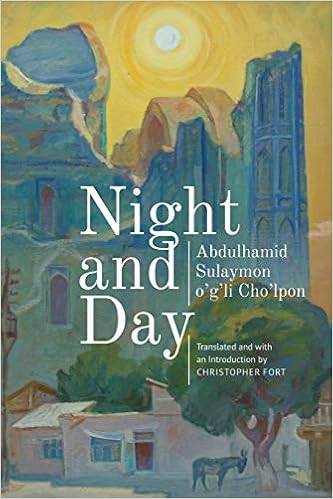
Night and Day by Abdulhamid Sulaymon o’g’li Cho’lpon, translated from Uzbek by Christopher Fort. This novel comes to us from the 1930s and is set at an earlier time, in Turkestan under Russian Imperial rule. “Despite increasing censorship and previous arrests by Soviet authorities, Cholpon subtly employs a variety of techniques including satire and farce to undermine the legitimacy of the Soviet government that was being established around him. Bitterly portraying the hypocrisy and collusion of jadid reformists, Muslim clerics and local Russian officials, this unfinished novel, which was halted by the author’s execution in 1938, remains as one of the darkest comments on Soviet Central Asian history in the Uzbek language,” wrote Shawn T. Lyon about this novel. An illuminating interview with the translator aired on a podcast New Books Network.

Pub Date: November 26, 2019
Publisher: Academic Studies Press

Translated from Uzbek by Shelley Fairweather-Vega, Hamid Ismailov’s GAIA, Queen of Ants is set in England in the milieu of Central Asian immigrants. ” The pivotal relationship in the novel is that between septuagenarian Uzbek émigré Gaia and Domrul, her young Turkish carer. Readers may recognize hints of Harold and Maude,” writes Joshua Bird in a review of this novel. “Contact with Gaia brings up [for Domrul] conflicting feelings of lust, shame and longing, and through their complex relationship, Gaia draws the young man into her dark world of infidelity, sexuality and secrets.”

Pub date: February 11, 2020
Publisher: Syracuse University Press

Good Citizens Need Not Fear is the first book by Maria Reva, who was born in Ukraine and grew up in Canada, and has published a number of the stories from this linked collection in the most prestigious journals of the English-language world, including Electric Literature, Granta, McSweeney’s, The Atlantic, and others. “Set in the Ukrainian town of Kirovka in the 1980s and starring a set of characters who live in the same block of flats, Maria Reva’s enthralling debut of interlinked short stories achieves the double effect of timelessness and timeliness,” Kapka Kassabova writes in The Guardian.

In addition to her fiction writing, Reva translates from French and writes opera libertti!

Pub date: March 10, 2020
Publisher: Doubleday Books

Nino Haratishvili’s The Eighth Life, translated from German by Ruth Martin and Charlotte Collins has been probably the best publicized book on my list. It is currently listed as #11 in “Russian Literature” on Amazon — woo hoo! This book opens in contemporary Berlin, but the family saga begins in Georgia, at the turn of the 20th Century, and follows the central characters to St. Petersburg during the Russian Revolution, and then on through time and geographical locations. “The Eighth Life is narrated by Niza Jashi, a Georgian expatriate living in Berlin, as she writes a history of her family for Brilka, her niece. The novel explores the ways that various characters are fated not only by the political tumult and government brutality of 20th-century Georgia but also by the legacy of a family curse,” explains Lori Feathers in an interview with Haratishvili on Lit Hub.

Pub Date: April 14, 2020
Publisher: Scribe US

Three Apples Fell From the Sky by Narine Abgaryan comes to English in translation by Lisa C. Hayden. Abgaryan was born in a small town in Soviet Armenia, and later moved to the capital of Armenia, Yerevan, and from there, to Moscow. Abgaryan fictionalizes her hometown in her work with tenderness and care, showing us a range of fascinating characters and a lifestyle that seems as though of a different century. This is Abgaryan’s seventh novel, and the first to be translated to English. Due to the pandemic, the pub date for this novel has been delayed to late August, but I encourage all of our readers to pre-order this book (it is already available for pre-order).

While we wait, read Katherine E. Young’s translation of an excerpt from Abgaryan’s earlier novel, People Who Are Always With Me, in Two Lines 31.

Pub Date: August 4, 2020
Publisher: ONEWorld Publications

Don’t forget to order from your favorite local bookshop, they need our help! Bookshop.org is a good second choice.

Welcome, MumberMag!

In April, as COVID19 was already changing our lives, a new literary magazine entered the world. “Literature pretends only to reflect the way things really are, and it is always there for you when everything else has failed,” writes Harry Leeds in his editor’s note to the first issue. “I hope that our magazine is a distraction while you are stuck the hell home.” Leeds is a writer, editor, a translator from Russian, “cat papa,” and is on his way to becoming a nurse. He has a sick sense of humor, he says, which I think gives him a leg up in the whole literary mag game.

We are so delighted to welcome MumberMag’s stellar Mumber One issue. (Gosh, some sense of humor really went into the making of this mag–and I LOVE IT!) Joining Harry in the editorial team is a much beloved poet D. A. Powell, who serves as a Founding Poetry Editor (here’s a profile of him in The New Yorker).

The first issue holds many wonderful gifts for the readers, and for us, interested in post-Soviet literature, there are Boris Dralyuk’s translations from Julia Nemirovskaya who lives in the U.S. and writes poetry and fiction in Russian, and teaches Russian literature and culture at the University of Oregon. Three poems appear in Mumber One, Lamp, Little Box, and Toilet Paper — “Kin to napkin and book.” (Poets really know what’s important in life, long before any crisis strikes.)

Also included in Mumber One is an interview with Maxim Matusevich, whom we at Punctured Lines had the joy to meet in person during our reading at Alley Cat Books in November of 2019. Matusevich lives in the US and writes fiction, essays, and academic work in English. His particular research interest is Russian-African relationships and I highly recommend the book that he edited in 2006: Africa in Russia, Russia in Africa: Three Centuries of Encounters. He has also published fiction in magazines such as The Kenyon Review and New England Review. In his conversation with Leeds, Matusevich talks about St. Petersburg’s legendary cafe Saigon, Soviet hippies, Soviet questionable attempt at being an ally of “the oppressed,” Russia’s current involvement in conflicts across Africa, and lots more. I recommend it!

Last but not least our MumberMag editors are working on creating their list of Top Literary Magazines Ranked By Influence on Social Media. As a huge literary magazine fan, I deeply appreciate the dedication that it takes to create a list like this — and a sense of joy from the fun of it all. Thank you, people!

Help Independent Bookstores Survive Quarantine

In the approximately month and a half that California has been on lockdown, I have barely read anything. This seems counter-intuitive, since I basically read for a living. It also feels like a particularly vulnerable admission, given how much of my personal identity is tied to being a serious reader of “high” literature; not reading feels like failing somehow. But all I’ve managed in the last few weeks is Pushkin’s very short “Пир во время чумы” (“A Feast in Time of Plague”) because it was mentioned on Twitter, a few pages of Proust’s Swann’s Way (thanks to a Twitter reading challenge), and skimming the Chekhov stories I’m teaching this quarter (which I’ve read many times before because I would never skim for teaching. Just to be clear.). My concentration, which was bad even before the pandemic, is abysmal. Zoom has taken over my life. I spend too much time on Twitter, where I envy all the people capable of reading right now.

But I’ve been writing. And every Tuesday and Thursday, my students and I bridge the divide of our Zoom screens by discussing Chekhov’s works. And my Twitter conversations are about literature, which means they’re about a lot of different things. I may not be actively reading at the moment, but books are, like always, very much a part of my life. They’re like that close friend who you might not be in touch with for a long time, but who, unfailingly and warmly, will be there when you finally reach out.

Independent bookstores are having a really hard time. They were having a really hard time before the pandemic, but now they are only able to exist online in a climate of drastically reduced general spending, as so many people have lost their jobs (while we’re at it: if you can, please support your local foodbanks, restaurants, healthcare workers, the post office, etc., etc.). Due to a surge in support, Powell’s hired back some of their employees, while City Lights’ GoFundMe campaign saved them from closing permanently. We’re thrilled for them and want all independent bookstores to have this kind of success.

Below are some of the bookstores we love and would love to help. If you are in the fortunate position to be able to, please order from them and/or support their fundraising efforts. Chekhov – both the writer and the humanitarian, who provided free medical treatment, built schools, donated to libraries, helped with famine relief and a cholera epidemic, and went all the way to Sakhalin Island to write about conditions in a penal colony that led to some reforms – would, I’m sure, appreciate it very much.

Alley Cat Books, San Francisco, CA: This bookstore holds a special place in Punctured Lines’ heart. Olga co-hosts the weekly San Francisco’s Writing Workshop there. The workshop is free and open to the public and is the longest continually running workshop in San Francisco–and, having started in 1946, maybe anywhere. (They are meeting on Zoom at the moment.) Last year, Alley Cat graciously hosted our first Punctured Lines reading. They have a GoFundMe campaign and a Patreon page.

Book Soup, West Hollywood, CA: Many of my family members and friends, and occasionally myself, have received gifts from this local-to-me institution.

City Lights, San Francisco, CA: An iconic beat-era bookstore and a related indie press that published Allen Ginsberg’s “Howl.” This bookstore is a tourist destination, and it’s also a destination for locals. They boast a dedicated poetry room and an amazing collection of books in translation. Their GoFundMe campaign is still running.

McNally Jackson, NYC. The fact that they’re in New York, one of the worst-hit areas of the pandemic, is reason enough. We can fight over whether New York is still the center of U.S. publishing or whether CA is making them very nervous later. We love you, New York. Please get well soon.

Powell’s Books, Portland, OR: If I’m ever in Portland again, I’m going here because I want to see this giant of a bookstore for myself. Until then, I will do what I’ve been doing for years: redeeming gift certificates from family members who know me well.

Skylight Books: Los Angeles, CA: My first-ever reading was here, organized for our class by my amazing creative writing instructor.

The Last Bookstore, Los Angeles, CA: I’ve only browsed here, but it’s pretty amazing.

Vroman’s, Pasadena, CA: I honestly can’t remember if I’ve ever been here, an oversight that needs to be rectified when it’s safe.

If you can’t decide, here’s a way to support Bay Area bookstores collectively.

If you want to help laid-off employees directly, you can give here.

Do you have a favorite indie bookstore not on this list? Let us know and we’ll help spread the word.

Making People Feel Uneasy: Joanna Chen in Conversation with Katherine Young

Katherine Young, a poet and translator, gave this interview on BLARB, the blog of the esteemed Los Angeles Review of Books. In 2018, Academic Studies Press published Young’s translation of the trilogy, Farewell, Aylis, by Akram Aylisli, currently a political prisoner in his native Azerbaijan (Young has spearheaded efforts to free him, including a recent petition circulated on social media). Olga Zilberbourg reviewed this novel, which Punctured Lines noted in our post. As we also noted, an excerpt from his novella, A Fantastical Traffic Jam, translated by Young, can be found here.

Young’s latest project is the translation of Look at Him by Anna Starobinets (Slavica, forthcoming 2020), an open, unflinching account of her abortion that was controversial when it came out in Russia. As Young says, “Women don’t talk about these things, even with their partners, so to write a book in which you expose the most intimate details of your body and the choices you made medically is a violation of a lot of subtle taboos about women who are supposed to grin and bear their trials and tribulations.”

Young also talks about being a poet and how much Russian poetry has shaped her own: “I feel very much more informed by Russian poets than most American poets. I’ve read Walt Whitman, but I don’t identify with him the same way I might say Alexander Pushkin or Mikhail Lermontov or Anna Akhmatova.”

You can read the full interview here: https://blog.lareviewofbooks.org/interviews/making-people-feel-uneasy-joanna-chen-conversation-katherine-young/

Q&A with Olga Livshin: A Life Replaced (Poets and Traitors Press, 2019)

Today on Punctured Lines, our Q&A with Olga Livshin, author of the recently released A Life Replaced: Poems with translations from Anna Akhmatova and Vladimir Gandelsman. We announced the book’s arrival here and you can listen to a podcast discussing it here. She and Olga Zilberbourg will be reading from their collections at an upcoming event in Rochester, NY on November 9, 2019. Olga answered our questions by email.

You wrote a book in which you both translated Akhmatova’s and Gandelsman’s work and wrote original poems that are, directly or indirectly, in dialogue with them. Describe, briefly, your writing process. 

I like the idea of going beyond the one voice–the idea of poetry as a play, and of a book as a porous object, absorbing other energies. There are three characters here: I translated two modernist Russian poets, and then I wrote responses to their work, some of which are imitations. Poets & Traitors Press has this format that fit what I was doing really well. They publish poems based on translations, poems that speak to these translations. So rather than publish a typical poetry collection, which, if you think about it, is this continuous solo for something like 50 or 80 pages, these Poets & Traitors books are a bit like jazz. They’re inclusive. They invent and improvise. Their dynamics are pluralistic and lively.

What were the differences in how you approached writing vs. translating poetry? 

It’s pretty seamless. When I translate, it’s a bit like giving a voice, and it’s also implicit dialogue, of course, since translation is interpretation–it’s full of choices. And when I write back, or talk back, the dialogue goes further. All of this, though, is part of the same kind of play: where the characters depend on one another and echo each other.  

What about translating/“talking to” Akhmatova? 

Yeah, “talking to,” for sure! Akhmatova is an author that a lot of mothers who grew up in the 1960s and 1970s quoted to their daughters–my mom quoted her to me. And I think a lot of people thought–still think–of her as a symbol of stoicism and of grieving wisdom, a model for how to live with dignity and defend fellow others under repressive regimes. In our family, she was like this Lilith, great mother, forever strong and even raging. It was rather difficult: you know, she was someone you could quote, but never be, right? Then I went to grad school to get my PhD in Slavic Studies, and I learned that some prominent literary scholars had showed that she was no angel, she was a full human with flaws, and–they wished to show–that she was rather a monster. I think both of these extremes are kind of silly. In my book I don’t so much aim to dethrone as to discover.  There’s a different Akhmatova than the one people know: brazen and humorous behind all that mighty moral raging. She’s a perpetual child, even in her later work, trusting love for love’s sake, no matter what life did to her. “To me, in poetry, everything should be out of line,” she writes, “Not how these things are done. / I wish you knew what garbage sprouts poems….” I want to know about this bold, hidden girl, and I want people to know her.

How about translating/“talking to” Gandelsman?

He is closer to me and thus less hidden. Vladimir Gandelsman was born in 1948 and came of age in Leningrad before it turned into St. Petersburg and before he left for the United States, where he lives now. He’s an immigrant like me, and he has similar instances of alienation. So when it comes to his work, I’m basically a devotee. I aim to push this writer forward and amplify his voice. Gandelsman’s work has such a unique way of balancing human emotions such as irritation and anxiety with this amazing appreciation of small joyful moments, which are just sublime in his work. Gandelsman, to my eye, transcends what so many poets and writers in Russia had: this hatred of byt, the everyday.  There was a bunch of visionary philosophers a hundred years ago, they all wished to go beyond our biological and biographical limitations. Beyond the body, beyond the home. On the other hand, Gandelsman is the supreme discoverer of light in the dust of the domestic. And in nature, which he paints in some beautifully minimalist ways. And in one’s own family, even in some difficult moments. He is a very generous poet. Where I write in parallel are poems of small joy: he has a small bird in the sky, I have little mushrooms; he has a hallowed moment of immigrant recognition of oneself in an American-grown boy, I have recognition of a Syrian immigrant’s stories in our own tales of self. I want to help this voice be in the world and take on new forms, in English, and in my little sprouts off it.

Other than Gandelsman, what is your relationship with contemporary Russian literature in general?

I enjoy some voices. Maria Stepanova. Vassia Borodin. Polina Barskova, in the US. And then in Ukraine, so much great and heartbreaking poetry in Russian is coming out from people writing about the war. Boris Khersonsky and Lyudmyla Khersonska. I really like Anastasia Afanasieva’s work. Iya Kiva’s poetry. There is an incredible urgency to these voices, and they’re profoundly intertextual, in dialogue with other language about war and violence, going all the way back to the Bible and all the way forward to how Russian and Ukrainian TV talks about war.

In addition to the two in your book, who are some of the writers that inspire you?

There is a flowering of immigrant and first-generation American poetry now. So many rich voices. From the better known, such as Chen Chen and Ocean Vuong, to those that should be better known. Ahmad Almallah’s recent book Bitter English addresses issues of writing in English as an immigrant. Jenna Le has gorgeous poems that capture the intersection of girlhood and growing up Vietnamese-American in Minnesota. Ananda Lima has made fine, strange, surrealist prose as well as poetry that looks at issues of home and motherhood in the context of being an immigrant. I love how these poets echo certain ruins of their cultural past with not-quite utopias of their American present. 

Do you find yourself working against some Russian cultural stereotypes?

Ha! I have carried so much shame about these for so many years. It’s kind of gone, but of course you can’t quite get rid of it. But that’s what writing is for–finding a voice that is more complicated than these stereotypes and insisting on maintaining that voice. Both in your writing and also, once you find it, the beautiful thing is, you can take it wherever you find it relevant. 

As a writer one of whose major topics is immigration, do you find yourself connecting with other diaspora writers?

I like Boris Fishman’s prose. Julia Kolchinsky Dasbach is one of my favorite Russian American poets. A fellow Russian-speaking Ukrainian Jew, she just published a fiery poetry collection called The Many Names for Mother. It’s such a bittersweet exploration of motherhood and the infinite in the context of her origins, both feminine and Soviet/ Ukrainian/Jewish. It’s so, so good.

How do you relate to feminist ideas and navigate the gap between the different gender expectations in American vs. Russian cultures? Do you see any shift of Russian gender norms in the diaspora?

So I got pretty lucky: I grew up with a mother who has a strong personality and who worked at this beautiful glorious music school in Moscow, where we lived from when I was 7 to when I was 14 and we moved to the US. To me, she channeled powerful feminist thought, although that’s not language she used. Yes, we dressed up, but it was to strut our stuff and have fun, not in order to please a man. I also grew up in a family where everyone had worked: both grandmas, my mom, all her female ancestors were peasants. So there was a version of Soviet and Russian homespun feminism that may be problematic and all, it wasn’t perfect, the guys didn’t necessarily help out, but at least there’s that gender modeling of strong women. There is this concept of the matriarchy, and also of women working for generations. 

I find it more irksome to navigate some situations with expectations for women from white Anglo-American upper middle class and upper class backgrounds. There’s an awful lot of stuff that I have trouble relating to, not only helicopter parenting or beautiful thin appearances in beautiful thin yoga pants, but also stay-at-home motherhood. That stuff is hard! It’s really a terrible thing when you know people who live according to those expectations–fraught with depression and with not being recognized as a human being. And when I was a stay-at-home–uh, poet–in our rather affluent suburb, I didn’t wear that identity, but the expectations were quite definite. But I think that the Russian strong woman, not unlike one that Akhmatova wanted people to think she was, wanted people to believe she could be, it’s an ideal and all, but it’s really a fantastic thing to embody. It’s a bigger expectation than the “little woman” that’s stuck around in our America. The resilient, powerful Russian lady–that’s a tall expectation, and it calls on us to stand tall, and I’m proud of that idea.