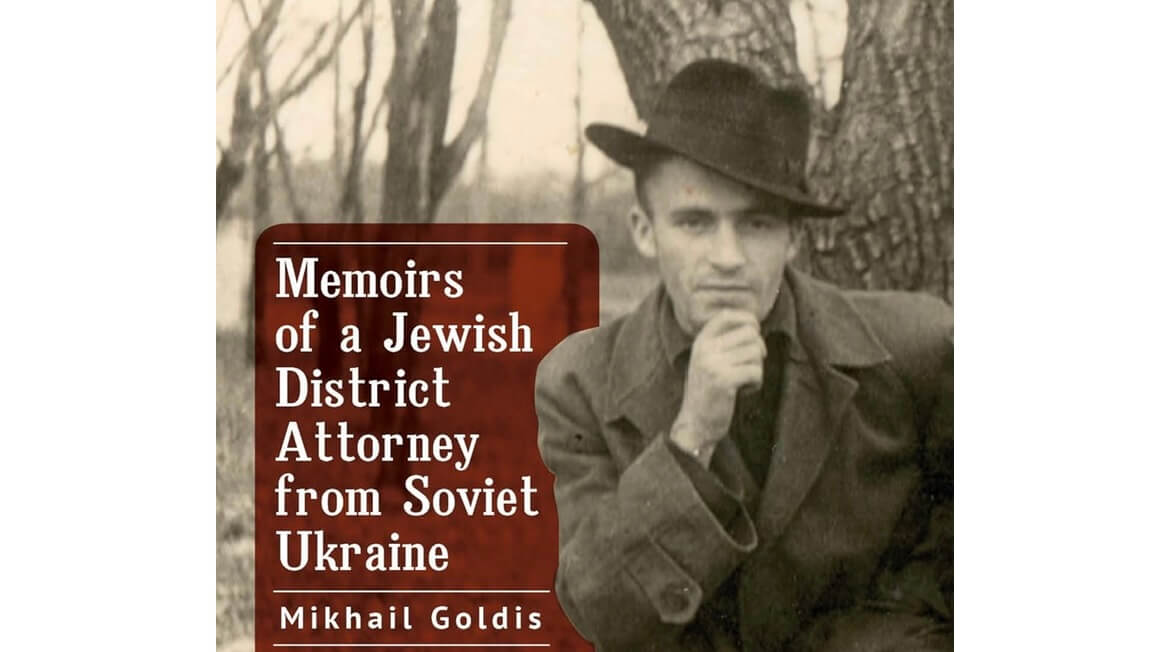
We are happy to feature an excerpt from Mikhail Goldis’s Memoirs of a Jewish District Attorney from Soviet Ukraine (Academic Studies Press, 2024), translated by Marat Grinberg, professor of Russian and humanities at Reed College and Goldis’s grandson. Grinberg’s previous book was the highly informative The Soviet Jewish Bookshelf: Jewish Culture and Identity Between the Lines (Brandeis University Press, 2022). The Soviet Jewish Bookshelf makes the original argument that, in the anti-Semitic Soviet Union, Jews circumvented the proscriptions on public expression of Jewish identity “through their ‘reading practices'”: they built up home libraries of books on Jewish subjects, which, given “the heavy censorship of Jewish content,” they often had to read “between the lines” (the citations are from my review). Olga interviewed Marat about his book, and you can listen to their rich conversation here, which includes reading suggestions of the various writers the book discusses.
Continue reading “Seven Forty: Memoirs of a Jewish District Attorney from Soviet Ukraine by Mikhail Goldis, translated, edited, and with an Introduction by Marat Grinberg”Category: Translated Literature
Video from Born in the USSR: Diaspora Writers Against War
Thanks to those of you who could attend our event, Born in the USSR: Diaspora Writers Against War, hosted by the Wende Museum on March 28. We loved having you as our audience and hope to continue the conversations in various ways.
Thank you for donating to Ukraine Trust Chain. Ukraine needs all of our support. Please continue to spread the word and donate here: https://www.ukrainetrustchain.org/
The video from our event is now online:
Continue reading “Video from Born in the USSR: Diaspora Writers Against War”Born in the USSR: Diaspora Writers Against War

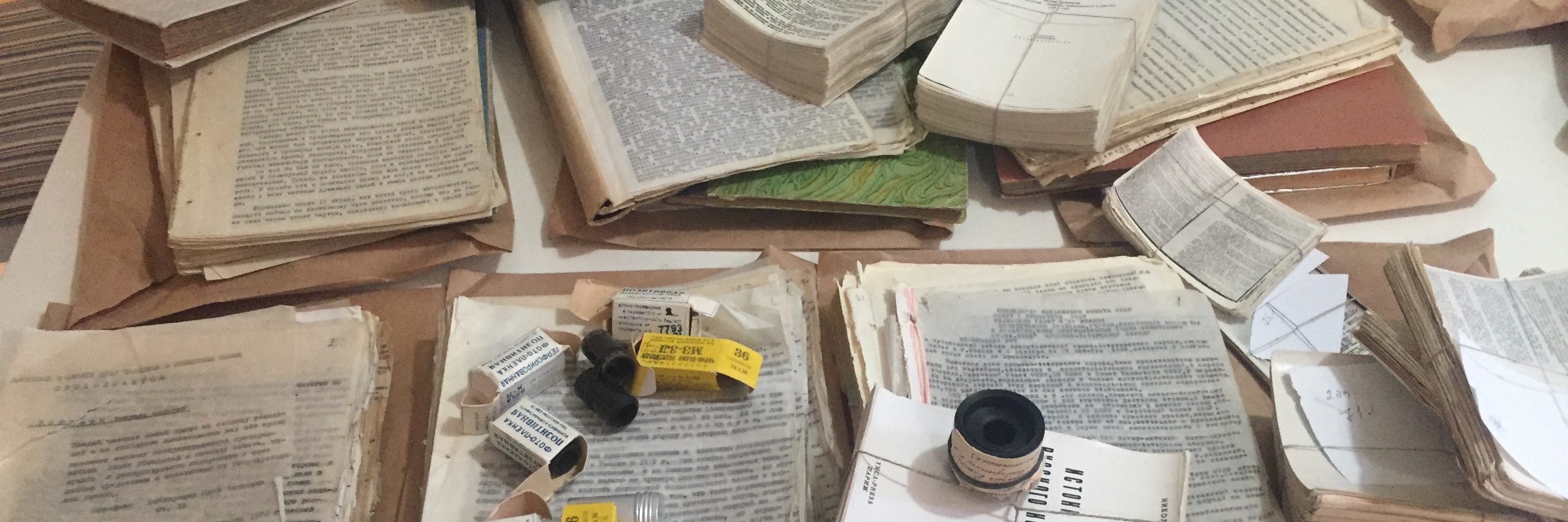
This one of a kind reading brings together Soviet-born writers as they weave together an intricate story of identity, memory, cultural intersections, immigration, and war. From fiction to poetry, memoir and journalism, and work in translation, the reading presents a deep dive into the individual and collective experiences of the Soviet-born diaspora in the U.S. This free event includes a fundraiser in support of humanitarian aid in Ukraine and aligns with The Wende Museum’s current exhibition “Undercurrents II: Archives and the Making of Soviet Jewish Identity.” Autographed books will be on sale, courtesy of Village Well.
Hosted by The Wende Museum, readers include poets, writers, and translators: Katya Apekina, Yelena Furman, Kristina Gorcheva-Newberry, Julia Kolchinsky, Arina Kole, Maria Kuznetsova, Olga Livshin, Ruth Madievsky, Ainsley Morse, Luisa Muradyan, Jane Muschenetz, Asya Partan, Irina Reyn, Diana Ruzova, Timmy Straw, Vlada Teper, Sasha Vasilyuk, and Olga Zilberbourg.
Continue reading “Born in the USSR: Diaspora Writers Against War”Narrating a Violent Childhood: A Q&A with Fiona Bell and Margarita Vaysman about Avdotya Panaeva’s The Talnikov Family
Avdotya Panaeva was born in 1820 and first began publishing her work in one of Russia’s premier literary magazines, Sovremennik, in 1846. The author of numerous short stories, novels, memoirs, as well as collaborative projects, she has only recently begun to achieve the recognition that she deserves in the English-speaking world.
On October 8, 2024, Columbia University Press published Fiona Bell’s translation of Panaeva’s first novel, The Talnikov Family. This became the second full-length translation of Panaeva’s work to English. In my review of the book in On the Seawall, I mention several social and historical factors that have kept this delightful novel from English-language readers for so long. In writing about this book, I have relied, in part, on Bell’s introduction to the novel and on the research by Margarita Vaysman, whose book Self-Conscious Realism: Metafiction and the Nineteenth-Century Russian Novel devotes a section to Panaeva’s work, including an excerpt that ran in Punctured Lines.
Today, it is my pleasure to discuss this novel and Panaeva’s work more broadly with her translator Fiona Bell and scholar Margarita Vaysman.
Continue reading “Narrating a Violent Childhood: A Q&A with Fiona Bell and Margarita Vaysman about Avdotya Panaeva’s The Talnikov Family”Ugrinovich and the Sex Giant: Fiction by Anna Natalia Malachowskaja, translated by Anastasia Savenko-Moore
Anna Natalia Malachowskaja is a well-known Soviet and Russian author, feminist, and dissident. In 1979, together with Tatiana Goricheva, Tatiana Mamonova, and Julia Voznesenskaya, she wrote and edited a feminist samizdat publication Женщина и Россия [Woman and Russia] and later Maria. These publications were deemed anti-Soviet; the women were questioned by the KGB and forced to emigrate. Having settled in Austria, Malachowskaja completed her Ph.D. at the University of Salzburg. She turned her research into the Russian folklore character of Baba Yaga into a series of published books where she argues that the fairy tale character is a marginalization and amalgamation of three goddesses of the ancient world. In addition to her scholarship, Malachowskaja is the author of novels, collections of stories, and poems. Malachowskaja’s fiction is frequently accompanied by art. As an artist, she has exhibited her work in St. Petersburg, Vienna, and Salzburg.
Continue reading “Ugrinovich and the Sex Giant: Fiction by Anna Natalia Malachowskaja, translated by Anastasia Savenko-Moore”Poems Betwixt Paths: Herb Randall in Conversation with Irina Mashinski
We are grateful to Herb Randall and Irina Mashinski for bringing us this interview about poetry, translation, music, and more. Both of them have appeared on Punctured Lines previously. An excerpt from Irina Mashinski’s hybrid poetry and prose collection The Naked World can be found here (while Herb Randall’s review of it in the Los Angeles Review of Books is here). At Punctured Lines, Herb Randall has contributed a personal essay about visiting Kharkiv and looking for traces of an English woman who moved there during Stalin’s reign and a review of Sana Krasikov’s The Patriots, about an American Jewish woman who also moves to Stalin’s Soviet Union (a clearly misguided endeavor from any country). We are very happy to have them back with the following in-depth discussion.
Continue reading “Poems Betwixt Paths: Herb Randall in Conversation with Irina Mashinski”Three Poems from Disbelief: 100 Russian Anti-War Poems, edited by Julia Nemirovskaya
Today we feature three poems from the Russian-language anthology Disbelief: 100 Russian Anti-War Poems (edited by Julia Nemirovskaya; various translators; Smokestack Books, 2023). We are grateful for the following introduction written for Punctured Lines by Maria Bloshteyn, one of the translators of the collection. As she notes below, one of the featured poets, Galina Itskovich, is a therapist helping those in Ukraine; you can donate here to support this work.
Continue reading “Three Poems from Disbelief: 100 Russian Anti-War Poems, edited by Julia Nemirovskaya”Olga Krauze, a profile by Sonja Franeta
“Обстрел прекратился в 11:30. Пока всё тихо. У нас в квартире тепло, работает водопровод и центральное отопление. Нет электричества, но светит солнце и на улице тает снег.” [The shelling stopped at 11:30. For now everything is quiet. Our apartment is warm, and there’s running water and central heating. No electricity, but the sun is shining and the snow is melting outside.]
—my friend Olga Krauze writes from Kharkiv, the second largest city in Ukraine. I was interviewing her on Zoom for this profile and we got interrupted. Olga is a poet and singer and I’ve known her since 1991. She has lived in Kharkiv for 12 years with her partner Elina, who is Ukrainian.
Continue reading “Olga Krauze, a profile by Sonja Franeta”Aikanush: An Excerpt from Akram Aylisli’s Stone Dreams, translated by Katherine E. Young

On February 9, 2013, Akram Aylisli’s books were burned in his native village. For more than six decades, Azerbaijan’s most prominent writer has written fiction about the mountain village of Aylis, from which he took his pen name; Aylisli called the day of the burning “the most terrible day of my life.” Why were his books burned? Aylisli had published a novella, Stone Dreams, that challenged official propaganda erasing the role played by Armenians in the history of Azerbaijan, a country currently dominated by ethnic Azeris (Azerbaijan and neighboring Armenia have engaged in military hostilities since before the collapse of the Soviet Union). Stone Dreams is among the first fictional works in the greater Turkic-speaking world to depict both historical and contemporary violence against ethnic Armenians, and it includes sympathetic portrayals of Armenian villagers residing in Azerbaijan. The novella also portrays the corruption and authoritarianism of modern-day Azerbaijan. In the uproar that greeted the novella’s publication, Aylisli was stripped of his presidential honors and pension. An empty coffin was paraded around the courtyard of his residence, and a bounty—later rescinded under international pressure—was offered to anyone who would cut off the writer’s ear. In 2014, international supporters nominated Aylisli for the Nobel Peace Prize for “his efforts to reconcile Azerbaijani and Armenian people.” In 2016, trumped-up legal charges were filed against Aylisli by the Azerbaijani government, a case that is still pending. Ten years after his books were burned, Akram Aylisli continues to live under de facto house arrest in Azerbaijan, unable to leave the city of Baku. He is 85.
Continue reading “Aikanush: An Excerpt from Akram Aylisli’s Stone Dreams, translated by Katherine E. Young”Every Story Deserves a Beautiful Happy Ending: A Review of Contemporary Queer Plays by Russian Playwrights, Edited and Translated by Tatiana Klepikova, by Dante Matero
Today’s review gives me special pleasure to feature on Punctured Lines, as Dante Matero was my student several years ago at UCLA. As he discusses below, Putin’s Russia is virulently homophobic, while as he also notes, the U.S. has its own share of highly regressive elements. In a heart-breaking and maddening coincidence, this review is coming out just after Russia has enacted its most far-reaching anti-LGBTQ law and in the aftermath in the U.S. of another mass shooting targeting LGBTQ members. Words cannot prevent homophobic laws or stop bullets. What they can do is offer a space of community and solidarity and to amplify marginalized voices. We at Punctured Lines stand with the LGBTQ communities in our old and new homes and are grateful to Dante for highlighting this unique and necessary collection. To support LGBTQ organizations, you can donate to RusaLGBTQ, which helps former Soviet immigrants in the U.S., and which, because of Russia’s attack on Ukraine, has started a GoFundMe for Ukrainian refugees in the U.S.
Continue reading “Every Story Deserves a Beautiful Happy Ending: A Review of Contemporary Queer Plays by Russian Playwrights, Edited and Translated by Tatiana Klepikova, by Dante Matero”

