Alicia J. Rouverol on Olga Zilberbourg’s Like Water and Other Stories (WTAW Press, 2019)

A recent review singing the richly deserved praises of our own Olga Zilberbourg’s debut English-language collection, LIKE WATER AND OTHER STORIES, out now:

“In an era of ‘short shorts’ hailed in by the venerable Lydia Davis—and culminating in ‘the fragmentary’ in the recent Nobel Prize-winning work of Olga Tokarczuk—one wonders if there remains space for a new collection of shorts: stories that up-end expectation and offer distinctive voice and lesser charted areas of exploration. San Francisco-based, Russian émigré writer Olga Zilberbourg, in her first story collection published in English, allays that concern. Zilberbourg is author of three Russian-language story collections; her fiction has been widely published in esteemed US literary journals; and she has won numerous prizes, including the Willesden Herald International Short Story Prize in 2016. A native of Leningrad, raised in St Petersburg, Zilberbourg moved to the US in 2006 to study at the Rochester Institute of Technology, later earning the MA in Comparative Literature at San Francisco State University.”

http://www.themanchesterreview.co.uk/?p=11103

The NOS(E) Award’s 2019 Longlist

Thank you, as always, to Lisa Hayden of Lizok’s Bookshelf for keeping us all up to date on prize-related announcements. We are happy to share the list here, particularly as it contains her very helpful, and entertaining, descriptions of the nominated works. Less happy is the subject we’ve talked about previously on this blog (and which, in the wake of the Nobel, some of us have debated in a – let’s go with “spirited” – manner on Twitter): of the sixteen titles, only three are by women. While no one in their right mind would suggest that gender should be the sole criterion for anything, really, there is a real issue with Russian literary prizes being overwhelmingly skewed toward male writers (googling the major award winners will confirm this in short order). This is not meant as a slight to any of the men on the list, but it is a question that needs to be asked, over and over, until we arrive at a workable solution: how do we honor good writing whoever the writer may be while at the same time ensure more balanced representation in terms of nominations and winners? Suggestions welcome; perhaps someone can forward them to the Russian prize committees.

http://lizoksbooks.blogspot.com/2019/10/the-nose-awards-2019-longlist.html

A Soviet YA Classic: Aleksandra Brushtein’s Дорога уходит в даль (The Road Goes off into the Distance)

It is hard to overstate just how much Aleksandra Brushtein’s autobiographical novel about Aleksandra (Sasha) Yanovskaya, a young Jewish girl growing up in Vilna at the turn of the century, was beloved by generations of Soviet children. At a time when I have completely forgotten plots of books I read much later, I can still recall various episodes from this one. A copy of the book, which my family took with us when we left the Soviet Union, is one of my prized possessions. My mom loved this book so much she wanted to name me Sasha (an attempt ended by my great-grandmother Aleksandra’s announcement post my birth that Ashkenazi Jews cannot name children after living relatives). A remarkable thing about this novel is that it has a Jewish protagonist and depicts Jewish life but still became so popular in a country as anti-Semitic as the Soviet Union. Its popularity has endured in contemporary Russia, where “since 2005, a new printing of the book by different publishers has appeared almost every two years,” including an annotated edition.

Yet as Liza Rozovsky’s article notes, Brushtein “is barely known outside the Russian-speaking world.” To date, there is no English translation. If there is a translator out there who could take on this project, many in the diaspora would be eternally grateful on behalf of their children and their English-speaking friends’ children. In any case, it’s great to see this book being written about at length and we — and our inner younger selves — are thrilled to highlight it on Punctured Lines.

“The book that is imprinted in my memory as a moral and political compass, and the book I would like my children to know, is a Soviet-era work for children and juveniles titled “The Road Slips Away into the Distance.” It’s an autobiographical trilogy by the Jewish children’s playwright and memoirist Aleksandra Brushtein, who is barely known outside the Russian-speaking world. The first volume of the work was translated into Hebrew in the 1980s, but Brushtein (1884-1968) remains unknown in Israel, too. In the Soviet Union, where it ran through many editions of tens of thousands of copies each, the trilogy achieved cult status.”

The Novel That Introduced Soviet Jews to Their Forgotten History
Yelena Furman on Olga Zilberbourg’s Like Water and Other Stories

“In ‘Rubicon,’ which opens Olga Zilberbourg’s Like Water and Other Stories, the narrator, on her way to pick up her son from preschool, says, ‘spring came on hard and much too early this year, which must be why the dimensions of reality shifted.’ If the story’s realistic beginning gives the impression that this shift is figurative, it soon becomes apparent that reality really does alter: on a street in San Francisco, a young man she knew back in 1990s Russia, who is ‘still seventeen on this day in 2018,’ drives up to hand her a ‘TDK compact cassette, the exact kind he and I used to exchange in high school.'”

http://jordanrussiacenter.org/news/review-olga-zilberbourgs-english-language-debut-like-water-and-other-stories/#.XaItf0ZKiyI  

Yelena Furman on Ksenia Buksha’s “The Freedom Factory”

“A NOVEL ABOUT a Soviet military factory whose workers must eventually adjust to a post-Soviet way of life does not sound like a thrilling read. Yet there’s a very good reason why Ksenia Buksha’s The Freedom Factory (Zavod “Svoboda”) won Russia’s National Bestseller Prize in 2014 (Buksha is only the second of three women to do so since the prize’s founding in 2001) and was also a finalist for the Big Book Award. In the author’s hands, this unpromising raw material is skillfully transformed into a genuinely and unexpectedly compelling narrative.” 

https://lareviewofbooks.org/article/shintity-fug-these-vulstes-on-ksenia-bukshas-the-freedom-factory

Russian Samizdat, Children’s Literature, and the Sunset Years of the Soviet Empire

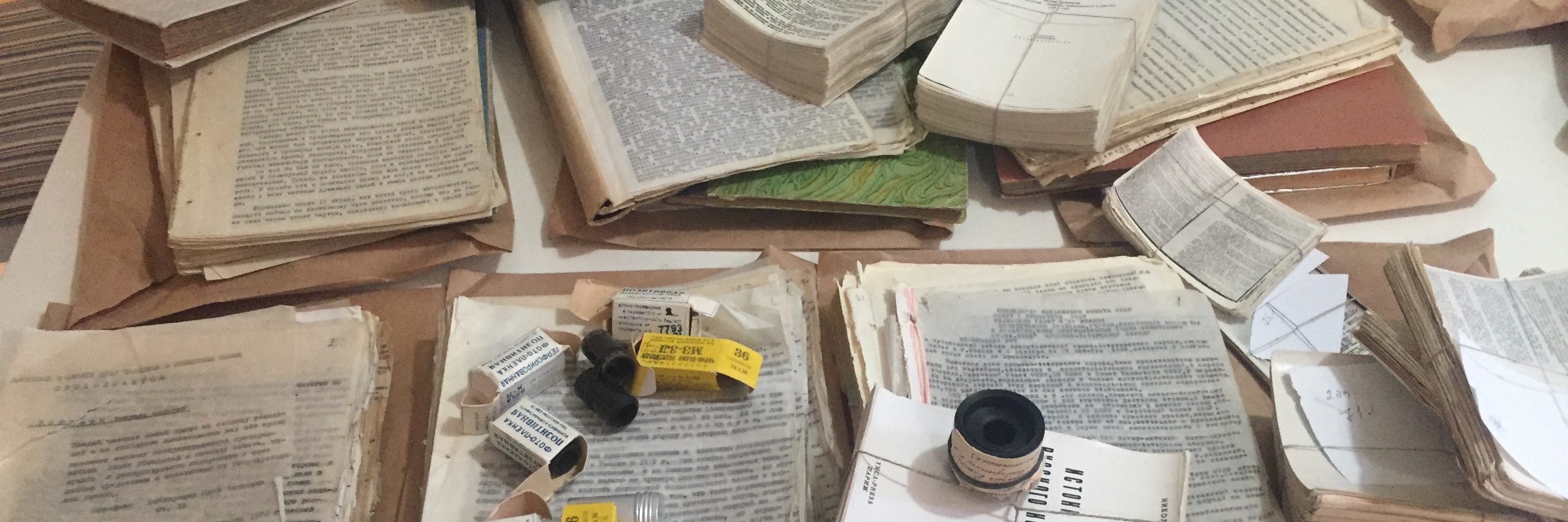
Olga Bukhina wrote a fascinating piece on the C.S. Lewis’s Chronicles of Narnia in the Soviet Union. My parents were regular consumers of Samizdat, but I don’t remember seeing the Narnia books in their hands — perhaps, it’s the overtly Christian message that put them off. My parents weren’t interested in religion or science fiction, but I was, and just a few years later I devoured Lord of the Rings when it was officially published in 1991. (Of course, it’s entirely possible that my parents read it without my knowledge. Parents are apt to do things like that…)

https://childlitassn.wixsite.com/intlcommittee/single-post/2019/09/25/Russian-Samizdat-Children%E2%80%99s-Literature-and-the-Sunset-Years-of-the-Soviet-Empire

Narnia was not just a religious threat; in the Soviet context, it was clearly political. The message of these fairytales turned out to be much more dangerous than particular words and images that could be eliminated by censorship. The words of the faun Mr. Tumnus, “It is winter in Narnia, and has been for ever so long… Always winter and never Christmas; think of that,” in The Lion, the Witch and the Wardrobe (The Chronicles of Narnia. New York: HarperCollins Publisher, 2001, p. 118), resonated to the reader as an image of the Soviet political winter without any hope for change; the change being symbolized by Christmas.

How Should We Review Translations? Part II

Asymptote journal continues its discussion about translating and reviewing literature. The focus this time is on Korean poetry, but the issues raised are relevant to other translated literatures.

“To me, the most interesting aspect of reviewing a translation—above and beyond the accurate and thoughtful accounting of the book in question that all reviews require—is imagining how it will affect and be affected by its reception within the standards of specific reading communities. Or to put it another way: how the translation speaks to the context of a reading community and how that community speaks to the translation.”

https://www.asymptotejournal.com/blog/2019/09/25/how-should-we-review-translations-part-ii/

An early reader’s review of Hamid Ismailov’s Of Strangers and Bees in Shelley Fairweather-Vega’s translation

David Chaffetz writes for Asian Review of Books:

“One could characterize the overall effect as Master and Margarita comes to the Uzbek Cultural Center of Queens, NY. The poet’s profusion of words underscores his passion for his experience as a child growing up in the fields of Transoxiana, the insouciance of being a state-sponsored intellectual, the desperation of being a stateless person in rigidly bourgeois Europe.”

Olga Zilberbourg: To Understand Russia’s Complexities, Turn to Its Contemporary Literature

“A FRIEND’S TEN-YEAR-OLD SON son recently came up to me at a party to ask, ‘You’re from Russia, right?’ Sensing caution in my assent, the boy hesitated before asking the next question, clearly trying to phrase it in a way that wouldn’t cause offense but would express his curiosity. He finally came up with, ‘It’s a very violent place, isn’t it?'”

http://epiphanyzine.com/features/understand-russias-complexities?fbclid=IwAR35rzgR1U6dFXsYJM6ueL6nid8S9R6BR0Qr44elOeHnU2HwPtyzVpxJ0RY

Olga Zilberbourg on Teffi’s Memories: From Moscow to the Black Sea

“Teffi, nom de plume of Nadezhda Lokhvitskaya, was born in 1872 into a prominent Russian family. Following in the footsteps of her older sister Maria—poet Mirra Lokhvitskaya—Teffi published poetry and prose from the age of 29. She soon rose to fame by practicing a unique brand of self-deprecating humor and topical social satire.”

https://www.thecommononline.org/review-memories-from-moscow-to-the-black-sea/?fbclid=IwAR2VI663kHbmhMarVRRwhcusvCmxG_KFMLKu7MtIRnHLUpUTBZs7dZmQnK8