How Should We Review Translations? Part II

Asymptote journal continues its discussion about translating and reviewing literature. The focus this time is on Korean poetry, but the issues raised are relevant to other translated literatures.

“To me, the most interesting aspect of reviewing a translation—above and beyond the accurate and thoughtful accounting of the book in question that all reviews require—is imagining how it will affect and be affected by its reception within the standards of specific reading communities. Or to put it another way: how the translation speaks to the context of a reading community and how that community speaks to the translation.”

https://www.asymptotejournal.com/blog/2019/09/25/how-should-we-review-translations-part-ii/

A profile of Ilya Kaminsky

The Guardian has published a lovely profile of Ilya Kaminsky, related to Deaf Republic, his second collection of poetry.

Odessa was a cosmopolitan place, a “city of laughter” in which poetry was revered, and from an early age Kaminsky wrote and learned it by heart. When he was 12 his prose writing was published in the local newspaper, after he answered a call-out to schoolchildren to contribute, because the paper had no money to pay journalists. At 15, though he thought of poetry as “a private thing”, he produced his first chapbook. He had graduated from school by the time the family was forced into exile.

Unfortunately, I Care: Joanna Chen Interviews Olga Livshin (BLARB)

Read Joanna Chen’s beautiful and insightful interview with poet and translator Olga Livshin about her just-released book A Life Replaced: Poems with translations from Anna Akhmatova and Vladimir Gandelsman:

“And so for me, even when I write in English, it’s as if I am writing in Russian because I’m releasing something that was the first fourteen years of my life, it’s like I carry this genie inside me and I need to let it out occasionally. Let it walk around a little before I bottle it back up.” https://blog.lareviewofbooks.org/poetry/unfortunately-care-joanna-chen-interviews-olga-livshin/

How Should We Review Translations? Part I

The beginning of an important, thoughtful, and often maddening conversation by Asymptote journal about the state of translated literature in the U.S. and the role of reviewers writing about it. Shocker: there is relatively little international literature being translated, published, reviewed, and read in this country. There is even less by women/non-Western European writers. A question we have been asking ourselves, each other, and anyone who would listen is what can be done about changing this situation. It is one of the main reasons we started this blog. This is a collective endeavor, which doesn’t have a simple answer. Suggestions welcome.

“For instance, only six of the nearly one hundred books reviewed on my watch were written by African writers. A whole 17% were translated either from Spanish or French. Moreover, only 16% were books of poetry rather than prose […] exactly two thirds of contributors to the Criticism section were men, and […] close to two thirds of the authors reviewed were men.”

https://www.asymptotejournal.com/blog/2019/09/23/how-should-we-review-translations-part-i/?fbclid=IwAR3Qh_3jCPSwCo2iXqO9vSZ2Pb_Wdra4rCt7r5ds4BQvGY0pkrOkRbaul54

Matter | A (somewhat) monthly journal of political poetry and commentary

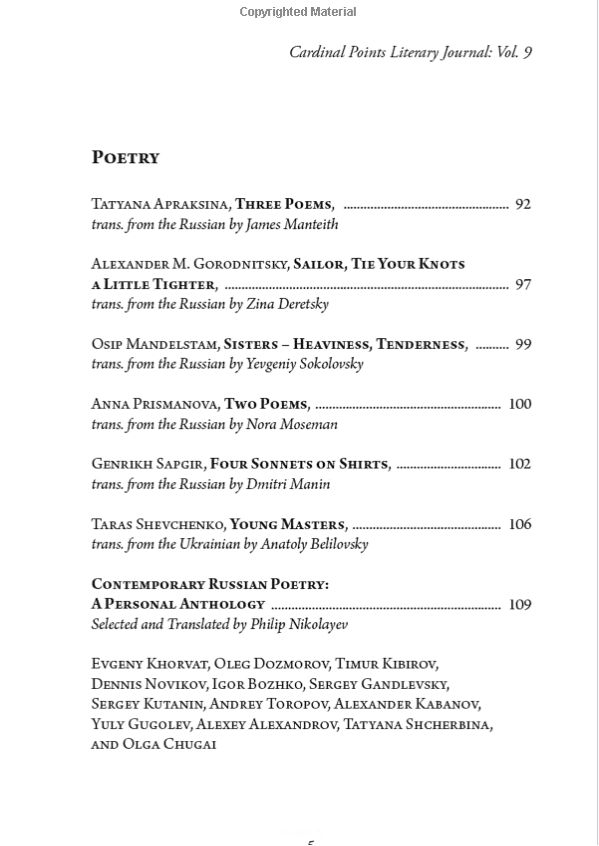
Guest-edited by Larissa Shmailo and Philip Nikolaev, Issue 26 is dedicated to political poetry and prose in translation from Russian and written originally in English by writers with Russian affiliations.

In the spirit of 2019, at least two poets (Anna Halberstadt and Katia Kapovich) write about Stalin: “O motherland. O motherfuckerland,” sighs-screams Kapovich.

Olga Livshin and Polina Barskova (translated by Philip Nikolaev) are in conversation with Akhmatova.

Katherine E. Young translates Inna Kabysh:

O, Moscow, Tatar sack of gold:
obedient and cunning,
boyar’s beard, son-of-a-bitch,
matchmaker, drunk in the morning

More treasures here:

Sinead Morrissey’s Soviet Poems

September 2019 issue of AWP’s The Writer’s Chronicle includes Chapman Hood Frazier’s interview with poet Sinead Morrissey, a highly decorated poet hailing from Northern Ireland. Her collection Parallax (which won the T.S. Eliot Prize) includes a poem titled “Shostakovich” in a group of a few others that directly reference the Soviet Union.

In the interview, Morrissey explains that her parents were members of the Communist Party. “Growing up in a Communist household and having, as a consequence, a rosier view of the Soviet Union and the Communist project than neraly everyone else around me, gave me a particular world-view which came under strain as an adult, when I began to read Russian history and to understand some of the atrocities which had taken place. This is one of the most important instances of parallax in my own life, and one which Parallax as a body of work is also most exercised with. The Soviet poems are kinds of punctuation marks throughout the book, and all of them are different. In the end I think the subject itself is unknowable–what we see is always so determined by where we stand–and it is the fraught act of perception itself which interests me most of all.”

The interview is in the print issue of the magazine and is available online with subscription.

New Book Alert: Elena Fanailova’s The Russian Version (2nd Edition)

Author: Elena Fanailova

Translators: Genya Turovskaya and Stephanie Sandler

Publisher: Ugly Duckling Presse

Website: https://uglyducklingpresse.org/publications/the-russian-version-2nd-edition/

Small Press Distribution announcement: ” Poetry. Translated from the Russian by Genya Turovskaya and Stephanie Sandler. THE RUSSIAN VERSION is a collection of poems that spans Russia’s post-Soviet era. Acclaimed journalist and poet, Elena Fanailova tells stories about the various social layers of a stratified and conflicted nation, reclaiming the poet’s role as social critic, while scrutinizing her own position as citizen and poet. Fanailova’s political lyricism casts personal pain into the net of historical suffering.”

Published in 2009 by Ugly Duckling Presse, it received Best Translated Book Award for Poetry from Three Percent. The 2019 second edition of THE RUSSIAN VERSION includes a more recent long poem, ‘Lena and Lena.’

The Cheburashka Collective: New poetry of the post-Soviet diaspora

The Cheburashka Collective is a group of women and non-binary writers whose identity has been shaped by immigration from the Soviet Union to the United States. On April 27, 2019, six members of the group, which is named for a beloved Soviet cartoon character, gathered in Philadelphia’s Penn Book Center for a poetry readingMeduza in English news editor Hilah Kohen sat down with five of those poets before the event. They discussed what shared immigrant experiences can do for collectives, what collectivity can do for poetry, and what poetry can do for our world today. The “Cheburashki” also shared seven of their recent poems, which are reprinted below this interview with the kind permission of their publishers.”

https://meduza.io/en/feature/2019/04/29/the-cheburashka-collective-new-poetry-of-the-post-soviet-diaspora