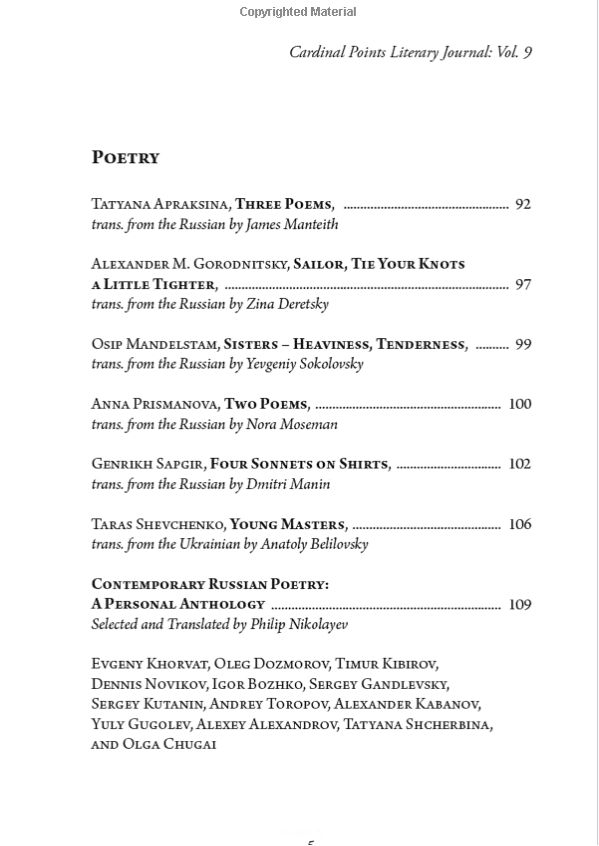
Cardinal Points is the Literary Journal of the Slavic Studies Department at Brown University. Issue editor: Boris Dralyuk. Editorial team includes: Boris Dralyuk, Irina Mashinski, Robert Chandler.
Issue 9 is now available for purchase:
Cardinal Points is the Literary Journal of the Slavic Studies Department at Brown University. Issue editor: Boris Dralyuk. Editorial team includes: Boris Dralyuk, Irina Mashinski, Robert Chandler.
Issue 9 is now available for purchase:

Guest-edited by Larissa Shmailo and Philip Nikolaev, Issue 26 is dedicated to political poetry and prose in translation from Russian and written originally in English by writers with Russian affiliations.
In the spirit of 2019, at least two poets (Anna Halberstadt and Katia Kapovich) write about Stalin: “O motherland. O motherfuckerland,” sighs-screams Kapovich.
Olga Livshin and Polina Barskova (translated by Philip Nikolaev) are in conversation with Akhmatova.
Katherine E. Young translates Inna Kabysh:
More treasures here:
From the publisher: “In Young Heroes of the Soviet Union, Russian-American author and journalist Alex Halberstadt sets out on a quest to name and acknowledge a legacy of familial trauma, and to end a cycle of estrangement that afflicts his family. This journey leads him to track down his grandfather–one of the last living bodyguards of Joseph Stalin–and to examine the ways in which The Great Terror and decades of Soviet totalitarianism indelibly shaped three generations of his family. He goes back to Lithuania, where his Jewish mother’s family was from, to revisit the trauma of the Holocaust and a pernicious legacy of anti-Semitism that has yet to be reckoned with. And he explores his own story, as a fatherless immigrant who arrived in America–to a housing project in Queens–as a twelve-year-old boy and struggled with feelings of rootlessness, identity, and yearning for home.”
Publisher: Random House
Agent: The Wylie Agency
Pub date: March 10, 2020
From Masha Rumer comes the following announcement:
“Very excited to share that my nonfiction book, Parenting with an Accent, will be published by Beacon Press and distributed by Penguin Random House. There’s no better time for this book, which will explore the everyday stories and challenges of immigrant families as they raise kids in their adopted American home. (And yes, there will be beets.)”
Agent Katelyn Hales, Robin Straus Agency
We’re very excited too. Having read Masha’s work before, we know this will be an insightful and engagingly written book. If you haven’t read her yet, you can do so here:
What Do You Do When Your Beloved Childhood Books Scare the Crap Out of Your Kids?
A note from the publisher: This November, Academic Studies Press will publish the first English translation of Cho’lpon’s Night, the first half of an unfinished dilogy whose intended second book, Day, was lost when Chol’pon was executed by Stalin’s secret police in 1938.
Stalinism undoubtedly robbed the Uzbek people and the world of an incredible talent at a young age—Cho’lpon was most likely 41 when Stalin’s secret police, the NKVD, took his life—but it is because of Stalinism and Cho’lpon’s erasure from Soviet Uzbek life that the author is so interesting and enigmatic a figure today. The absence of information about his life and his oeuvre echoes across history and continues to affect how Uzbek audiences relate to the author. This absence provides opportunities for individuals to offer differentiated and heterogenous interpretations of the author’s biography, his art, and consequently, Uzbekistan’s past, present, and future.
Kritika is “a leading journal of Russian and Eurasian history and culture, Kritika is dedicated to internationalizing the field and making it relevant to a broad interdisciplinary audience,” and this particular issue features many voices of women who have contributed to Russian feminist criticism.
Of particular interest are personal essays by Natalia Pushkareva, Barbara Engel, Eve Levin, David L. Ransel, and Christine D. Worobec.
From the introduction to this section of the issue:
Russian women’s history—and we use the qualifier “Russian” advisedly, as focused analysis of the intersection of gender with imperial contexts and identities mainly began in the 1990s—formed in dialogue with these broader developments, drawing many of its inspirations and models from non-Russian fields.5 At the same time, it also evolved within the particular context of the Cold War—which had both practical ramifications, such as limited access to archival sources, and more complex political and ideological ones. In the Soviet Union, the “woman question” had long been relegated to a secondary status before class and social structure, which helped marginalize the history of women institutionally and as a topic of study. Early contributions to the field in the United States, such as Richard Stites’s important monograph on what he called “the women’s liberation movement,” tended to focus on activists and elites; the sources were more readily available, as was an abiding interest in radical politics, if told here with an original focus on women that included the powerful movement of so-called “bourgeois” feminism.6 Although Cold War politics and ideological differences helped shape distinctive academic cultures between east and west, scholarly exchange and travel also began to break down some of these barriers during the 1970s, a process that accelerated in the 1980s and after.
This academic publication is accessible here through Project Muse and your nearest academic (and some public) library subscription.
A Russian immigrant helped an Egyptian immigrant start writing in English. Then she found her own voice:
“To Nabokov, who probably would neither have approved of nor cared about my writing, I say this: thank you for opening this door through which I now walk.
Now, I make my own path.”
An excerpt in the Guardian of Peter Pomerantsev’s new book, This Is Not Propaganda: Adventures in the War Against Reality.
It was 1976, in Odessa, Soviet Ukraine, and my father, Igor, a writer and poet, had been detained for “distributing copies of harmful literature to friends and acquaintances”: books censored for telling the truth about the Soviet Gulag (Solzhenitsyn) or for being written by exiles (Nabokov). He was threatened with seven years’ prison and five in exile. One after another, his friends were called in to confess whether he had ever spoken “anti-Soviet fabrications of a defamatory nature, such as that creative people cannot realise their potential in the USSR”.
The book comes out on August 6, 2019, from PublicAffairs.
FSG’s Winter 2020 Catalogue includes a mysterious entry: Untitled on Russia by Camilla Bartlett. The book has an ISBN number, but no title, and a one-line description: “A revelatory history of the new Russian elite by a finance journalist with unrivaled access.” I’m intrigued.
I’ve been following Anastasia Edel’s the New York Review of Books Daily column, where she writes lyrical and thought-provoking essays about life in the USSR, often with a very contemporary hook. This week’s piece is called “My Chernobyl Vacation Friend,” tied to the recent popularity of the HBO series, and conveys the drama of how the Chernobyl survivors and people from the area were seen elsewhere in the USSR. How scared people were of each other.
 Punctured Lines