Narrating a Violent Childhood: A Q&A with Fiona Bell and Margarita Vaysman about Avdotya Panaeva’s The Talnikov Family

Avdotya Panaeva was born in 1820 and first began publishing her work in one of Russia’s premier literary magazines, Sovremennik, in 1846. The author of numerous short stories, novels, memoirs, as well as collaborative projects, she has only recently begun to achieve the recognition that she deserves in the English-speaking world.

On October 8, 2024, Columbia University Press published Fiona Bell’s translation of Panaeva’s first novel, The Talnikov Family. This became the second full-length translation of Panaeva’s work to English. In my review of the book in On the Seawall, I mention several social and historical factors that have kept this delightful novel from English-language readers for so long. In writing about this book, I have relied, in part, on Bell’s introduction to the novel and on the research by Margarita Vaysman, whose book Self-Conscious Realism: Metafiction and the Nineteenth-Century Russian Novel devotes a section to Panaeva’s work, including an excerpt that ran in Punctured Lines.

Today, it is my pleasure to discuss this novel and Panaeva’s work more broadly with her translator Fiona Bell and scholar Margarita Vaysman.

Continue reading “Narrating a Violent Childhood: A Q&A with Fiona Bell and Margarita Vaysman about Avdotya Panaeva’s The Talnikov Family”
Responding to Marat Grinberg’s The Soviet Jewish Bookshelf

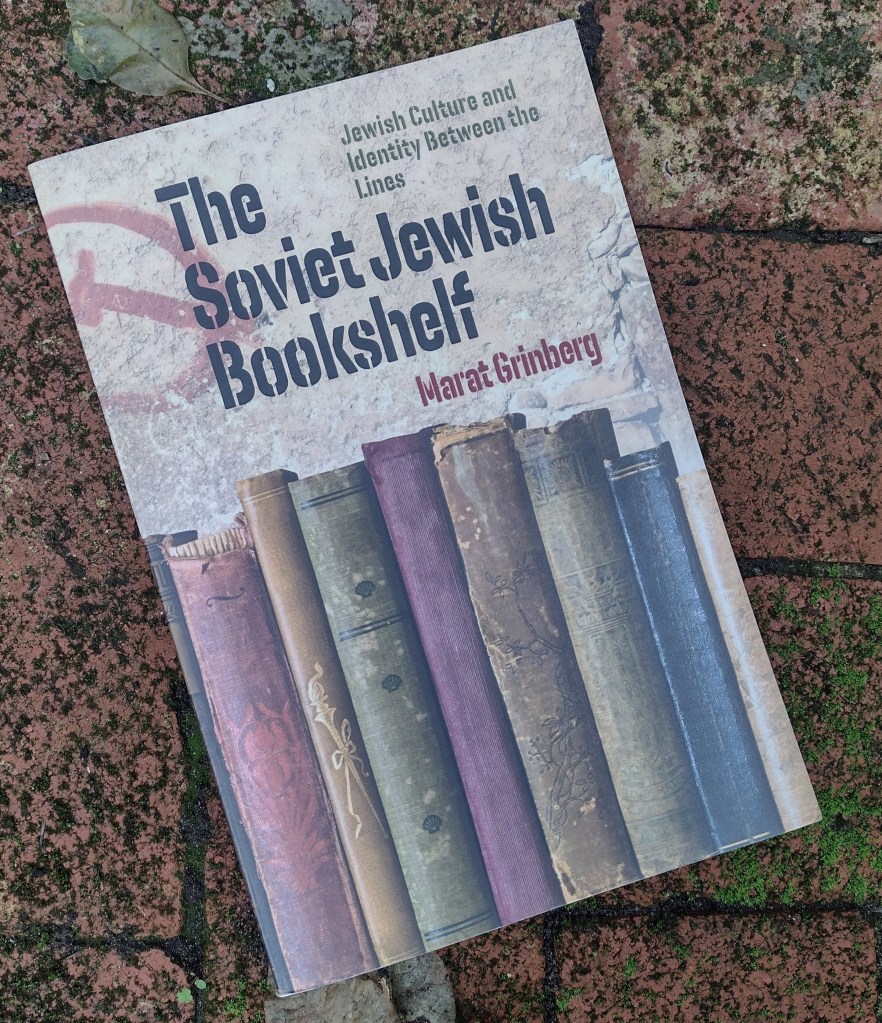
Marat Grinberg’s academic volume The Soviet Jewish Bookshelf (The Tauber Institute Series for the Study of European Jewry, Brandeis UP, 2022) is an important book for the authors of this blog for personal and professional reasons as it reflects on a large body of work that we grew up with and have returned to in professional contexts. In its contributions toward re-defining Soviet Jewish identity in positive terms–as thick and multidirectional–it allows us to reshape our personal narratives and forge a path toward future research and creative projects.

Today we’re highlighting our responses to this book and encourage our readers to continue this conversation.

Continue reading “Responding to Marat Grinberg’s The Soviet Jewish Bookshelf”

I Think that Everything I Do Is a Form of Translation: A Conversation with Michele A. Berdy

We at Punctured Lines are thrilled to feature a conversation with Michele A. Berdy, longtime editor and columnist for The Moscow Times, now living in Riga, Latvia. Given both the political and personal upheavals of the last few years, this interview was long in the making. We are so glad to now publish this wide-ranging discussion about, among other things, cataclysmic changes, Soviet life hacks, art and culture, and of course, the war in Ukraine; there are many organizations you can support, including this one. This interview was conducted over email.

Yelena Furman: Let’s start with your intriguing reverse immigration story: you left the U.S. in 1978 to live in what was then the Soviet Union (the same year, as it happens, that my family left Soviet Ukraine for the U.S.). What inspired you to make that move, several years before the country began opening up under Gorbachev?

Continue reading “I Think that Everything I Do Is a Form of Translation: A Conversation with Michele A. Berdy”

A Character with a Secret Is an Easy Sell: A Conversation with Sasha Vasilyuk, by Olga Zilberbourg

A new novel set in World War II enters a crowded and hotly contested field. It is a particularly remarkable feat for a debut novelist that Sasha Vasilyuk’s Your Presence Is Mandatory (Bloomsbury, 2024) earned universal praise from celebrated writers across the former USSR diaspora community and far beyond. Gary Shteyngart wrote, “Wonderfully written, elegiac and necessary, Sasha Vasilyuk uncovers the history behind the recent headlines with great skill and grace.” Susanne Pari, author of In the Time of Our History and The Fortune Catcher, wrote, “An outstanding novel of sacrifice, love, and forgiveness.”

We celebrate this novel’s arrival with particular pleasure. A contributor to Punctured Lines, Vasilyuk participated in a number of events we’ve hosted over the years, and we’ve heard excerpts from this novel as she was working on one draft after another. In May 2024, Olga Zilberbourg interviewed Vasilyuk during a book release event at Telegraph Hill Books in San Francisco. The following Q&A is a follow-up to that in-person conversation. 

Continue reading “A Character with a Secret Is an Easy Sell: A Conversation with Sasha Vasilyuk, by Olga Zilberbourg”

Queer Encounters in the USSR and Russia, A Conversation with Sonja Franeta

Born in New York to Yugoslav parents, Sonja Franeta is a writer, educator, translator, and activist. In 1991, she was a delegate to the first Russian Lesbian and Gay Symposium, organized by International Gay and Lesbian Human Rights Commission (IGLHRC), and she helped facilitate LGBTQ film festivals in Russia.

From 1992 until 1996, Franeta collected video interviews with Russian gay, lesbian, and transgender people. Before Russia repealed its sodomy laws in 1993, some of the people she interviewed had served criminal sentences for homosexuality, while others experienced forced psychiatric treatment. In 2004, Franeta published the edited transcripts of these interviews in Russia, and later translated them to English in a book called Pink Flamingos: 10 Siberian Interviews (Dacha Books, 2017). These in-depth conversations allow us to learn her subjects’ life stories, as well as to understand the way they evaluated their experiences and conceptualized questions of identity and belonging.

In her second book, My Pink Road to Russia: Tales of Amazons, Peasants and Queers (Dacha Books, 2015), Franeta collected her essays on a wide range of topics. They include her childhood in the Bronx with a Croat mother and Serb father, her coming out story, her experiences as a female machinist and labor activist, and studying Russian literature, becoming a writer, and extensive travels across the former Soviet Union and the deep friendships she has formed there. Franeta’s writing is often very personal, exceptionally frank, and deeply insightful. Coming from a working-class background, she studied at NYU and UC Berkeley before rejecting the traditional academic path. In the 1990s, she taught English in Moscow and spent several years in Novosibirsk, working on a project for people with disabilities. 

Continue reading “Queer Encounters in the USSR and Russia, A Conversation with Sonja Franeta”

The Soviet-Jewish Experience in North America: A Conversation Between Masha Rumer and Lea Zeltserman

Today we welcome Masha Rumer and Lea Zeltserman back to Punctured Lines. They have both done Q&As with us previously (here and here), and each has participated in one of two different readings we organized by FSU immigrant writers (the recordings are here and here). We are extremely grateful to them for generating both the thought-provoking questions and answers in this exchange. This piece was a long time in the making, as all of us dealt, in various combinations, with the pandemic, the war, cross-country moves, and personal upheavals. We are thrilled to feature their wide-ranging and poignant conversation about immigration, writing, food, and more.

Continue reading “The Soviet-Jewish Experience in North America: A Conversation Between Masha Rumer and Lea Zeltserman”

Poems Betwixt Paths: Herb Randall in Conversation with Irina Mashinski

We are grateful to Herb Randall and Irina Mashinski for bringing us this interview about poetry, translation, music, and more. Both of them have appeared on Punctured Lines previously. An excerpt from Irina Mashinski’s hybrid poetry and prose collection The Naked World can be found here (while Herb Randall’s review of it in the Los Angeles Review of Books is here). At Punctured Lines, Herb Randall has contributed a personal essay about visiting Kharkiv and looking for traces of an English woman who moved there during Stalin’s reign and a review of Sana Krasikov’s The Patriots, about an American Jewish woman who also moves to Stalin’s Soviet Union (a clearly misguided endeavor from any country). We are very happy to have them back with the following in-depth discussion.

Continue reading “Poems Betwixt Paths: Herb Randall in Conversation with Irina Mashinski”

Perpetual Instability: An Interview with Lars Horn, by Natalya Sukhonos

Lars Horn’s Voice of the Fish (Graywolf Press, 2022) is a collection of lyric essays in which the author enters into a dialogue with ancient writers and contemporary artists, contributing personal reflections on the elusiveness of the trans body. The book is made up of 23 sections that converge on the theme of water. Most sections are further broken up into short segments or sentences set off by Roman numerals. In the first section, “In Water Disjointed from Me,” the author describes the way in which a mysterious illness upended their life and their ability to communicate. Four pages later, in “Last Night, A Pike Swam Up the Stairs,” Horn speaks to the experience of their trans body through short segments. This is the opening page of this section:

Continue reading “Perpetual Instability: An Interview with Lars Horn, by Natalya Sukhonos”

“Writing Fiction Allows Us to Build Bridges”: Ian Ross Singleton and Kristina Gorcheva-Newberry in Conversation

Punctured Lines is happy to host a conversation between Ian Ross Singleton, author of Two Big Differences (M-Graphics Publishing, 2021) and Kristina Gorcheva-Newberry, author of The Orchard (Ballantine Books, 2022). The novels’ synopses are below, and you can listen to the writers read excerpts here. Both of these works feature post-/late Soviet space, Ukraine in Two Big Differences and late Soviet/post-Soviet Russia in The Orchard. To support Ukraine in its fight against Russia, you can donate here and here, as well as to several other organizations doing work on the ground. If in addition you would like to support Russian protesters, you can donate for legal help here.

Continue reading ““Writing Fiction Allows Us to Build Bridges”: Ian Ross Singleton and Kristina Gorcheva-Newberry in Conversation”

From Black Panthers to Ukraine’s Orange Revolution and More: A Conversation with the Author of Revolutions of All Colors Dewaine Farria

Revolutions of All Colors (Syracuse UP, 2020) first came to my attention when we were putting together Punctured Lines’ 2021 Books for Review list. The novel’s description indicated that it featured African-American characters and was set, in part, in Ukraine. Intrigued, I looked it up and found myself completely immersed in the multi-generational saga that intertwines locations and histories that I had not previously seen connected.

This novel opens in New Orleans in the 1970s, with Ettie, a young African-American woman who, unsatisfied with what she perceives as her preacher father’s complacence in the face of racial violence, becomes involved with the Black Panther Party. The story details a dramatic incident of police brutality against the Panthers and the long-term repercussions of this violence.

Continue reading “From Black Panthers to Ukraine’s Orange Revolution and More: A Conversation with the Author of Revolutions of All Colors Dewaine Farria”