Writing is the Closest We Will Ever Get to Time Travel: A Guest Essay by Dana Kanafina

Today we are featuring a personal essay by Dana Kanafina, a writer from Kazakhstan, currently living in Germany. Although I have never been to Kazakhstan, I have (an admittedly tenuous) connection with it: my grandmother and her family were evacuated to Alma-Ata (now Almaty) from Ukraine during WWII, which is how she and my great-grandmother survived. In a more recent and less life-and-death way, Almaty is where students from our department at UCLA have been going to study abroad, given that, even before the outbreak of the war in Ukraine, they have been unable to study in Russia (I “entertained” the first cohort of such students by telling them that I was sure their experiences would be much better than my grandmother’s). We have previously highlighted contemporary Kazakhstani literature on Punctured Lines; the essay by Dana Kanafina focuses on Kazakhstan’s literary scene, both what it looks like today and what it might look like in the future.

Writing is the Closest We Will Ever Get to Time Travel by Dana Kanafina

In April of last year, my short story came out in Aina Journal, a Kazakhstani literary magazine for women. A week after that, I was at a meeting of a poetry club I was running at the time. This was on a weekday because on Saturdays I was busy with a writers’ group, a completely different set of people, and the two never wanted to interact with one another. The reasons were understandable. There was an age component that couldn’t be overlooked. Everyone in the writers’ group besides me was my parents’ age. The poetry club was “queer-friendly,” which, around here, of course, simply means “gay,” whereas people at the writers’ group didn’t understand labels of that sort. That I also understood: I suppose some self-exploration loses relevance by that point in life, or at least it does in Kazakhstan, where same-sex marriage is illegal and doesn’t look to become legal anytime soon.

It was a busy time for me, because I was also in the process of moving to Germany, an activity that, unbeknownst to me at the time, would occupy another year and a half of my life. In the middle of the poetry club meeting, we always had a smoking break. I smoke sporadically, which I’m not very proud of, so I was outside the cafe where we held the club, at the bottom of the stairs, one hand hovering over a trash can. There was another poet with me, a man, unlike me, but also Kazakh and also young. We weren’t really talking about anything. He didn’t speak Russian all that well and spoke no English, and I, in turn, don’t speak Kazakh all that well (another thing I’m not very proud of).

Language, or rather the gap I kept finding myself in between languages, had been a big topic for me for a few years by that point. It was the kind of thing I thought – and still think – about so much that when I had to face it externally, I almost had this urge to shoo it away, as if it were a fly hovering near my face. I always thought that being from Kazakhstan was a limitation; it set me up to write in languages that didn’t have as wide a reach as Western languages, making me simultaneously surrounded by people who didn’t consider the wider literary history, its significance, and profitability.

I often think about the time I went to a book signing by Alisher Rakhat, a contemporary Kazakhstani novelist. He was presenting his second novel, Parallel, which I thought was well-paced and well-told, especially for its relatively short size. I was there because I know Rakhat personally – he signed my copy “your friend, Alisher” – but the entire library room where the book signing was taking place was full. There must have been at least a hundred people. I was there with another friend who pointed this out while we waited for the presentation to begin.

“His publishing house should submit it for a literary prize,” I told her.

“Oh, Mecenat?” she asked me.

“No, not Mecenat,” I frowned; I felt silly for forgetting we have that. “I meant like, something prestigious, the International Booker maybe? Or for the Internationaler Literaturpreis. This one’s new, so maybe there’s a better chance.”

She thought about it for a moment.

“And would you translate it?” she asked me, “to help Alisher out?”

I laughed at that, quickly and involuntarily, which in retrospect might have come off as mean.

“I’m not a translator. And I don’t speak German well enough for that. Anyway, this is what the publishing house should worry about or his agent.”

“I don’t think anyone here has an agent.”

“Well, then,” I said simply. There wasn’t much else to say.

This was about two years before the interaction I am now describing. Not much has changed in the Kazakhstani literary community in terms of global representation. I, too, did mostly the same things as before, except, like I said, I ran a poetry club.

The guy I was talking to during the smoke break said that he’d read my story in Aina Journal, and I said, “Oh, yeah?” like it’s news to me, like I haven’t been a writer my whole life.

“Yeah,” he said, squinting slightly because it was a windy evening and cigarette smoke found its way towards his face.

“What did you think?”

“Oh, so good,” he said flatly, but everyone in Kazakhstan always speaks this way. It’s something I am still not used to, even though I grew up here.

I nodded, or maybe even murmured a “Thanks,” and kept smoking. The sun was setting. It was the part of the year when days were getting long, but they never got long enough, and, at least in Almaty, everyone starts their day late anyway, so every event seems to last deep into the night.

“They have sex in there,” he said then, just as flatly as before, and I wasn’t sure what he meant. I turned my head and looked back, thinking maybe something scandalous was finally happening right in front of our eyes, this hunger-like feeling familiar to anyone who lives where nothing is ever going on. But the entrance to the cafe looked the same. There was a glass door and a potted plant with long leaves behind it, and then the hallway, which tilted to the right, making it look cave-like and endless.

I looked back at him and asked, rather stupidly, “Who?”

He took another drag of his cigarette and, copying him without thinking, so did I.

“I mean, in your story.”

“You mean the characters?”

 “Yes.”

He looked at me a bit more tentatively now, as if expecting me to say something only he would ever get to hear, but I didn’t have anything of this sort to say to him. I took another drag. The rim of my cigarette and even the tips of my index and middle fingers looked deep pink, smudged all over with my lipstick.

“Well, yes,” I said finally. “They do.”

He nodded without any expression, or maybe he had an expression I didn’t really register because he looked away or at his phone, and I went on staring at what was left of my cigarette. I was angry at how strangely direct this interaction was, as if he implied I was a nymphomaniac of some sort, even though the characters of my story were only described as having sex towards the very end and not graphically. As an adult, I always wrote fiction about struggling as part of a lower economic class in Kazakhstan and the desire to escape it; it struck me as weird that he interpreted sex to be at the forefront of my writing. But I didn’t have the words to say any of this, somehow. We went back inside and continued the meeting; we read poetry, eavesdropped on what the tables around us said, and listened to the music playing through the hoarsely sounding speakers.

I forgot about this interaction until almost a year later, when I was listening to an interview with Margaret Atwood on TVO Today Live. When asked about tribalism in modern society, Atwood recalled an anecdote about her grandmother. “Her next-door neighbor came – she is from rural Nova Scotia – her next-door neighbor came to bawl her out because her granddaughter,” here Atwood points at herself with an open hand, “had written a [debut] novel with sex in it.” There is laughter in the audience; Atwood continues: “I know all this because my aunt was behind the door, laughing her head off.”

I had to pause and stop what I was doing (a puzzle) to look up Atwood’s debut, The Edible Woman. It came out when Atwood was thirty years old. I am twenty-five, so she was a bit older than me, but not substantially so. I tried to imagine her in my shoes: outside of a cafe, smoking, being confronted the way I was, with the word “sex” heavy in the air, accusatory in its very nature. What would she say, or rather, what did she say to people? In my head, she is way cooler somehow; maybe she even laughs at all of this, tilting her head slightly, the way she always does in interviews.

This had a profound effect on me, and I thought about it for days. In fact, it bothered me so much that I re-listened to the interview and caught a new detail: it was her aunt who initially told Atwood this story. This implies the aunt was on Atwood’s side. There wasn’t a thick veil of shame as I initially assumed, even though this is a family member we are talking about. I live in Almaty, which is one of the biggest cities in the country and is commonly agreed to be the most progressive. And yet I can’t imagine telling this story to anyone in my family and them being on my side, even before the conversation ever steers towards sex. My mom gave up on my literary career when she found my notebook full of short stories in sixth grade. It was something that understandably never saw the light of day, but she was appalled by it.

“People in this part of the world go to jail forever for making up stories!” she told me. “Why do you do this? Is that what you think boys like?”

I was quite insulted by this. I was twelve; of course, I knew what boys liked (boobs and eyelashes), but what I did was intentionally different (literary fiction). My mom, of course, didn’t understand literature at all. I don’t remember now what it was exactly I wrote about at that age, but I doubt it was revolutionary anti-government essays. Yet, over the years I’ve met plenty of people like my mom (also older than her, as well as surprisingly young) – people who are afraid of the act of writing itself. In some circles in Kazakhstan, the very idea of expressing one’s thoughts in public seems dangerous and punishable. It is a kind of superstitious, unshakable belief. I could make an argument that this is almost genetic memory, tracing back to the destruction of the intelligentsia under Stalin in the 1930s, but regardless of whether it is or not, this sentiment definitely still overshadows contemporary writing life in Kazakhstan.

The Edible Woman came out in 1969, over half a century ago. I can’t really imagine the way life was back then, and yet the implication is that Canada was already socially ahead of where Kazakhstan is now. In the context of kleptocracy and colonization, it is, of course, an unfair comparison to make: contrasted with the West, Kazakhstan is a poor country with an outdated educational system. This isn’t something we can easily change. Even in that same poetry club that I am describing, someone once stated that all worthy poets grew up poor, it comes with the territory, to which I said, “No, they don’t. Wasn’t Anne Sexton, for example, a daughter of a socialite?” There was a pause, my peers looked at one another and then back at me: “Who is Anne Sexton?”

Recently, Almaty-based writer Meruert Alonso got in trouble over public prudery. She alleged that certain chapters of her novel Forbidden Forms of Love have been banned from publication specifically for sexually explicit content. It is my understanding that, despite its name, the book features heterosexual storylines (admittedly, I haven’t read the book, though I tried twice – once when I loitered at a bookstore on the weekend and another time when a friend lent me her copy, which I kept by my bed alongside my other current reads and couldn’t look at without feeling vaguely guilty, but the prose style just isn’t for me).

In interviews elsewhere, Atwood alludes to the fact that she moved to the United States because the publishing industry was stronger there. She wouldn’t be the first writer in history to physically move to a different geographic location to find oneself “in the future” of the literary world. T. S. Eliot followed a similar trajectory during his time (though it was from the US to the UK; he would later claim that his poetry would have been quite different if he were born in England). This was Nabokov, too (Russia to Germany to France to the US; in his case, prosecution was responsible). I am moving both to find a better life and to build a career – I’m finishing this essay on the last Friday of August, and my flight to Germany is at three in the morning the next day. Between writing this, working, and packing today, I ran to the store to pick up something, and an older woman tried cutting ahead of me in line; when I didn’t let her, she called me a whore. This is what I write about: the way poverty, hopelessness, and unspoken and unprocessed violence corrode a person, and I can’t write about it as it is actively happening to me. This isn’t an untreated, progressing illness; this is my home. 

In another interview, when Atwood is asked whether she ever daydreamed about the “incredible success of productivity” that eventually did happen to her, she firmly says no. “[T]his was Canada,” she says. “And it was Canada in the early sixties. And nobody had in Canada, at that time […] that kind of international success. Canada was the boonies, even for Canadians.” She goes on to say that she was the first Canadian writer to make it in places like Sweden or Finland, and people asked her “where this Canada is” and if there were any other writers besides her. This isn’t all that different from what happens to authors from Kazakhstan (though the situation here is a bit more complex because of the added racial component – for example, out of the five Kazakhstani residents of the International Writing Program in Iowa over the years, three are white, despite white people representing under 30% of Kazakhstan’s population, according to most sources; but this is a topic for another time). Similar interactions have even happened to me whenever I was in writing circles in the US and in the Czech Republic, which always baffled me – I don’t even have a novel out right now, so why am I expected to be the spokesperson for almost twenty million people?

So does all this suggest that sixty years from now, Kazakhstan will be as central to world literature as Canada is today? I don’t want to be grim, so I say, “I don’t know.” I would love to imagine Kazakhstan entirely different by the time I am in my eighties (Atwood’s age). I can also see myself on my third or fourth marriage, and Kazakhstan, though by then it will be a distant memory for me, as promising and comforting as a familiar room after waking up from a nightmare.

Dana Kanafina is an author from Petropavl, Kazakhstan. She is an alumna of Between the Lines of the International Writing Program (2019). She was an ambassador for the Almaty Writing Residency (2021) and a judge for the women-only literary journal Aina Journal (3rd issue, 2024). She co-ran Kazakhstan’s first queer poetry collective, Jalanash Poezia (and curated its zine in 2024), and Writers Rule! Club (2023 – 2025). She now lives in Konstanz, Germany.

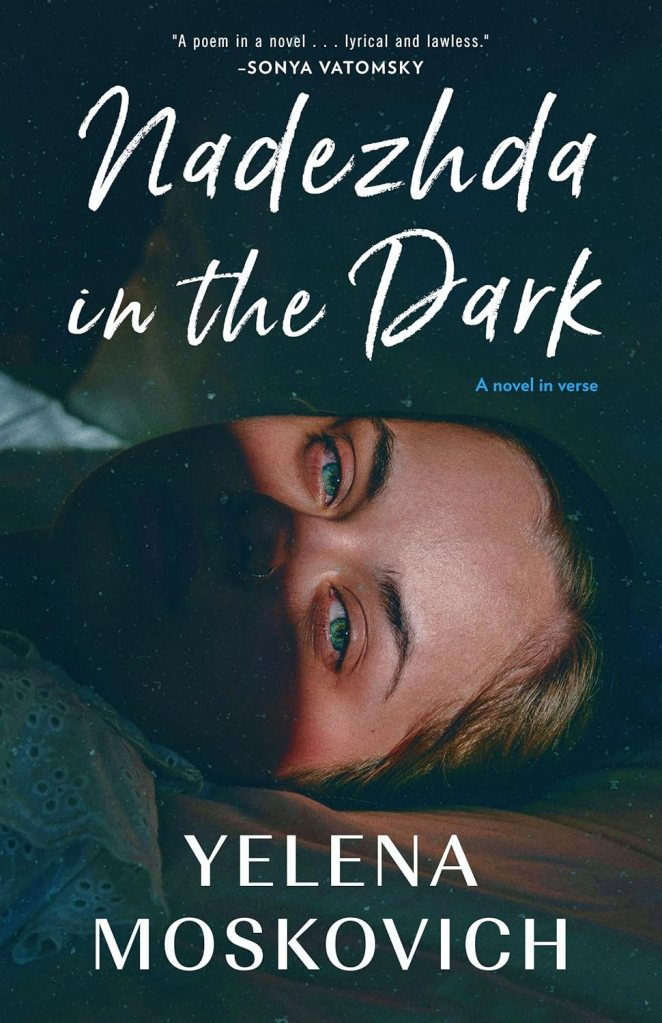
“everybody knows . . .” An Excerpt from Nadezhda in the Dark by Yelena Moskovich

Today, in the US, we welcome a new book by Ukrainian-born American and French author Yelena Moskovich. Innovative Dzanc Books is bringing to us Nadezhda in the Dark, a novel-in-verse, previously published in the United Kingdom by Footnote Press. We’re deeply grateful to independent presses that make great books accessible to readers across the world. Please support Dzanc Books by ordering your copy today!

When asked to contribute our responses to this book, Yelena Furman said:

“Brimming with references from Russian and Ukrainian literatures to Alla Pugacheva and the Moscow 1990s gay club scene, Nadezhda in the Dark is a poetic disquisition on global history and self-identity. Discussions of Soviet anti-Semitism and the war in Ukraine merge with explorations of immigration and queer love. In language simultaneously lyrical and sharp, Moskovich shows how the personal and political, the present and past, are inextricably linked in ways that are often traumatic but also occasionally hopeful.”

Continue reading ““everybody knows . . .” An Excerpt from Nadezhda in the Dark by Yelena Moskovich”

We Have to Go Back: Speculative Fiction, Nostalgia, and the Ghosts of Bookshelves Past, Guest Essay by Kristina Ten

We’re delighted to welcome Kristina Ten on the blog with an essay about some of the origins—personal, familial, cultural, and political—of her debut short story collection. Tell Me Yours, I’ll Tell You Mine will be published by Stillhouse Press on October 7, 2025. Please pre-order the book and ask your local and academic libraries to purchase it. Authors and publishers depend on advance orders! And please don’t forget to rate and review.

— Punctured Lines

History Without Guilt

Part of putting a book out into the world is asking people to read it, and part of asking people to read it is letting go of whatever carefully assembled artist statement lives in your head—how you would describe what your work is circling around, grasping at—and embracing that every reader is going to define their experience with your book for themselves.

That’s what I’m currently doing with my debut story collection, Tell Me Yours, I’ll Tell You Mine. And the definition early readers keep landing on is the word “nostalgic.”

Knowing these readers, I can tell they mean it as a compliment, or at least a helpful neutral statement. All the stories in the book revolve around games and the childlore of the aughts: the divinatory power of cootie catchers, the electrifying lawlessness of the early internet, bonfire legends whispered with a flashlight held under the chin. About half the stories feature young protagonists. Many are set in schoolyards, summer camps, and locker rooms. Others are set in the kind of far-off realms that would feel right at home in a child’s imagination—even as the book itself is unquestionably adult, preoccupied with the horrors of, one, being controlled; and, two, the constant vigilance some of us (girls and women, immigrants, queer people) learn to exercise against it.

Continue reading “We Have to Go Back: Speculative Fiction, Nostalgia, and the Ghosts of Bookshelves Past, Guest Essay by Kristina Ten”

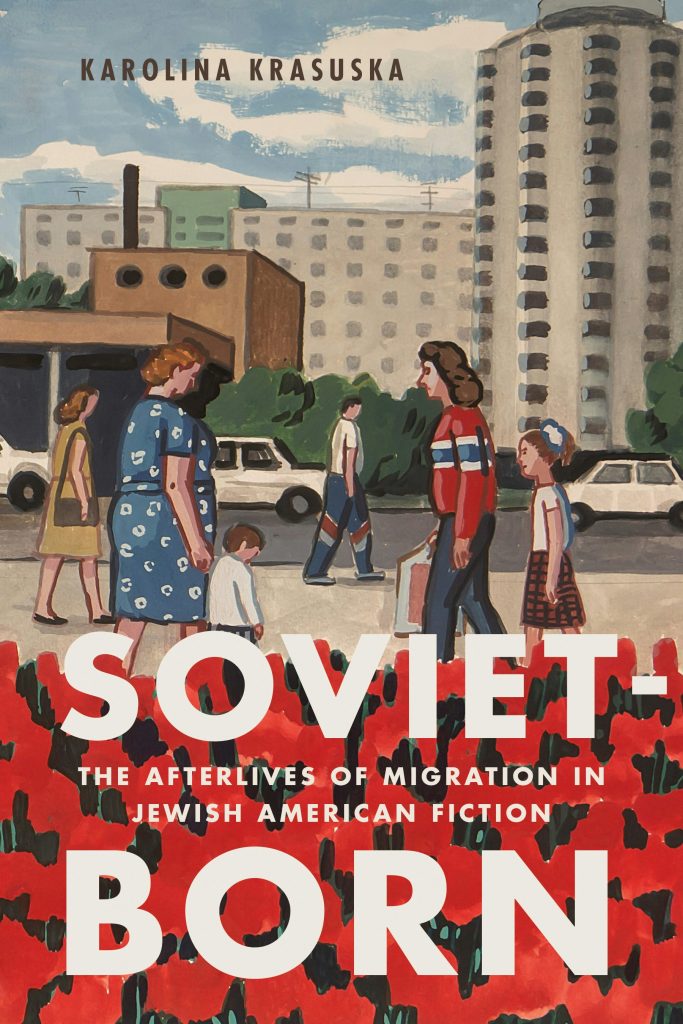
Queering Peripheries: Lara Vapnyar’s “Lydia’s Grove”: Soviet-Born: The Afterlives of Migration in Jewish American Fiction by Karolina Krasuska

Today we are featuring an excerpt from Soviet-Born: The Afterlives of Migration in Jewish American Fiction (Rutgers UP, 2024) by Karolina Krasuska, associate professor at the American Studies Center and co-founder of the Gender and Sexuality MA Program at the University of Warsaw, Poland. Starting in the early 2000s, Jewish immigrant writers from the former Soviet Union have appeared on the US literary scene in increasing numbers. While Gary Shteyngart, who can give lessons in self-promotion, is the most well known, the list comprises more women, including Lara Vapnyar (a Q&A with whom we have featured on this blog), Anya Ulinich, Irina Reyn, and Ellen Litman, to name only a few. As their books continued to be published, academics began to take note, organizing conference panels and writing on the subject (I am happy to have contributed to this field of study from its inception). The first and foundational monograph was Adrian Wanner’s Out of Russia: Fictions of a New Translingual Diaspora (Northwestern UP, 2011), which discussed the global phenomenon of ex-Soviet immigrant writers in the various countries to which they immigrated. Krasuska’s is the first academic volume specifically devoted to ex-Soviet Jews living and writing in the US, where the largest number of such immigrants resides.

Continue reading “Queering Peripheries: Lara Vapnyar’s “Lydia’s Grove”: Soviet-Born: The Afterlives of Migration in Jewish American Fiction by Karolina Krasuska”

Graphic Memoirs and Novels of Soviet Trauma

I didn’t grow up reading graphic novels. Back in the USSR and Russia comics did not exist as a genre. To this day, some of my contemporaries from that part of the world might occasionally dismiss the whole field of graphic literature as meant only for children. But as time goes on, this genre has been asserting itself within the field of literary studies and has been taken up by an ever-increasing number of creators from the countries of the former USSR and diaspora. It’s become a vibrant source of nuanced, memorable narratives. Many contemporary artists and writers are turning to graphic forms of storytelling to explore creative possibilities that the form has to offer.

Continue reading “Graphic Memoirs and Novels of Soviet Trauma”

How Moscow’s 1957 World Youth Festival Inspired Me to Go On Pretending: Guest Essay by Alina Adams

Today we welcome Alina Adams back to the blog with an essay about her interracial family’s trip to Moscow (before the war in Ukraine) and its connection to her recently released novel, Go On Pretending (History Through Fiction, 2025), featuring a fictional interracial family. You can read our previous conversations with Alina here and here. As one of the excerpts below shows, a key element in her novel is the 1957 World Youth Festival in Moscow, during Khrushchev’s Thaw, which was meant to demonstrate the Soviet Union’s liberalization and racial tolerance (you can guess how that turned out). The reference to the festival immediately made me think of a different novel by another ex-Soviet Jewish immigrant writer in which it is an important plot element: Petropolis (Penguin Random House, 2008) by Anya Ulinich. If you would like to know more about this lesser-known event and about the Soviet Union/post-Soviet Russia and race, let Alina explain below and then order Go On Pretending (and Petropolis).

Continue reading “How Moscow’s 1957 World Youth Festival Inspired Me to Go On Pretending: Guest Essay by Alina Adams”

Video from Born in the USSR: Diaspora Writers Against War

Thanks to those of you who could attend our event, Born in the USSR: Diaspora Writers Against War, hosted by the Wende Museum on March 28. We loved having you as our audience and hope to continue the conversations in various ways.

Thank you for donating to Ukraine Trust Chain. Ukraine needs all of our support. Please continue to spread the word and donate here: https://www.ukrainetrustchain.org/

The video from our event is now online:

Continue reading “Video from Born in the USSR: Diaspora Writers Against War”

Born in the USSR: Diaspora Writers Against War

This one of a kind reading brings together Soviet-born writers as they weave together an intricate story of identity, memory, cultural intersections, immigration, and war. From fiction to poetry, memoir and journalism, and work in translation, the reading presents a deep dive into the individual and collective experiences of the Soviet-born diaspora in the U.S. This free event includes a fundraiser in support of humanitarian aid in Ukraine and aligns with The Wende Museum’s current exhibition “Undercurrents II: Archives and the Making of Soviet Jewish Identity.” Autographed books will be on sale, courtesy of Village Well.

Hosted by The Wende Museum, readers include poets, writers, and translators: Katya Apekina, Yelena Furman, Kristina Gorcheva-Newberry, Julia Kolchinsky, Arina Kole, Maria Kuznetsova, Olga Livshin, Ruth Madievsky, Ainsley Morse, Luisa Muradyan, Jane Muschenetz, Asya Partan, Irina Reyn, Diana Ruzova, Timmy Straw, Vlada Teper, Sasha Vasilyuk, and Olga Zilberbourg.

Continue reading “Born in the USSR: Diaspora Writers Against War”

Narrating a Violent Childhood: A Q&A with Fiona Bell and Margarita Vaysman about Avdotya Panaeva’s The Talnikov Family

Avdotya Panaeva was born in 1820 and first began publishing her work in one of Russia’s premier literary magazines, Sovremennik, in 1846. The author of numerous short stories, novels, memoirs, as well as collaborative projects, she has only recently begun to achieve the recognition that she deserves in the English-speaking world.

On October 8, 2024, Columbia University Press published Fiona Bell’s translation of Panaeva’s first novel, The Talnikov Family. This became the second full-length translation of Panaeva’s work to English. In my review of the book in On the Seawall, I mention several social and historical factors that have kept this delightful novel from English-language readers for so long. In writing about this book, I have relied, in part, on Bell’s introduction to the novel and on the research by Margarita Vaysman, whose book Self-Conscious Realism: Metafiction and the Nineteenth-Century Russian Novel devotes a section to Panaeva’s work, including an excerpt that ran in Punctured Lines.

Today, it is my pleasure to discuss this novel and Panaeva’s work more broadly with her translator Fiona Bell and scholar Margarita Vaysman.

Continue reading “Narrating a Violent Childhood: A Q&A with Fiona Bell and Margarita Vaysman about Avdotya Panaeva’s The Talnikov Family”

2025 Books by Post-Soviet Authors

2025 is going to be a big year for books written by immigrant authors hailing from the Soviet Union who now call North America home. Since 2021, I’ve kept a running list of books coming out from our community as a way to keep tabs and, frankly, because no one else was doing it. Last year, when my own debut novel came out, there were only 7 books out from our community, a couple of them paperback editions of 2023 novels. This year, however, we have twelve new titles, plus three books–including my own–being released in paperback. A recent record! I imagine the war in Ukraine might have had something to do with this increased output as several of the authors below engage with the war and the resulting refugee crisis. As the war drags on and the public’s attention on it wanes, this feels like an especially critical time for our voices to be heard. This is why I’m glad to see that our books are finding publishers and readers, and I hope that the incredible variety of books on this list is encouraging to other writers in our community. From poetry to dystopian novels to short story collections, nonfiction, and a cookbook memoir, check out the list of FSU books and please support these authors by pre-ordering.

Continue reading “2025 Books by Post-Soviet Authors”