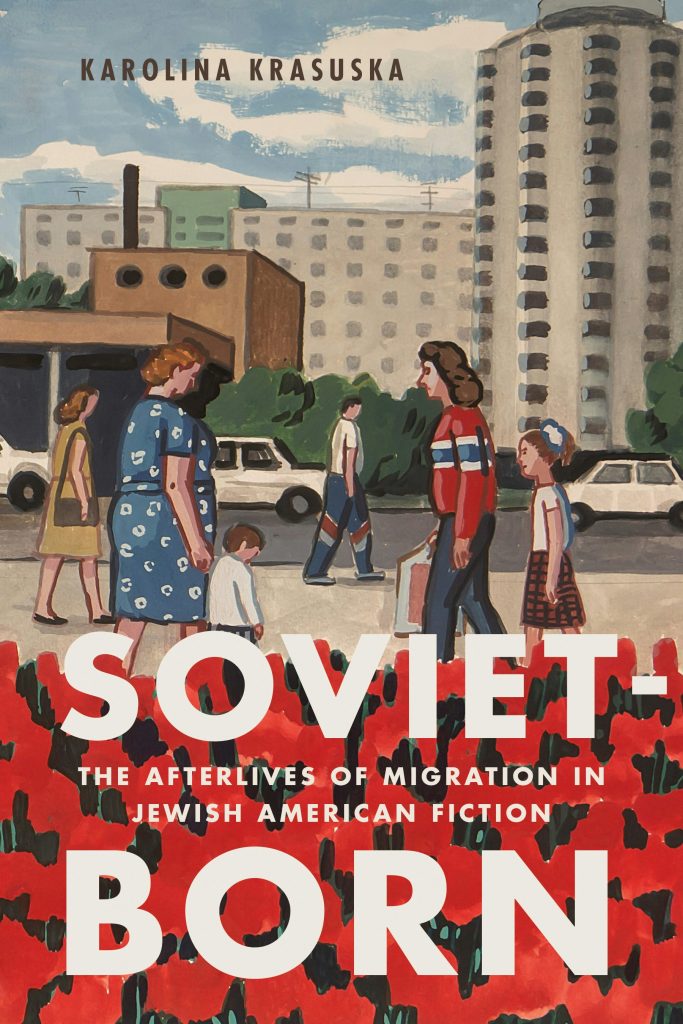
Today we are featuring an excerpt from Soviet-Born: The Afterlives of Migration in Jewish American Fiction (Rutgers UP, 2024) by Karolina Krasuska, associate professor at the American Studies Center and co-founder of the Gender and Sexuality MA Program at the University of Warsaw, Poland. Starting in the early 2000s, Jewish immigrant writers from the former Soviet Union have appeared on the US literary scene in increasing numbers. While Gary Shteyngart, who can give lessons in self-promotion, is the most well known, the list comprises more women, including Lara Vapnyar (a Q&A with whom we have featured on this blog), Anya Ulinich, Irina Reyn, and Ellen Litman, to name only a few. As their books continued to be published, academics began to take note, organizing conference panels and writing on the subject (I am happy to have contributed to this field of study from its inception). The first and foundational monograph was Adrian Wanner’s Out of Russia: Fictions of a New Translingual Diaspora (Northwestern UP, 2011), which discussed the global phenomenon of ex-Soviet immigrant writers in the various countries to which they immigrated. Krasuska’s is the first academic volume specifically devoted to ex-Soviet Jews living and writing in the US, where the largest number of such immigrants resides.
Continue reading “Queering Peripheries: Lara Vapnyar’s “Lydia’s Grove”: Soviet-Born: The Afterlives of Migration in Jewish American Fiction by Karolina Krasuska”Category: Excerpt
Seven Forty: Memoirs of a Jewish District Attorney from Soviet Ukraine by Mikhail Goldis, translated, edited, and with an Introduction by Marat Grinberg
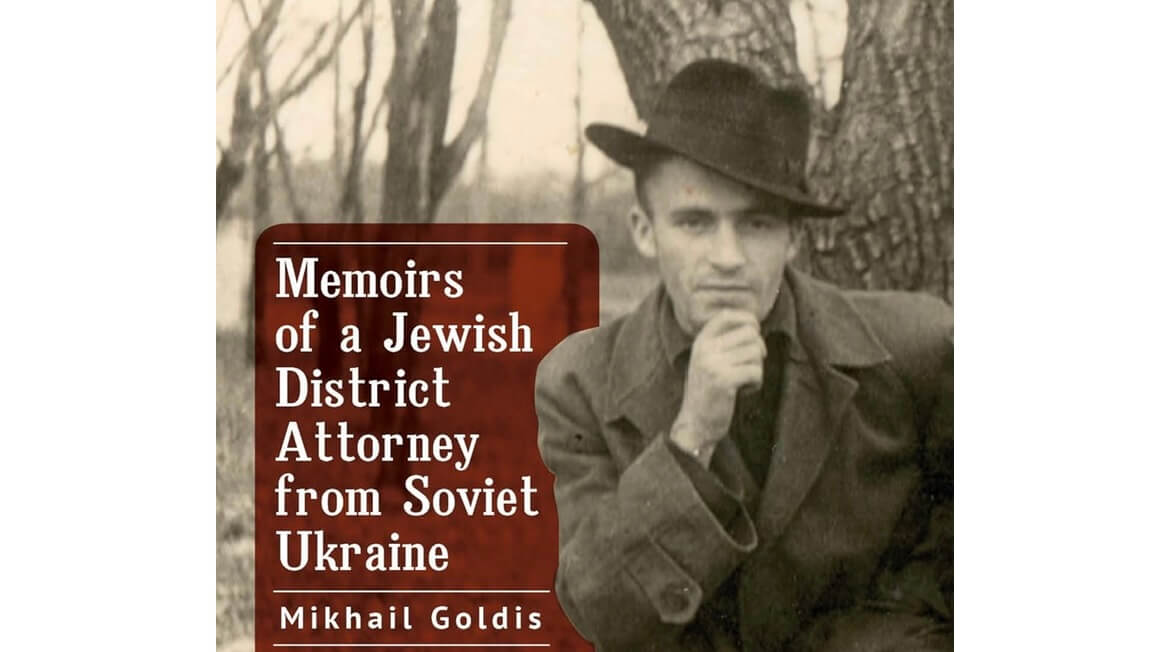
We are happy to feature an excerpt from Mikhail Goldis’s Memoirs of a Jewish District Attorney from Soviet Ukraine (Academic Studies Press, 2024), translated by Marat Grinberg, professor of Russian and humanities at Reed College and Goldis’s grandson. Grinberg’s previous book was the highly informative The Soviet Jewish Bookshelf: Jewish Culture and Identity Between the Lines (Brandeis University Press, 2022). The Soviet Jewish Bookshelf makes the original argument that, in the anti-Semitic Soviet Union, Jews circumvented the proscriptions on public expression of Jewish identity “through their ‘reading practices'”: they built up home libraries of books on Jewish subjects, which, given “the heavy censorship of Jewish content,” they often had to read “between the lines” (the citations are from my review). Olga interviewed Marat about his book, and you can listen to their rich conversation here, which includes reading suggestions of the various writers the book discusses.
Continue reading “Seven Forty: Memoirs of a Jewish District Attorney from Soviet Ukraine by Mikhail Goldis, translated, edited, and with an Introduction by Marat Grinberg”Vinegret, a Recipe for Disaster by Jane Muschenetz
I want to tell you something small, in the great turning of this world, intimate as your grandmother’s soup. When you boil beets, carrots, and potatoes together, the potatoes will soften first, even if they are bigger than the other vegetables.
It is summer 2020, and my hands are Shakespearian (“out, damned spot!”)—beet stained. Our mid-century dining table is a stage set for “Salat Vinegret,” the Soviet-era culinary staple featuring ingredients that are readily available and inexpensive, even in wintertime. The supporting cast of bowls, knives, etc., isn’t from the old country, but is well practiced in recipes that travel back to my early childhood in L’viv, Ukraine.
Three Poems from Disbelief: 100 Russian Anti-War Poems, edited by Julia Nemirovskaya
Today we feature three poems from the Russian-language anthology Disbelief: 100 Russian Anti-War Poems (edited by Julia Nemirovskaya; various translators; Smokestack Books, 2023). We are grateful for the following introduction written for Punctured Lines by Maria Bloshteyn, one of the translators of the collection. As she notes below, one of the featured poets, Galina Itskovich, is a therapist helping those in Ukraine; you can donate here to support this work.
Continue reading “Three Poems from Disbelief: 100 Russian Anti-War Poems, edited by Julia Nemirovskaya”Aikanush: An Excerpt from Akram Aylisli’s Stone Dreams, translated by Katherine E. Young

On February 9, 2013, Akram Aylisli’s books were burned in his native village. For more than six decades, Azerbaijan’s most prominent writer has written fiction about the mountain village of Aylis, from which he took his pen name; Aylisli called the day of the burning “the most terrible day of my life.” Why were his books burned? Aylisli had published a novella, Stone Dreams, that challenged official propaganda erasing the role played by Armenians in the history of Azerbaijan, a country currently dominated by ethnic Azeris (Azerbaijan and neighboring Armenia have engaged in military hostilities since before the collapse of the Soviet Union). Stone Dreams is among the first fictional works in the greater Turkic-speaking world to depict both historical and contemporary violence against ethnic Armenians, and it includes sympathetic portrayals of Armenian villagers residing in Azerbaijan. The novella also portrays the corruption and authoritarianism of modern-day Azerbaijan. In the uproar that greeted the novella’s publication, Aylisli was stripped of his presidential honors and pension. An empty coffin was paraded around the courtyard of his residence, and a bounty—later rescinded under international pressure—was offered to anyone who would cut off the writer’s ear. In 2014, international supporters nominated Aylisli for the Nobel Peace Prize for “his efforts to reconcile Azerbaijani and Armenian people.” In 2016, trumped-up legal charges were filed against Aylisli by the Azerbaijani government, a case that is still pending. Ten years after his books were burned, Akram Aylisli continues to live under de facto house arrest in Azerbaijan, unable to leave the city of Baku. He is 85.
Continue reading “Aikanush: An Excerpt from Akram Aylisli’s Stone Dreams, translated by Katherine E. Young”To Fairyland: An Excerpt from Yelena Lembersky and Galina Lembersky’s Memoir Like a Drop of Ink in a Downpour
Like a Drop of Ink in a Downpour (Academic Studies Press, 2022) is a rare dual memoir co-written by Yelena Lembersky and her mother Galina. Born and raised in the USSR, following the death of her prominent painter father in 1970, Galina decides to emigrate with her young daughter and aging mother. In anticipation of her departure, Galina quits her job and becomes a refusenik. Yet, once her immigration papers go through, instead of boarding an airplane, she finds herself behind bars of a Leningrad prison on a criminal charge. Her mother has already left for the United States. Her young daughter Yelena–nicknamed Alëna in the book–is left in the care of friends, in danger of finding herself in an orphanage.
The chapter below is narrated by Yelena, eleven years old at the time of these events. We are deeply grateful to the author and publisher for permission to excerpt a chapter from this revealing and touching memoir. To continue reading, please buy the book from Academic Studies Press.
Continue reading “To Fairyland: An Excerpt from Yelena Lembersky and Galina Lembersky’s Memoir Like a Drop of Ink in a Downpour”Irina Mashinski’s The Naked World, Three Excerpts
Irina Mashinski’s The Naked World, recently published by MadHat Press after many years in the making, is an impressive achievement in the hybrid genre. The collection combines pieces of original and translated poetry and prose that together illuminate not only the author’s past but also her way of seeing. Thematically, this book centers four generations of a Soviet family from the Stalin era to the 1990s and immigration to the United States. Writer, translator, and editor Irina Mashinski has penned ten books of poetry in Russian, and this is her English-language debut that also includes her Russian-language poems in translation by Maria Bloshteyn, Boris Dralyuk, Angela Livingstone, Tony Brinkley, Alexander Sumerkin, and Daniel Weissbort. Mashinski is co-editor, with Robert Chandler and Boris Dralyuk, of The Penguin Book of Russian Poetry and of the Cardinal Points Journal.
Continue reading “Irina Mashinski’s The Naked World, Three Excerpts”Secrets: An Excerpt from Nataliya Meshchaninova’s Stories of a Life, translated by Fiona Bell
Nataliya Meshchaninova is Russian filmmaker. In 2017, she published a book of autobiographical short stories that resonated with her audience, in part, because they supported the Russian #metoo movement. In February 2022, Deep Vellum brought out Fiona Bell’s translation of Meshchaninova’s book under the title Stories of a Life. We are honored to share with you an excerpt from this book, a section from the fourth chapter, “Secrets.”


Avdot’ia Panaeva’s Feminist Metafiction: An Excerpt from Margarita Vaysman’s Self-Conscious Realism
We’re proud to present an excerpt from Margarita Vaysman’s book-length study Self-Conscious Realism: Metafiction and the Nineteenth-Century Russian Novel. Published by Legenda, an imprint of the Modern Humanities Research Association (where it is available to order), this book focuses on the role of metafiction in the Russian novelistic tradition. The excerpt below is but a small taste of the depth and breadth of this project and highlights the work of one important practitioner of this technique, Avdot’ia Panaeva.
Avdot’ia Panaeva (1819-1893) was a successful novelist and short story writer, who made significant contributions to the development of ideas on education equality, marriage, women’s financial and property rights, and the problem of domestic violence. She was also a common-law wife of poet Nikolai Nekrasov, who was valorized in Soviet literary criticism and the popular canon. We are deeply grateful to Vaysman that, as a part of her research, she illuminates the process through which Panaeva’s legacy as a novelist and short story author has been excised from the canon of nineteenth-century Russian literature and begins the work of restoring it to its rightful place.
Continue reading “Avdot’ia Panaeva’s Feminist Metafiction: An Excerpt from Margarita Vaysman’s Self-Conscious Realism”Olga Mark’s “The Lighter”: An Excerpt from Amanat, a Collection-in-Progress of Recent Women’s Writing from Kazakhstan
Shelley Fairweather-Vega on Amanat: Women’s Writing from Kazakhstan
The idea to translate and publish a collection of recent women’s writing from Kazakhstan grew out of my collaboration with Zaure Batayeva, a Kazakh writer and translator living in Belgium. Zaure contacted me in October 2016 when she wanted to hire someone to edit her English translation of a novella by Aigul Kemelbayeva. We eventually submitted the final version to Words Without Borders, whose editor, Susan Harris, was looking for “post-Soviet” literature from different places. Excerpts from the Kemelbayeva novella and two other pieces appeared in a WWB feature in January 2018. By that time, Zaure and I were thinking seriously about collecting writing by more authors and publishing an anthology. Ever since, she and I have been trading stories, checking each other’s translations (she translated the Kazakh-language stories, and I translated the Russian-language pieces), and querying publishers. We won some much-needed funding and publicity from the generous RusTrans program, and our collection is now nearly complete.
Continue reading “Olga Mark’s “The Lighter”: An Excerpt from Amanat, a Collection-in-Progress of Recent Women’s Writing from Kazakhstan”