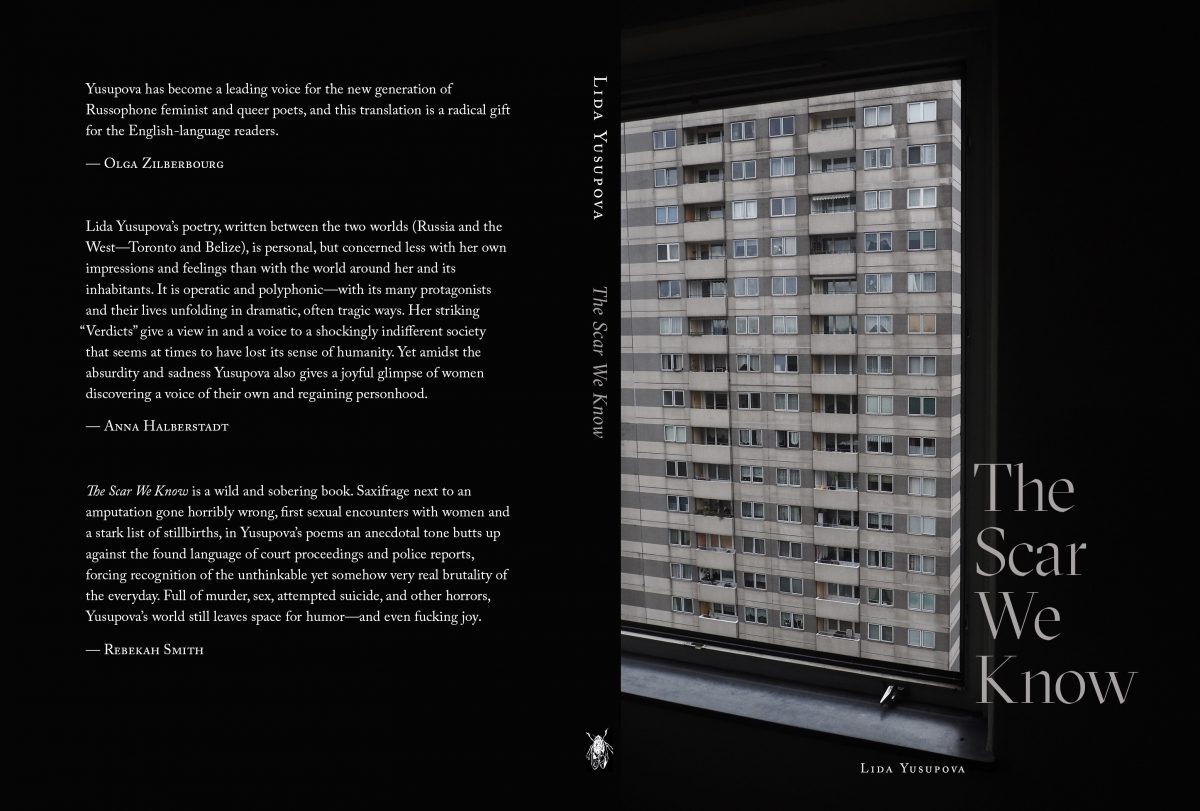
Lida Yusupova’s Poetry Collection The Scar We Know

In the spring of 2007, in St. Petersburg to visit my parents and to promote my first collection of stories, I decided to attend a graduation party of the Gender Studies program at the European University. I’d been a semi-active participant in the Russian-language feminist blogs, where I learned about this program. I contemplated applying; or, at least, since by then I lived in San Francisco, I dreamed about befriending the students and the faculty and making myself useful to them. I had just graduated from a Master’s program in Comparative Literature in San Francisco, where I learned a few things about feminism. I thought my experience could be useful and interesting to my Russian peers. My ideas were somewhat far-fetched.

European University building until 2017

Established in 1994, European University had the reputation of a progressive institution, focusing on social studies, including history, anthropology, economics, politics. I had never been there before, and I was imagining something akin the American universities that I knew: welcoming signage, flyers everywhere, friendly faces ready to help. I forgot to account for one small thing: my native city’s culture.

The address of European University took me to a grand old palace in the old part of town. The entrance should’ve been obvious, but there were a few young men smoking right outside. Intimidated by the smokers (there was very little smoking on campus in the San Francisco by then) and confused by where one palace ended and another began, I’d walked past the door, before eventually turning around. The smokers–students, presumably there for their exams–stared at me in a way that was evaluative and none too friendly. Once finally inside, I had instructions about where to go, but the instructions simply said “auditorium,” or some such thing; not very descriptive. I remember walking up and down the halls and stairs of this labyrinthine building, feeling very sorry for myself. Did I ask somebody for directions? I can’t remember, but I remember my fear that if I did, the response would be dismissive. “If you don’t know where you’re going, you’ll never get there”–something along these lines. I never made it to the auditorium. I was doomed to being an outsider.

Ok, this was a low moment, but I wasn’t really doomed. The next day, I turned to my aunt Maya for help. She, a librarian, helped me find a bookstore where I could buy the books written by the program’s faculty, and later still I was able to meet some of my LiveJournal friends at cafes and conferences in Russia, Ukraine, in the US. These relationships shaped much of my writing.

Many years later, continuing to lurk on the Russian-language feminist sites, I came across Lida Yusupova’s poem “the center for gender problems” (link to the Russian-language version):

i called an organization by the name of the center for gender problems
could i come to your library
it was January of 1999
i had come back to Russia
from Canada
where i had read a whole lot of books
about feminism
in English
i thought i had a lot of useful knowledge i could share

Though it’s not set in European University, the space that the poet describes is socially and geographically very much adjacent to it (the poem includes a physical address!). I felt absolutely seen by this poem; moreover, the poet had managed to capture and deliver lines I’d been too scared to even fully form in my head: Yusupova’s poem is also about the speaker’s realization that she’s a lesbian and the desire to meet other lesbians. Her words gave me courage and opened a few doors in my mind for me. I became a devotee and sought out Yusupova’s Russian-language book Dead Dad and read everything I could find online.

Given the above, you can imagine what an honor it was to be asked to contribute a blurb to Yusupova’s first English-language collection, The Scar We Know, forthcoming from Cicada Press on March 1, 2021. I had to hold myself back from gushing, and nevertheless wrote the three paragraphs below. The editors, advisedly, picked one sentence for the book cover. One benefit of co-editing a feminist blog is that Punctured Lines gives me lots of space to gush…

The “blurb”:

Arriving to the literary scene as the USSR disintegrated into the new Russia, Yusupova gathered her poetic influences both from within and from far outside the mainstream Russian literary tradition. Writing in free verse and relying on line breaks and the blank space of the page for emotional effect, Yusupova anchors her poems in the physical human body. Edited by Ainsley Morse, The Scar We Know is a celebration of Lida Yusupova’s groundbreaking poetry by a community of translators. Madeline Kinkel, Hilah Kohen, Ainsley Morse, Bela Shayevich, Sibelan Forrester, Martha Kelly, Brendan Kiernan, Joseph Schlegel, Stephanie Sandler all contributed to this collection.

The bodies in this book have vaginas and penises, they suffer from dog bites and rape and mental illness and brutal murder, they deliver dead children and alive children that they don’t know what to do with; and they experience occasional bursts of joy, those, too, provoked by the physical bodily sensations: a touch, a look, a good fuck. The poet brings the dead close to us and allows us to grieve for the ways they died, no matter how far away and long ago. Yusupova frequently draws on the language of news reports and court summaries, transforming our relationship with the bureaucratese. In English, her translators juxtapose vocabulary from different registers and patterns of speech and incorporate Russian to insist that the reader looks closely at the subjects of these poems in both their familiarity and uniqueness.

Yusupova has become a leading voice for the new generation of feminist and queer poets in Russia and in the global Russian diaspora, and this translation is a radical gift for the English-language readers, offering us an opportunity to draw deeper connections with the transnational humans who have been marginalized and othered, and to do so while dismantling the accepted patriarchal narratives and systems of value.

Finally, three more links:

In October, Punctured Lines ran a piece about contemporary feminist and queer Russophone poetry, and it included an in-depth interview with Ainsley Morse, the editor and one of the translators of The Scar We Know. Lots more there about Yusupova and the way this book came together.

On January 25, 2021, Globus Books will be holding an online event to celebrate the publication of this book. This event will be held on Zoom at 9.00 am PDT, 12.00 pm EDT and will be streaming on the Globus Books YouTube channel. To register for the Zoom conference, please send a private message to Globus Books Facebook page.

Please preorder and buy the book from Cicada Press or your local bookstore!

Izmailovich, the General’s Daughter: an Excerpt from the Memoir by Maximalist Klara Klebanova, translated by Caraid O’Brien

After more than one hundred years, the history of the Russian revolution remains contentious. Heated, politicized debate has focused on the issue of violence, namely the origin and impact of violent terror tactics used by some revolutionary groups against the tsarist government. Another area of ongoing debate has to do with the role of Jewish revolutionaries within the larger movement. In his volume Two Hundred Years Together Alexander Solzhenitsyn construes a narrative in which assimilated Jewish revolutionaries took over the “Russian soul” and turned it toward terror. Solzhenitsyn — and in his footsteps some contemporary Russian commentators — lays the blame for the origins of the Leninist and Stalinist mass terror on the Jewish revolutionary contingent.

In the United States such arguments, thankfully, have not had much currency. Given the historical remove of the revolution, the views of the likes of Solzhenitsyn have been received with complacency; there’s been no urge to examine Solzhenitsyn’s biases. It is thus particularly exciting when a new account of the era emerges, shedding fresh light on the past.

###

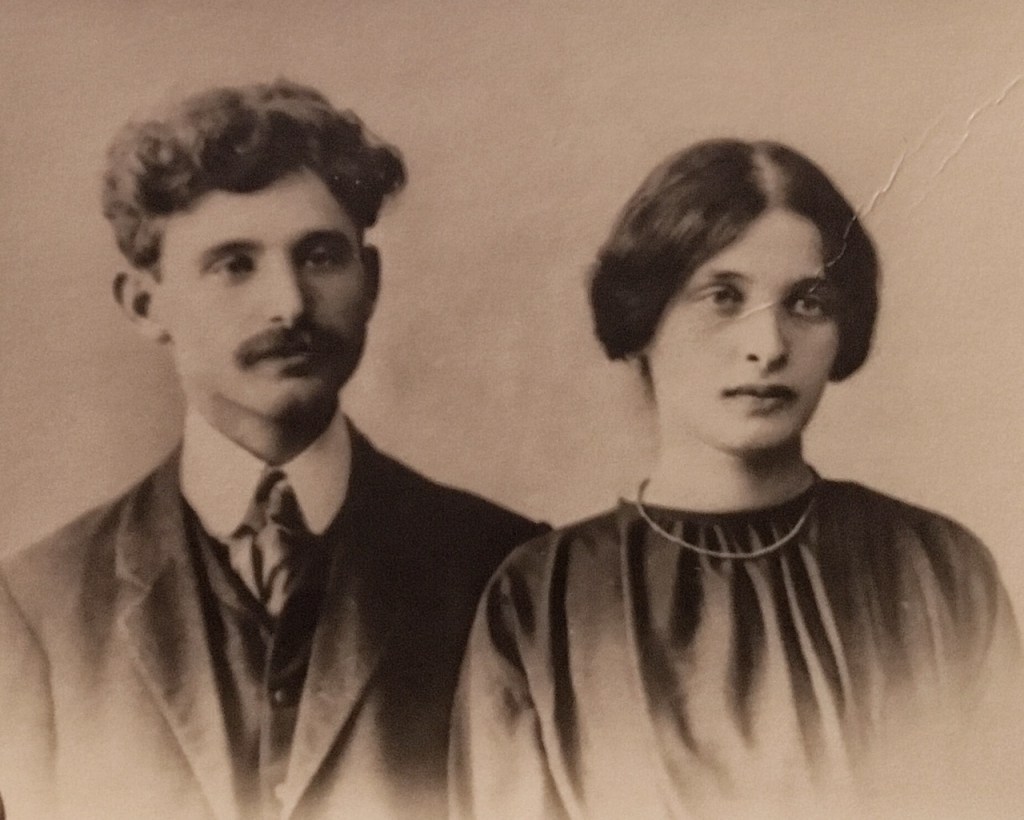
Lipa Katz — fellow Maximalist and later Klebanova’s husband — and Klara Klebanova. Likely taken in Italy, 1911. Courtesy of Paul Bassen.

Klara Klebanova was a member of the Maximalist wing of the Socialist Revolutionary party, active in the revolution of 1905. In 1914 she immigrated to the US and in 1922 published her memoirs in the Yiddish-language daily Forverts. Klebanova grew up in Novozybkov, a town in the Chernigov province, which was then Ukraine but is now part of Russia’s Bryansk oblast. Klebanova came from a relatively assimilated and well-off Jewish family; she mentions graduating from a secondary school that was known to have strict quotas for Jewish students. The work of popular Russian writers — Turgenev, Tolstoy, Uspensky, and Nekrasov — moved Klebanova to participate in the revolution. The plight of the Russian peasants and the desire to ease their poverty and suffering brought her into the fold of the Socialist Revolutionary party.

The historical value of an authentic voice may be reason enough to read this memoir. What makes this tale outstanding, however, is Klebanova’s gift as a writer. She deftly weaves together the personal and the political, breathing life into her sketches of fellow activists. Her memoir is both a history of ideas and a love story. It contains an account of a revolutionary movement, a glimpse into the St. Petersburg prison system in the 1900s, and affectionate portraits of some notable revolutionaries.

For the excerpt below, I have chosen from the sections of Klebanova’s story that focus on Katya Izmailovich, a young woman who had a special place in Klara’s heart and who was one of her earliest guides in revolutionary work.

WILD STRAWBERRY, as Klara Klebanova’s memoir is tentatively titled, is as yet unpublished in full. It came to my attention through Peter Kleban, Klara’s relative and a champion of her writing. Kleban worked with translator Caraid O’Brien to render Klebanova’s memoir into English. O’Brien has also made a radiocast of the memoir, available in twelve 30-minute episodes from the Yiddish Book Center. An excerpt “Petticoats and Bombs” also appeared in the Yiddish Book Center’s magazine Pakn Treger and is available online.

This excerpt has been made possible by Peter Kleban, who owns the copyright to the work.

Izmailovich, the General’s Daughter

A Memoir by Klara Klebanova, translated from Yiddish by Caraid O’Brien

Speakers from the Social Democrats and the Socialist Revolutionaries often came to our city to address the students. On one occasion an active and well-known Socialist Revolutionary who went by the name “Grandfather” (Zeyde) came to visit. He was the husband of the famous Socialist Revolutionary Anastasia Bitsenko, who was given a life sentence of hard labor for an attempt on the life of a prominent government official. Grandfather organized a clandestine student group to prepare for propaganda work. I was among its members.

Novozybkov, circa 1918; source: Wikipedia and website Novozybkov.ru

By the time I finished high school in 1904, I was already a committed Socialist Revolutionary. My small home town could not satisfy me. I was drawn to where I believed revolutionary activity was in full swing. I wanted to leave home and be independent of my parents.

Given that my older sister had already served time in prison for protest activity, my father under no circumstances wanted to let me go. After long and difficult arguments, he agreed to send me to Borisov, his hometown, where many friends and relatives could keep an eye on me. He even arranged a part-time job for me as a teacher in a Jewish school. I had absolutely no interest in teaching. In my mind Borisov was just the first phase of my plan to liberate myself completely.

It was not difficult to leave home for the first time and be apart from my parents. Because I was leaving against her wishes, my mother was too angry with me to say goodbye. This did not move me. It was as nothing compared to the happiness I imagined I would feel when I was entirely devoted to revolutionary action. I had no idea what the effort entailed, but I was thrilled to be on the brink of freedom and able to live alone, independently, as I wished.

I stayed only a few months in Borisov. Bitsenko’s husband, the tireless Grandfather, sent Rosa Shabat, a young member of the Socialist Revolutionary party, to collect me. I left with her for Minsk, a city which I knew had a very active Socialist Revolutionary organization. It was where I needed to be to take my first revolutionary steps.

Rosa took me to the house of the famous revolutionary Katya Izmailovich. Katya’s father, a lieutenant general, was in the Far East at the time; her mother was dead and her sister, Sonya, was in prison in St. Petersburg awaiting a life sentence of hard labor for an attempt on the life of Kurlov, the governor of Minsk, who was one of the hated so-called “bloodhounds.” Katya occupied the entire family home along with a soldier assigned as her orderly. I stayed with her for about three weeks.

Ekaterina Izmailovich; source: Wikipedia

From the outset Katya’s orderly was very unfriendly toward me and suspicious. Apparently it was inconceivable to him that his noble lady would bring a Jew into the general’s house. He had a dull soldier’s face that appeared to notice nothing, but in fact he was very sly and kept track of everything Katya did. He noted, for example, that she was hosting workers’ meetings. Katya suspected he was spying and informing on her. She was terrified of him, but nonetheless teased him and made fun of him. She named the dog that was always at his side “Compatriot,” meaning countryman, the word soldiers used to greet one another. This offended him tremendously. I often noticed his face was red when Katya stood laughing at him. To taunt him further she invited some of us revolutionaries to dance on the general’s furniture. We jumped all over the white armchairs and divans. Katya even jumped onto the piano and banged the keys with her shoes. The orderly boiled as he watched this group of hooligans desecrating the holy shrine of his general’s furniture. Katya winked at him from across the room with a roguish smile as if scoffing at the luxurious surroundings.

What a wonderful person Katya was, so dignified and distinguished that a young provincial like me could not but idolize her! Still, it annoyed me that she behaved with such contempt toward the orderly. It seemed to me that a revolutionary should not behave in such a way toward a young, poor, unimportant soldier. Once I spoke up about it.

“He spies on me, you know,” Katya said. “He’s here to inform on me, the dog, and he acts as if he doesn’t notice anything.”

Katya was twenty-five or twenty-six years old, tall, bony, and not pretty. From her looks one would have taken her for a small-town seamstress rather than a general’s daughter. She always wore the same blue calico dress, with her hair combed straight and almost nothing feminine about her movements. She gave the impression of being a wily person, aware of everything she did. She was close to everyone and all the comrades, even the old revolutionaries, treated her with great respect. She was very determined and a wellspring of energy; her eyes sparkled with humor. She found things to deride and mock that we would never have noticed. Often she made fun of the sound of Russian spoken with a Yiddish accent. She imitated it perfectly. She told of running with her sister from their secondary school over to the Jewish schools to tease the children and shout “zhidovki, zhidovki!” Anyone could see that she did not intend this in anger or out of anti-semitism, but as pure mischief making.

Minsk in 1905; source: Wikipedia

Katya got fifty rubles a month from her father the general. At the time, this was a huge sum for one person. (It was not meant as maintenance for the orderly, who ate at the barracks.) Katya gave most of the money to the Minsk revolutionary organization and lived on what few groschen remained. Her needs were minimal and she denied herself many things. While I was living with her she sometimes ordered lunch for two from the club, ate a little and saved the rest for later. Sometimes we just bought sour milk and black bread from the corner store and nothing more. I can’t speak for my friend, but I myself was hungry after those meals and my stomach growled a lot.

###

At this time, Katya’s revolutionary activity consisted of propagandizing the workers, in particular the railway workers [and Klara joined her in this activity].

[…Soon], Katya told me that there had been a split among the Socialist Revolutionaries. An opposition group had emerged under the banner “Young Ones.” It differentiated itself from the Socialist Revolutionaries and Democratic Socialists by not recognizing the Minimum Program, part of the program of the latter two groups. The Minimum Program was a set of immediate demands for political rights, a parliament or the creation of a representative body, a free press, a right of free speech and assembly, the right to strike, and an eight hour work day. The Socialist Revolutionaries also included the socialization of the land. The Maximum Program was a more ambitious, longer-term goal, demanding the establishment of a Socialist society.

Materials, establishing the program of the Maximalist wing of the Socialist Revolutionary party; image from the archives of the Russian Historical Society

The Young Ones, by contrast, demanded that the Maximum Program be the immediate goal. They did not recognize the struggle for a parliament as a necessary first step, judging that a parliament would not bring them any closer to their goal of socialism and that indeed it would hinder their aims while dulling the consciousness of the workers. In this sense the Young Ones were like the Syndicalists in France.

The Young Ones declared that the upcoming Russian revolution should be a social revolution rather than a revolution for political freedom. Accordingly the peasants should seize the land and the workers take over the factories and industries. In other words the Young Ones—or Maximalists as they were later called—preached and fought for what Lenin was to bring to life ten to twelve years later. They had to endure a difficult internal struggle, with the Democratic Socialists on one side and the Socialist Revolutionaries on the other! In addition, they—or rather we, because I soon joined them—were called Utopian fantasists, irresponsible people with petit bourgeois aspirations. (At the time it was fashionable to insult people with the label petit bourgeois.)

[…] I could not stay in Katya’s house any longer—spies appeared with increasing frequency—so I rented my own little room. I had no servants and the only way I could earn anything was by giving lessons. I had very few acquaintances in Minsk and in addition I lived under a false passport. I did not think it was fair to take money from the organization at a time when I had brought so little to it, and I didn’t want to take money from Katya. I lived truly half starving. I could have asked my parents for money, but I didn’t want to write to them: it might have exposed where I lived. At times the organization in Minsk sent me to surrounding cities and towns to speak at gatherings. Addressing a crowd no longer made me confused or anxious; everything came out smoothly and clearly. I came back happy, knowing that I had accomplished something.

[Klara then decided to move from Minsk to Bialystok, which had a strong Young Ones group.]

[…] Katya was also about to go away. The night before she left, she had a small good-bye party. A few comrades gathered at her house for wine and drinks. Handing me a glass she said, “Tonight, you and I will sing our swan song.”

I had no inkling that she was about to attempt the assassination of Admiral Chukhnin of the Sevastopol Black Sea Fleet, or that this would be the last time I would see her.

She went to Chukhnin dressed in mourning and naturally under a different name. She posed as a sailor’s widow whose husband had been killed in battle. She had a request, she said, and was allowed to see the admiral. She shot him, but only succeeded in wounding him in the foot.

In a rage, Chukhnin ordered his servant to cut Katya to pieces with his sword. This was in 1906.

Thus this noble revolutionary died. She had rejected all the pleasures that her station in life could have given her and chose instead the greater happiness of fighting for the freedom of all people. Because she believed in the necessity of violence, she thought it wonderful good luck to be chosen to participate.

By then I had decided to become one of the chosen, but I did not yet feel worthy of a deed as important as Katya’s. A feeling smoldered deep in my soul: wait, your time will come.

At Katya’s death, though, I was quite overcome.

Katya had of course guessed that I wanted to take part in violent action. That was what she had meant when she said that I too would soon sing my swan song.

It turned out that my destiny was to survive, forever on the threshold between life and death. My song remained unsung until the end. I traveled to Bialystok.

Translators Reflect Europe in Transition: an Excerpt and a Cast of Characters from Cathy McAteer’s monograph Translating Great Russian Literature: The Penguin Russian Classics

We at Punctured Lines are delighted to bring to you an excerpt from Cathy McAteer’s monograph Translating Great Russian Literature: The Penguin Russian Classics (forthcoming from Routledge on January 4, 2021). As most academic publications, this book (available for pre-order here and here) is priced for university library purchases, but luckily for those of us without a university affiliation, this title will also be available as an Open Access publication. Please ask your libraries to order this title, and in the meantime, here’s a brief preview and a fascinating cast of characters whose work McAteer explores in her book.

Abstract: Launched in 1950, Penguin’s Russian Classics quickly progressed to include translations of many great works of Russian literature and the series came to be regarded by readers, both academic and general, as the de facto provider of classic Russian literature in English translation, the legacy of which reputation resonates right up to the present day. Through an analysis of the individuals involved, their agendas, and their socio-cultural context, this book, based on extensive original research, examines how Penguin’s decisions and practices when translating and publishing the series played a significant role in deciding how Russian literature would be produced and marketed in English translation. As such the book represents a major contribution to Translation Studies, to the study of Russian literature, to book history, and to the history of publishing.

The following extract has been selected from Chapter One: Creating Penguin’s Russian Classics, and is accompanied by abridged cameos of just some of the translators who feature in more detail during the course of the book.

[Excerpt begins]

[In 1946], British readers were still largely reliant on Constance Garnett’s renderings of the Russian literary canon. Hence while Rieu (Penguin Classics editor — PL) could easily make a case for re-translating the Russian classics, he did not have a wide choice of experienced Russian-English literary translators at his disposal. Since the era of vocational training in literary translation had not yet arrived, anyone with knowledge of translation theory would have been self-taught. Those commissioned by Rieu probably possessed intuitive translational talent and a feel for writing, or else aspired to develop both. Penguin’s early Russian classics translators might have acquired and used their language skills in different settings, both professional and personal, but without exception their backgrounds reflect the lived experience of a Europe in transition. Elisaveta Fen and David Magarshack immigrated to the United Kingdom from turbulent, post-revolutionary Russia; Rosemary Edmonds had worked as a senior wartime translator; Paul Foote studied Russian on the inter-service Joint Services School of Linguists (JSSL) course at Cambridge before working as an interpreter in Potsdam in 1946; and Richard Freeborn had worked in the Royal Air Force and post-war Potsdam, before finally moving to the British Embassy in Moscow. With background details such as these, it is not surprising that these individuals eventually found work which transposed their language skills to the field of translation in peace-time Britain. Where better to do this than Penguin Classics, the publisher of the moment?

Elisaveta Fen

Although Fen translated other Russian authors, Zoshchenko, Bondariev and Shvarts for other publishing houses, she translated only Chekhov’s plays for Penguin, adding four more plays (The Seagull, The Bear, The Proposal, A Jubilee) to a new 1954 edition, and a final edition in 1959. Correspondence reveals that Rieu declined Fen’s offer to translate Chekhov’s short stories for Penguin. Rieu informed her that ‘We are going slow on Russian works, apart from the 2 great works of Tolstoy and 4 of Dostoievsky’s’ (26 March 1957). Just six months later, however, Fen received confirmation of Penguin’s decision to commission a different Chekhov translator (Magarshack) instead:

I think it only fair to let you know now that we have just decided to place the work in the hands of another translator. I am afraid this news may be a disappointment to you, but you will remember that we and our advisors had something to say in criticism of the English style in which the samples were submitted. (Rieu, 1957)

Rosemary Edmonds

Rosemary Edmonds (1905-1998) worked as a translator to General de Gaulle at the Fighting France Headquarters in London, and on liberation in Paris. Having been funded by de Gaulle to study Russian at the Sorbonne after the war (Hahn, 2004), she was ‘recruited’ by Rieu (the details of their first meeting are not recorded) after submitting sample translations. She translated works by Tolstoi, starting with Anna Karenin (1954), the first re-translation in the UK since the Maudes’ version in the 1920s. Like Garnett before her, Edmonds embarked on a career in Russian literary translation without ever having been to Russia; in the same year that her translation of War and Peace was published, Edmonds informed Penguin (4 May 1957) that she had been invited to Russia for the first time.

Edmonds’s lack of direct experience of Russia might explain Rieu’s evaluation of her first typescript. In a letter to fellow editor A.S.B. Glover on the typescript of Anna Karenin, Rieu discussed the improvements she had made to the text at his suggestion (such as reading her ‘stuff aloud’ and consulting with native Russians). He remarks that, ‘I have examined the text carefully and found it good, though I do not think she is one of our A+ translators. I have also read the introduction which is, in my opinion, a bit feeble, but not altogether rotten’ (8 September 1952).

David Magarshack

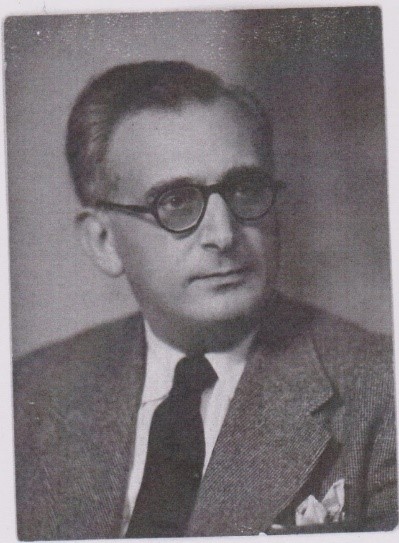
David Magarshack

Whereas Edmonds exerted linguistic power over the Penguin editors, insisting that she knew best when it came to the text, there is no evidence to suggest that she ever called into question her terms and conditions. By contrast, Magarshack regularly challenged his editors Rieu and Glover over both payment and, to a lesser extent, textual matters. In Rieu’s introductory letter to Glover of 20 January 1949, he explains that Magarshack ‘lives by his translations’, adding, with a suggestion of caution, that he ‘has published translations from the Russian with other publishers and has several new ones in the hands of various firms (Faber’s, Lehman, etc [sic]). They deal generously with him’. We may presume from this that, in their initial meeting, Magarshack offered Rieu this information himself in a bid to increase his negotiating power, a position which is reiterated in Magarshack’s first letter to Glover. Dissatisfied that Glover appeared to be reneging on Rieu’s terms, Magarshack spelled out his views:

There is no question of approval at all. I am not an amateur, and my books have been published and are due to be published by well-known publishing houses […]. Mr Rieu was in complete agreement with me about this question of approval. (3 March 1949)

This cohort of fascinating characters had its day immediately after the war, but the next decades saw a shift to other, younger, differently trained translators such as Glenny whose Solzhenitsyn and Bulgakov would change readers’ perceptions of what Russian literature meant. The second half of my book charts this change.

To keep on reading, please access the book through its publisher.

Dr. Cathy McAteer is Postdoctoral Fellow on the “Dark Side of Translation” project. She holds a PhD (2018) in Russian and Translation Studies from the University of Bristol, a Masters in Translation Studies (2011) and a first-class BA (Hons) in Russian (1996). Her main research interests lie in the field of classic Russian literature in English translation during the twentieth century, using archival material to shed new light on the people and processes behind historical commissions, specifically Penguin’s Russian Classics. Cathy taught Russian-English translation for the MA Translation Studies programme at the University of Bristol from 2013-2019. She has worked as a freelance commercial translator but has also translated the novella Timka’s Tale and a monograph on the Soviet sculptor David Yakerson. Cathy previously worked as an in-house translator in her role as Russia Coordinator at Nestle UK Ltd. Her academic monograph, Translating Great Russian Literature: The Penguin Russian Classics, is forthcoming from Routledge in 2021.

Note: “The Dark Side of Translation: 20th and 21st Century Translation from Russian as a Political Phenomenon in the UK, Ireland and the USA” is an ERC-funded research project (Horizon 2020, Grant Agreement No.: 802437). To learn more, find it on twitter: @Rustransdark or use the project website: rustrans.exeter.ac.uk  

“Only happy children are loved” — A Review of Daughter of the Shtetl: The Memoirs of Doba-Mera Medvedeva

Most of us who grew up in the Soviet Union will remember Samuil Marshak’s rhyming dramatic tale Koshkin dom — The Cat’s House. A wealthy angora cat builds herself a new residence. Two destitute kittens show up at her doorstep, begging her to share her house with them: We’re your nephews, they say. We’re poor orphans. Won’t you let us in and feed us? The wealthy angora cat has her servant shoo them away, setting off the action of the drama in which the angora cat eventually gets her punishment for refusing help to the kittens in need, and the orphan kittens prove to be in the position to give her shelter.

Marshak’s rhymes were at the tip of my tongue while I was reading Daughter of the Shtetl: The Memoirs of Doba-Mera Medvedeva (Academic Studies Press, 2019), as though Doba-Mera and her brothers were the original orphans, the prototypes behind Marshak’s dramatic tale — except their life’s story didn’t make room for happy endings.

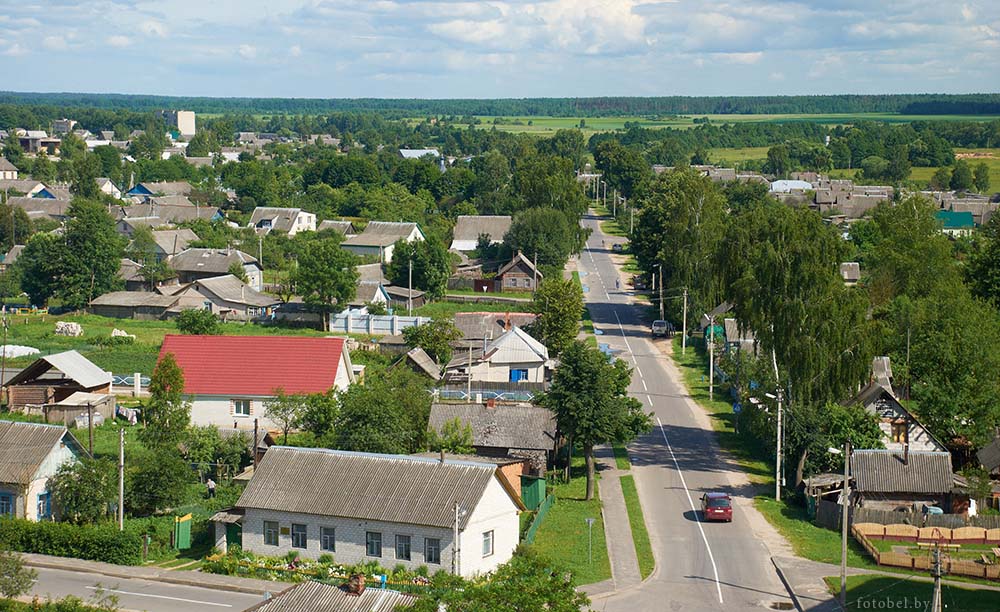
Doba-Mera Gurevich was born in 1892 in the shtetl of Khotimsk on the eastern edge of Belarus and the Pale of Settlement — that part of the Russian empire where Jews were allowed to live. Her mother died in 1903, when Doba-Mera was eleven, and as she was dying, she left Doba-Mera this parting message: “From the moment I close my eyes, the whole world will reject you. Because only happy children are loved.”

This is, indeed, what happened: Doba-Mera had to leave school to take care of her brothers; Doba-Mera’s father, a teacher, remarried, and because his new wife didn’t have the resources to raise the children from his previous marriage, Doba-Mera and her two younger brothers went from relative’s house to relative’s house, working and suffering their way through their childhood. Several years later, her baby brother, of poor health from birth, succumbed to an illness and died.

Khotimsk in 2013, photo by Dmitriy Ivchenko from Photo Encylopedia Belarus

Doba-Mera describes one occasion on which, after spending time with their grandfather for High Holidays, she and her brothers were sent by a hired wagon to their uncle’s house:

Uncle himself came out and asked in a saccharine way, “Who are these children you have brought me?” “They are the orphans of your younger sister Rokhl”… “So why did you bring them to me? asked Uncle. “You, Veniaminovich,” said the driver, “take them off the wagon, warm them up and feed them — they are hungry and wet — then ask your questions. Look, the poor little ones are frozen stiff.”…. And Uncle stood by the door and stroked his beard and said, addressing the driver by name: “I have nowhere to put them, but they have an aunt here, their father’s sister. They don’t live very far; take them there.”

Eventually, Doba-Mera’s family put together the money to apprentice her to a tailor, and after learning how to fend for herself in a male-dominated environment, she acquired a trade. She witnessed a pogrom and was lucky to come out unscathed physically. She married a distant relative whose parents hated her and made her married life very difficult. She describes years of fear, poverty, and anguish during WWI. After October 1917, she and her husband were eventually able to leave their shtetl and settle in Leningrad, improving their fortunes somewhat, but then came WWII and its attendant horrors.

I won’t overstate the matter if I say that this was a relentlessly sad book down to the very last page. In fact, the most horrific incident comes in a footnote on that page: in this footnote, Michael Beizer, Doba-Mera’s grandson and the force behind the publication of this book, recounts a story told by a resident of the town of Klintsy (not far from Khotimsk), who had been forced to bury the dead after the Nazi shooting of the Jewish residents. I won’t tell this story here — it’s painful. I have to admit, at first, I was deeply angry at Beizer for leaving me with this story on the last page of Doba-Mera’s book, and it’s only with time that I came to realize how appropriate it was to end the book with this Holocaust story. Though Doba-Mera and her children had been able to escape it, it is the Holocaust and the loss of so many lives and so much knowledge that necessitated if not the writing than the publishing of her book. It still hurts to recall that story though.

Doba-Mera began writing her memoirs in the 1930s, living in Leningrad and wanting to tell her children something about her past. Having left school at the age of eleven, she clearly took a lot of pride at her abilities as a learner and deeply regretted that life hadn’t allowed her to use those skills more. She wrote in Russian and addressed herself to her Russian-speaking children and grandchildren, explaining Jewish customs and a way of life. The memoir comes to us in English in a deeply nuanced translation by Alice Nakhimovsky, who in her accompanying note marvels at Doba-Mera, ascribing to her membership in “a vanishingly small group of memoirists who are neither elite nor highly literate but whose observations from the ground cast a vivid light on a lost world.” Nakhimovsky helps to illuminate that world by bringing into English Doba-Mera’s particular idiom, a Russian infused with concepts and a particular cadence taken from Yiddish — the memoirist’s first language.

To me, this memoir feels valuable also because of the way Doba-Mera not only captures her personal experience but constantly connects it to the larger social structures that governed her life. For instance, this is how she recounts life at the edge of the Pale of Settlement (her town was apparently right on the border of what is now Belarus and Russia):

One summer day after work I went with my girlfriends to walk along Barabanovka Street. The street was on the other side of the river, where everybody used to go walking. Jews were allowed to walk but not to live there. A landowner lived there by the name of Robert. He couldn’t stand Jews, but as our stetl was in Mogilev Province, and Jews were permitted to live there, he got the government to make his street part of Orel Province, where Jews were forbidden to live. And he got all the Jews sent away from there. The empty houses where the Jews had lived were boarded up, and nobody would buy them because the Russians were confident that they would get everything anyway.

So on the Sabbath and holidays everybody would stroll there. The street was beautiful, with a lot of greenery, and so everybody liked to stroll along it.

This moment from the year 1907 is probably one of the happiest in Doba-Mera’s life. She goes on to describe her encounters with various socialist revolutionary groups during this period of her life. She wasn’t a revolutionary herself — she had her brothers to provide for — but she recalls going to underground gatherings and gives us the outline of the underground activity in her area.

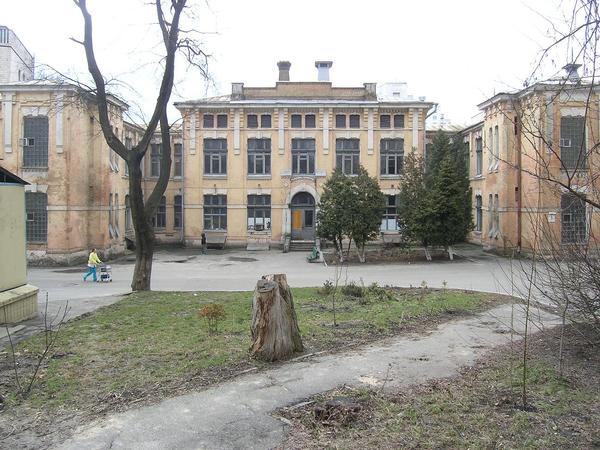
The other distinct pleasure of reading this memoir is the candid way Doba-Mera writes about her own emotions, including the times when they turned ugly. She doesn’t shy away from describing her feelings of regret, sadness, jealousy. In one particularly devastating moment, she drops her work for several months to travel with her ailing father to Kiev, in the vague hope that he might be saved by the doctors there. She gets recommendation letters to distant family members and with trepidation approaches them upon arrival, encountering in their way of life such luxury and wealth that she hadn’t seen in the Pale.

Brodsky’s free Jewish clinic in Kiev (image circa 2011 from the website Interesting Kyiv)

I was seized with anger and at the same time envy, because [a relative’s son] was a student and could get nothing but Cs and was given everything he could possibly need, while I studied so well but had to become a tailor and live a life of piteous need and, to make matters worse, turn up in a big, unknown city where Jews weren’t allowed to live with a sick father, without money, wondering every minute whether I would get him home alive. At every step I cursed the day of my birth and came to the conclusion that only rich people should have children, because poor people get only suffering from them and the children also suffer.

The bitterness of Doba-Mera’s voice felt deeply familiar to me and eventually I realized that it was bringing back the intonations of my grandmother’s speech. My grandmother Raissa (Reesya) was born in Tikhinichi, another Belarusian stetl, about 130 miles from Khotimsk in 1912 or 13, about the same time as Doba-Mera’s first child. Like Doba-Mera, Raissa received her first education in a male cheder (elementary school where boys learned to read Hebrew and studied the Torah), though being a generation younger and having her mother to help her, she was able to continue her education in Leningrad. Nevertheless, life, to Raissa was a series of trials and punishments for sins she didn’t commit, and though she believed that she improved her lot by hard work and sacrifice, she refused to talk about things like “love” and “happiness.” When I tried to ask her about these things, the most she would tell me was pozhivesh–uvidish, which loosely translates as “just wait and see what life is really like.”

As a child in the 1980s, I resented this attitude and was only too happy to have a chance to escape “my lot” by moving to the United States. I have escaped, and so completely that I needed Doba-Mera’s book as a reminder of this way of thinking. Today, I find myself deeply grateful to Michael Beizer and Alice Nakhimovsky and to Academic Studies Press for this brave book. Its nonconformity to the expectations we place on the genre of the memoir (tell us what your struggles have taught you; or in any case, please land on an uplifting note) is liberating and feels deeply true to my ancestors’ ways of conceptualizing their own lives.

Feminist and Queer Russophone Poetry

This year, English-speaking readers will be introduced to three books in translation from Russian, each of which is groundbreaking on its own terms; taken together, these books showcase the aesthetic potential of feminism in contemporary Russian-language poetry. The feminist and queer voices in these books are amplified by the group of poet-translators, whose own politics and identities allow them to negotiate the cultural gap between russophone and anglophone contexts, enriching both. Punctured Lines is proud to introduce the three books and our conversation with Ainsley Morse, Eugene Ostashevsky, and Joan Brooks, who as editors and translators served to bring these books to English-language readers. 

Update: This post was originally published on October 14, 2020. Subsequently, Joan Brooks asked us to remove their answers to the questionnaire, and we’ve done so on December 11, 2020.

The Books

Lida Yusupova’s collection, The Scar We Know, edited by Ainsley Morse, with translations by Madeline Kinkel, Hilah Kohen, Ainsley Morse, Bela Shayevich, Sibelan Forrester, Martha Kelly, Brendan Kiernan, Joseph Schlegel and Stephanie Sandler 
(Cicada Press, Winter 2020/21)

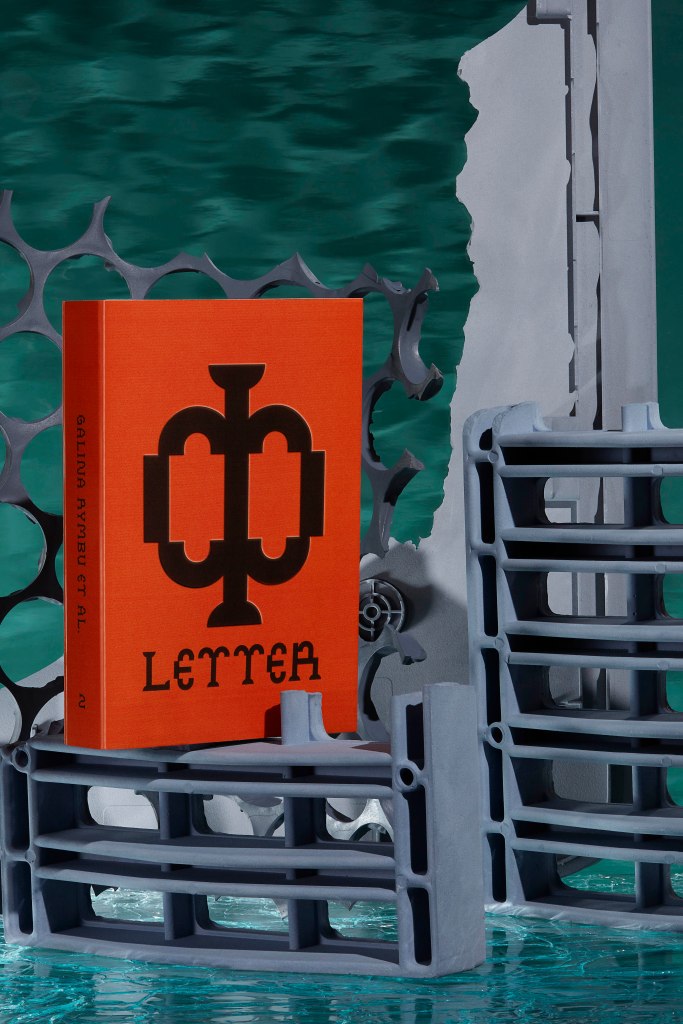
F Letter: New Russian Feminist Poetry, an anthology edited by Galina Rymbu, Eugene Ostashevsky and Ainsley Morse, with original poems by Lolita Agamalova, Oksana Vasyakina, Elena Georgievskaya, Egana Dzhabbarova, Nastya Denisova, Elena Kostyleva, Stanislava Mogileva, Yulia Podlubnova, Galina Rymbu, Daria Serenko, Ekaterina Simonova and Lida Yusupova; translated by Eugene Ostashevsky, Ainsley Morse, Helena Kernan, Kit Eginton, Alex Karsavin, Kevin M. F. Platt, and Valzhyna Mort
(isolarii, October 2020)

Galina Rymbu’s collection, Life in Space, translated by Joan Brooks with an introduction by Eugene Ostashevsky and contributions by other translators
(Ugly Duckling Presse, 2020)

NB: Dear readers, please pre-order and buy these books and request that your local libraries purchase them for their collections. This directly supports the work of everyone involved in their making.

Conversation

PL: These are Rymbu’s and Yusupova’s first poetry collections in English, and many authors in the anthology are being published in English for the first time. How did these books come to be? What’s the story–or stories–behind their near simultaneous publication in the US? 

Ainsley Morse: I met Yusupova in 2017, when we invited her as the “poetic guest” to AATSEEL (the annual conference of the Association of American Teachers of Slavic and East European Languages)–when funds allow, we like to invite a poet to have translators workshop some of their poems and to give a reading. The idea of making a book started then but really took shape as, over the ensuing couple of years, I kept encountering other translators who were interested in Lida’s work and wanted to take on various texts. (I am the editor of the book and did some of the translations, but really couldn’t have done this project on my own.) Most of the other books I’ve done have been labors of love–me wanting to bring something strange that I love into English, but not always with a huge resonance–but my sense of Yusupova’s book is that it almost made itself; it sensed its English-language audience ready and waiting.

Eugene Ostashevsky: It’s both a coincidence and not a coincidence. Historically, it’s not a coincidence. It has to do with the emergence of feminist and queer poetry in Russia in this decade, mostly written by the young poetry generation, i.e. by people who did not live in the USSR. Yusupova, who is older and did live in the USSR, was the inspiration for some of this poetry. Rymbu is currently its most visible representative. I first came across a poem of hers by chance, online: it was during Maidan, in February 2014. It was the Lesbia poem, about the coming of fascism to Russia. It was obviously the work of somebody who had a vast poetic erudition but was doing something new with it, and something wildly compelling. So I did a feature on her in Music and Literature with Joan’s translations. Sebastian and India, the publishers of isolarii, read the feature and contacted me. We decided to do an anthology that she would edit and that would represent some of the people from her circle. It just so happened that all three books–the anthology and Rymbu’s and Yusupova’s English-language books–are coming out simultaneously. I think we have COVID to thank for it, because they all got held up by the lockdown in different ways.

PL: There have been a number of writers in the russophone space who wrote to queer and feminist themes in the past, including Yusupova herself, who published her first collection in 1995. In 2017, a collective of poet-activists launched “Ф-Письмо [F-Writing],” an online platform, specifically dedicated to feminist poetry. F Letter: New Russian Feminist Poetry gathers the work of poets associated with the F-Writing collective who intentionally blur the lines between poetry and activism. They do this both by breaching taboo topics–for instance, the physiology of the female body (as in Galina Rymbu’s recently published poem “My Vagina”)–as well as by breaking with tradition in Russian-language poetry by moving away from rhyme and meter. What do you see as some of the most exciting and innovative aspects of the poems you worked with? 

Ainsley Morse: A noticeable shift away from rhyme and meter has been underway in Russian poetry for at least twenty years now, probably more like thirty (depending on how you understand “noticeable”). But this shift has had a political charge, since it certainly coincided with other, more noticeable rapprochements with the West, and to this day the majority of Russians would certainly tell you that poetry is something that rhymes. Some of the poets in the anthology, particularly the ones with personal experience of life in the USSR–Ekaterina Simonova, or Elena Georgievskaya, for instance–started out writing much more traditional-sounding verse. Lida Yusupova (b. 1963) certainly grew up in a poetic environment dominated by rhyme and meter, but her years of living (and reading) abroad have also surely affected her general sense of poetry. In any case, when she gives specific instructions to translators / editors to “let the lines run on as long as the page will let them”–you know this is someone who has a sense of the constrictions imposed by a neat stanza, such that these unhinged rambling lines are a really meaningful part of her poetics. I’d say, though, that most of the poets represented in the anthology came of age as poets in an (admittedly rarefied) environment that saw free-verse as the new normal; as Eugene describes, their innovations are happening more in the realm of selfhood, subjectivity, identity. 

Eugene Ostashevsky: Feminist and queer work–and left-wing political work in general–is what’s exciting in Russian poetry now, at least as far as movements are concerned. Russian poetry has for many generations generally tended to avoid politics. There were a number of deep reasons for it, from the cultural policy of the state to ideologies about poetry held even by people who were deeply anti-establishment. Of course, the aim of the state was to knock out the political instinct altogether, or rather the critical political instinct, to make people believe that politics is corrupt, so that conformism may rule. (This is still the current strategy because it works.) At the same time, stylistic experimentation sufficed to demonstrate your anti-establishment colors, because stylistically interesting work generally could not be published under the Soviets. In the aughts, during Putin’s first decade, some poetry started to break away from the general aversion to political engagement. And it was also a poetry that started breaking other taboos–including talking about the body, and about sexuality in ways that ultimately turned out to be socially impermissible and politically volatile. This poetry moved towards reflecting upon the self in new ways, towards constructing the self differently, and that self would very obviously no longer be a Soviet self, and not even a post-Soviet self. So it was anthropologically innovative, which made it politically innovative also. 

However, it was the state that took the crucial step of making such poetry necessarily and obviously political. The state politicized sexuality by associating LGBTQ+ issues with the decadent West, pretending that LGBTQ+ posed a danger to Russian society, as if they were some sort of rainbow-colored NATO special forces, largely criminalizing them and positioning itself as the defender of family values. Once that happened–once Putin, as dictators everywhere, consciously threw in his lot with defense of patriarchy–feminist and queer poetry automatically got shoved onto the political frontline, and automatically became–it’s perhaps unsuitable to use military metaphors here but in Russia we/they like military metaphors–the vanguard of resistance to Putin or the putative Putin or the state.  

PL: Most of the poets included in the three books are closely connected to each other by personal and artistic ties. F Letter: New Russian Feminist Poetry was edited and includes work by Galina Rymbu as well as Lida Yusupova’s poetry. What connections between the three books strike you as the most meaningful?

Ainsley Morse: As someone who teaches / tries to teach Russian poetry to American undergraduates, I love that these books are coming out in hot succession–it’s a rare moment when the slow and painstaking world of translation publishing comes a little closer to the pace of the “real life” of this subset of Russian poetry, where these poets are all constantly releasing work that is in conversation with, responding to, each other. Single-author books always give a broader and deeper sense of a writer than a couple of poems in an anthology, but here we also have this anthology providing a whole additional level of context to both Rymbu’s and Yusupova’s work; I would hope, too, that readers intrigued by some of the anthology authors might feel empowered to suggest further translations of some of them. Another rare treat (pedagogical and otherwise) is the possibility, at least with the anthology and Yusupova’s solo book, to compare the voices of different translators grappling with the same poet’s work. I’m also excited and curious about the way English-language readers will react to all three of them being available at once: it seems like an unusual opportunity for a more in-depth and nuanced cross-cultural poetic dialogue, more or less in real time.

Eugene Ostashevsky: Well, it’s the same corpus. Poems don’t really get written individually. They are always collaborations. When you’re a loner, you collaborate with dead people. But here you have work by contemporaries responding to each other–you have a conversation of the living, who are trying to make sense of themselves and of their surroundings. The F Letter: New Russian Feminist Poetry anthology has an incredible poem by Oksana Vasyakina, “These People Didn’t Know My Father,” which starts by talking about the importance of Yusupova as a catalyst. For me, I love Galya Rymbu’s slightly earlier, more anthemic poems in White Bread, that Joan translated, and it’s really interesting to see her return to the same area in “My Vagina” but years later, as a different person. But she works in a number of different directions, and another direction picks up, for example, on the poetics of Arkadii Dragomoshchenko, a Petersburg poet of an older generation, who died a decade ago, and a lot of whose images are apophatic, nonvisualizable.    

PL: Despite their similarities, these are three very distinct books, published by three separate presses and presumably aimed at different, albeit partially overlapping audiences. What are some of the unique aspects of each of these books? 

Ainsley Morse: As I said earlier, I really have this sense that the Yusupova book “made itself”–I don’t ever remember having a serious conversation about the contents, it just came together in what now feels like a strikingly harmonious and well-balanced structure. All the texts were proposed by the individual translators, with the exception of one poem (“Patchwork Quilt”) that Lida asked us to add (otherwise she did not comment on the contents, except to say how delighted she was). I suspect that the excellent quality of the translations and the overall pleasing shape of the book comes out of this shared creative satisfaction, the fact that everyone was following individual inspiration. Perhaps I should also add that we took our time and agreed on deadlines collectively–no one was rushed.

Eugene Ostashevsky: One aspect that F Letter: New Russian Feminist Poetry shares with Rymbu’s Life in Space, as well as with Yusupova’s collection, is that all three are bilingual. The bilingualism of the books means they are addressed to several audiences at once–to poetry audiences in the US and UK (not at all the same audience), as well as to English-speakers globally, because we, or at least I, aren’t writing for just American readers now. Being bilingual, the books are also addressed to Russians–to global Russians also, meaning to Russians outside of Russia, to people fluent in Russian, and to people just beginning to learn Russian. I ended the introduction to Life in Space with a request that readers who don’t read Russian at least learn the letters so that they can pick up some of the materiality of the language on the facing page. It’s not because I have a Russian fetish, it’s because I think poems are material things, and especially material in the original. Just reading the translation is not enough for me. But I digressed and said nothing about the differences between the books, only the similarities. Sorry. 

PL: Though Russian is the common language from which these poems originated, most of the poets have lived experiences in a number of cultural and linguistic contexts. Having grown up in Petrozavodsk, Karelia, Lida Yusupova lived in St. Petersburg and Jerusalem, and currently divides her time between Canada and Belize. Galina Rymbu was born in Omsk, Siberia, and Oksana Vasyakina further East, in Ust-Ilimsk, Irkutsk oblast. Lolita Agamalova was born in Chechnya and Egana Dzhabbarova spent her childhood in Georgia and currently lives in Yekaterinburg. What do you think these complex mobilities contribute to their poetics?  

Ainsley Morse: In Yusupova’s case, I would say complex mobility makes her poetics. A lot of the poems in her 2013 book Ritual C-4 (excerpts from which open The Scar We Know) are outright multilingual and/or strongly gesturing toward other cultures, histories, languages, etc. This is a really interesting problem for translation, since part of what makes these poems powerful and strange is the simple fact that they tell these stories in Russian, and Yusupova–as someone who spent several decades living in Russia–is fully aware of how dramatically different these (Belizean, Canadian, American, etc.) scenarios and names sound and mean when they are transplanted into Russian. To some extent she is playing around with exoticism in a way that can seem not entirely politically correct. But both in Ritual and in more recent work, she also uses the distance gained from her own personal displacement to look back to Russia (to her own past and the present day alike) from an estranged position. I think this crucial shift in viewpoint is one of the moves that made Lida’s work so inspiring for some of the younger poets in the anthology.

Eugene Ostashevsky: It makes them modern. Modernity is displacement. But, on the less slogany level, it also shows that Russia is not just Moscow and Petersburg anymore, because Russia, with its history of absolutism, used to be like France–just Paris.

PL: Translators have played a very active role in bringing these books to English-language audiences. Some of the translators are themselves poets and activists, and many were born in the Soviet Union or to USSR-born parents. Considering that poetry translation is the act of co-creation in the new language, what do you think these complex identities of the translators contribute to the shape of these books? 

Ainsley Morse: I have to say that I still don’t know very much about the personal background of the translators who did the bulk of the work on the Yusupova book–Madeline Kinkel and Hilah Kohen. I know that they’re both younger than me (by how much, I don’t know), hard-working, bright, responsive, creative and generous, and driven by a vested interest in the work. 

With the anthology, I do remember feeling that we needed to involve younger translators–many of the poets there were born in the 1990s, and it seemed important to me that the English come from people reasonably coeval with them. But that was an easy task because there are so many fantastic young(er) Ru-En translators out there right now! I suppose that does bring the conversation back around to the question of family background, since for some of the translators growing up with Russian in the family probably means they achieved a greater degree of bilingual fluency at a younger age (without years of study). But we also worked with several marvelous translators who have just learned Russian from scratch.

The question of translators-cum-activists is interesting. In some ways the history of twentieth-century Ru-En translation is one of activism, since the Cold War narrative of oppressed writers drove much Russian literature publishing for a long time. To some extent this anthology will draw attention precisely because of the persistence of the Cold War model: Russia’s government is still/again villainous, and some of these poems call direct attention to this fact. In the internet age, though, translators have an easier time finding writers they find compelling for whatever reason–they don’t just automatically translate prominent dissidents and Nobel Prize winners. Also, although many of the translators whose work is featured in these books identify as queer, the problems that are relevant for queer poets in the US right now are not necessarily the same ones being grappled with in Russia. So it’s probably more important that the translator has a connection with the poems than necessarily with the poet / the poet’s self-identification.  

Eugene Ostashevsky: Since translation is, at bottom, work with language, before you get to gender, ethnic or other identities, the translator needs to know how to write in the target language and how to read in the source language. The translator also needs self-control–you need to check even things you think you understand and you need to make sure you are not smothering the text with your own ideas. Having said that, it is also important–in fact, it’s crucial–for the translator to have an internal connection with the author. This can happen on any level. It can happen on the more existential level of shared, say, gender or sexual preference, although this kind of internal connection strikes me as impossibly broad if unsupported by others.

I personally need a connection through poetics. I really wanted to translate Lolita Agamalova’s Dilige, et quod vis fac, although it’s a lesbian sex poem, and I’m neither young nor a lesbian. But I also know what it’s like to use philosophy, even Neoplatonic philosophy, to talk about sex, I am at home in the kind of metaphysical poetry that she writes. And my job is not to imitate what she, as a character, is doing with another character, but to imitate in English what she, as a poet, is doing with the Russian language. We did aim for a range of “complex identities” of translators in our anthology but I don’t know to what extent that shows up on the page. Like, my “complex identity” is probably differently complex from the “complex identity” of Alex Karsavin, who is a terrific translator I first met working on this book–inventive, thoughtful, precise–but can you read the difference in our word choice? Translation is not the same as original poetry. It’s not about the translator, or rather it’s about the translator very, very obliquely. So identities don’t work in the same way. 

PL: In the anglophone world, we have seen a growing interest on the part of translators and editors to give space to Russian queer and female writers. In 2019, for instance, Brooklyn Rail’s InTranslation folio Life Stories, Death Sentences,” was co-edited by Anne O. Fisher and Margarita Meklina. This increased interest came on the wings of the reportage about the socially regressive laws passed in Russia that decriminalize domestic violence and criminalize “gay propaganda” (conveniently loosely defined), and most notoriously the persecution of gay men in Chechnya. On the geopolitical scale, we’re seeing Russian leadership align itself with the socially conservative values maintained in the US by the political far-right, upholding patriarchy and heteronormativity. In the Russian context, many if not most of these authors have engaged in acts of dissent. What do you think of the potential for these books to also act as works of activism in the anglophone context by, for instance, helping to build socially progressive alliances? 

Ainsley Morse: I don’t know how much activism these books are capable of bringing about in the anglophone context. I am very glad they are all bilingual, because I think they are definitely capable of sending small shock-waves out into the Russian-reading community–because many of these texts really are earth-shaking and unprecedented in Russian. But my sense is that many of the poems come across as much less shocking in English, where women in particular have been writing the body and sex, etc. for a while now. I’d make an exception for Yusupova’s cycle “Verdicts,” composed of found poems made using court documents she accessed on various Russian legal websites. Several of these are extremely graphic and brutal, in English just as much as in Russian. But I worry too that the English-language poetry reading public has this special category for “brutal Eastern European art” and there’s a kind of automatic distancing that neatly sections off the visceral violence and pain there as the sort of thing that happens elsewhere. Ironically, I think the more programmatic work, which highlights the legal and social differences between the US and Russia, can be less effective at bridging that gap. That said, I recently taught Vasyakina’s “These People Didn’t Know my Father” to a class of non-Russian-speaking students and several people really responded–not as much to the narrator’s fantasies of an underground feminist-terrorist organization, but to her nuanced portrait of economic disparities and social-medical stigma. The “feminist poets” in the anthology are really addressing so much in their work–their “feminism” is often so far-reaching in its calls for human rights and general decency, it almost seems limiting to use that designation (even as we can see the crucial importance of specific demands for women’s rights).

Eugene Ostashevsky: Especially now, given Russian interference in elections in the US, the EU, and elsewhere, and given international cooperation among extreme-right-wing parties and the Russians, the enemy seems to be the same in many locations all over the world, and the systems seem increasingly similar. But that may be an optical illusion. Let me think about it. Well, Russia is just more patriarchal than the US, because the Russian state depends on the traumatization of men–of all of its male citizens–during army service, as well as by the casual violence of the family, of the street. Being a Russian man–a “common,” “normal” Russian man–has to do with the internalization of violence directed at you, with directing violence at others, with accepting it as the natural economy of manhood. I think in the US, which does not have the draft, but does have gun ownership, there exists systematic abuse of men in order to rule them, but it’s directed at a smaller subset of men and it’s organized differently. Just think of American prisons and of the likelihood that an African-American man will go to prison, as opposed to a representative of another group. But it’s less obvious how it works in the US, because oppression in the US tends to be by the indirect, alienated violence of money, rather than by simple beatings or shootings. I understand about police brutality, but there is also money brutality, and I hope I am not downplaying real physical violence if I say that money brutality is more in charge. Anyway, I don’t live in Russia and I don’t even live in the US now, and I’m not a sociologist, so my pontificating is not to be taken too seriously. What I was trying to get at is the obvious point–well, obvious to you and me but clearly not for everybody–that feminism and queerness are extremely good for “straight” men also, because these ideologies aim at constructing a different body politic, one where the men also would not be brutalized, where the state would not depend on the brutalization of men, and of others by means of men, to survive. As it does in Russia. As it does in part in the US, although the violence of money is so much more complicated and less clear cut, and maybe to some extent compatible with nonpatriarchal thinking. Maybe. I don’t know. 

But I didn’t answer your question. Do I think these books can act as a work of resistance in an anglophone context? No doubt. I never say “no doubt,” but this is really no doubt. Much of the material in all three books translates pragmatically as well as semantically. 

PL: In the process of translating and editing these books, what images, concepts, and/or words have emerged as some of the trickiest to carry over into English?

Ainsley Morse: Encroaching multilingualism! I talked about this some in relation to Yusupova above; her poems have words from English, Spanish, Kriol (in one poem, Inuktitut), as well as a persistent orientation toward a kind of “other” or foreign space (even when they’re written in plain Russian). Likewise some of the anthology poets use foreign words or phrases, and it’s always so hard to get–and then convey–a sense of how that feels and means in Russian (especially since the “other” language is so often English). 

The legal language in Yusupova’s “Verdicts” cycle also offered a technically tricky problem. We, non-lawyers, were not familiar with this kind of language in English, and the Russian legal code is just different. In one case we had to redo a significant chunk because Lida pointed out that there isn’t a manslaughter charge (this had been our approximation of what was, crucially, “causing death by negligence”). Even “Verdicts” should technically be “Rulings,” but we went for the etymological rhyme (the root of the Russian word, Prigovory, is speaking or saying, di(c)t-).

For me, the “Verdicts” cycle also entailed a different kind of difficulty because of the extremely brutal and graphic violence toward women and LGBT+ people depicted in most of the poems. I should acknowledge right away that Madeline Kinkel is the translator of the cycle, for which I’m very grateful–I always knew they would need to be a big part of the book, but was reticent to translate them myself because simply reading them was such a viscerally wrenching experience. Since translating entails getting deep inside of texts and reading them over and over again, translating the “Verdicts” was sure to be hard going (of course, as editor of the book, I ended up working closely with them anyway). I remember Bela Shayevich told me that while she was translating Svetlana Alexievich’s Secondhand Time, which abounds in tales of relentless and horrific suffering, she would cry pretty much every day.

Eugene Ostashevsky: Relatively speaking, this is not hard material to translate. Older poetry is much harder, both because of greater linguistic materiality, especially in the case of classical forms, and because of greater conceptual dissimilarity. With contemporary Russian feminist poetry, though, we all live more or less in the same world, or at least we live in a world whose parts are kind of legible from the vantage point of other parts. Maybe the hardest part of the anthology was the title. F-pis’mo really translates as F-Writing, referring to écriture feminine, but to translate it as F-Writing into English would be like living in the 70s all over again, because the idea of poetry as écriture, which appeared in Russia only recently, becomes a key idea in experimental poetry in the US with Language poetry. So I translated F-pis’mo materially, because pis’mo originally means letter, the kind you send, but if you combine it with F, its meaning alters once again, to letter like ABC. So the title became F Letter: New Russian Feminist Poetry. The F is actually a Russian F, Ф, because it’s a what’s-the-f-you-lookin-at letter, and there’s even an obsolete expression, стоять фертом, to stand like an Ф, which is to have your elbows out and your hands by your waist, but figuratively it means to stand in a what’s-the-f-you-lookin-at pose. It’ll be a tiny book with an Ф on the cover. This kind of translation may be called a double sdvig.


Ainsley Morse translates from Russian and Bosnian/Croatian/Serbian and teaches at Dartmouth College. In addition to F Letter and The Scar We Know, she has worked mostly on Soviet-era poetry, prose and theory, including Vsevolod Nekrasov’s I Live I See and Igor Kholin’s Kholin 66: Diaries and Poems (both with Bela Shayevich, published by Ugly Duckling Presse), Andrei Egunov-Nikolev’s Beyond Tula: A Soviet Pastoral  and Yuri Tynianov’s Permanent Evolution: Selected Essays on Literature, Theory and Film (with Philip Redko, published by Academic Studies Press). 

Image credit:  Una Ostashevsky

Eugene Ostashevsky‘s books of poetry include The Pirate Who Does Not Know the Value of Pi (NYRB 2017), wonderfully translated into the language of German by Uljana Wolf and Monika Rinck, and into the language of music by Lucia Ronchetti, and The Life and Opinions of DJ Spinoza (UDP 2008), now available in digital copy here. As translator from Russian, he works primarily with OBERIU, the 1920s-1930s underground circle led by Daniil Kharms and Alexander Vvedensky. He has edited the first English-language collection of their writings, called OBERIU: An Anthology of Russian Absurdism (Northwestern UP, 2006). His collection of Alexander Vvedensky’s poetry, An Invitation for Me to Think (NYRB Poets, 2013), with contributions by Matvei Yankelevich, won the 2014 National Translation Award from the American Literary Translators Association. He is “against translation.”

Video from our book release celebration of LOOK AT HIM by Anna Starobinets, translated by Katherine E. Young

On September 27, 2020, Punctured Lines hosted our first ever Zoom event dedicated to the publication of LOOK AT HIM by Anna Starobinets, translated from Russian by Katherine E. Young. The author and the translator were joined on Zoom by scholar Dr. Muireann Maguire from the University of Exeter, UK to discuss this important book and the what it has to give to its English-language audiences.

The video of the event is now online:

Buy the book from the publisher Three String Books / Slavica.

To keep up with the conversation about Look at Him, including interviews, reviews, and other links, please visit translator Katherine E. Young’s website.

Anyone interested in the cover artist can find Ghislaine Howard’s work on her website.

Book Release Event: LOOK AT HIM by Anna Starobinets, trans. Katherine E. Young

We at Punctured Lines are delighted to host our first public event via Zoom. We recently ran Svetlana Satchkova’s interview with Anna Starobinets about her memoir, and welcome an opportunity to continue this conversation. On September 26, we’ll be moderating a book release celebration for LOOK AT HIM by Anna Starobinets in Katherine E. Young’s translation. This event will begin at 3 pm EST.

About the Event:

In 2012, Russia-based writer and journalist Anna Starobinets was told in her sixteenth week of pregnancy that the baby she was carrying had developed a kidney defect incompatible with life. Following a dehumanizing experience in Moscow clinics, Starobinets traveled to Berlin, Germany, to undergo an abortion. In Berlin, Starobinets also discovered a level of medical support, including emotional support and counseling, that was practically unheard of in Russia at the time.

Starobinets wrote LOOK AT HIM on the heels of those events. Its 2017 publication in Russia was met with critical praise, including a nomination for the National Bestseller Prize, but the book also ignited a firestorm of condemnation. The author was blamed for breaking social taboos by discussing women’s agency over their own bodies and examining the lingering aftereffects of abortion and miscarriage on women and families—taboos that we, as feminists, believe needed to be broken. Beautiful, darkly humorous, and deeply moving, LOOK AT HIM explores moral, ethical—and quintessentially human—issues that resonate for families in the world beyond Russia.

Now Three String Books / Slavica Publishers has brought out Katherine E. Young’s English translation of LOOK AT HIM. Today we’re celebrating the publication of this book that expands the English-language literary canon with a powerful story, masterfully told. Young has captured not only the factual specificity of Starobinets’s experiences but has also emphatically conveyed their emotional intensity.

Join us for a reading from the book and a Q&A with author Anna Starobinets and translator Katherine E. Young. Dr. Muireann Maguire from the University of Exeter, UK, will comment. Hosting are Yelena Furman and Olga Zilberbourg from Punctured Lines, a feminist blog about post-Soviet literature.

*** A special publisher discount for purchase and free shipping (US) of the book will be available during the event. ***

*** This event will be recorded. ***

Register below or proceed to our Eventbrite to register.

“I felt that it was my social mission”: an Interview with Anna Starobinets

By Svetlana Satchkova

Anna Starobinets is a Russian journalist, novelist, screenwriter, and children’s book author. Her only book of non-fiction, Look at Him, is coming out in September from Slavica Publishers in Katherine E. Young’s translation. It was originally published in Russia in 2017 and caused an extraordinary public discussion. In Look at Him, Starobinets describes how, in 2012, she found out that the baby she was carrying had a congenital condition incompatible with life, and how, following a dehumanizing experience with the medical system in her own country, she had to travel to Germany to terminate her pregnancy and to receive grief counseling – a thing practically unheard of in Russia at the time.

The incredible outpouring of outrage and vicious criticism that followed the book’s publication is perhaps explained by the fact that it was the first of its kind: in Russia, it’s still the norm to keep silent about one’s grief. I spoke with Anna about her book in order to better understand why it had created such a scandal and what changes in medical practices it had helped bring about.

When did you come up with the idea of writing this book?

The thought first occurred to me when I spoke to a psychologist in Berlin and I saw all the books she had on her shelves about losing a child, in many different languages. I guessed that there were no books of this kind in Russian, which later proved to be true. After I terminated my pregnancy, I felt a need to absorb somebody else’s experience that was similar to mine, so I read a couple of books in English, but, even though my English is pretty good, there’s still an invisible wall between me and a text in this language. That’s when I started seriously thinking about writing about my own experience – I felt that it was my social mission. After the book came out, the most benign criticism I received was that I’d written it in order to sublimate my suffering and to dump it onto other people. I have no idea if there’s any truth to this accusation: you never know where the subconscious is concerned. But I can tell you that that was not my conscious goal. I felt that I had a duty to change the world using the only power I had – the power of the written word. My overarching goal was to break the silence, and I also had some smaller goals. For example, I wanted the doctors who had behaved unprofessionally towards me to stop working with women. That’s why I decided to use their real names.

Have these micro goals been accomplished?

Partially. One doctor I’d written about left his job. I don’t know if my book was the reason, but I know for certain that his reputation suffered. The clinic he’d worked in also organized a training session for their staff with the purpose of teaching them how to deliver bad news to pregnant women. I know that the director of one large private clinic in Moscow made all the obstetricians and gynecologists on his staff read my book. Also, some time later, a hospice was founded in Moscow for women who are pregnant with babies with congenital conditions. There, the women can receive medical help, no matter what decision they ultimately make.

I feel that we have to explain to American readers why everything that has to do with obstetrics and gynecology in Russia carries so much violence towards women. What are your thoughts on that?

There are historical reasons for that. In the USSR, a spartan outlook on life was widespread and almost official: only the strongest were supposed to survive. If you were weak, you couldn’t be a part of the great Soviet system. If you were in pain, you had to keep a low profile. This spartan ideology was curiously fused with even more ancient concepts. For instance, childbirth was considered to be a punishment for pleasure: if you’d been with a man, you had to bear the consequences. A woman in labor wasn’t supposed to cry out in pain and ask for special treatment, more so because this whole sphere was viewed as obscene and dirty, connected to blood and slime. All of that had come from the depths of a conservative peasant mentality. A lot of traditional cultures hold similar views, but in developed countries these have been replaced by modern-day values.

In Look at Him, you write about coming to a state women’s clinic in Moscow together with your husband for a consultation and him not being allowed inside. Why do you think men are barred from entering these clinics in Russia?

This, of course, is true only of state clinics [vs. privately funded – PL] that are still under the influence of old Soviet traditions. It was believed that no woman who had any sense would want her man to see her under those indecent circumstances where she gave birth or underwent a gynecological checkup. And if, for some reason, her man would actually want to be there with her, he’d embarrass all the other women, because he’d see them in this awkward indelicate situation: he’d know that, in a couple of minutes, they’d go in and spread their legs in front of a doctor. Presumably, men were and are barred from the clinics to protect the women.

As a result, Russian men are often separated from women’s experiences. When a woman loses a baby, her own husband often tells her to forget about it as soon as possible. Why do you think most well-wishers in Russia are so bent on making you forget about your loss instead of live through it?

Because we still lack the language to talk about it, and most people, medical professionals included, don’t realize that to talk about your pain is much more therapeutic than to keep silent about it. Paradoxically, when they tell you to forget, they are being helpful. If you don’t talk about it, they believe, the thing will just disappear. For example, my relatives told my 8-year-old daughter not to talk to me about the baby I’d lost, and I was stunned by her silence. I kept wondering if she didn’t care about what happened, and then I found out that she was trying to protect me.

What are your views on psychotherapy? There’s still a lot of prejudice against it in Russia.

Speaking abstractly, I’m all for it, of course. But I’ve encountered a huge number of ignorant and unprofessional psychotherapists in Russia. Finally, I got lucky – I did meet a great psychologist after a long while. The thing is, there isn’t a system in place that certifies therapists and makes sure that if somebody shows you a psychotherapist’s diploma, they are adequately trained to treat you. Anyone in Russia can take a three-month course, call themselves a therapist, and start taking clients.

Let’s talk about the scandal your book caused. How did it develop?

First of all, no publisher wanted to publish my book: they were scared of the subject matter. When it did finally find a home, I was worried that people wouldn’t buy it and that my work would turn out to have been for nothing. When Look at Him was ready to come out, journalists became very interested in it, and fragments of it appeared in various media outlets. I began to read the comments, and my hair stood up! There was so much hate: people were insulting me, saying that I was a disgrace to my country and that I should go and live in Germany if I liked it so much. The commenters also said that our doctors were not overly emotional, but that they had hearts of gold, and that I was demonstrating my dirty bloody underwear. I was shocked. I’d been preparing for a backlash from the medical community, but I’d thought that regular people, especially women, would be on my side because we were all patients, we all had similar experiences with our medical system. It turned out that I’d been mistaken: regular women were my most violent haters, and those who’d lost their children were especially vicious. In the public space, at least: privately, I received hundreds of messages where other women shared their own stories and thanked me for writing about what nobody else wanted to address.

What happened after the book came out?

It sold out in a month, and additional copies had to be printed. Most journalists reacted positively to it, but I would say that fifty percent of regular readers reacted negatively. Then the book was nominated for the National Bestseller award. I knew the people who worked on the committee and was on friendly terms with them: I’d been on the jury several times over the years, and we’d met at various literary events. Those people were outraged by my book too. When it was shortlisted, the judges who were supposed to make the selection among the books on the shortlist violated ethical norms by lashing out against me publicly. Which is ironic, because the book is about ethics, among other things. For example, Aglaya Toporova who is a journalist and who’d lost a three-year-old daughter, wrote a review of my book (you can still see it on the National Bestseller website) where she called my baby a fragment of my body and my book socially dangerous. What most of these people held against me was that I was, in their opinion, trying to capitalize on my grief.

How exactly?

Here, I have to explain to the American audience that the money one makes in Russia as a writer is laughable, and these people knew it perfectly well because they were part of the book industry. At first, I didn’t understand what they meant, but soon it dawned on me: they meant that I was trying to become famous by demonstrating my dirty underwear. The bottom line was that I lost a lot of friends after the book had come out. Fun fact: I live in the same building with a family of writers, and we used to be very friendly. Now, they behave as though I don’t exist.

How did you feel while all of that was going on?

It hurt a great deal, of course – I’m a live human being. But I’d accomplished my goal, and that made me feel better. The public discussion I’d been hoping to start not only happened, but turned out to be huge. My book was everywhere. I remember, someone said during that time that if you turned on the tap at home, Anna Starobinets and her book would start pouring out.

Did the doctors you’d mentioned in the book try to reach out to you?

Their friends and acquaintances did. They tried to shame me: how dare I tarnish the image of those great people? A lady from the clinic called me about Dr. Demidov, who’d brought fifteen students into the examination room without my consent, while I was lying there naked with my legs spread out, and proceeded to talk to them about the “interesting pathology” as though I wasn’t there at all. The lady said that I’d lied in my book. I said, okay, what did I say that wasn’t true? That Demidov hadn’t brought the students into the room? She said that she didn’t doubt that he had, but that I’d written that I had to buy plastic overshoes while those were free of charge at their clinic! I just laughed. I asked her if she wanted an official retraction where I’d say that the clinic confirmed all the facts except for overshoes, and she said no.

Did you get any positive feedback?

There appeared a couple of publications by medical professionals who thanked me for my book and said that everything I’d described in it was true and needed to be changed. And, as I’ve mentioned, I received a lot of personal messages with words of support from women who’d experienced something similar to what I’d gone through. But the overall situation still seemed to me sort of crazy, because the medical community reacted mostly positively, and most of the regular readers were scandalized.

I know that Look at Him has been made into a theater production. Tell me about that.

Roman Kaganovich, a young theater director from Saint Petersburg, wrote to me and said that he’d read the book and that it had changed his outlook on life. He wanted to adapt it for the stage, and the idea seemed plain crazy to me, but I liked him so much that I agreed. In a few months, I came to see the production and was absolutely blown away by it. It was incredible: the actors sang and danced, and the show was not only poignant, but also very funny – I would say it had elements of burlesque. It turned out to be very entertaining and, at the same time, very true to the spirit of my book. It was about personal grief and the Kafkian absurdity of our medical system. Roman said that during the very first performances the audience had been silent the whole time, and he realized that people had been afraid to laugh because the theme was so serious. So, he started saying before every performance that it was okay to laugh – and people started laughing.

Do you think you’ll write any more non-fiction?

I won’t. When I started writing Look at Him, I did it knowing that it would be my only non-fiction book.

Why?

First of all, I’m an active Facebook user, and I post on my page whenever I feel like sharing something of my life. Secondly, I love to make up my own stories and to create my own reality – I do it not just for the money, but because it brings me joy. For me, a book of non-fiction isn’t a creative act, but rather community service. I write speculative fiction and horror fiction for adults, and I’ve been writing a lot for children. I have a very popular children’s book series that’s called Beastly Crime Chronicles and that’s been translated into several languages. These are crime mysteries that take place in a forest, and all the characters are animals. There are two detectives: a middle-aged Chief Badger and his assistant Badgercat, who’s undergoing a personal identity crisis. This is my most successful project to date: it’s being made into a cartoon and a show for the stage.

You also write for film and TV. How do you manage to do so many things at once?

I have catastrophically little time: I work a lot. I have two kids; my daughter is a teenager, so she doesn’t care about spending time with me, but my son is five, and he really misses me. But I love writing – it’s the only thing I know how to do. Screenwriting is basically the same thing – you’re creating a story. It differs from fiction writing only in some technical aspects.

I read your Facebook on a regular basis, and I remember reading about a trip you made to China because you needed some material for a novel. What was that about?

I’m writing a novel for adults, and it takes place in 1945 in Manchuria. I’d tried to research online, of course: I didn’t want to go to China at first because I had to spend my own money, and the trip took a lot of time and effort. But I finally realized that I had to go there because I couldn’t feel what I was writing about. I had a feeling that I was writing while wearing thick rubber gloves, and that nothing would change if I didn’t go there.

Why didn’t you just change the place?

I couldn’t because there’s a story behind this novel. In 2008, my husband Alexander Garros [Alexander Garros died in 2017 – PL] and I wrote a script for Russian Channel Two. It was a 20-episode fantastic series that took place in Manchuria in 1945, with demons and werefoxes – a mix of historical truth and mythology. For two years, we lived off the money they’d paid us, but they never actually produced it because the 2008 crisis happened, and the story was really expensive to make. They thought of it as the Russian Game of Thrones. To this day, it hasn’t been produced, and possibly never will be. This gnawed at me for years because I really liked the story and I wanted it to be realized in some way, so I started to talk the producers into giving me the right to write it in the form of a novel. It took a long time, but finally they gave in. This is really ironic because when you’re a writer, the most money you can hope to make is when you sell the screen rights to your novel, and in this case it’s already happened. So, I’m only doing it because I want to tell the story. When you’re writing for the screen, however, you don’t really need a lot of details, but with a novel, you need to dive into the atmosphere. I couldn’t travel back in time to 1945, obviously, but I needed at least something – to see the landscapes, the faces that populated the land, to smell the smells, things like that. Sometimes I teach creative writing to teenagers, and I always tell them the same thing: write what you know, otherwise it won’t sound true. This is especially important in science fiction or fantasy. To make the reader believe you, you need to be true to life in every possible detail, then they’ll believe in werefoxes and demons, too.

This interview was conducted in Russian and translated by the interviewer Svetlana Satchkova.

Anna Starobinets is a writer and scriptwriter. She writes horror and supernatural fiction for adults, and also fairy tales and detective stories for children. Awarded with several Russian and European literature prizes, her books have been translated into many world languages.

Her website is: https://starobinets.ru/eng/

Svetlana Satchkova is a writer and journalist from Moscow, Russia, who currently lives in New York City and is working on her MFA at Brooklyn College. Her new novel People and Birds is coming out from Eksmo in September.

Facebook: https://www.facebook.com/svetlana.satchkova

“Just because Belarusians write in Russian doesn’t mean they’re a part of Russian culture”: An Interview with Tatsiana Zamirovskaya

This is a translation of a Russian-language interview conducted by Svetlana Satchkova and published by Storytel on June 16, 2020. The translation is by Fiona Bell.

Tatsiana Zamirovskaya is a writer from Belarus who has lived in New York for the past five years. She writes in Russian and English. Her short story collection, The Land of Random Numbers (Земля случайных чисел, AST, Russia, 2019) was nominated for the National Bestseller prize and compared by critics to works by premier authors of metaphysical science fiction, from Ursula K. Le Guin to the Strugatskii brothers. She recently completed a new novel about memory and digital immortality.

Svetlana Satchkova spoke with Tatsiana about how her interest in fantasy developed, how she came up with the idea to move to the United States, and what the Belarusian language means to her.

Photo: Furkan Uzunsac

What was your childhood like?

I was born in Borisov, a small city where Napoleon’s army was defeated in 1812. Nothing else has happened there, which is why all local culture revolves around Napoleon: there are regular battle reenactments on the floodplain of the Berezina river, where the army drowned, and guys walk around with metal detectors looking for Napoleon’s golden carriage, and drunk high school graduates go to Brilevskoe field to watch the sunrise. Borisov is also famous because Hitler came there during his only visit to the Nazi-occupied parts of the Soviet Union, in 1943. When I was a kid, the neighbors once told me that he probably stayed in our house, since it was one of the only brick houses in the city at that time…

My parents were pretty ordinary: in Soviet times, my mother was a music teacher at a music school and my dad was an engineer at a factory, where he designed tanks. After the collapse of the Soviet Union, he tried to survive in any way he could. Belarus is a transit territory, which is why Belarusians survived thanks to these huge overnight bags, which they used to carry all sorts of junk to sell across the border in Poland. So I grew up among mountains of junk: for example, thousands of crystal swans from the Borisov Crystal Factory, or boxes of dichlorvos.

I went to a great school that specialized in English. We periodically went on exchange trips to London. The British kids also visited us, bringing all the new music on cassette tapes, which we then copied from each other. I listened to all the Brit Pop albums of the nineties right when they came out, and back then, that was a huge accomplishment – living in contemporary music culture. Borisov was also a hub for violent youth groups, kids who actually lived by the laws of the street. So, my childhood was a mix of prison aesthetics, elite education, and difficult, post-perestroika life.

What did you want to be when you grew up?

I always wanted to become a writer or a musician. My parents hung out with a great crowd of rock-intellectuals. One of them, the famous musician Oleg Minakov, who sang in the German group Inspector back then, told me I should study journalism because, with my interest in music and desire to write, I could become a music critic. I thought that sounded like a really cool life, so I decided to study journalism at Belarusian State University in Minsk.

Then, at the end of the 90s, Lukashenko changed the constitution so that he could be president without interruption or term limits — in fact, Russia recently took a page from his book. But the journalism department at my university was very liberal: I was accepted, writing in my entrance exam essay about how I dreamed of working for the opposition newspaper Name (Имя). When my mom found out, she cried for two days. Then we heard that I’d gotten the highest score of all the applicants. The journalism department was a cool crowd, everything was suffused with the spirit of freedom and hope for a different future. I went to protest rallies, rock concerts – basically, it was a great time.

When did you become a working journalist?

The same time I started doing everything else – university. When I was 19, my friends and I published a completely out-there newspaper for an opposition party that got a grant for it. One time we were paid in NATO pilot jumpsuits, since humanitarian aid had been sent that consisted of canned food and these jumpsuits. I only published one article in Name (Имя) I handed it over to the legendary journalist Irina Khalip, she published it, and two weeks later the newspaper closed down. The article was about a Rolling Stones concert in Moscow, and Khalip even remembered me later. In one of her interviews she said: “I remember this first-year student Zamirovskaya coming to me with her article on a sheet of paper.” It made me so happy to read that.

Even at that time, professional music media in Belarus was well-established, in the spirit of publications like Q and NME: Music News Weekly (Музыкальная газета), the magazine Legion (Легион), and the magazine Jazz Quad (Джаз-квадрат). I wrote for all three and was the editor at Jazz Quad. That was my first job after university. We worked directly with labels, who had a lot of respect for us and sent us new albums to review. You have to remember that in 1997 Minsk, getting a review copy of OK Computer, when no one else had heard it, was very cool. I spent hours on the phone and did interviews with all sorts of famous musicians, which allowed me to make up for the English I hadn’t been taught in school.

When did you start writing prose?

While I was studying journalism, I wrote short surrealist stories and, without telling my friends, sent them to the Dnipropetrovsk cult contemporary art magazine, Ours (Hаш). People like Linor Goralik and Mikhail Elizarov started publishing there. I didn’t get a response, but one day the magazine sent all its contacts a letter saying that their work mail had gotten messed up and everything had been lost, but that some girl from Minsk’s journalism department had sent them a story about a guy who fucked a pyramid. They wanted to publish that story but didn’t know how to find the girl.

The next day, everyone in the department kept looking at me. It turns out we had all been secretly sending things to Ours (Hаш). My piece was an homage to Ray Bradbury, who had a story about a man and a woman who give birth to a pyramid and then decide to move to the land of pyramids to live on the same wavelength as their child. Now I have three published short story collections, the most recent of which, The Land of Random Numbers, came out in 2019 with AST, Moscow.

What made you decide to move to the U.S.?

At 35, I felt like I had already lived a full life. I didn’t know where to go next. I’d worked as a journalist for a long time, applying an apocalyptic perspective to everything: first to music, then politics, culture, and contemporary art. I’d hosted a jazz program on Polish radio and edited a glossy men’s magazine with friends. We’d even had Sergey Mostovshchikov, who we all idolized at the time, as a guest editor in a joint issue with Crocodile (Крокодил).

My time in Belarusian journalism had run its course and I thought it would be cool to get an education in the arts – I worried that I wasn’t writing deeply enough about contemporary art – and simultaneously improve as a writer. I set out to do an MFA in New York because it was my favorite city, where I’d been as a tourist but wanted to live.

Was it difficult to adapt to a new place?

My friends couldn’t understand my decision to move, since in Minsk I lived in my own apartment and worked as a content editor at an ad agency – my life was great. And now I’d decided to spend all the money I had saved to go to some art school and live in a tiny, screened-off corner of a puppeteer’s apartment in Bushwick. While I was earning my MFA, I had all kinds of weird side hustles: writing texts and sometimes even being a pet sitter. It was really cool because I got to spend time in the fancy apartments of some artist or another, lying on their couch with their dog and looking at their art books. But I always saw this as forward movement: I immediately realized that in the U.S., education is a huge investment in yourself, even if it’s not the sort of education that gives you the opportunity to find the perfect job right now.

What types of opportunities does it offer?

A Master of Fine Arts degree legitimizes you as a practitioner in an artistic field. This degree is so expensive because it gives you access to circles that you wouldn’t otherwise be able to get into. After I graduated from Bard College, I went to several prestigious writers’ residencies, where people would ask me who I was and where I was from. “Belarus,” I’d say. “Oh, they kill journalists there, don’t they? Or is that Bulgaria?” they’d say. “Alexievich, Chernobyl,” I’d say. They would nod, still unsure. Then I started saying that I’d graduated from Bard, and they would immediately reply, “Oh, Bard!” Their attitude towards me changed instantly: they no longer needed to know what I wrote or whether I was any good.

The fact that I’d received an MFA meant that I had already been verified by someone somewhere and that I was, roughly speaking, part of their circle. This program also helped me understand what I do more generally. At Bard MFA, they teach you to be aware of all the stages of creative work: so, it’s not that I sit down, and the universe hands me a text because thus is its divine will. They teach you to understand your own practices, how they relate to your life story and your identity, what is borrowed and what is your own. I learned how to write grant applications, to put myself in context, and basically to understand what I want. If I hadn’t gone there, I’m not sure I would still be writing.

What’s special about Bard College?

Bard is one of the oldest liberal arts colleges in New York and it has a Graduate School of the Arts with a focus on interdisciplinarity. Its founders decided to bring together professors from various disciplines – sculpture, painting, photography, film and video, music, and literature – and educate students so that they interact as much as possible. There aren’t many students, so people from various faculties can visit each other’s caucuses. It really opens up your perspective, especially as a writer. For instance, I’ve never done normal readings of my texts – they’ve always been performances.

Could you describe one of them?

I did a performance on the impossibility of translation. I handed audience members pages of a surrealist short story that I – someone with very synthetic English – had self-translated into English and told them to follow along with the text. Then I took the microphone and read the story in Russian with periodic pauses. My classmate Anastasia Kolas, who was hiding in a closet, translated each phrase live. She emigrated from Belarus as a teenager and knows English like a native speaker, but she has kind of torn herself away from Russian. This was the first time she had heard my story. Naturally, my translation was very different from what Anastasia came up with. In this way, the audience simultaneously heard three different versions of this text through three different channels of perception. I was later told that this was a totally psychedelic experience.

Do MFA graduates manage to make a living as artists?

I don’t have the naïve belief that if I make good art, that means I can make a living off of it. But at the same time, I don’t think that if you can’t make money off of it, that means you should be ashamed of it. For artists, generally speaking, it’s normal to be poor and unsettled – maybe it was actually Bard that taught me to feel this way. Basically, I see it like a sort of gambling: you can win the jackpot or not win anything at all, but that’s where the nice sense of excitement comes from.

There are people who have achieved conventional success: Salley Rooney, for example. She clearly didn’t set out to write a bestseller, her prose just coincided with something and set off a reaction. It’s all about chance and synchronicity, themes that are very close to me. But, as far as I know, some of my former classmates work as assistants to more successful artists or writers, teach at colleges, or work as copywriters, journalists, or PR professionals. But some are lucky: they get a book contract or are exhibited in MoMA, like Martine Syms – a classmate of mine who is a superstar in the contemporary art world.

What are you writing now, in Russian and in English?

I’m finishing a novella in English that was originally my thesis project. It’s about false testimonies: people who talk about persecutions and abuse that they never actually experienced. It’s experimental prose – something at the intersection of prose and poetry. Since I’ve been writing it for a long time, my English has evolved in the process. The reader can trace the improvement of the author’s language. The first chapters are really shaky, and now I can’t even edit those because my English has noticeably improved. Maybe by the end it will be quite natural.

Anna Moschovakis, my professor, came up with the idea. She said that I would never have another chance to write a text in a language that was poor at the beginning, but then improved. To waste that transitional moment would be stupid. In Russian, I wrote a novel about how a person’s consciousness continues to exist after their death, or rather, not the consciousness itself, but its digital copy. This is a very important difference because it’s impossible to maintain consciousness after death – you completely disappear. But if you have a digital copy, it considers itself to be you. It’s a kind of post-apocalyptic utopia about people who copy their consciousness, and the copies go to some sort of afterlife, thinking that they themselves are people.

You are from Belarus and identify as a Belarusian writer, but you write in Russian and English. Why?

I can’t write literary prose in Belarusian because I only learned it at school as a second language, although I consider it my native language and that’s something I always emphasize. Like many Belarusians, I grew up in a Russian-speaking environment and I think in Russian, and I respect Belarusian too much for it to just be a target language for mental translations from Russian. I’m planning to write something in Belarusian that won’t require this sort of code conversion – maybe a memoir about working as a journalist in Minsk.

I think it’s important to note that the identity of a Russian-speaking Belarusian is that of a person who, though they grew up in a Russian-speaking culture, very clearly separates themselves from Russia because Russophone culture doesn’t only include Russia. When I studied journalism in the nineties, if you spoke Belarusian, it meant that you were against Lukashenko, that you went to protests and, more often than not, wrote poetry. This was the language of the artistic intelligentsia. I worked at Belarusian radio stations for many years, I speak Belarusian as well as I would a first language, and I always switch to it when I’m with Belarusians. But I haven’t used it in literature. I’ve always thought it would be an opportunistic act on my part, since authors who write in Belarusian are rightly given more support. Svetlana Alexievich, for example, also writes in Russian and, in so doing, emphasizes the fact that she is not Russian.

Belarusian has been in a difficult position for a long time, since Stalin destroyed practically the entire Belarusian cultural elite in 1937. Perhaps our culture would be different if those hundreds of writers and poets hadn’t been taken to the forest and shot. Nowadays it’s very important to understand the terminology at play. The way I see it, I work in the field of international culture and Russian is a convenient tool I use. Just because Belarusians write in Russian doesn’t mean they’re a part of Russian culture. I want to be treated in Russia – and for other Belarusian authors to be treated – like any other foreign author, one who happens to write in Russian simply due to historical circumstance. In any case, native speakers of Russian are lucky – they can read our work in the original.

The Russian-language original of this interview is available on Storytel.

Svetlana Satchkova is a writer and journalist from Moscow, Russia, who currently lives in New York City and is working on her MFA at Brooklyn College. Her new novel People and Birds is coming out from Eksmo in September.

Facebook: https://www.facebook.com/svetlana.satchkova

Fiona Bell is a literary translator and scholar of Russophone literature. Her translation of Stories by Nataliya Meshchaninova received a 2020 PEN/Heim Translation Fund grant. She is from St. Petersburg, Florida and currently lives in New Haven, Connecticut.

Twitter: @fiona_ina_bell

Carolyn Gold Heilbrun on Constance Garnett

Most readers of Punctured Lines are likely familiar with the name of Constance Garnett –English-language translator from Russian par excellence — and so I’ll begin this post with a bit of a tangent.

I forget who of my friends had recommended to me, years ago, mystery novels by Amanda Cross, whose fictional detective Kate Fansler solved crimes while quoting W.H. Auden. These were highly literary mysteries, and, intrigued, I looked up the author’s biography to discover a fascinating story. Amanda Cross was a pseudonym of an academic, Carolyn Gold Heilbrun, the first woman to be tenured in Columbia’s English department. In the course of her life, she became an outspoken feminist, and in 1992 accused her department of discriminating against women. Her oeuvre includes a book about Gloria Steinem and a collection of essays How to Write a Woman’s Life.

I’ve been slowly making my way through Heilbrun’s work, both fiction and nonfiction, and recently I finished her first published book The Garnett Family (The Macmillan Co, 1961). Heilbrun was trained in Modern British Lit, and, in particular, studied the Bloomsbury group. This book, as she announced in the introduction, “is the history of a literary family,” — the “literary intelligentsia,” as we might call it in Russian. By the by, Heilbrun makes a very good case that studying literary dynasties makes very good sense for historians of literature, and that the work of Constance Garnett needs to be examined next to the work of her husband Edward, who in his position as a Publisher’s Reader presided over so much of what we consider today Modern — and Modernist British Lit, from John Galsworthy to Joseph Conrad and D.H. Lawrence, among others. (And by suggesting that her work needs to be examined next to his, I mean exactly that — stressing the lack of a hierarchical relationship between the wife’s and husband’s work, and their ongoing conversation.)

Heilbrun is a very engaging and opinionated writer, and I only wish her treatment of Constance had been fuller. Brief as it is, it gave me a portrait of Constance in a vastly different light than I’ve been accustomed to seeing. For instance,

An obituary in the New Republic said of Constance Garnett that “she was a product of the Victorian Age and shared the prejudices and pruderies of her time.” Apart from the fact that she was born in the Victorian Age, the statement is the direct opposite of the truth; it would be nearer the mark to say that the post-Victorian Age, with its lost prejudices and pruderies, was the product of her generation, and, to a significant extent, of her own work. Born in 1862, she belonged to the first generation of women that received an education comparable to a man’s, and, shaping its life according to its own, rather than society’s, or parental, decision, remained in a very real sense in control of its own destiny.

Heilbrun’s monograph contains four chapters: 1) Background of the Garnett Family, including the Elder Richard Garnett (1789-1850), 2) The Younger Richard Garnett (1835-1906), 3) Edward Garnett (1868-1937), 4) Constance Garnett (1862-1946), and concludes with the Epilogue about Edward and Constance’s son David (1892-[1981]). The book was written, apparently, in a close collaboration with David, who as a prolific writer himself, I imagine, had some stakes in the shape of Heilbrun’s monograph. (One could probably study his writing and that of his descendants for further insights on the family.)

In her chapter on Edward Garnett, Heilbrun tells a “meet cute” story: Edward and Constance Black were introduced by Constance’s sister Clementina Black (a writer herself), who was a regular at the British Library’s reading room, where Edward’s father Richard assisted her. The sisters came to tea at the Garnett house, and 18-year old Edward immediately fell in love with 24-year old Constance. Constance was lukewarm.

In the evenings Constance took him to various Fabian and Socialist meetings, which he refused to take seriously. They quarrelled because Edward said that Land Nationalization would not come in England for the next ten or even twenty years. This was to Constance a terrible lack of faith, and a real grief. George Bernard Shaw, with whom she had often gone to political meetings before, asked her who was the pretty young man he had seen her with. She replied that he was a boy whose education she was undertaking.

Heilbrun’s chapter on Constance provides one other fascinating facet of the fabled translator’s biography. From the stories I’d read about her (for instance, in this David Remnick piece in the New Yorker), I’d gotten a sense that she fell to translating from Russian almost randomly, without any particular reason. This was, apparently, not quite so.

Her grandfather, Peter Black, was Naval Architect to the Tsar, Nicholas I; Peter Black’s daughter is supposed to have danced with the Tsar at a Court Ball. When this daughter married, in Petersburg, the Tsar presented her with a glass salad bowl as a wedding present. Peter Black was buried in the Russian naval fortress of Kronstadt; his son, David Black, Constance’s father, having spent much of his youth in Russia, came to live in London as a law student . . . went on to Canada . . . was recalled to England by a telegram from his brother Peter, who was French Consul in Brighton.

Aha! This background, from family ties to Russia to strong interest in socialism, makes it so much easier to understand why Constance would choose to dedicate her life to translating from Russian. And to return to the question of how far Constance had been removed from “the pruderies of her time,” Heilbrun paraphrases this story from a manuscript by Constance’s son David:

She was never particularly outspoken on the subject [of sex], nor militant about it, having strong views about the privacy of sexual matters, which she thought no business of society or the State. However, when, on vacation from Newnham, she had been entertained in London and had seen the prostitutes in Haymarket and Trafalgar Square, that ‘hideous spectacle of coarse cynical brutality and degradation accepted by everybody as a matter of course’ threw her into despair. Believing prostitution to be chiefly the fault of women putting a high premium on their own chastity for economic reasons, she thought that if women were brought up to expect to earn their own living and have love affairs, it would disappear.

From the advantage of time, we may judge her naive, but her thought is far from prudish. We may also perhaps glean how she might be a much more sympathetic translator for, say, Chekhov and Turgenev than for Dostoevsky. Here would be an interesting project: to re-read her Dostoevsky with her politics in mind… because, of course (and as we learn from our friends at the RusTrans project), translation has politics.